
There is no single “best toothpaste”; there is the best toothpaste for your specific situation. Someone with sensitive teeth needs a different formula from someone fighting cavities, and both need something different from a parent choosing toothpaste for a three-year-old. This hub takes the winning pick from each of our dedicated toothpaste roundups and puts them side by side, checked against the ADA’s toothpaste guidance, its fluoride topic review, and each product’s own Drug Facts label. If you already know what you need, jump to that section. If you are not sure, start with our how to choose guide below.
The short answer: the first fork is fluoride or not. Fluoride compounds are the only anticaries ingredients named in the FDA toothpaste monograph, in three forms (sodium fluoride, sodium monofluorophosphate, stannous fluoride), and seven of our eight picks carry one. Within fluoride, stannous fluoride (Colgate Total, Parodontax, TheraBreath) adds labeled antigingivitis action for people whose gums bleed; sodium fluoride pastes (Sensodyne Pronamel, Biotene) are the everyday default, and both of those are SLS-free on their labels. If you want fluoride-free, nano-hydroxyapatite (Boka) is the one alternative with randomized trial evidence, and it is a decision to make with your dentist if you are cavity-prone.
Quick picks: Sensodyne Pronamel Gentle Whitening is our top overall recommendation: it covers sensitivity, enamel protection, and light stain removal in one SLS-free tube, which meets the three most common reasons people go looking for a new toothpaste. For cavity prevention, Colgate Total Deep Clean. For whitening, Crest 3D White Brilliance Pro. For gum disease, Parodontax Clean Mint. Every pick below names what its label actually says, because the front of the box and the Drug Facts panel do not always tell the same story.
How We Chose These Picks
This page selects one top toothpaste per category from across our full library of niche roundups. For each category, we started with the winner from our dedicated roundup (for example, the #1 pick from our best toothpaste for sensitive teeth guide), then re-verified it as a standalone recommendation here. We evaluated on three criteria:
- Clinical backing: Does the active ingredient have peer-reviewed evidence for the claimed benefit, and does the Drug Facts label say what the marketing says?
- Real-world feedback: Does the product hold up in user reviews and in the dental-professional and patient discussions we read, not just on paper?
- Broad suitability: Is it a safe recommendation for most people in that category, or does it only work for a narrow subset?
For this update we re-read all eight products’ US listings and FDA Drug Facts labels, which changed several cards, most visibly two: the Colgate listing now ships the reformulated Active Prevention paste, and the TheraBreath toothpaste we link is the stannous fluoride Deep Clean, not a sodium chlorite paste. Each pick links to its full niche roundup, where you will find five to seven alternatives and a detailed buyer’s guide for that concern.
Evidence Receipt
- Fluoride is the US anticaries standard, in three label forms. The ADA’s toothpaste topic page names sodium monofluorophosphate, sodium fluoride and stannous fluoride as the only anticaries compounds in the FDA monograph, and a 2019 Cochrane review of 96 studies found fluoride toothpaste at standard over-the-counter concentrations prevents cavities in children and adults, with only a slight difference between the 1,000–1,250 ppm and 1,450–1,500 ppm bands.
- Potassium nitrate helps on instrument tests more clearly than on how people feel. The Cochrane review of potassium toothpastes found significant improvement on air-blast and tactile sensitivity at 6 to 8 weeks but no significant effect on patients’ own ratings, and concluded there was no clear evidence either way; the ADA’s toothpaste page still says twice-daily self-applied stannous, potassium, or arginine pastes “can be recommended” for dentine hypersensitivity pain.
- Stannous fluoride is the gum-health active, with caveats. A 2019 systematic review of stabilized stannous fluoride toothpastes found a positive effect on plaque, gingivitis, calculus, stain, and halitosis, with a tendency toward stronger results than non-stannous pastes, while rating the halitosis, stain, and calculus studies as high risk of bias and calling for better trials.
- SLS-free is a real category, and the labels decide who is in it. A 2019 systematic review of four crossover trials found SLS-free toothpaste reduced the number, duration, and pain of recurrent canker sores. Of our eight picks, the Drug Facts labels for Sensodyne Pronamel Gentle Whitening and Biotene list no sodium lauryl sulfate, and Boka’s listing states none; Colgate Total, Crest 3D White Brilliance Pro, Parodontax, TheraBreath Deep Clean, and Crest Kids all list it.
- Hydroxyapatite’s cavity evidence is real, growing, and mostly industry-funded. An 18-month randomized trial in adults found a fluoride-free 10% hydroxyapatite toothpaste non-inferior to a 1,450 ppm fluoride paste on new cavities, and a 2024 updated systematic review concluded the evidence has expanded; both were funded or co-authored by Dr. Kurt Wolff GmbH, a hydroxyapatite toothpaste manufacturer, and the ADA’s toothpaste page does not list hydroxyapatite as an anticaries agent.
- Peroxide whitens; abrasion only polishes. A 2014 review concluded hydrogen peroxide and carbamide peroxide whitening is safe and effective when manufacturer instructions are followed, with sensitivity, gum irritation, and surface effects as the risks to watch; the Crest 3D White Brilliance Pro label lists hydrogen peroxide at 4% w/v, and the ADA considers dentifrices at or below 250 RDA safe on abrasivity.
- Dry mouth is a cavity-risk problem first. The NIDCR states that dry mouth “increases the risk for tooth decay or fungal infections in the mouth because saliva helps keep harmful germs in check” and that hundreds of medicines reduce saliva, which is why our dry-mouth pick keeps full-strength fluoride and drops SLS.
- Most bad breath starts in the mouth, not the stomach. A 2023 systematic review attributes 80 to 90 percent of halitosis to intra-oral factors, chiefly coated tongue, periodontal disease, and poor hygiene, so a toothpaste is one part of the fix and tongue cleaning and gum care are the others.
- Kids’ dosing comes from the label and the ADA, not the tube’s cartoon. The Crest Kids Advanced Color Changing label directs use for ages 2 and older with a pea-sized amount under 6, and the ADA recommends “a smear of toothpaste (the size of a grain of rice) from the time the first tooth erupts until age 3 years”.
Best Overall: Sensodyne Pronamel Gentle Whitening
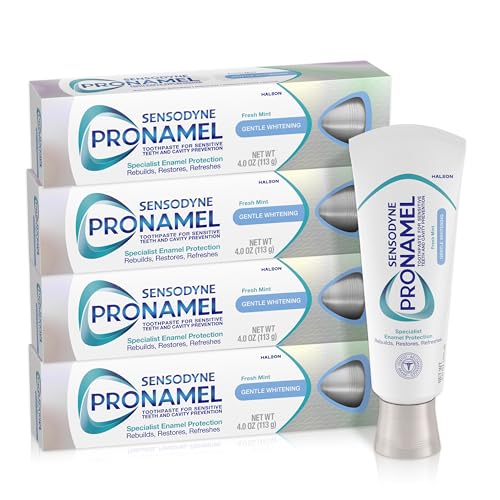
Sensodyne Pronamel Gentle Whitening
Best for: Most adults who want sensitivity relief, enamel protection, and light stain removal in one SLS-free tube
- 5% potassium nitrate (antihypersensitivity) and 0.25% sodium fluoride (anticavity) on the Drug Facts label
- No sodium lauryl sulfate: the detergent is cocamidopropyl betaine, so it suits canker-sore-prone and peeling-prone mouths
- Surface-stain polishing rather than peroxide whitening; the listing's phrase is 'gently polish away stains'
- The linked listing is a 4-pack of 4 oz tubes, about $6 a tube
- +5% potassium nitrate, the standard over-the-counter desensitizer, plus sodium fluoride for cavity protection
- +SLS-free (the label lists cocamidopropyl betaine instead), which matters if you get canker sores or mouth peeling
- +The linked listing is a 4-pack, so it works out to about $6 a tube
- −Whitening is surface-stain removal only, not a peroxide whitener
- −Label directs users under 12 to ask a dentist first
(Affiliate link) · Free shipping on eligible Prime items
Pronamel Gentle Whitening earns the top overall spot because it addresses the three most common toothpaste concerns at once. Its Drug Facts label lists 5% potassium nitrate for sensitivity and 0.25% sodium fluoride (0.15% fluoride ion, the standard over-the-counter strength) for cavities, and its inactive list carries no sodium lauryl sulfate, which is the ingredient most often blamed for canker sores and mouth peeling. The whitening is surface polishing (the listing’s phrase is “gently polish away stains”), not bleaching, so it will not change your shade the way a peroxide paste can, but it also will not add sensitivity. The linked listing is a 4-pack at around $23, which puts it near $6 a tube.
Be clear about what the sensitivity ingredient can and cannot do: the Cochrane review of potassium toothpastes found measurable improvement on air-blast and touch tests after 6 to 8 weeks but no significant change in how patients rated their own pain, so give it two months and judge for yourself. The community reading matches the label rather than the marketing. Asked which Sensodyne to use, a commenter with Dental Hygienist flair on r/DentalHygiene answered: “Which Sensodyne? Because there are different formulas across the brand. I always recommend Sensodyne Pronamel because it’s SLS free, contains fluoride, and works for sensitivity.” Patient-side discussion of the Gentle Whitening variant specifically is thin: in five years of threads we found no organic praise or complaint naming it, so read that as a view of Pronamel as a line. Two cautions travel with that endorsement. Nearly every positive Pronamel mention we read names the line rather than this Gentle Whitening tube, and the highest-scoring Pronamel recommendation on r/CankerSores adds, “Just make sure to avoid the whitening kind because that can also cause canker sores.” The Gentle Whitening label lists no SLS (its detergent is cocamidopropyl betaine, the same as the Daily Protection, Fresh Breath, and Multi-Action variants filed on the same Drug Facts label), so that warning has no ingredient behind it on this tube, but if sores continue on this tube the next thing to change is the detergent, not the whitening word.
If sensitivity is your main problem, see our full best toothpaste for sensitive teeth roundup for five more options, including Sensodyne’s other formulas, and our Sensodyne comparison for which Sensodyne variant fits which mouth.
(Affiliate link) · Free shipping on eligible Prime items
Best for Cavities: Colgate Total Deep Clean
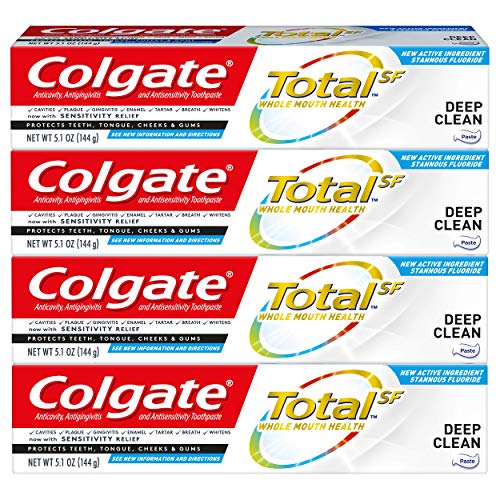
Colgate Total SF Deep Clean
Best for: Cavity-prone adults who want one stannous fluoride paste covering cavities, gum inflammation, and sensitivity
- 0.454% stannous fluoride (0.15% fluoride ion) labeled anticavity, antigingivitis, and antisensitivity
- The linked listing is the reformulated Colgate Total Active Prevention Deep Clean, a 3-pack of 5.1 oz tubes
- Colgate claims 24-hour antibacterial protection with twice-daily brushing after four weeks of use; treat that as the brand's claim, not ours
- Contains sodium lauryl sulfate and potassium nitrate among its inactive ingredients
- +Stannous fluoride carries anticavity, antigingivitis, and antisensitivity purposes on the Drug Facts label
- +The linked 3-pack is among the lowest per-tube prices in this guide, about $3.70 a tube
- +Stannous fluoride has documented antibacterial effects on plaque and gum inflammation that sodium fluoride pastes do not claim
- −Reformulated as Active Prevention; the taste changed and long-time users are split on it
- −Contains sodium lauryl sulfate, so it is not the pick for canker-sore-prone mouths
(Affiliate link) · Free shipping on eligible Prime items
Colgate Total is a stannous fluoride paste, and Colgate has since rebranded it as Colgate Total Active Prevention. The listing we link now ships that version as a 3-pack. Its Drug Facts label lists 0.454% stannous fluoride with three purposes, anticavity, antigingivitis, and antisensitivity, and an inactive list that includes potassium nitrate and sodium lauryl sulfate. The label we read in September 2026 lists no zinc phosphate, an ingredient older reviews of Colgate Total often mention. What stannous fluoride does bring is antibacterial action: a 2019 systematic review found stabilized stannous toothpastes reduced plaque, gingivitis, and calculus, and its meta-analysis of six-month gingivitis trials favored stannous over other pastes, with the caveat that the trials varied widely and the authors asked for better ones.
The reformulation is the thing to know before buying. Long-time users noticed. In an r/DentalHygiene thread about the change, one unflaired user wrote, “I’ve been using Colgate total for years and it’s been serving me absolutely perfectly but since they changed their formula and package design it has not been the same,” another in the same thread named the exact line we link, “I bought total deep clean at Walmart it has been over a month and my teeth are still killing me,” while a commenter with Dental Hygienist flair in the same subreddit made the case for the paste itself in an earlier thread: “Colgate Total uses stannous fluoride which is a considerably more effective fluoride compound that has higher cavity prevention, sensitivity reduction, erosion protection, and anti-inflammatory properties.” Read that second quote as one professional’s view; the trial evidence for stannous fluoride is in the Evidence Receipt above. At around $11 for three 5.1 oz tubes, it is tied with Crest Kids for the cheapest per tube on this page, which is a large part of why it stays our cavity pick for adults who want one paste that does everything adequately.
For more cavity-fighting options, including the sodium fluoride pastes that suit stannous-sensitive mouths, see our full best toothpaste for cavities roundup.
(Affiliate link) · Free shipping on eligible Prime items
Best for Whitening: Crest 3D White Brilliance Pro
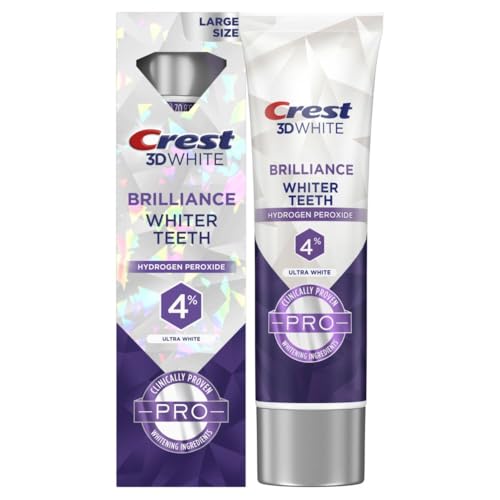
Crest 3D White Brilliance Pro
Best for: Adults who want a peroxide whitening toothpaste rather than strips or trays
- Hydrogen peroxide at 4% w/v on the Drug Facts label, a bleaching agent rather than abrasion alone
- 1.14% sodium monofluorophosphate (0.17% fluoride ion) for cavity protection, so it replaces your daily paste
- Single 3.8 oz tube at around $9
- Contains sodium lauryl sulfate
- +4% hydrogen peroxide listed on the Drug Facts label, which most whitening pastes do not carry
- +Fluoride anticavity toothpaste, so it can replace your daily paste rather than adding a step
- +Around $9 for a single 3.8 oz tube
- −Expect modest shade change; strips, trays, and in-office whitening use far higher peroxide contact
- −Contains sodium lauryl sulfate and peroxide, a combination sensitive mouths may not tolerate
(Affiliate link) · Free shipping on eligible Prime items
Most whitening toothpastes, the ADA notes, rely primarily on abrasives to remove surface stains. Brilliance Pro is different in one specific, checkable way: its Drug Facts label lists hydrogen peroxide at 4% w/v among the inactive ingredients, alongside 1.14% sodium monofluorophosphate as the anticavity active. Peroxide is the chemistry that changes tooth color; a 2014 review concluded that hydrogen peroxide and carbamide peroxide whitening is safe and effective when the manufacturer’s instructions are followed, and named sensitivity and gum irritation as the risks to watch. Keep expectations in proportion: a toothpaste’s contact time is two minutes, so it will not match whitening strips or professional treatment, and the dental professionals we read treat whitening pastes as maintenance rather than a fix. We found no Reddit discussion naming this exact Brilliance Pro tube in five years; the threads talk about Crest 3D White as a line, and the professionals in them are blunt about it. Answering a user who felt their teeth looked more yellow after a month on Crest 3D White, a commenter with General Dentist flair on r/askdentists wrote: “Whitening toothpastes really don’t do much at all. It’s not that you’re doing anything wrong, they are just super underwhelming.” The most-upvoted comment in the whitening threads we read, from a self-described dental nurse on r/AskIreland, went further: “What’s marketed as whitening toothpaste is a gimmick, the only thing that will whiten your teeth is the bleach.” A commenter with Dental Hygienist flair on r/DentalHygiene raised the other objection to whitening pastes as a class, abrasion: “It is very abrasive, almost like sand paper, and will wear away your enamel.” Read that as one professional’s view of abrasive whiteners generally; Crest gives no abrasivity figure for this tube on its Drug Facts label, and its whitening claim rests on peroxide rather than grit. Brilliance Pro’s answer to that objection is that it contains the bleach, at a low dose and a short contact time, which is why we place it as maintenance between strip courses rather than a substitute for them.
At around $9 for a 3.8 oz tube, it costs more per ounce than a basic paste and far less than a whitening kit. For more whitening options, including sensitivity-friendly picks, see our full best whitening toothpaste and best whitening toothpaste for sensitive teeth roundups.
(Affiliate link) · Free shipping on eligible Prime items
Best for Gum Disease: Parodontax Clean Mint
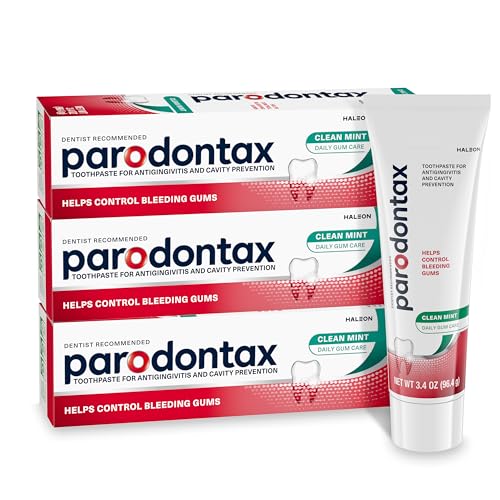
Parodontax Clean Mint
Best for: Adults with bleeding gums or early gum disease who want a stannous fluoride paste built around gum health
- 0.454% stannous fluoride (0.15% fluoride ion), labeled anticavity and antigingivitis
- Drug Facts uses include 'helps control bleeding gums' and interfering with plaque associated with gingivitis
- Single 3.4 oz tube at around $7.50, the lowest checkout price in this guide
- Contains sodium lauryl sulfate; the current US label lists no sodium bicarbonate
- +Drug Facts uses include helping control bleeding gums, the clearest gum-health labeling in this lineup
- +The second-largest review base in this guide at more than 32,000 ratings
- +Lowest checkout price here at around $7.50 for a single tube
- −One Amazon reviewer calls the taste extremely salty, with a medicinal bite that takes a while to get used to
- −Contains sodium lauryl sulfate, per the current US Drug Facts label
(Affiliate link) · Free shipping on eligible Prime items
If your dentist has flagged gingivitis or your gums bleed when you brush, Parodontax is the specialist. Its Drug Facts label lists 0.454% stannous fluoride with “helps control bleeding gums” among its uses, the most direct gum-health language on any label in this guide, alongside cavity prevention. The same 2019 review that supports stannous fluoride for gingivitis applies here, and it applies with the same caveat: the trials were heterogeneous and the authors asked for better ones. At around $7.50 for a single 3.4 oz tube it has the lowest checkout price on this page, though per ounce most of the multipacks on this page beat it (Boka does not).
The trade-off is taste. One Amazon reviewer of this Clean Mint tube called it “extremely salty” with “a medicinal bite that takes a while to get used to.” The current US Clean Mint label lists no baking soda. Users who stay with it describe the trade the label implies. “When I was told I had gingivitis I was told by my dentist to use Parodontax to brush with. I also flossed twice a day and brushed twice a day… in 6 weeks I no longer had gingivitis,” one r/Teethcare commenter wrote, and an r/askdentists user put the stannous bargain plainly: “I think I might have some staining due to it but I’d rather have staining than bleeding and inflamed gums.” The other side is a small cluster of r/askdentists reports of new sensitivity or sore gums after starting it; a thread asking “Does Parodontax toothpaste have a tendency to cause tooth sensitivity?” drew several me-too replies over the following months. Stannous fluoride is labeled for sensitivity relief on other pastes, so treat that as an individual reaction to watch for rather than the norm. If your gums bleed for more than a couple of weeks on any paste, that is a cleaning-and-exam problem, not a toothpaste problem.
For more gum health options, see our full best toothpaste for gum disease, best toothpaste for gingivitis, and best toothpaste for gum recession roundups.
(Affiliate link) · Free shipping on eligible Prime items
Best Fluoride-Free: Boka Ela Mint Nano-Hydroxyapatite
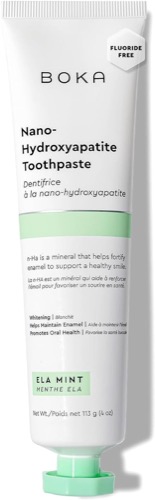
Boka Ela Mint Nano-Hydroxyapatite
Best for: Adults who want a fluoride-free toothpaste whose active ingredient has clinical trial evidence behind it
- Nano-hydroxyapatite (n-HAp), a synthetic form of the calcium phosphate mineral that makes up enamel
- Hydroxyapatite has an 18-month randomized trial in adults showing non-inferiority to fluoride on new cavities (industry-funded)
- No SLS, parabens, or artificial colors or flavors, per the listing; not an FDA-monograph anticaries drug
- The linked listing is a 3-pack of 4 oz tubes at around $32, about $10.70 a tube
- +Hydroxyapatite has randomized trial evidence for cavity prevention, unlike most fluoride-free actives
- +No SLS, parabens, or artificial colors or flavors per the listing
- +More than 61,000 ratings, the largest review base in this guide
- −The linked 3-pack costs about $32, roughly $10.70 a tube, the highest per-tube price here
- −The key trials were funded by a hydroxyapatite toothpaste maker, and fluoride remains the US default for high-cavity-risk mouths
(Affiliate link) · Free shipping on eligible Prime items
If you want fluoride-free toothpaste with actual clinical evidence behind it, Boka is the pick. Nano-hydroxyapatite is a synthetic version of the mineral enamel is made of, and it is the one fluoride alternative with cavity trials rather than lab studies alone: an 18-month randomized trial in adults found a 10% hydroxyapatite toothpaste non-inferior to a 1,450 ppm fluoride paste on new cavities, and a 2024 updated systematic review concluded the evidence for fluoride-free hydroxyapatite products has expanded. Read both with the funding in view: the trial was financed by Dr. Kurt Wolff GmbH, a hydroxyapatite toothpaste maker, and two of the review’s authors work there. The ADA’s toothpaste page does not list hydroxyapatite among anticaries agents, and fluoride remains the US default.
Two practical notes. The linked listing is a 3-pack at around $32, which is about $10.70 a tube and the highest per-tube price in this guide, so buy a single tube first if you are unsure about the Ela Mint flavor. Boka itself has almost no organic Reddit footprint: across eleven subreddits and five years of threads, the only posts naming it were listing reposts, so the community evidence here is about hydroxyapatite generally, and it leans cautious. A self-identified hygienist in the most-upvoted hydroxyapatite thread we read on r/Biohackers wrote, “I work in an office that attracts a lot of ‘holistic patients’ and lately we’ve been seeing a lot of patients who have gone FL free and switched to using HA toothpastes getting multiple and large cavities all of a sudden,” and the top-voted comment in an r/Dentistry thread on the same question framed the difference this way: “HA toothpastes put your tooth back where it started. Fluoride toothpastes put your tooth a step ahead for future acid attack, thus reducing your risk for future cavities.” One more community complaint checks out against the listing: Boka’s Amazon page lists what the paste is free of but no hydroxyapatite percentage, which is what an r/DentalHygiene commenter meant by “Most nano hydroxyapatite toothpastes don’t list their percentage.” The number matters to the people answering those threads: in a July 2026 r/DentalHygiene thread asking whether hydroxyapatite even works, a high-scoring commenter (no professional flair) wrote of a 4% paste, “This is essentially as good as brushing with water IMHO,” and the top comment recommended “returning to traditional fluoridated/sensodyne.” Because the listing gives no percentage, we cannot say where it lands on that scale. If you have frequent cavities, exposed roots, braces, dry mouth, or a dentist who has told you to use fluoride, treat a fluoride-free switch as a decision to discuss rather than a default upgrade.
For more fluoride-free and natural options, see our full best hydroxyapatite toothpaste, best fluoride-free toothpaste, and best natural toothpaste roundups, or our Boka review.
(Affiliate link) · Free shipping on eligible Prime items
Best for Dry Mouth: Biotene Fluoride Toothpaste
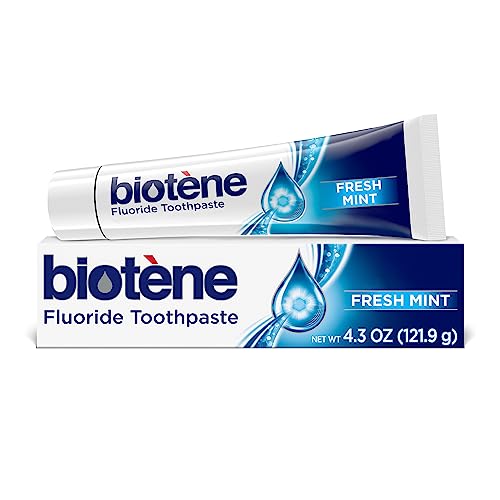
Biotene Fluoride Toothpaste
Best for: People with medication-related or chronic dry mouth who need a mild, SLS-free fluoride paste
- SLS-free: the Drug Facts label lists cocamidopropyl betaine as the detergent and the package reads 'GENTLE FORMULA' and 'SLS FREE'
- 0.25% sodium fluoride (0.15% fluoride ion), full anticavity strength for a mouth that has lost saliva's protection
- Low foam and mild mint, so brushing does not sting a dry mouth
- The linked listing is a 2-pack of 4.3 oz tubes at around $14, about $7 a tube
- +SLS-free per the Drug Facts label, with cocamidopropyl betaine as the detergent
- +Full-strength 0.25% sodium fluoride, important because dry mouth raises cavity risk
- +Low-foam, mild mint that dry-mouth users tolerate
- −The current label lists no enzymes; older Biotene marketing leaned on them, and this is now a plain gentle fluoride paste
(Affiliate link) · Free shipping on eligible Prime items
Dry mouth (xerostomia) makes standard toothpaste uncomfortable: the foaming agent stings, the mint overwhelms, and the experience discourages brushing at exactly the time brushing matters most. The NIDCR notes that dry mouth raises the risk of tooth decay because saliva keeps harmful germs in check, and that hundreds of medicines reduce saliva, including common blood pressure and depression drugs. Biotene’s Drug Facts label answers both halves of that problem: 0.25% sodium fluoride at full over-the-counter strength, and an inactive list with cocamidopropyl betaine in place of sodium lauryl sulfate, which the package calls out as “SLS FREE” and “specially formulated to not irritate”.
One label fact to know: the current Biotene toothpaste label, verified in September 2026, lists no enzymes, whatever older reviews say. Biotene’s original formulas were marketed on salivary enzymes, and dry-mouth communities still debate the change, but what is in the tube today is a gentle sodium fluoride paste, and that is how we rate it. The dry-mouth communities reflect that split. On r/Sjogrens, one patient described the standard starter kit, “Biotene toothpaste and mouthwash, sips of water throughout the day, and I stay strapped with the Biotene lozenges,” while a higher-scoring patient post in the same subreddit reads, “read a lot of positive reviews about biotene but using the toothpaste, gel and mouth wash but dont really see an improvement.” Both are right about what the toothpaste is: a mild fluoride paste a dry mouth can tolerate, not a saliva substitute. Keep your expectations there. Not every dry mouth tolerates it, though. In a February 2026 r/Sjogrens thread asking for alternatives, the poster wrote, “Biotene is suddenly irritating my mouth (noticed this change with manufacturer changing from gsk to Haleon),” a reply added, “I use Oral7 toothpaste as I found Biotene to burn,” and an earlier r/Sjogrens commenter said it “causes my gums and lips to swell slightly and burn.” If it stings, that is a reason to switch, not to push through. One more thing to watch: in August 2026 a UK poster on r/DentalHygiene reported that Haleon “confirmed the discontinuation of their toothpaste line” after retail stock problems there; the US listing we link was in stock when we checked in September 2026. At around $14 for a 2-pack of 4.3 oz tubes, it works out to about $7 a tube.
For more dry mouth options, see our full best toothpaste for dry mouth roundup, and consider pairing it with a dry mouth mouthwash.
(Affiliate link) · Free shipping on eligible Prime items
Best for Bad Breath: TheraBreath Deep Clean Toothpaste
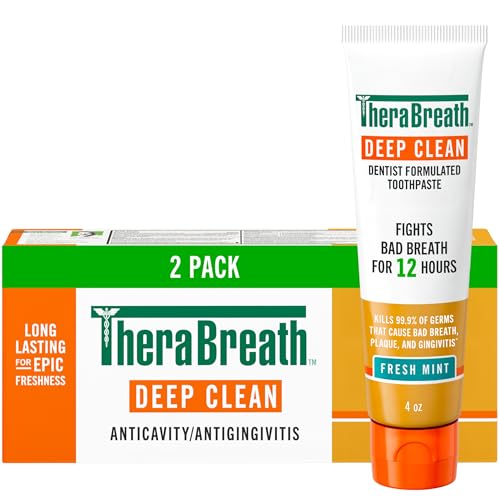
TheraBreath Deep Clean Toothpaste
Best for: Adults whose bad breath comes with plaque and gum inflammation and who want a stannous fluoride paste from a breath-focused brand
- 0.454% stannous fluoride (0.14% fluoride ion), labeled anticavity and antigingivitis
- TheraBreath's listing claims it kills 99.9% of germs that cause bad breath, plaque, and gingivitis; that is the brand's claim
- The sodium chlorite (OXYD-8) chemistry TheraBreath is known for is in its rinses, not this paste
- 2-pack of 4 oz tubes at around $12.60; contains sodium lauryl sulfate
- +Stannous fluoride, the toothpaste active with the most halitosis evidence, at the standard 0.454%
- +Pairs with TheraBreath's sodium chlorite rinse, which is where the brand's breath chemistry actually lives
- +2-pack of 4 oz tubes at about $12.60, roughly $6.30 a tube
- −Contains sodium lauryl sulfate; this is not the SLS-free paste the brand's rinses might lead you to expect
- −Persistent bad breath usually traces to tongue coating or gum disease, which no toothpaste fixes alone
(Affiliate link) · Free shipping on eligible Prime items
Know which TheraBreath toothpaste this is. The product our link goes to is TheraBreath Deep Clean, and its Drug Facts label, verified in September 2026, lists 0.454% stannous fluoride as the only active, with anticavity and antigingivitis purposes and sodium lauryl sulfate among the inactives; it is not an OXYD-8 sodium chlorite paste, whatever older reviews say. The sodium chlorite chemistry lives in TheraBreath’s rinses. So why keep it as the bad-breath pick? Because most bad breath is a mouth problem, and stannous fluoride is the toothpaste active with evidence against the causes: a 2023 systematic review attributes 80 to 90 percent of halitosis to intra-oral factors, chiefly coated tongue, gum disease, and poor hygiene, and the 2019 stannous review reported significant halitosis reductions for stannous pastes, while flagging those particular studies as high risk of bias.
Practically: brush with this, clean your tongue, and use the rinse if you want the sodium chlorite step. If bad breath persists after two weeks of that routine plus flossing, look for gum disease, tonsil stones, reflux, or dry mouth rather than switching pastes again. One forum report names this tube; an older one praises the brand’s toothpaste generally and predates the current Deep Clean listing, so read it as brand-level. On r/badbreath, a user who had nearly given up on the brand wrote, “I recently found out about the Therabreath toothpaste which was designed to be used together with the mouthwash so I decided to give it one last shot. And surprised to say, it has helped immensely!” On r/askdentists, in a widely upvoted thread about severe toothpaste reactions, a poster with a known SLS sensitivity described buying Deep Clean and reacting to its second detergent, sodium lauroyl sarcosinate: “One use caused the epithelial tissue in my mouth to melt down again, into dozens of ulcers and white tissue sloughing off.” That poster believed the tube was SLS-free; the current Drug Facts label lists both sodium lauryl sulfate and sodium lauroyl sarcosinate, which is why we do not recommend it for a mouth that reacts to detergents. The confusion reaches professionals too: a commenter with Dental Hygienist flair on r/DentalHygiene wrote in April 2026, “I believe Therabreath toothpaste is SLS free with stannous.” The label says otherwise. At around $12.60 for two 4 oz tubes, it is about $6.30 a tube.
For more bad breath solutions, see our full best toothpaste for bad breath roundup; the sodium chlorite step lives in TheraBreath’s rinses, covered in our TheraBreath mouthwash guide.
(Affiliate link) · Free shipping on eligible Prime items
Best for Kids: Crest Kids Advanced Color Changing
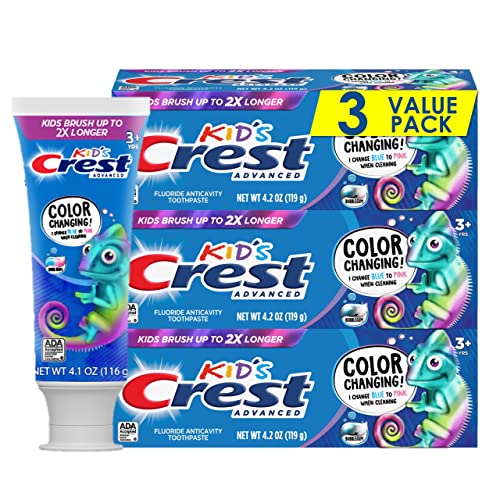
Crest Kids Advanced Color Changing
Best for: Children 2 and up who need a visual cue to brush every tooth, with pea-sized dosing under 6
- Color-changing paste turns from blue to pink as kids brush (per the listing), a visible cue that brushing is happening
- 0.834% sodium monofluorophosphate (0.15% fluoride ion), the same fluoride strength as adult pastes
- Label: ages 2 and older, pea-sized amount under 6, ask a dentist under 2
- The linked listing is a 3-pack of 4.2 oz tubes at around $11, bubblegum flavor
- +Blue-to-pink color change gives children a visible cue that the brush is working, timed to a longer brush per Crest
- +Standard fluoride strength on the label, the same 0.15% fluoride ion as adult pastes
- +The linked 3-pack works out to about $3.70 a tube
- −Label directs a pea-sized amount under 6 and a dentist's advice under 2; the ADA's rice-grain smear applies until age 3
- −Contains sodium lauryl sulfate
(Affiliate link) · Free shipping on eligible Prime items
The biggest challenge with kids’ toothpaste is not the formula but getting a child to brush long enough and everywhere. Crest’s color-changing paste starts blue and turns pink as kids brush, and Crest’s listing claims the change helps kids brush up to twice as long; read it as a cue that brushing is happening rather than a map of missed spots. Underneath the gimmick it is a standard fluoride paste: the Drug Facts label lists 0.834% sodium monofluorophosphate, the same 0.15% fluoride ion as adult toothpaste, and directs use for children 2 and older with a pea-sized amount under 6 and a dentist’s advice under 2. The ADA adds the finer rule: a rice-grain smear from the first tooth until age 3, then pea-sized. Supervise until spitting is reliable. We found no Reddit thread reviewing this specific Crest Kids paste by name (the closest is an r/askdentists user asking for an adult version of its color-change trick), so the community evidence here is about kids’ toothpaste generally. The recurring parent problem is refusal: “My kiddo can identify every toothpaste with fluoride… even when I try to blend a non-fluoride paste she likes with a fluoride one,” one parent wrote in a busy r/toddlers thread, where another commenter notes that “spicy” is what children call mint. The color change is Crest’s answer to the brushing-long-enough half of that problem. Flavor is the other half, and bubblegum is not a universal win: in an r/beyondthebump thread asking for a fluoride paste for a toddler who hated bubblegum, one parent wrote of a rival bubblefruit paste, “you would have thought it was laced with capsaicin,” and another’s daughter “hated bubblegum flavored toothpaste also.” If your child is in that camp, buy a single tube before the 3-pack.
The linked listing is a 3-pack of 4.2 oz tubes at around $11, about $3.70 a tube. For more children’s options by age, see our full best toothpaste for kids and best toothpaste for toddlers roundups, and our fluoride-free toothpaste for kids guide if you are weighing that route.
(Affiliate link) · Free shipping on eligible Prime items
How to Choose the Right Toothpaste
If you are not sure which category fits you, start here:
Do your teeth hurt with cold drinks or sweets? That is sensitivity. Start with Sensodyne Pronamel Gentle Whitening (our top overall pick) or see our full sensitive teeth roundup.
Do your gums bleed when you brush or floss? That is gingivitis. Parodontax Clean Mint is the targeted fix. See our gum disease roundup for alternatives.
Have you had cavities recently? Colgate Total Deep Clean provides the broadest labeled protection. For fluoride-focused options, see our fluoride toothpaste roundup or cavity-fighting roundup.
Is whitening your priority? Crest 3D White Brilliance Pro for a peroxide toothpaste. For sensitive teeth plus whitening, see our whitening toothpaste for sensitive teeth roundup.
Do you prefer natural or fluoride-free? Boka for hydroxyapatite-based remineralization. See our natural toothpaste roundup or fluoride-free roundup.
Is dry mouth a daily problem? Biotene was designed for you. See our dry mouth toothpaste roundup.
Is bad breath persistent despite regular brushing? TheraBreath Deep Clean plus tongue cleaning. See our bad breath toothpaste roundup.
Shopping for children? Crest Kids Color Changing for ages 2 and up. See our kids roundup or toddler roundup.
Stannous Fluoride vs. Sodium Fluoride
Both prevent cavities. The 2019 Cochrane review of fluoride toothpastes found standard over-the-counter concentrations clearly effective in children and adults, with only a slight edge for the 1,450 to 1,500 ppm band over 1,000 to 1,250 ppm; it compared concentrations, not fluoride salts. Stannous fluoride adds antibacterial action, and a 2019 systematic review found stabilized stannous pastes reduced plaque, gingivitis, and calculus, with six-month gingivitis trials favoring stannous. That is why Colgate Total, Parodontax, and TheraBreath Deep Clean carry antigingivitis on their labels and sodium fluoride pastes do not. The trade-offs are tolerability ones, and they come from labels and forum reports rather than the trials: stannous pastes often taste medicinal or salty, some users report mouth soreness or tissue peeling on them, and older formulas stained. Sodium fluoride is the everyday choice when tolerability matters most; stannous is the choice when your gums are the problem. The soreness point is under-reported in most guides and well documented in the threads we read. A self-identified hygienist in a large r/Frugal thread explained their own preference for sodium fluoride pastes because stannous fluoride “can cause tissue sloughing in some people,” and an r/Allergies thread collected half a dozen first-hand accounts of mouth sores, lip irritation, or a blocked salivary gland on stannous pastes, several from people who had been fine on sodium fluoride; one traced a sudden reaction after decades on the same brand to a reformulation: “Colgate had changed the main ingredient to stannous fl without saying anything.” On staining, two commenters with Dental Hygienist flair on r/DentalHygiene split: one wrote that current pastes “don’t cause stains the way they used to because the stannous fluoride is now stabilized,” the other that stannous “can definitely cause light brown staining,” which a cleaning removes. If your mouth gets sore on a stannous paste, switch back to sodium fluoride rather than giving up fluoride.
Across the professional threads we read for this guide the pattern holds: brand matters less than fluoride and technique, Sensodyne Pronamel is the most-named personal pick (for being SLS-free more than for sensitivity), a self-identified hygienist on r/Frugal prefers sodium fluoride pastes because stannous 'can cause tissue sloughing in some people,' and hydroxyapatite is positioned as the option for patients who refuse fluoride, not as an upgrade.
When SLS-Free Matters
Sodium lauryl sulfate is the foaming detergent in most toothpaste. Most people tolerate it, but a 2019 systematic review of four crossover trials found that switching to an SLS-free paste reduced the number, duration, and pain of recurrent canker sores, and forum threads repeatedly describe mouth peeling, dry lips, and burning that stopped after the switch. The catch is that “gentle” on the box does not mean SLS-free on the label. Of our picks, Sensodyne Pronamel Gentle Whitening and Biotene are SLS-free on their Drug Facts labels and Boka’s listing states no SLS; Colgate Total, Crest 3D White, Parodontax, TheraBreath Deep Clean, and Crest Kids all list it. If canker sores or peeling sound familiar, start with the first three, or see our SLS-free toothpaste roundup, which names every replacement detergent.
Fluoride-Free Does Not Mean Risk-Free
If you prefer fluoride-free toothpaste, choose one with an active alternative such as nano-hydroxyapatite; a “fluoride-free” paste with no remineralizing ingredient cleans but does not protect. Boka is the strongest pick here because hydroxyapatite has randomized trial evidence of cavity prevention comparable to fluoride in adults, with the funding caveat above. If you have frequent cavities, exposed roots, braces, dry mouth, or a dentist who has specifically told you to use fluoride, treat fluoride-free toothpaste as a decision to discuss rather than a default upgrade. Our fluoride vs hydroxyapatite comparison walks through the evidence in detail.
Whitening Toothpaste Has Limits
Whitening toothpaste is best for surface stains and maintenance between other treatments. Crest 3D White Brilliance Pro is unusual for a paste because it carries 4% hydrogen peroxide on its label, but two minutes of contact will not behave like strips, trays, or professional whitening. The dental professionals in the threads we read make the same point from the other side: a whitening paste without peroxide is just abrasion, and abrasion has a ceiling set by the ADA’s 250 RDA safety limit. If your goal is several shades of change, go to a whitening-specific guide instead of asking a daily toothpaste to do that work.
Dry Mouth and Bad Breath Need Different Logic
Dry mouth raises cavity risk because saliva is part of your natural defense, so Biotene’s SLS-free, full-strength fluoride formula is the sensible first stop, and a dry-mouth rinse can help at night. Persistent bad breath is different: mint masks odor, and a paste can only address the plaque and gum piece. Since most halitosis starts with the tongue and gums, pair TheraBreath Deep Clean with a tongue scraper and flossing before spending more on products, and if it persists, look for gum disease, reflux, tonsil stones, or dry mouth.
Read the Drug Facts, Not the Front of the Box
Three things this update turned up apply to any toothpaste you pick up. Brand names drift: “Colgate Total” today is a reformulated Active Prevention paste, and “TheraBreath toothpaste” is a stannous fluoride paste, not the brand’s sodium chlorite rinse in tube form. Store brands and multipacks can differ from the tube you know (one r/Allergies commenter’s reaction traced to a store-brand sensitivity paste that turned out to be stannous fluoride). And “gentle” is not a regulated word. The Drug Facts panel settles all three in ten seconds: the active ingredient and its percentage, the purposes, and whether sodium lauryl sulfate appears in the inactive list. The forums learned this the hard way. An r/CankerSores thread titled ”!!Not all sensodyne is SLS FREE!!” came from someone whose sores returned on a Sensodyne Repair and Protect tube; their advice was “Read the active and inactive ingreeds [sic] for your toothpaste because even if it’s for sensitive teeth it may still have SLS.” A commenter with Dental Hygienist flair on r/DentalHygiene made the same point about another Pronamel tube: “The clinical protection has sulfates while the og is sulfate free.”
What About “All-in-One” Toothpastes?
Colgate Total Deep Clean comes closest to all-in-one protection: its label carries anticavity, antigingivitis, and antisensitivity purposes on a single stannous fluoride formula. But “all-in-one” means compromise. It will not desensitize as reliably as a 5% potassium nitrate paste, it will not whiten like a peroxide paste, and it is not the pick for a canker-sore-prone mouth because it contains SLS. If you have a specific dominant concern, the specialist will outperform the generalist. If you have no particular issue and want solid daily protection, Colgate Total or Sensodyne Pronamel are both reasonable defaults.
All Our Toothpaste Roundups
We have published 29 toothpaste guides. Here is the complete list:
By concern: Sensitive teeth · Cavities · Whitening · Gum disease · Gingivitis · Gum recession · Periodontal disease · Bad breath · Dry mouth · Enamel erosion · Braces
By type: Fluoride · Fluoride-free · Natural · Hydroxyapatite · SLS-free · Non-mint · Purple · Charcoal · Enamel repair · Whitening for sensitive teeth
By age: Kids · Toddlers · Hydroxyapatite for kids · Fluoride-free for kids
By brand: Sensodyne · Boka review · Apagard review · LivFresh review
FAQ
What toothpaste do dentists actually recommend?
The consistent professional answer is any fluoride toothpaste used twice a day for two minutes: the ADA recommends a fluoride toothpaste carrying its Seal of Acceptance, and the dental professionals in the threads we read put technique and consistency ahead of the brand. When pressed for names, the professionals in our research most often reach for Sensodyne Pronamel for sensitivity, Colgate Total for general protection, and Parodontax or another stannous fluoride paste for bleeding gums. The top comment in a large r/Frugal thread on this question, from a self-identified dentist, is representative: “Dentist here: I personally use Sensodyne. It is great for sensitive teeth. Use whatever you like and will actually brush your teeth with is the honest answer.” Another self-identified dentist in an r/AskReddit thread set the bar even lower: “As long as it has flouride [sic] in it, the brand doesn’t matter you can buy the cheapest.” Credentials on Reddit are self-reported unless flaired, so read these as consistent with the ADA guidance rather than as proof of it.
Is fluoride-free toothpaste safe?
Fluoride-free toothpaste is safe to use; the question is whether it protects. A paste with no active remineralizing ingredient cleans but does not prevent cavities. Nano-hydroxyapatite pastes such as Boka are the exception with trial evidence, as covered above. Toothpastes that are simply “fluoride-free” with no alternative active provide cleaning, not enamel protection.
Can I use whitening toothpaste every day?
Most whitening toothpastes are formulated for daily use; the Crest 3D White Brilliance Pro label directs brushing at least twice a day for ages 12 and up. Peroxide pastes can raise sensitivity in some users. On abrasion, the ADA says the clinical evidence suggests lifelong proper brushing with a paste at or below 250 RDA produces limited wear to dentin and virtually no wear to enamel, and that RDA values below 250 cannot be used to rank one paste as safer than another. If you have sensitive teeth, use a whitening toothpaste designed for sensitivity (see our whitening for sensitive teeth picks) or alternate a whitening paste with a sensitivity paste.
Should kids use adult toothpaste?
Children under 3 should get a rice-grain smear of fluoride toothpaste and children under 6 a pea-sized amount, per the ADA and the Crest Kids label, because the concern is swallowing rather than the fluoride strength, which is the same in most kids’ and adult pastes. After age 6, most children can use an adult paste, though kid formats like Crest Kids still help with brushing habits. Stannous fluoride pastes often taste medicinal, so a sodium fluoride or monofluorophosphate paste is the easier start for a child.
Is the Costco or store-brand version the same as the name brand?
Not always. Warehouse-club multipacks and store brands can differ from the tube you know, in flavor, in detergent, or in the fluoride salt, and the only way to know is the Drug Facts panel: compare the active ingredient line and its percentage with the tube you meant to buy. Two things from the threads we read: some of the taste and irritation complaints about Colgate Total Active Prevention came from people who had bought it in bulk at Costco, which raises the cost of guessing wrong, and the professionals in the “what do dentists use” threads are relaxed about store brands as long as the fluoride is there. Buy one tube before the multipack.
Why does my Colgate Total taste different?
Colgate has rebranded its Total toothpaste as Colgate Total Active Prevention, and the version we link is the reformulated one. The active ingredient is unchanged on the label (0.454% stannous fluoride), but the flavor and texture changed, and long-time users are split on the result. In an r/DentalHygiene thread on the change, one long-time user (no professional flair) wrote, “Ever since the formula change my teeth and gums feel so achy and strange (it’s hard to describe the sensation, but it’s quite uncomfortable). Colgate total was my go-to but I’m going to switch to a different brand now,” and two of the taste complaints we read came from warehouse-club multipacks. If the new tube disagrees with you, the Drug Facts panel is the tie-breaker: the active ingredient line matches the old tube, and the two DailyMed labels list the same inactive ingredients, so what users are reporting is a flavor and texture change the label does not itemize. A sodium fluoride paste is the usual fallback if it does not settle.