
Best Fluoride-Free Toothpaste for Kids (2026)
If you have decided (or are seriously weighing) going fluoride-free for your child’s toothpaste, this page is for you. We are not here to talk you into or out of that decision. We are here to help you find the safest, most effective fluoride-free option for your kid, whether they are six months old and swallowing everything or six years old and finally learning to spit.
A quick note on where we stand: fluoride toothpaste is the ADA and AAPD recommendation for children from the first tooth (a rice-grain smear under age 3, pea-sized at 3 and up). Fluoride-free toothpaste does not offer the same cavity-prevention benefits. We will be clear about that throughout this page because your kid’s teeth are more important than our credibility. If you are open to fluoride, our general kids toothpaste guide covers the best options. For toddlers specifically, see our toddler toothpaste picks.
That said, there are real reasons parents choose fluoride-free (swallowing concerns with very young children, sensitivity to certain ingredients, or personal preference), and the products below are the ones we would trust for those families.
How We Chose These Products
We compared fluoride-free kids toothpastes across ingredient safety, sweetener type, flavor appeal, review depth, and real parent feedback from parenting communities (r/beyondthebump, r/toddlers, r/ScienceBasedParenting, and others, about our research process). We also checked whether each product contains xylitol, since some families need to avoid sugar alcohols entirely. Every product was verified in stock and priced on Amazon as of June 2026. We did not test these products hands-on: we researched and compared them.
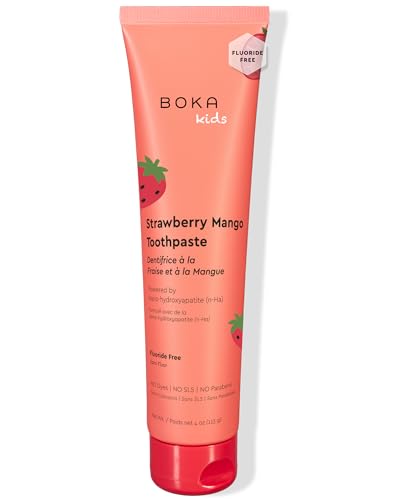
Boka Kids Strawberry Mango nHAP Toothpaste (3-Pack)
Best for: Families who want fluoride-free remineralization from nano-hydroxyapatite
- Nano-hydroxyapatite (nHAP) — studied for enamel remineralization without fluoride
- Kid-friendly Strawberry Mango flavor with no artificial colors or sulfates
- #1 Best Seller in Children's Toothpaste on Amazon (11,500+ reviews)
- Also available in Watermelon Mint, Orange Cream, and Blueberry Dragon Fruit
- +nHAP supports enamel remineralization without fluoride
- +Kid-friendly Strawberry Mango flavor with no artificial colors
- +#1 Best Seller in Children's Toothpaste on Amazon
- −Boka doesn't list the nHAP concentration on its product page or Amazon listing
- −Contains xylitol, not suitable for xylitol-sensitive children
(Affiliate link) · Free shipping on eligible Prime items
Boka Kids Strawberry Mango — Editor’s Pick
Boka is the standout in the fluoride-free kids space because it offers something most fluoride-free toothpastes do not: an ingredient studied for enamel remineralization. Nano-hydroxyapatite (nHAP) is a biocompatible form of the mineral that makes up most of tooth enamel, and research suggests hydroxyapatite may support enamel remineralization without the fluorosis risk fluoride carries if swallowed. That makes it particularly appealing for young children who are still learning to spit.
The Strawberry Mango flavor is a hit with kids: as of June 2026, Boka is the #1 Best Seller in Children’s Toothpaste on Amazon, with over 11,500 reviews. The formula is free from fluoride, sulfates, parabens, and artificial flavors or colors. Other flavor options include Watermelon Mint, Orange Cream, and Blueberry Dragon Fruit.
What to know before buying: Boka doesn’t list the nHAP concentration on its kids product page or Amazon listing, a point that dental professionals on r/askdentists have noted for the adult line. If you are choosing Boka specifically for remineralization, the undisclosed concentration means you cannot compare it directly to clinical study dosages. Also, Boka contains xylitol: if your child needs to avoid sugar alcohols, see our Orajel pick below. Around $32 for the 3-pack (~$10.66 per tube). A single tube is also available on Amazon.
(Affiliate link) · Free shipping on eligible Prime items
(Affiliate link)
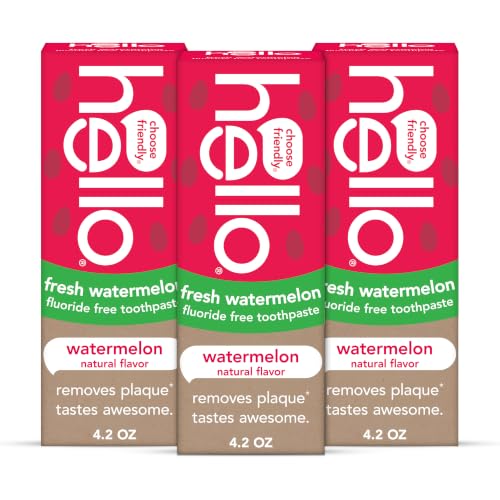
Hello Kids Fluoride-Free Watermelon Toothpaste (3-Pack)
Best for: Parents who want a widely available fluoride-free option at a drugstore price
- Watermelon flavor that kids consistently enjoy
- Available at CVS, Walgreens, Target, and most grocery chains
- No SLS, parabens, dyes, or artificial sweeteners
- 4-pack for ~$4.47 per tube — best value among full-sized tubes
- +Watermelon flavor that kids consistently enjoy
- +Available at most drugstores and grocery chains
- +No SLS, parabens, dyes, or artificial sweeteners
- −Contains both xylitol and erythritol
- −Disputed, non-peer-reviewed test reported trace heavy metals; no regulatory confirmation; disclosed for transparency, not as a verified finding
(Affiliate link) · Free shipping on eligible Prime items
Hello Kids Fluoride-Free Watermelon — Best Value
Hello is one of the most widely available fluoride-free kids toothpastes: stocked at CVS, Walgreens, Target, and most grocery chains. The watermelon flavor is well-liked by kids, and parents in r/toddlers mention Hello as a toothpaste their children will actually use without a fight.
The formula is free from SLS, parabens, dyes, artificial sweeteners, and artificial flavors. It contains xylitol and erythritol for sweetness and mild antibacterial benefit. At around $18 for a 4-pack (~$4.47 per tube), it is the best value among full-sized tubes in this lineup. A single tube runs around $5.
What to know before buying: In early 2025, an independent tester reported trace amounts of lead, arsenic, and mercury in Hello Watermelon Fluoride-Free, a claim that circulated widely in parenting communities (the same tester has flagged a number of natural and kids toothpaste brands). The testing was not peer-reviewed, its methodology was disputed by others in those discussions, and we have not found regulatory or independent peer-reviewed confirmation either way. Trace heavy metals occur naturally in soil and therefore in many foods and consumer products. We flag this for transparency (not as a verified safety finding), so you have the full picture; weigh it against the product’s 4.6-star rating across more than 2,300 Amazon reviews. Hello also contains xylitol and erythritol, so it is not xylitol-free.
(Affiliate link) · Free shipping on eligible Prime items
(Affiliate link)
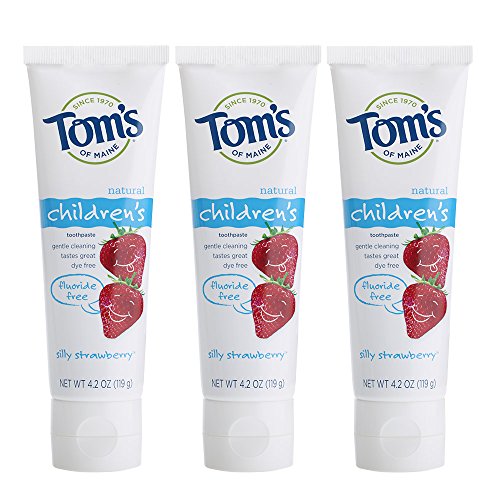
Tom's of Maine Kids Fluoride-Free Silly Strawberry (3-Pack)
Best for: Parents who want a recognized natural brand with the largest tube size
- Largest tube (5.1 oz) and lowest per-ounce cost in this lineup
- No xylitol, no artificial preservatives, colors, or flavors
- Most recognized natural toothpaste brand — available virtually everywhere
- Simple ingredient list: calcium carbonate, silica, and strawberry juice
- +Largest tube (5.1 oz) and lowest per-ounce cost in the lineup
- +No xylitol, no artificial preservatives, colors, or flavors
- +Back in original formula after a temporary change that concerned some parents
- −Contains SLS (sodium lauryl sulfate), which some parents prefer to avoid
- −Not labeled as safe to swallow like dedicated training toothpastes
(Affiliate link) · Free shipping on eligible Prime items
Tom’s of Maine Kids Fluoride-Free Silly Strawberry (3-Pack) — Most Trusted Brand
Tom’s of Maine is the name most parents think of when they think “natural toothpaste,” and for many families, brand trust matters, especially when choosing products for children. The Silly Strawberry formula is one of the simplest in this lineup: glycerin, water, calcium carbonate, hydrated silica, and strawberry fruit juice for flavor. No xylitol, no artificial preservatives, colors, or flavors.
At about $13.82 for a 3-pack of 5.1 oz tubes (about $4.61 per tube, or $0.90/oz), Tom’s offers the largest tubes and the lowest per-ounce cost in this lineup. It is sold at virtually every pharmacy and grocery store in the US; on Amazon, the reliably in-stock option is the 3-pack.
What to know before buying: Tom’s contains SLS (sodium lauryl sulfate), which some parents prefer to avoid for children with sensitive mouths: most other products in this lineup are SLS-free. Tom’s is also not explicitly labeled as a “training” toothpaste safe to swallow, unlike Orajel. The current Amazon listing notes “back in original formula,” which suggests a temporary formula change that some parents noticed in 2024. On the credential question: neither version of Tom’s kids toothpaste (fluoride or fluoride-free) is on the ADA’s Accepted list today. The one Tom’s kids product the ADA Accepts is its Children’s Anticavity Fluoride Rinse, and fluoride is the active ingredient carrying that credential.
(Affiliate link) · Free shipping on eligible Prime items
(Affiliate link)
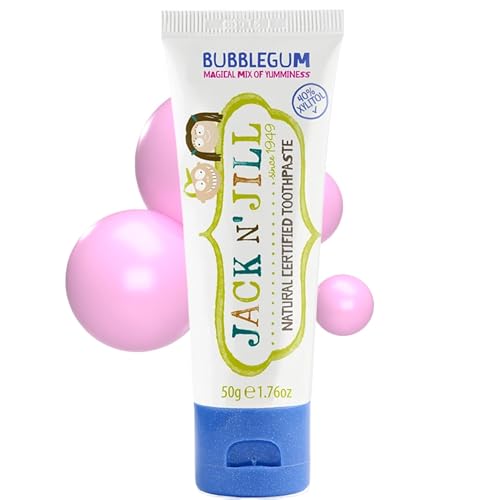
Jack N' Jill Natural Bubblegum Toothpaste
Best for: Families with a strong preference for certified organic and natural products
- COSMOS Natural certified by Ecocert — independently verified natural ingredients
- 40% xylitol plus calendula to help soothe gums
- Made in Australia, BPA-free, vegan, Peta-certified cruelty-free
- Flavor-Free version available for sensory-sensitive children
- +COSMOS Natural certified (Ecocert), independently verified natural ingredients
- +Contains calendula to help soothe gums
- +Flavor-Free version available for sensory-sensitive children
- −Small tube (1.76 oz) at the highest per-ounce cost in this lineup
- −Contains 40% xylitol, the highest concentration here
(Affiliate link) · Free shipping on eligible Prime items
Jack N’ Jill Bubblegum — Best Natural / Organic
If third-party certification matters to you, Jack N’ Jill is the strongest pick. It carries COSMOS Natural certification from Ecocert (the globally recognized standard for natural and organic cosmetics), which none of the other products in this lineup have. The formula uses organic fruit flavoring, 40% xylitol, calendula to help soothe gums, and silica, which Jack N’ Jill says gently removes plaque; the brand lists an RDA of 15 (a lab abrasiveness score) on its product page, a figure we found on few other kids’ pastes. It is BPA-free, vegan, cruelty-free (Peta-certified), and made in Australia.
Jack N’ Jill is recommended in parenting communities for sensory-sensitive children, particularly the Flavor-Free version, which offers a completely neutral brushing experience for kids who reject every flavor.
What to know before buying: The tube is small (1.76 oz, roughly a third the size of the Tom’s tube), and at about $8 it carries the highest per-ounce cost in this lineup (about $4.54/oz). Multiple reviewers note the size-to-price ratio. It also contains the highest xylitol concentration here (40%). The Bubblegum flavor is the most readily available single-tube option on Amazon; the Flavor-Free version is currently only available in multi-packs.
(Affiliate link) · Free shipping on eligible Prime items
(Affiliate link)
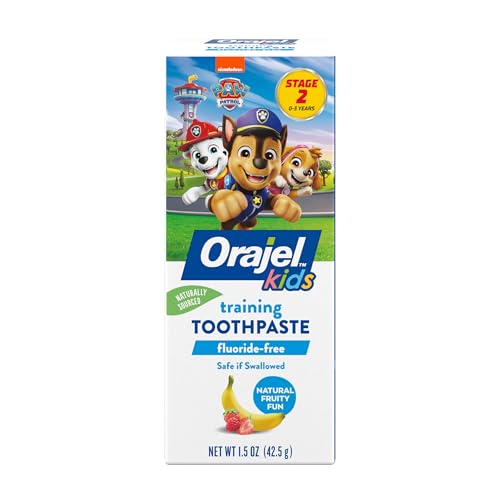
Orajel Kids Paw Patrol Fluoride-Free Training Toothpaste
Best for: Children who swallow toothpaste and need to avoid xylitol, sorbitol, and other sugar alcohols
- Stevia-sweetened, no xylitol, sorbitol, erythritol, or other sugar alcohols
- Explicitly labeled safe to swallow when used as directed
- SLS-free, with no abrasive in its ingredient list, for babies and toddlers
- Available in Paw Patrol, Elmo, and CoComelon character packaging
- +Stevia-sweetened, no xylitol, sorbitol, erythritol, or other sugar alcohols
- +Explicitly labeled safe to swallow when used as directed
- +SLS-free, with no abrasive in its ingredient list, designed for babies and toddlers
- −Smallest tube (1.5 oz), you will go through it quickly
- −Near-identical branding to Orajel's fluoride-containing Anti-Cavity line, check the label carefully
(Affiliate link) · Free shipping on eligible Prime items
Orajel Kids Paw Patrol Fluoride-Free Training — Best Xylitol-Free & Swallow-Safe
If your child swallows toothpaste and you need to avoid sugar alcohols entirely, Orajel is the only pick in this lineup that clears every hurdle. It is fluoride-free, xylitol-free, sorbitol-free, erythritol-free, and explicitly labeled safe to swallow when used as directed. The sweetener is stevia leaf extract: no sugar alcohols at all.
The full ingredient list (verified via Church & Dwight manufacturer disclosure) is notably short: water, glycerin, cellulose gum, banana extract, natural flavor, stevia leaf extract, and cocamidopropyl betaine. None of those is an abrasive, the maker lists it as free of SLS, and it is designed for babies and toddlers who cannot spit. Parents in r/beyondthebump name it as their actual training toothpaste of choice, specifically citing the safe-to-swallow label.
At around $4 for a 1.5 oz tube, it is the most affordable option here but also the smallest. The same base formula comes in Paw Patrol, Elmo, and CoComelon character packaging.
What to know before buying: The “natural flavor” in the ingredient list is legally vague: Church & Dwight’s ingredient list does not specify what the flavoring agent is beyond the banana extract. More importantly, Orajel also makes a “Kids Anti-Cavity” toothpaste line that contains fluoride (the Super Mario line, among others). The branding is near-identical: both say “Orajel Kids” prominently. The fluoride-free version says “Training” and “Fluoride-Free” on the front; the fluoride version says “Anti-Cavity.” If you are specifically seeking fluoride-free, check the label carefully before buying.
(Affiliate link) · Free shipping on eligible Prime items
(Affiliate link)
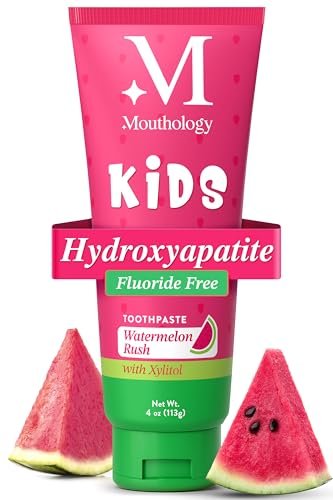
Mouthology Hydroxyapatite Kids Toothpaste (Watermelon)
Best for: Parents who want to try nano-hydroxyapatite at a lower per-tube price than Boka, with a choice of three mild flavors
- Nano-hydroxyapatite (nHAP) — the same fluoride-free enamel mineral used in our Editor's Pick
- Also available in Subtle Mint and Strawberry, all $9.99
- Formulated for ages 1-3, 3-6, and 6-12 in one product
- Contains xylitol
- +Nano-hydroxyapatite formula like our Editor's Pick, at a lower single-tube price
- +Three kid-tested flavor options (Subtle Mint, Strawberry, Watermelon) so you can find one your child will actually use
- +Formulated for a wide age range (1-3, 3-6, and 6-12) in one product
- −Review base is far smaller than Boka's, about 144 reviews on the Watermelon flavor versus Boka's 11,500+, so there's less real-world track record to lean on
- −Contains xylitol, like Boka and most fluoride-free options here: not suitable for children who need to avoid sugar alcohols entirely (see our Orajel pick)
(Affiliate link) · Free shipping on eligible Prime items
Mouthology Hydroxyapatite Kids Toothpaste — Budget nHAP Pick
If Boka’s nano-hydroxyapatite approach appeals to you but the price gives you pause, Mouthology is a newer entrant covering the same ground: a fluoride-free formula built around nHAP, the biocompatible mineral research suggests may support enamel remineralization without fluoride’s swallowing risk. It comes in three mild flavors (Subtle Mint, Strawberry, and Watermelon), each a single 4 oz tube for $9.99, and is labeled for the full 1-12 age range rather than a narrower band.
What to know before buying: we want to be direct about the review base here. Mouthology’s Watermelon flavor carries a 4.6-star rating from roughly 144 reviews as of this writing, a newer listing with a smaller review base than the other picks here, compared to Boka’s 11,500+. That is a real difference in how much real-world usage backs up the rating, so we are presenting this as a budget-friendly alternative worth considering, not a replacement for our Editor’s Pick. Like Boka, it contains xylitol; if you need to avoid sugar alcohols entirely, see our Orajel pick above instead.
(Affiliate link) · Free shipping on eligible Prime items
(Affiliate link)
What If You Also Need to Avoid Xylitol?
This is a narrower need than fluoride-free alone, but it is a real one. Xylitol is a sugar alcohol used as a sweetener in most fluoride-free kids toothpastes. In higher doses, xylitol can cause diarrhea and GI distress, a recognized side effect. While the amount in a single brushing is small, children who swallow their toothpaste get more exposure than those who spit.
Here is how the lineup breaks down on xylitol:
| Product | Xylitol? | Other Sugar Alcohols? | Sweetener Used |
|---|---|---|---|
| Orajel Paw Patrol FF Training | No | No | Stevia |
| Tom’s of Maine Kids FF | No | No | None listed |
| Boka Kids nHAP | Yes | Yes (sorbitol) | Xylitol + sorbitol + stevia |
| Mouthology Kids nHAP | Yes | No | Xylitol |
| Hello Kids FF | Yes | Yes (erythritol) | Xylitol + erythritol |
| Jack N’ Jill | Yes (40%) | No | Xylitol |
If you need to avoid all sugar alcohols and want a paste explicitly designed to be swallowed, Orajel is the stronger pick. Tom’s is also xylitol-free, but it contains SLS and is not marketed as a training toothpaste safe for swallowing, it may work for older children who can spit. Sugar-alcohol avoidance is most relevant for children with conditions like IBS, fructose malabsorption, or other GI sensitivities where even small amounts of xylitol or sorbitol can trigger symptoms. One product parents often ask about (Weleda’s Children’s Tooth Gel) is polyol-free (no xylitol or sorbitol), but it is flavored with spearmint and fennel essential oils and contains limonene, so it tends to fail the “mild, no strong flavors” test for sensitive young children; that is why it is not in our featured lineup.
It is worth noting that the AAPD retired its policy on xylitol in July 2025: the policy, which had acknowledged xylitol’s potential to help prevent cavities, is no longer part of AAPD’s current policies. AAPD did not say xylitol is harmful; it simply no longer maintains an active policy on it. That removes the clinical justification some brands cite in their marketing, without making xylitol a problem in normal use.
Buyer’s Guide: Choosing Fluoride-Free Toothpaste for Your Child
The fluoride-free trade-off — be honest with yourself
Fluoride toothpaste is the standard of care for a reason. The ADA recommends fluoride from the very first tooth and calls fluoride safe and effective for preventing tooth decay in children and adults. In parenting communities, we see a recurring pattern: parents who used fluoride-free toothpaste exclusively later discovering white spots or early decay on their toddler’s teeth.
One parent in r/toddlers shared that they “opted out of fluoride” early on and their 2.5-year-old now had early decay. Another in r/Mommit described their child needing sedation for multiple cavities.
This does not mean every child using fluoride-free will get cavities: diet, genetics, brushing technique, and professional fluoride treatments all matter. But fluoride-free toothpaste alone does not prevent decay. If you choose it, consider regular dental visits and ask your pediatric dentist about professional fluoride varnish, a concentrated fluoride treatment applied at the dental office, typically every 3 to 6 months. Varnish provides the topical fluoride protection that a fluoride-free toothpaste does not, and it is applied in a controlled setting where swallowing is not a concern. For many families, this combination (fluoride-free at home + varnish at the dentist) is a practical middle ground.
To be direct about it: for most children, the strongest evidence-based choice remains a parent-supervised rice-grain smear of fluoride toothpaste. If your reason for avoiding fluoride is general caution rather than a specific medical need or your dentist’s advice, it is worth revisiting that decision with them first. And if your child wears braces or other appliances, the calculus tips further toward fluoride: food trapped around brackets raises cavity risk. Whatever you choose, use only a thin smear for a child who still swallows; even a fluoride-free paste is not meant to be eaten in quantity.
Age bands: baby, toddler, and older kids
- Under 12 months: A training toothpaste like Orajel is designed for this age: SLS-free, no abrasive on the ingredient list, labeled safe to swallow. Any amount a baby ingests during brushing is expected.
- 12 months to 3 years: Most children in this range still swallow most of their toothpaste. A training toothpaste or a mild fluoride-free option (Hello, Boka, Tom’s) works. If you choose fluoride, use only a rice-grain smear.
- 3 years and up: Children are learning to spit. You have more options, including mildly flavored fluoride toothpastes if you decide to transition.
nHAP vs. xylitol vs. neither — what is actually in these pastes?
Nano-hydroxyapatite (nHAP): Found in Boka. A mineral identical to what makes up tooth enamel. Research is promising: a 2022 scoping review reported benefits across remineralization, demineralization reduction, and sensitivity, though it noted the evidence specific to children is still limited. Dental professionals add that the overall evidence base is thinner than fluoride’s, and the ADA says any toothpaste carrying its Seal for cavity protection must contain fluoride. Japanese dental guidelines have used it for decades. (Davids also makes a kids nHAP paste in a recyclable metal tube, but it launched recently with only about 90 reviews, so we are not featuring it as a pick yet; it is worth watching as it builds a track record.)
Xylitol: A sugar alcohol with some evidence for inhibiting cavity-causing bacteria. Found in most fluoride-free kids pastes. Generally safe, but can cause GI distress in larger amounts, relevant for toddlers who swallow. The AAPD retired its xylitol policy in July 2025, so there is no longer an active AAPD policy endorsing it.
Neither (Orajel, Tom’s): These pastes clean mechanically without an active anti-cavity ingredient. Orajel’s training paste lists no abrasive at all, while Tom’s uses calcium carbonate and silica; neither offers a remineralization benefit.
Flavor sensitivity and the “spicy” problem
If your child refuses toothpaste or calls it “spicy,” they are not being difficult. Children’s taste buds are more sensitive than adults’, and even mild mint can register as burning. Every product in this lineup uses fruity or mild flavors. For the most sensitive children, Jack N’ Jill’s Flavor-Free option is worth trying: it has no flavor at all.
A note on xylitol and dogs
Four of the six toothpastes featured here contain xylitol (as does the Davids paste noted above), which is toxic to dogs—even small amounts can cause a dangerous drop in blood sugar and liver damage. In a household with young children and pets, toothpaste tubes end up on the floor. Store xylitol-containing toothpaste where dogs cannot reach it.
The Orajel buy-safety warning
Orajel sells both fluoride-free Training toothpaste and fluoride-containing Anti-Cavity toothpaste under nearly identical branding. Both say “Orajel Kids” in the same font and style. The difference is in the fine print:
- “Fluoride-Free Training Toothpaste” = no fluoride, safe to swallow
- “Anti-Cavity Fluoride Toothpaste” = contains fluoride
If you are buying in a store, check the front label before putting it in your cart. If buying on Amazon, verify the word “Fluoride-Free” appears in the product title.
Frequently Asked Questions
Should I use fluoride or fluoride-free toothpaste for my toddler?
The ADA and AAPD recommend fluoride toothpaste from the first tooth—a rice-grain-sized smear for children under 3, a pea-sized amount for ages 3 to 6. The amount is designed to be safe even if swallowed. Fluoride-free toothpaste is a reasonable choice for very young babies still learning to tolerate brushing, or for families who prefer to avoid fluoride with their dentist’s guidance. Talk to your pediatric dentist about what makes sense for your child.
Can xylitol in toothpaste cause stomach problems if my child swallows it?
Xylitol can cause diarrhea and GI distress at higher doses, a documented side effect. The amount in a single brushing is small, but children who routinely swallow toothpaste get cumulative exposure. If your child has shown sensitivity to sugar alcohols, Orajel (stevia-sweetened, no xylitol) and Tom’s of Maine (no xylitol, no sweetener listed) are the two options in this lineup that avoid them entirely.
Is nano-hydroxyapatite (nHAP) as effective as fluoride for preventing cavities?
Not yet, at least not at the same confidence level. The ADA says any toothpaste carrying its Seal for cavity protection must contain fluoride, and dental professionals on r/askdentists describe the evidence base as “very limited in terms of time and sample size.” That said, the research is promising: an 18-month randomized controlled trial in adults found a hydroxyapatite toothpaste was non-inferior to fluoride for preventing cavities, and a 2022 scoping review reported benefits across remineralization, demineralization reduction, and sensitivity, though the evidence specific to children remains limited. Japan has recognized hydroxyapatite in dental products for decades. nHAP is non-toxic if swallowed, which is a genuine advantage for young children.
Does Hello kids toothpaste contain lead or mercury?
In early 2025, an independent tester reported trace amounts of lead, arsenic, and mercury in Hello Watermelon Fluoride-Free (the same tester has flagged a number of natural and kids toothpaste brands). The testing was not peer-reviewed, its methodology was disputed by others in those discussions, and we have not found regulatory or independent peer-reviewed confirmation. Trace heavy metals occur naturally in soil and therefore in many foods and consumer products. Hello has 4.6 stars from over 2,300 Amazon reviews. We mention this so you have the full picture if you encounter the claim while researching—not as a verified safety finding.
What is the difference between Orajel Training toothpaste and Orajel Anti-Cavity toothpaste?
They look nearly identical on the shelf but are very different products. Orajel Training toothpaste is fluoride-free and designed for babies and toddlers who swallow: it says “Fluoride-Free” and “Training” on the packaging. Orajel Anti-Cavity toothpaste contains fluoride and is designed for older children who can spit: it says “Anti-Cavity” on the packaging. Both use the same Orajel Kids branding and licensed characters (Paw Patrol, Elmo, etc.). Always check the label.
My child says toothpaste is “spicy” — is that normal?
Yes. Children’s taste buds are more sensitive than adults’, and mint flavoring (even mild mint) can feel like a burning sensation to young children. This is not pickiness. All of the products featured here use fruity or mild flavors rather than mint. If your child rejects even fruity flavors, Jack N’ Jill offers a Flavor-Free version with no flavoring at all. A child who uses a “less optimal” toothpaste they will tolerate is better off than a child who refuses to brush entirely.
For adult fluoride-free options, see our best fluoride-free toothpaste guide. For the science behind nano-hydroxyapatite, see our hydroxyapatite toothpaste guide.