
Standard whitening strips work, but for anyone with sensitive teeth, the burning, shooting pain they often cause is enough to make the trade-off not worth it. The good news: formulations have improved significantly. Whether your sensitivity stems from thin enamel, gum recession, or a previous bad experience with peroxide-heavy strips, there are now strips built specifically to whiten without the discomfort. We researched the field closely (looking at ingredient science, peroxide concentrations, and real-world user feedback) to find the best whitening strips for sensitive teeth on the market right now. If peroxide has never bothered your teeth, our best whitening strips roundup is the right page: it ranks the full-strength lineup on results and cost per treatment. If you’re exploring beyond strips, our guide to the best teeth whitening kits covers trays, pens, and LED options that also include sensitive-friendly picks. If you would rather not run a timed peroxide course at all, a daily paste is the lower-risk route: our best whitening toothpaste for sensitive teeth guide covers the potassium-nitrate and low-abrasion pastes that work on surface stains.
How We Evaluated
- Peroxide concentration: Lower hydrogen peroxide percentages (below 10%) and peroxide-free alternatives (PAP, plant-based) cause significantly less sensitivity. We weighted low-peroxide and peroxide-free options highly for this roundup.
- Sensitivity-reducing additives: Ingredients like nano-hydroxyapatite (nHAp), potassium nitrate, and coconut oil have evidence supporting a reduction in whitening-induced sensitivity. We looked for strips that include these alongside the whitening agent.
- Whitening effectiveness: Sensitivity-safe doesn’t have to mean ineffective. We assessed each product’s documented shade improvement and how that holds up against user feedback across multiple sources.
- Contact time and wear frequency: Shorter wear times and every-other-day use schedules reduce cumulative peroxide exposure on enamel. We noted how each product is designed to be used.
- Value per treatment: Given that sensitive-teeth strips often require more gradual treatment schedules, cost per treatment matters. We compared value per treatment across budget and premium options rather than the headline pack price.
Crest 3D Whitestrips Sensitive White
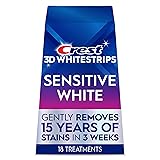
Crest 3D Whitestrips Sensitive White
Best for: Anyone who wants proven, mainstream whitening results with a formula specifically engineered to minimise tooth sensitivity
- Specially formulated hydrogen peroxide gel for sensitive teeth
- Removes up to 15 years of stains in 3 weeks
- 18 treatments (36 strips — upper and lower)
- Non-slip strips stay in place for hands-free wear
- +Lower hydrogen peroxide concentration than standard Crest strips, engineered to minimise sensitivity
- +Removes up to 15 years of set-in stains over a 3-week course
- +Non-slip strips stay in place for hands-free wear
- −Some users with significant pre-existing sensitivity still report mild discomfort in the first few applications
- −Results take the full 3 weeks to appear, not a fast-turnaround product
(Affiliate link) · Free shipping on eligible Prime items
Why We Recommend It
Crest 3D Whitestrips Sensitive White is the go-to for anyone who wants the trust of the market’s most recognised whitening strip brand without the aggressive peroxide concentration that triggers sensitivity. The formula uses a lower hydrogen peroxide percentage than Crest’s standard Professional Effects strips, and is specifically engineered for people who experience discomfort from whitening treatments. The ADA’s guidance on whitening safety notes that over-the-counter whitening strips are safe for most adults when used as directed, and sensitivity-formulated strips represent a clinically sensible middle ground between doing nothing and pursuing in-office treatments.
Multiple editorial roundups from sources including NBC Select and NewMouth cite the Crest Sensitive line as the benchmark recommendation for sensitive-teeth whitening.
Key Features
- Specially formulated hydrogen peroxide gel: lower concentration than standard Crest strips
- Removes up to 15 years of set-in stains over a 3-week treatment course
- 18 treatments (36 strips total, upper and lower arch)
- Non-slip grip means no sliding during wear
- No need to adjust your diet significantly during treatment (though avoiding staining foods/drinks while whitening is always sensible)
Who It’s Best For
Anyone with mild-to-moderate sensitivity who wants a dependable, widely available strip from a brand recommended by the #1 dentist-recommended whitening brand in the US. It’s the obvious starting point if you’ve been hesitant to try strips due to sensitivity concerns: the formula is specifically designed to lower that barrier.
Potential Downsides
Some users with significant pre-existing sensitivity still report mild discomfort, particularly during the first few applications. If you experience zingers or sharp sensations that persist beyond 24 hours, spacing treatments every other day rather than daily is recommended. Results take the full 3 weeks to become most apparent: this is not a fast-turnaround product.
(Affiliate link) · Free shipping on eligible Prime items
Lumineux Whitening Strips (21 Treatments)
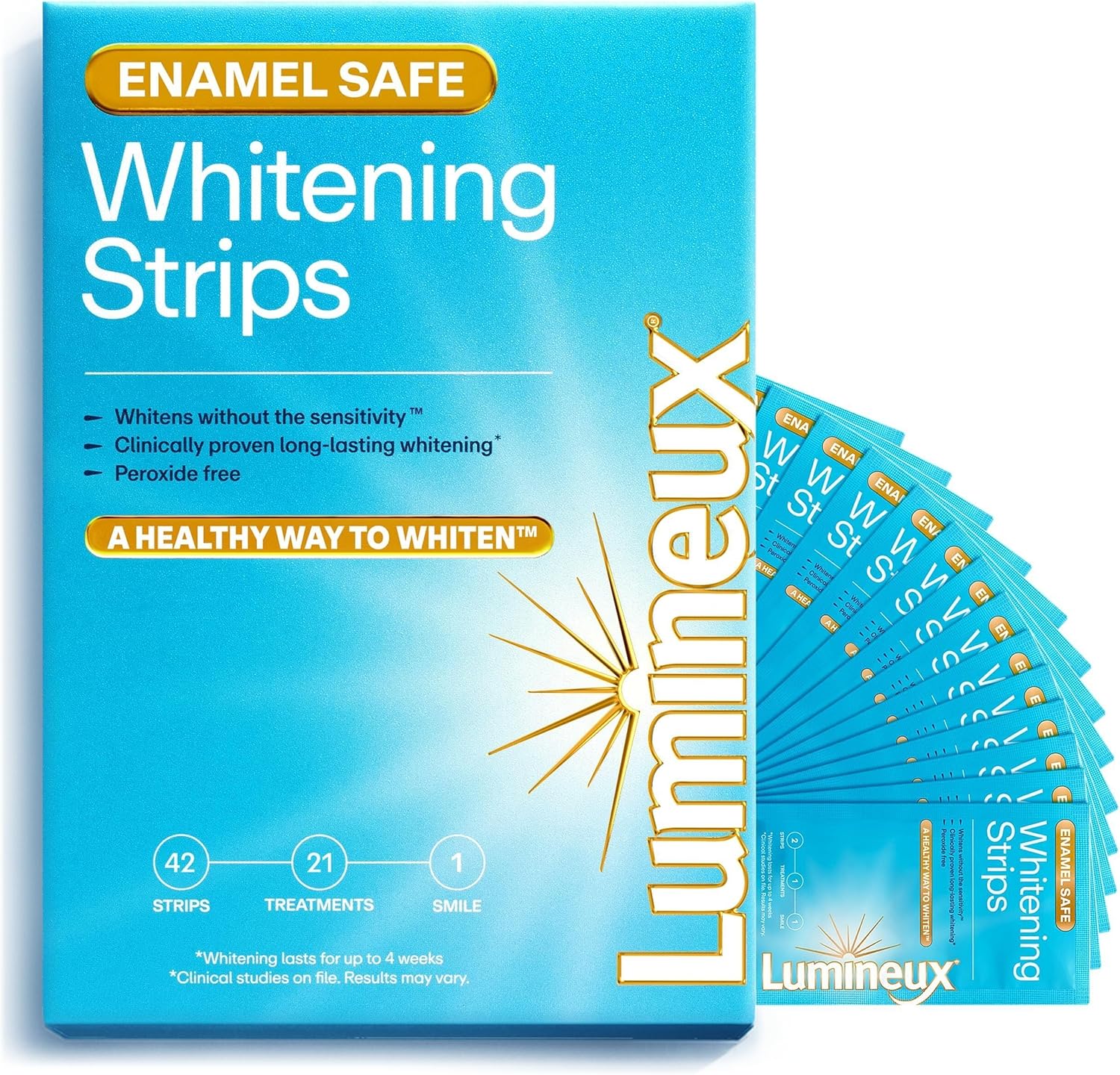
Lumineux Whitening Strips (21 Treatments)
Best for: People with significant peroxide sensitivity or anyone who has reacted badly to standard whitening strips in the past
- Peroxide-free formula — whitens without hydrogen or carbamide peroxide
- Dentist formulated with dead sea salt, coconut oil, sage oil, and lemon peel oil
- 21 treatments (3-month supply) — enamel-safe certified
- Worn for about 30 minutes per session, then removed
- +Completely peroxide-free, removes the primary sensitivity trigger
- +Plant-based actives (dead sea salt, coconut oil, sage oil, lemon peel oil); dentist formulated and enamel-safe certified
- +Sensitive-teeth users consistently report zero sensitivity during or after treatment
- −Results are gradual, often only 1-2 shades versus 3-5 from peroxide strips
- −Strips can be fragile and tear on application if not handled carefully
(Affiliate link) · Free shipping on eligible Prime items
Why We Recommend It
Lumineux takes a fundamentally different approach: there’s no peroxide in the formula at all. Instead, it uses a combination of dead sea salt, coconut oil, lemon peel oil, and sage oil to lift stains while maintaining enamel health. For people who have experienced serious sensitivity, burning gums, or nerve pain from peroxide-based strips, this is the product the dental community tends to point to as the most established peroxide-free alternative.
The trade-off is that results take longer and the shade improvement is typically more gradual than with high-concentration peroxide strips. But across multiple independent reviews and user panels, Lumineux users with sensitive teeth consistently report zero sensitivity during or after treatment, which for many people is the whole point.
Key Features
- Zero hydrogen peroxide or carbamide peroxide: no bleach chemistry
- Plant-based actives: dead sea salt (mineral cleansing), coconut oil (anti-inflammatory), sage oil (antimicrobial), lemon peel oil
- 21 treatments—a full 3-month whitening cycle
- Worn for about 30 minutes per session, then peeled off (the strips do not dissolve)
- Clinically tested and dentist formulated
- Enamel-safe certification
Who It’s Best For
Anyone with significant sensitivity who has given up on whitening strips after painful past experiences. Also well suited to people with gum recession, enamel erosion, or dental work (crowns, veneers, bonding) who have been advised to avoid peroxide.
Potential Downsides
Results are noticeably more gradual than peroxide-based strips: some users report only 1–2 shades of improvement over the full 21-treatment course, compared to 3–5 shades from professional-strength peroxide products. A small number of reviews note that the strips are fragile and can tear on application if not handled carefully. Not a fast-results product; best suited to consistent long-term use.
(Affiliate link) · Free shipping on eligible Prime items
Auraglow Sensitive Whitening Strips
Auraglow Sensitive Whitening Strips
Best for: People who want the whitening power of hydrogen peroxide but with built-in protection against the sensitivity it can cause
- 8% hydrogen peroxide — professional-strength whitening at a gentle concentration
- Nano-hydroxyapatite (nHAp) actively reduces whitening-induced sensitivity
- 14 treatments (28 strips, upper and lower)
- nHAp remineralises enamel during treatment
- +8% hydrogen peroxide delivers meaningful whitening without crossing into aggressive territory
- +Nano-hydroxyapatite (nHAp) actively reduces sensitivity and remineralises enamel during treatment
- +Faster results than a fully peroxide-free product
- −Limited independent clinical data on this specific DTC product
- −Results may vary more than with the category's most-tested options
(Affiliate link) · Free shipping on eligible Prime items
Why We Recommend It
What makes Auraglow’s sensitive strips stand out is the addition of nano-hydroxyapatite (nHAp) alongside the hydrogen peroxide. nHAp is a biocompatible form of calcium phosphate (the same mineral that makes up enamel), and a randomized controlled trial in BDJ Open found nano-hydroxyapatite toothpaste as effective as a leading desensitising toothpaste at relieving dentin sensitivity—an effect its authors attribute to hydroxyapatite plugs that occlude the dentinal tubules that transmit pain signals. That trial tested everyday sensitivity rather than whitening-induced sensitivity and was manufacturer-funded, but the tubule-occlusion mechanism is the same one at work during a whitening course. In practical terms, you get real peroxide-powered whitening with an ingredient working actively to counteract the sensitivity that peroxide can cause.
This dual-action approach positions Auraglow’s sensitive formula as a strong option for people who find fully peroxide-free strips too slow but can’t tolerate high-concentration peroxide products.
Key Features
- 8% hydrogen peroxide: meaningfully effective whitening without crossing into aggressive peroxide territory
- Nano-hydroxyapatite (nHAp) added specifically to reduce sensitivity and protect enamel
- 14 treatments, a two-week course
- Clean, dry-application strip technology
Who It’s Best For
Anyone who wants faster results than a peroxide-free product delivers, but has found standard high-strength strips too aggressive. The nHAp addition makes this particularly interesting for people who want a more science-backed approach to managing sensitivity rather than simply reducing the whitening agent. If you’re already using a sensitivity-focused toothpaste like Sensodyne or a nano-hydroxyapatite toothpaste, this formula is the logical equivalent in strip form.
Potential Downsides
Being a DTC brand without the same market presence as Crest or Lumineux, independent clinical data on this specific product is limited: the nHAp evidence base draws on broader research into the ingredient, not this product specifically. Results may vary more than with the category’s most tested options.
(Affiliate link) · Free shipping on eligible Prime items
Zimba Whitening Strips (Reduced Sensitivity, 28 Strips)
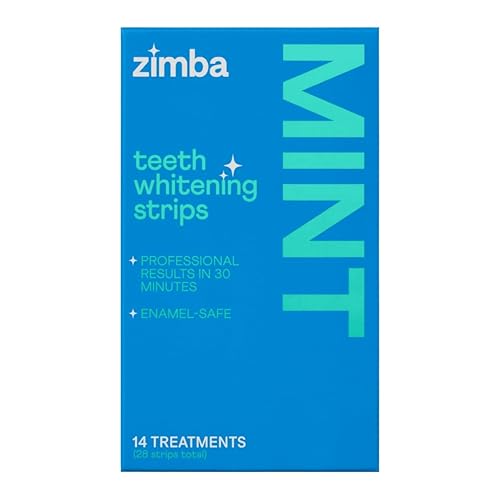
Zimba Whitening Strips (Reduced Sensitivity, 28 Strips)
Best for: Vegan shoppers or anyone wanting a natural-ingredient approach to whitening without sacrificing visible results
- Hydrogen peroxide strips the listing markets as reduced-sensitivity and enamel-safe
- Vegan and cruelty-free — no animal-derived ingredients
- 14 treatments (28 strips, upper and lower)
- Mint flavour
- +Hydrogen peroxide whitening in a formula the listing markets as reduced-sensitivity and enamel-safe
- +100% vegan and cruelty-free with a clean ingredient profile
- +Competitive cost-per-treatment with a strong real-world track record (18,000+ reviews at 4.4 stars)
- −Some users with more significant sensitivity report mild discomfort on the first few applications
(Affiliate link) · Free shipping on eligible Prime items
Why We Recommend It
Zimba has built a significant following in the DTC wellness space, and their strips occupy a useful middle ground: real hydrogen peroxide whitening in a formula the listing markets as reduced-sensitivity and enamel-safe, rather than a separate sensitive-specific product. For those who prefer cleaner-label products or follow a vegan lifestyle, Zimba’s transparent ingredient approach is a genuine point of difference from legacy brands like Crest.
At under $20 for a 14-day course, the cost-per-treatment is competitive, and with over 18,000 Amazon reviews at 4.4 stars, Zimba’s sensitive formulation has a strong real-world track record behind it.
Key Features
- Hydrogen peroxide whitening in a formula the listing markets as reduced-sensitivity
- 100% vegan, cruelty-free certified
- 14 treatments (28 strips, upper and lower)
- Enamel-safe formulation
- Mint flavour
Who It’s Best For
Vegan and clean-beauty consumers who want effective whitening without compromising on ingredient values. Also a strong pick for anyone who has found standard HP strips irritating and wants a formula that uses natural co-ingredients to soften the experience. If you’re building a full natural oral care routine, our best natural toothpaste guide covers fluoride-free and plant-based paste options to pair with.
Potential Downsides
Some users with more significant sensitivity report that even the sensitive formulation causes mild discomfort on the first few applications: this is common across all HP-based strips and typically resolves by spacing treatments every other day.
(Affiliate link) · Free shipping on eligible Prime items
Buyer’s Guide: What to Look For
Peroxide Concentration: The Sensitivity Dial
The single biggest factor in how much sensitivity you experience from whitening strips is the hydrogen peroxide concentration. Standard strips often contain 10–14% hydrogen peroxide; sensitive-tooth formulas typically drop to 5–9%. Go peroxide-free (PAP, plant-based) and you remove the primary sensitivity trigger entirely, at the cost of some whitening speed. If you find you tolerate standard peroxide levels fine, a full-strength strip will whiten faster for the same money.
According to ADA guidance on whitening, over-the-counter whitening products are safe at typical concentrations when used as directed. For sensitive teeth specifically, the ADA recommends choosing products with lower peroxide concentrations or consulting your dentist before starting a treatment. If you experience pain rather than mild discomfort during whitening, stop treatment and speak to your dentist.
Hydrogen Peroxide vs. PAP: The Core Trade-Off
Hydrogen peroxide (HP) is the most studied and fastest-acting whitening ingredient. Even at lower concentrations (6–10%), it penetrates enamel to break down intrinsic stains. The sensitivity risk comes from peroxide temporarily dehydrating enamel and irritating the dental pulp.
Phthalimidoperoxycaproic acid (PAP) is the leading peroxide-free alternative. Early research suggests it may whiten comparably to low-concentration HP with significantly less sensitivity risk, because it works through an oxidative mechanism that doesn’t dehydrate enamel. The evidence base is smaller than for HP.
Plant-based peroxide-free formulas take a third route. Lumineux is the most established example, and it uses neither peroxide nor PAP: its actives are dead sea salt, coconut oil, sage oil, and lemon peel oil. The shade change is gradual, but the real-world track record for sensitivity-free whitening is strong.
Nano-hydroxyapatite (nHAp) is increasingly being added alongside HP to reduce whitening-induced sensitivity. It works by remineralising enamel and occluding the dentinal tubules that transmit pain. Products like Auraglow’s sensitive strips use this dual approach.
How Often Can You Whiten?
For sensitive teeth, spacing treatments matters as much as concentration. Even with a sensitive-formulated strip, daily back-to-back use can accumulate enough peroxide exposure to cause real discomfort. Most dental professionals suggest:
- Daily use: only if the product is designed for it and your sensitivity is minimal
- Every other day: standard recommendation for most people with sensitivity
- Every third day or less: if you experience significant sensitivity
Most clinical strips recommend a break of 3–6 months between full treatment courses. Peroxide-free products like Lumineux are generally considered safe for more frequent use, as the sensitivity mechanism differs.
What to Do if Sensitivity Strikes
If you develop sensitivity during a whitening course, some dental professionals recommend using a potassium nitrate toothpaste (such as Sensodyne) for a few days before resuming. Potassium nitrate calms the nerve signals inside the tooth and can meaningfully reduce whitening-induced discomfort. Our guide to the best toothpaste for sensitive teeth covers the most effective options.
Taking a 24–48 hour break between strips, avoiding very hot or cold foods and drinks during treatment, and not using the strips immediately after brushing (which temporarily opens enamel pores) can all help reduce sensitivity.
FAQ
Q: Can I use whitening strips if I have very sensitive teeth?
A: Yes, but formulation choice matters significantly. People with significant sensitivity should start with peroxide-free options (like Lumineux) or low-concentration HP strips (6–8% or lower). According to the ADA, most adults can safely use whitening strips without adverse effects when used as directed. If your sensitivity is caused by gum recession, cracked teeth, or exposed dentin, consult your dentist before starting any whitening treatment.
Q: Should I buy a sensitive-formula strip or a regular one?
A: If you have never had a whitening product hurt, a regular full-strength strip is the better buy: it whitens faster and costs the same or less. Choose a sensitive formula, like the picks on this page, if peroxide has caused zingers before, if you have gum recession or exposed dentin, or if you have been advised to avoid peroxide entirely.
Q: How long does whitening-induced sensitivity last?
A: Most whitening sensitivity resolves within 24–72 hours of stopping treatment. In cases of more intensive use or higher peroxide concentrations, it can last up to a week. If sensitivity persists beyond a week or is accompanied by sharp pain rather than mild discomfort, stop treatment and see a dentist. Sensitivity from the products in this roundup (which are formulated specifically for sensitive teeth) typically resolves within 24 hours.
Q: Are peroxide-free strips as effective as regular whitening strips?
A: Generally, they’re slower and the shade improvement is more gradual. Independent testing consistently finds that peroxide-free products like Lumineux produce 1–2 shades of improvement, while comparable HP-based strips produce 3–5 shades. For people who can’t tolerate peroxide, the slower results are a worthwhile trade-off for zero sensitivity; for people with mild sensitivity, a low-concentration HP strip often delivers a better balance of speed and comfort.
Q: Can whitening strips damage my enamel?
A: At the concentrations found in over-the-counter products, whitening strips are not considered to cause permanent enamel damage when used as directed. According to the ADA, research on the safety of peroxide-based whitening products shows no significant adverse effects at OTC concentrations with proper use. Overuse (using strips more frequently or for longer than instructed) increases the risk of temporary sensitivity and is not recommended. People with pre-existing enamel erosion should consult their dentist before whitening.
Q: How long before I see results with sensitive-teeth strips?
A: With peroxide-based sensitive strips (like Crest or Auraglow), most users notice visible brightening within 5–7 days of starting a standard treatment course. Full results typically emerge at the 2–3 week mark. Peroxide-free strips like Lumineux take longer—most users see visible improvement between weeks 2 and 4. Realistic expectations are important: strips whiten by lifting surface and some intrinsic staining; they won’t match in-office whitening results.
Q: Should I use a sensitivity toothpaste alongside whitening strips?
A: Many dental professionals recommend it. Using a desensitising toothpaste containing potassium nitrate (such as Sensodyne) twice daily in the days before, during, and after a whitening course may meaningfully reduce sensitivity. Some dentists also recommend applying a potassium nitrate gel to the teeth after strip removal. Pairing strips with a compatible toothpaste is one of the most practical steps sensitive-teeth whiteners can take.
Q: Should I use whitening strips or a whitening toothpaste?
A: It depends on the stain and how much sensitivity you get. Strips sit on the tooth for 20 to 60 minutes, long enough for peroxide (or a peroxide-free active) to reach intrinsic stain, which is why a two to three week course can move shade by whole steps. Toothpaste gets about two minutes of contact and works on surface stain from coffee, tea, and wine through low-abrasion polishing, used twice a day indefinitely. If your discolouration is mild or your sensitivity is significant, the paste is the gentler starting point; if you want a visible shade change, the strip course is the faster route. Plenty of people run both: a desensitising paste daily, and a sensitive-formulated strip course a few times a year. For the paste route, start with our best toothpaste for whitening roundup.
Our Methodology
We built this guide through multi-source research across dental professional guidance, clinical ingredient science, and real-world user feedback. We began by reviewing current (2025–2026) editorial roundups from outlets including NBC Select, NewMouth, and TeethTalkGirl, and cross-referenced product selections against ADA guidance on whitening safety and peroxide concentrations.
We evaluated each product for: hydrogen peroxide concentration (or peroxide-free mechanism), sensitivity-reducing additives (nHAp, potassium nitrate, coconut oil), documented shade improvement, treatment schedule design, and price-per-treatment value. We then cross-referenced against Reddit discussions in r/dentistry and r/oralhealth to ensure our selections reflect real-world user experiences rather than marketing claims alone.
Products are chosen editorially. Our affiliate relationships (clearly disclosed on each product link) do not influence which products are included or how they are ranked.