
Charcoal toothpaste is one of the most polarizing products in oral care. Millions of people swear by it for removing coffee, tea, and wine stains. Dental professionals, on the other hand, urge caution: the American Dental Association says there is insufficient evidence that charcoal oral care products whiten teeth with adequate safety and effectiveness, and a 2022 evidence summary in the Journal of the Michigan Dental Association noted that no activated charcoal toothpaste had received the ADA Seal of Acceptance. We also checked broader ADA toothpaste guidance before weighing fluoride, abrasiveness, and anticavity trade-offs. Much of the caution centers on abrasiveness, though lab testing is more reassuring than the reputation: a 2023 University of Zurich study of 12 charcoal pastes found abrasivity values no different from ordinary toothpastes, but noted that many of them lack fluoride.
That does not mean all charcoal toothpastes are dangerous: it means you need to choose carefully. We evaluated five options across ingredient safety, what each maker says about abrasiveness, fluoride content, review sentiment, and price to find charcoal toothpastes that offer reasonable stain removal without excessive risk. If you want whitening without charcoal, see our guide to the best whitening toothpaste.
Our Top Picks
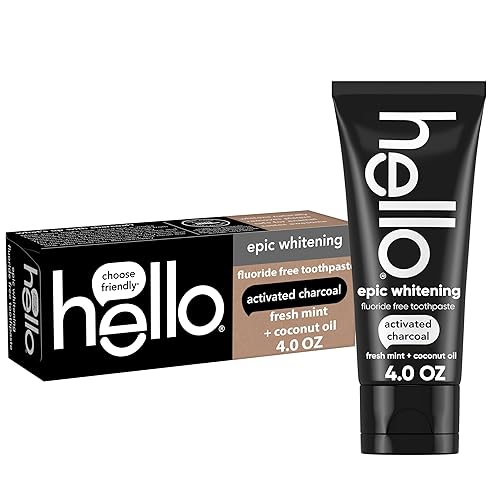
hello Epic Whitening Charcoal Fluoride Free Toothpaste
Best for: Most people looking for a charcoal toothpaste: the most-reviewed pick on this list, with 46,000+ Amazon ratings and an SLS-free, vegan formula
- Activated charcoal with coconut oil for stain removal
- Fluoride-free and SLS-free formula
- Vegan, no artificial sweeteners or dyes
- Fresh Mint flavor that doesn't taste like charcoal
- +Most-reviewed pick on this list, with 46,000+ Amazon ratings
- +SLS-free, no artificial sweeteners or dyes, vegan and cruelty-free
- +Fresh Mint flavor without the gritty or metallic taste common to charcoal pastes
- −Fluoride-free, so cavity-prone users need to pair it with a fluoride mouthwash or toothpaste
(Affiliate link) · Free shipping on eligible Prime items
hello Epic Whitening Charcoal Fluoride Free Toothpaste — Editor’s Pick
The hello charcoal toothpaste has by far the largest review base of any pick on this list, and its 46,000+ Amazon ratings paint a consistent picture of gradual surface-stain removal. On abrasiveness, hello says its charcoal paste is well within the ISO standard for enamel safety but does not publish a number. The formula combines activated charcoal with coconut oil in a black paste that (despite appearances) rinses clean without staining your sink or toothbrush.
What sets hello apart from generic charcoal pastes is what it leaves out. There’s no SLS (sodium lauryl sulfate), no artificial sweeteners, no dyes, and no parabens. It’s vegan, cruelty-free, and the Fresh Mint flavor is pleasant: a common complaint about charcoal toothpastes is that they taste gritty or metallic, and hello avoids both. At $5.96 per tube, the price-to-quality ratio is hard to beat.
The main tradeoff is the lack of fluoride. If cavity prevention is your primary concern, you’ll want to pair this with a fluoride mouthwash or use a fluoride toothpaste at a different time of day. Some dental professionals on forums note that charcoal toothpaste without fluoride means you’re trading cavity protection for cosmetic whitening, a reasonable choice for adults with low cavity risk, but worth discussing with your dentist if you’re cavity-prone.
(Affiliate link) · Free shipping on eligible Prime items
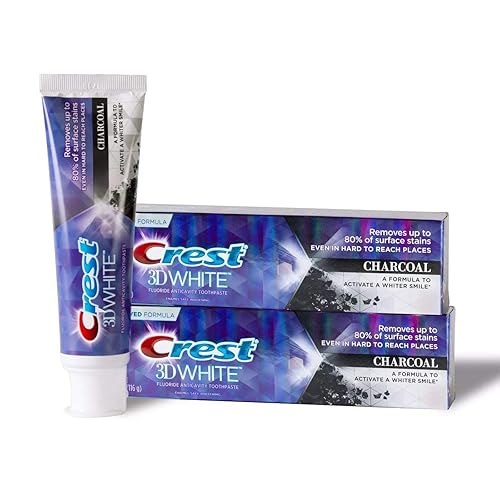
Crest 3D White Charcoal Toothpaste
Best for: People who want charcoal whitening with the cavity protection of fluoride from a trusted mainstream brand
- Fluoride anticavity formula with activated charcoal
- Striped formula Crest says gently whitens by removing surface stains
- Crest says the fluoride remineralizes weakened enamel
- Invigorating Mint flavor
- +Fluoride anticavity protection combined with charcoal whitening
- +Highest-rated pick on this list at 4.7 stars across 21,000+ reviews
- +Drug-facts label lists sodium fluoride 0.243% as the active ingredient, though neither the label nor the Amazon listing gives an abrasivity figure
- −Costs about $8.33 per tube, pricier than hello or Himalaya
- −Charcoal undertone is stronger than expected for some reviewers
(Affiliate link) · Free shipping on eligible Prime items
Crest 3D White Charcoal Toothpaste — Best With Fluoride
If you want charcoal’s stain-removing properties without giving up fluoride, the Crest 3D White Charcoal is the strongest mainstream option. With 21,000+ reviews and a 4.7-star average, it has the highest rating of any product on this list. Crest’s formula adds activated charcoal to their established 3D White whitening base, which means you’re getting fluoride cavity protection alongside the charcoal.
The tube we link is the striped Whitening Therapy Deep Clean version, and Crest’s Amazon listing for it says it gently whitens teeth by removing surface stains; the review consensus supports noticeable whitening over two to four weeks of regular use. The “enamel safe whitening” and “removes up to 80% of surface stains” lines you may see on other Crest charcoal packs come from the label of the plain 3D White Charcoal tube, a different product. Given the abrasiveness questions around charcoal, note that Crest gives no abrasivity number on this tube’s label or its Amazon listing. This tube’s drug-facts label lists sodium fluoride 0.243% (about 1,100 ppm fluoride) as the active ingredient, and the listing says the fluoride remineralizes weakened enamel, so the cavity protection is a labelled drug claim rather than marketing copy.
The downside is price: at about $25 for a 3-pack as of this writing (roughly $8.33 per tube), it still costs noticeably more per tube than hello. Some reviewers also note that the charcoal flavor is stronger than expected: it’s a conventional mint taste, but with a charcoal undertone that not everyone loves. If you’re already a Crest user, this is the easiest charcoal toothpaste to integrate into your routine.
(Affiliate link) · Free shipping on eligible Prime items
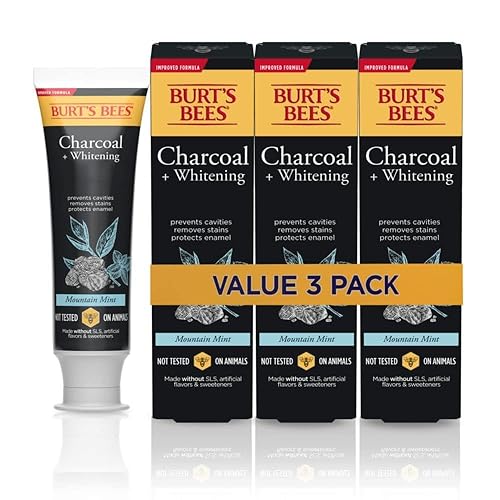
Burt's Bees Charcoal with Fluoride Toothpaste
Best for: Parents and adults who want natural ingredients without giving up fluoride cavity protection
- Natural charcoal formula with fluoride protection
- No SLS, no artificial flavors or sweeteners
- Mountain Mint flavor, not tested on animals
- Prevents cavities, removes stains, protects enamel
- +Combines fluoride cavity protection with natural ingredients, no SLS or artificial sweeteners
- +Not tested on animals, with a mild Mountain Mint flavor
- +About $5.05 per tube, cheaper than Crest and competitive with hello
- −Whitening effect is subtle, more brightness maintenance than dramatic whitening
- −Smaller review base than hello or Crest, at 3,697 reviews
(Affiliate link) · Free shipping on eligible Prime items
Burt’s Bees Charcoal with Fluoride Toothpaste — Best Natural With Fluoride
Burt’s Bees occupies a sweet spot that few charcoal toothpastes hit: natural ingredients and fluoride in the same tube. Many natural charcoal pastes skip fluoride entirely (like hello and Himalaya on this list), while conventional options like Crest include fluoride but also artificial ingredients. Burt’s Bees threads the needle: you get fluoride cavity protection in a formula made without SLS, artificial flavors, or artificial sweeteners, and the product is not tested on animals.
The Mountain Mint flavor is mild and pleasant, and parents in reviews appreciate that it’s a formula they feel comfortable using themselves and recommending for older kids. At about $15.15 for a 3-pack (roughly $5.05 per tube), the per-tube cost is competitive with hello and significantly cheaper than Crest.
The review base is smaller than hello or Crest (3,697 reviews), and some reviewers mention the charcoal whitening effect is subtle: more “maintains brightness” than “dramatically whitens.” That’s not necessarily a bad thing, since steady brightness maintenance is the realistic goal for any daily toothpaste. If you want a daily-driver toothpaste that happens to include charcoal rather than an aggressive whitening paste, Burt’s Bees is the pick.
(Affiliate link) · Free shipping on eligible Prime items
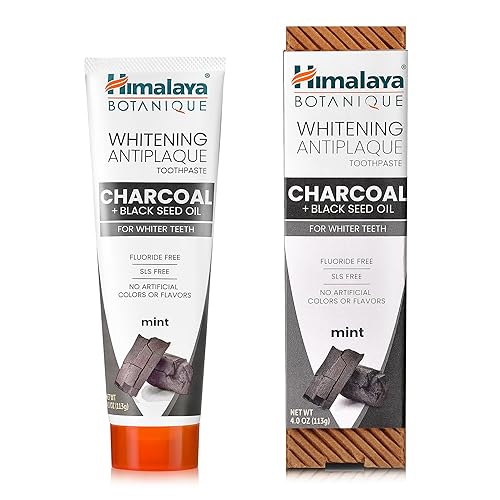
Himalaya Botanique Charcoal Whitening Toothpaste
Best for: Budget-conscious buyers who want a plant-based charcoal toothpaste under $8
- Charcoal plus black seed oil for whitening
- Fluoride-free, SLS-free, no artificial colors
- Plant-based and vegan formula
- Single tube under $8
- +One of only two single-tube options on this list at $7.49
- +Charcoal paired with black seed oil, an ingredient with research-supported antibacterial properties
- +Reviewers cite a minty taste and a smooth texture, and one says it leaves none of the gritty residue some charcoal products have
- −Fluoride-free, so cavity prevention needs a supplemental fluoride rinse
- −4 oz tube is smaller than the standard 4.7 oz, so per-ounce savings are modest
(Affiliate link) · Free shipping on eligible Prime items
Himalaya Botanique Charcoal Whitening Toothpaste — Best Budget
Himalaya’s Botanique line has built a loyal following in the natural toothpaste space, and their charcoal variant delivers a plant-based whitening formula in a low-commitment single tube. At $7.49 for a 4 oz tube, it undercuts most charcoal toothpastes while offering a distinctive formulation: activated charcoal paired with black seed oil, an ingredient with research-supported antibacterial properties.
The formula is fluoride-free, SLS-free, and contains no artificial colors, flavors, or preservatives. With 7,470 Amazon ratings and a 4.6-star average, it’s well-reviewed for a niche product. Multiple flavor variants are available (Charcoal, Bamboo, Turmeric), and Amazon’s review summary says customers cite its minty taste and smooth texture, with one reviewer saying it doesn’t leave the gritty residue some charcoal products have.
Like hello, the lack of fluoride means you’ll want to supplement with a fluoride rinse if cavity prevention is a priority. The 4 oz tube is also slightly smaller than the standard 4.7 oz from competitors, so per-ounce it’s not dramatically cheaper, but the low upfront cost makes it an easy entry point for anyone curious about charcoal toothpaste without a big commitment.
(Affiliate link) · Free shipping on eligible Prime items
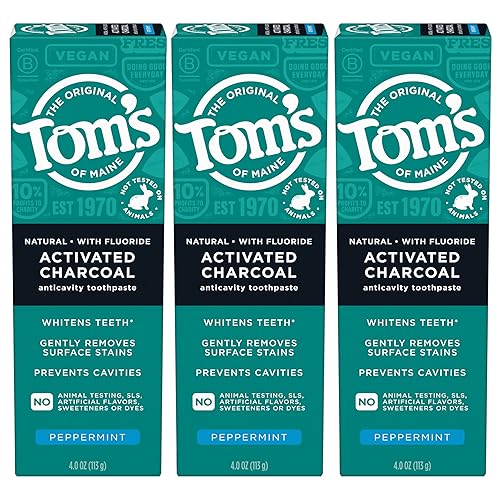
Tom's of Maine Activated Charcoal Whitening Toothpaste
Best for: Shoppers who prioritize brand transparency and verified natural ingredients — B Corp certified with fluoride
- Activated charcoal with fluoride anticavity protection
- No artificial flavors, colors, or preservatives
- Certified B Corp, cruelty-free
- Peppermint flavor, whitens and prevents cavities
- +B Corp certified and cruelty-free, with fluoride cavity protection included
- +No artificial flavors or preservatives, clean Peppermint flavor
- +Brushes and foams like a conventional toothpaste despite the clean ingredient list
- −Most expensive option on this list at about $13.17 per tube
(Affiliate link) · Free shipping on eligible Prime items
Tom’s of Maine Activated Charcoal Whitening Toothpaste — Best Certified Natural
Tom’s of Maine is one of the most recognized names in natural oral care, and their charcoal toothpaste carries the brand’s hallmarks: fluoride for cavity protection, no artificial flavors or preservatives, B Corp certification, and cruelty-free production. For shoppers who want both the transparency of a certified natural brand and the cavity-fighting power of fluoride, Tom’s is the most credible option on this list.
The formula combines activated charcoal with fluoride in a Peppermint flavor that’s clean and straightforward. With 3,518 reviews and a 4.6-star average, parents and natural-product enthusiasts consistently praise the whitening results and the fact that it doesn’t feel like a compromise: it brushes and foams like a conventional toothpaste while keeping the ingredient list clean.
The tradeoff is price. At about $39.50 for a 3-pack (roughly $13.17 per tube), Tom’s is the most expensive option per tube on this list. The B Corp certification and brand reputation carry a premium. If price matters more than certification, Burt’s Bees offers a similar natural-with-fluoride proposition at well under half the per-tube cost.
(Affiliate link) · Free shipping on eligible Prime items
Buyer’s Guide: What You Need to Know About Charcoal Toothpaste
Does Charcoal Toothpaste Actually Whiten Teeth?
Charcoal toothpaste can remove surface stains from coffee, tea, wine, and tobacco: the kind of stains that sit on the enamel surface. What it cannot do is change the underlying color of your teeth. That’s an important distinction: if your teeth are naturally yellowish (which is normal, dentin beneath enamel is naturally yellow), charcoal toothpaste will not make them white. For intrinsic whitening, you need peroxide-based products like whitening strips or professional treatments. If it’s the powder format you’re weighing, our teeth whitening powder guide puts the charcoal option next to non-charcoal alternatives.
A review published in the British Dental Journal found insufficient clinical evidence to support charcoal’s whitening claims beyond surface stain removal. That doesn’t mean charcoal does nothing (many users see brighter-looking teeth after consistent use), but it means the results are modest and limited to extrinsic stains.
Is Charcoal Toothpaste Safe?
The primary concern is abrasiveness, and the lab evidence is more nuanced than the reputation. When University of Zurich researchers measured 12 charcoal toothpastes, dentin abrasivity (RDA) ranged from 24 to 166 and enamel abrasivity from 0 to 14, values that did not differ significantly from ordinary toothpastes tested before; all of them sat under the 250 RDA ceiling the ADA treats as safe and effective. Both the ADA and the Zurich authors add that an RDA number on its own does not settle a paste’s clinical safety. The real warning signs are elsewhere: a 2017 review in the Journal of the American Dental Association found insufficient clinical and laboratory data to back charcoal pastes’ safety and efficacy claims, and the ADA’s whitening review cites a report of a charcoal-and-table-salt mixture that left deep concave abrasion cavities in front teeth and a yellow cast as dentin showed through.
That said, we found no published abrasivity figure for any of the five pastes on this list: hello says only that its paste is well within the ISO standard (its Amazon listing calls it safe for enamel), Tom’s of Maine says its Peppermint Activated Charcoal Toothpaste is the gentlest charcoal toothpaste among leading natural brands based on RDA testing without giving the number, and neither the label nor the Amazon listing of the Crest tube we link makes an abrasivity claim. The practical hedge is moderation: most dental professionals who weigh in on charcoal toothpaste suggest using it a few times per week rather than twice daily, and alternating with a standard fluoride toothpaste.
Fluoride vs. Fluoride-Free Charcoal Toothpaste
This is the biggest decision point. Three products on this list include fluoride (Crest, Burt’s Bees, Tom’s of Maine) and two are fluoride-free (hello, Himalaya).
Choose fluoride if cavity prevention is important to you: fluoride helps make enamel more resistant to cavities, and the American Dental Association calls it safe and effective for preventing tooth decay in children and adults, and recommends brushing with a fluoride toothpaste.
Choose fluoride-free if you already get fluoride from other sources (mouthwash, drinking water) or have a specific reason to avoid it. If you go fluoride-free, consider adding a fluoride mouthwash to your routine to compensate.
How to Use Charcoal Toothpaste Safely
Don’t use it as your only toothpaste. Alternating with a standard fluoride toothpaste (charcoal in the morning, fluoride at night, for example) gives you whitening benefits without skipping cavity protection.
Use a soft-bristled toothbrush. The ADA’s consensus recommendation is to brush for two minutes twice a day with soft bristles, whatever toothpaste you use, and charcoal is no reason to make an exception.
Don’t scrub aggressively. Let the paste do the work. The ADA suggests angling the brush at 45 degrees to the gumline and moving it gently back and forth in short strokes; it notes there are several brushing techniques and does not name one as best.
Watch for sensitivity. If your teeth become sensitive to hot or cold after starting a charcoal toothpaste, that may indicate enamel wear. Stop using it and consult your dentist.
What Dentists Actually Say
Dental professionals are generally cautious about charcoal toothpaste. The consensus from dental forums and professional commentary: charcoal can be an acceptable occasional whitening tool for adults with healthy enamel, but it should not replace fluoride toothpaste as a daily staple. Multiple dentists note that charcoal particles can also accumulate in cracks, between fillings, and along the gumline: potentially creating cosmetic issues rather than solving them. If you have dental restorations (fillings, crowns, veneers), ask your dentist before using charcoal toothpaste.
Frequently Asked Questions
Can charcoal toothpaste damage enamel?
It can, if the formulation is overly abrasive or if you use it too aggressively. We found no published abrasivity figure for the pastes on this list, though lab testing of 12 other charcoal pastes found values in the same range as ordinary toothpaste. The cautious approach is to use charcoal toothpaste a few times per week rather than twice daily, and to brush gently with a soft-bristled toothbrush. If you notice increased tooth sensitivity, stop using charcoal toothpaste and see your dentist.
Does any charcoal toothpaste have the ADA Seal?
The ADA Seal of Acceptance requires clinical evidence that a product is safe and effective for its stated claims. A 2022 evidence summary in the Journal of the Michigan Dental Association noted that no activated charcoal toothpaste had received the Seal, and that every toothpaste with the Seal contained fluoride, whereas many charcoal pastes are fluoride-free. This doesn’t necessarily mean charcoal toothpastes are unsafe: it means the evidence base hasn’t met the ADA’s threshold for independent verification.
Is charcoal toothpaste safe for kids?
We’d skip it for children. A 2017 review in the Journal of the American Dental Association found too little clinical and laboratory data to back charcoal pastes’ safety claims and advised caution, and the lack of fluoride in many charcoal formulas is a concern for developing teeth. For children’s toothpaste recommendations, see our guide to the best toothpaste for kids.
Can I use charcoal toothpaste with braces?
Use caution. Charcoal particles can get trapped in brackets and wires, and the little lab testing we found is mixed: a 2023 lab study found that whitening pastes, a charcoal one among them, did not weaken composite bonding to brushed enamel, while a 2026 lab study found a charcoal paste sapped the force of orthodontic elastic chains faster than the other pastes tested. If you’re wearing braces, check with your orthodontist before using charcoal toothpaste. For braces-specific recommendations, see our best toothpaste for braces guide.
How long does it take for charcoal toothpaste to whiten teeth?
Most users report visible improvement in surface stain removal within two to four weeks of regular use. Results depend on the severity of staining and how frequently you use the product. Charcoal toothpaste works best on extrinsic stains from food and drink—it will not change the intrinsic color of your teeth.
Should I use charcoal toothpaste if I have sensitive teeth?
If your teeth are already sensitive, start with a paste built for that instead: ADA toothpaste guidance cites evidence for stannous fluoride, potassium, and arginine approaches to sensitivity, while charcoal pastes’ safety claims rest on thin evidence. See our toothpaste formulated for sensitivity guide.