
Quick Answer
Fluoride has decades of large-scale evidence behind it and remains the default recommendation of dental professionals; hydroxyapatite (nHAp) has two credible head-to-head trials, a real sensitivity story, and important caveats attached to both. If you’re cavity-prone, fluoride is the safer bet. If you’re a low-risk adult who won’t use fluoride, a well-formulated 10% hydroxyapatite paste is the most evidence-backed alternative. The full picture—including who funded the hydroxyapatite trials and what happened to people who switched—is below, along with our fluoride and hydroxyapatite roundups.
Fluoride vs Hydroxyapatite at a Glance
| Fluoride | Hydroxyapatite (nHAp) | |
|---|---|---|
| How it protects teeth | Forms fluorapatite, a mineral more acid-resistant than natural enamel | Deposits the same mineral your enamel is made of |
| Evidence base | Decades of large-scale trials; the professional standard | Two head-to-head randomized trials, both manufacturer-funded |
| Cavity prevention | Proven across all risk levels | Non-inferior to fluoride in the two trials; populations ranged from low-risk adults to cavity-prone kids |
| Sensitivity relief | Stannous fluoride formulas block exposed dentin tubules | The benefit switchers most consistently report |
| Known drawbacks | Toxic if swallowed in quantity; stannous can irritate some mouths | Most brands don’t disclose concentration; nano form subject to EU particle-shape restrictions, discussion ongoing |
| Typical cost | About $1 per ounce | Around $2.50 per ounce for a disclosed-concentration formula |
What the Clinical Evidence Actually Says
Fluoride’s case rests on volume and time. Community water fluoridation and fluoride toothpaste have been studied across populations for decades, and the ADA’s guidance on topical fluoride reflects that depth; per Mayo Clinic, fluoride strengthens enamel and makes it more resistant to the acid attacks that cause decay. The chemistry professionals kept citing in our research is fluorapatite—the harder mineral fluoride helps form in your enamel’s outer layer. A dental professional on r/Dentistry put it in one sentence, in the single most upvoted professional comment in our research: “Fluoride toothpastes put your tooth a step ahead for future acid attack, thus reducing your risk for future cavities.”
Hydroxyapatite’s case is newer and narrower. Two double-blind randomized trials—one in adults over 18 months (Frontiers in Public Health, 2023) and one in children over roughly a year (Scientific Reports, 2021)—found 10% hydroxyapatite toothpaste non-inferior to fluoride at preventing new cavities. That is genuinely the strongest head-to-head evidence any fluoride alternative has. It also comes with three caveats worth knowing before you switch: both trials were funded by Dr. Kurt Wolff GmbH, a hydroxyapatite toothpaste maker; neither reports testing the nano form (nHAp) most US products contain — the children’s paste is specified as 10% microcrystalline hydroxyapatite, while the adult trial lists its paste only as “hydroxyapatite (10%)” with no particle size given; and the adult trial enrolled healthy, low-risk mouths, so it says little about what happens if you’re already cavity-prone.
What Five Years of Reddit Switching Taught
We drew on 40 discussion threads across r/Biohackers, r/Dentistry, r/askdentists, r/DentalHygiene, and r/ZeroWaste—covering May 2021 through May 2026—for this comparison. The community ran the uncontrolled version of the experiment the trials couldn’t, and its results cut both ways.
| Community signal | What the evidence supports |
|---|---|
| The most influential comment in the dataset (1,031 upvotes): “I also listened to the hype and used it exclusively for over a year… After: 12 cavities.” | Anecdote, not data—but consistent with the trials’ gap: the adult trial only tested low-risk mouths |
| A dental hygienist: patients who went fluoride-free “getting multiple and large cavities all of a sudden” | Practitioner-level observation, unpublished; the strongest real-world warning signal in our research |
| Switchers repeatedly report sensitivity improvement (“After a few weeks my teeth felt smoother and way less sensitive”) | Matches hydroxyapatite’s plausible mechanism; sensitivity is where user experience and marketing claims align best |
| Community consensus that 10% concentration is the efficacy threshold, and a recurring frustration that many brands don’t disclose a percentage at all | The trials used 10%; a paste with an undisclosed, lower concentration is not what was tested |
That last row may be the most practical finding of all. Many negative hydroxyapatite outcomes in these threads may trace to products that never disclosed their concentration. If the trials tested 10% and your tube won’t tell you its number, you are not buying the thing the evidence describes.
Sensitivity: The One Place nHAp Wins on Experience
Across the threads, sensitivity relief—not cavity prevention—is the benefit hydroxyapatite users actually feel. “NHA paste has solved my sensitive teeth” is a representative report, and several long-term users describe staying with it for years primarily for that reason.
Fluoride has its own sensitivity answer: stannous fluoride, which a dental professional in our research favored for this problem specifically, putting it plainly: “It has advantages over sodium fluoride mainly that it will help more with sensitivity by blocking off dentin tubules.” The honest counterpoint from the same thread: some users find stannous formulas harsh—“it really burns and irritates my mucosa.” If you’ve reacted to a stannous toothpaste before, that trade-off is real. For a broader lineup of options on this problem, see our sensitive-teeth toothpaste picks.
Safety: Where Each Side’s Anxiety Actually Lands
The fluoride-toxicity fear that drives much of the fluoride-free market is, at toothpaste doses, not supported by the professionals in our research. The standard framing—the dose makes the poison—came up repeatedly: you would need to eat implausible amounts of toothpaste for systemic harm as an adult. The real cautions are for young children who swallow paste (use age-appropriate amounts) and prescription-strength products.
Hydroxyapatite has its own open safety question, and it’s specifically about the nano form. The EU’s Scientific Committee on Consumer Safety has published opinions on nano-hydroxyapatite restricting which particle shapes it considers acceptable in oral products, and as of mid-2026 the community discussion around nano-particle safety remains active and unresolved. A rod-shaped particle spec is exactly the distinction those opinions turn on. Worth repeating: neither supportive cavity trial reports testing the nano form — the children’s paste is specified as microcrystalline, the adult’s not specified at all — so the nano-safety question and the efficacy evidence do not rest on the same material.
The asymmetry lands hardest for children. The one caries-active trial population is the children’s trial—nHAp’s strongest efficacy evidence—but kids are also the group most likely to swallow toothpaste, which is where fluoride’s risk is well-characterized and dose-bounded while nano-ingestion questions remain open. If you’re choosing for a child, our kids fluoride-free guide covers this in depth, and a pediatric dentist’s input is worth more than any label.
Price: The Quiet Dealbreaker
Hydroxyapatite costs meaningfully more, and in our research that gap—not science—is what pushed several users back to fluoride. Based on our live pricing reads for the two products below: a disclosed-10% nHAp paste runs about $10 for a 4 oz tube (around $2.50 per ounce), while a stannous fluoride paste from a major brand runs about $5 for 5.1 oz (just under $1 per ounce). Per ounce, that’s roughly two and a half times the cost for the hydroxyapatite option—every month, indefinitely. If a fluoride-free routine only lasts until the third $10 tube, the cheaper paste you’ll actually keep using is the better paste. Our Boka toothpaste review weighs that same price-vs-value question for the flagship nHAp brand specifically.
Can You Just Use Both?
Combination products exist but are rare—CariFree’s gel line is the one dental professionals in our research named approvingly—and the community’s chemistry debate—whether fluoride and hydroxyapatite react in the tube to form fluorapatite before ever reaching your teeth—doesn’t have a clean published answer. What has emerged instead is a practical compromise with real community traction: a split routine, fluoride at one brushing and hydroxyapatite at the other. One long-term user’s version: “I use Apagard Royal at night for restoration and a fluoride toothpaste in the morning.” No formal trial has validated the split routine, but it lets you keep fluoride’s proven protection while testing whether nHAp helps your sensitivity. We cover it in more depth in our fluoride-free toothpaste guide.
Verdict: Who Should Choose Which
Choose fluoride if you’ve had a cavity in the last few years, have deep grooves or dry mouth, or just want the option with the most evidence behind it. Every professional community we researched—including hygienists who recommend nHAp to fluoride-averse patients—treats fluoride as the default for cavity-prone mouths. The most balanced professional take in our dataset: HA toothpastes “put your tooth back where it started,” while fluoride puts it a step ahead.
Choose hydroxyapatite if you’re a low-risk adult who has decided against fluoride, or sensitivity is your main complaint. In that case buy like the evidence reads, with one admission: no mainstream US nano product matches the one form the trials actually specify (microcrystalline, in the children’s trial; the adult trial did not report its form, so nothing can be said to match or miss it), so a disclosed 10% concentration is the closest available proxy—and undisclosed concentration is the community’s most recurring complaint about nHAp products.
Choose the split routine if you can’t decide—it’s the community’s own compromise, with one honest cost: you keep once-daily fluoride exposure, which is less than the twice-daily standard, but not zero. And whichever way you lean, if you’re switching because of cavity concerns, the properly reader-first move is asking your dentist for a caries-risk assessment first—the three proxies above are a rough substitute for what a professional exam does properly.
If You’ve Picked a Side
One representative pick per ingredient—chosen for matching what the research above actually rewards (a disclosed concentration on the nHAp side, stannous fluoride on the fluoride side), not ranked against each other. If you’re leaning nHAp and want a concrete brand to start with, our Apagard toothpaste review covers the reference Japanese line in more depth.
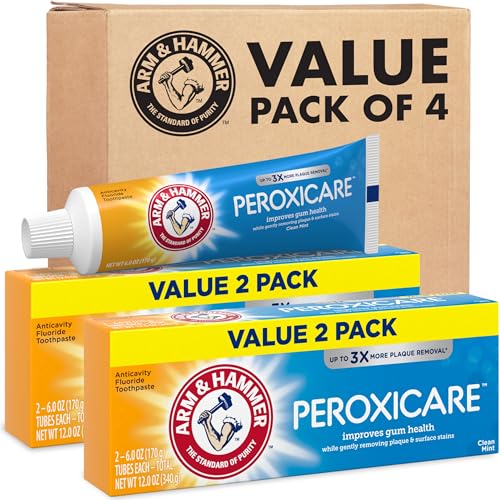
Crest Pro-Health Advanced Deep Clean
Best for: The fluoride side: stannous fluoride for cavity protection plus a sensitivity benefit
- Stannous fluoride, the fluoride type a dental professional in our research singled out for sensitivity
- Marketed for cavities, plaque, gingivitis, and sensitivity in one formula
- About $5 for a 5.1 oz tube at our last price check
- +Pairs fluoride's proven cavity protection with dentin-tubule sensitivity relief, per the professional comment in our research
- +Just under $1 per ounce, less than half the per-ounce cost of the nHAp pick
- −Stannous irritates some mouths, per community reports
(Affiliate link) · Free shipping on eligible Prime items
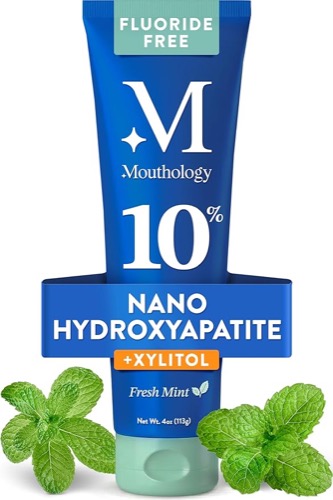
Mouthology 10% Nano-Hydroxyapatite Toothpaste
Best for: The nHAp side: one of the few pastes that discloses a full 10% concentration on its listing
- Discloses 10% nano-hydroxyapatite, the concentration threshold the community treats as the efficacy floor
- Specifies rod-shaped particles, the shape the EU opinions treat as acceptable
- Fluoride-free with xylitol as a non-cariogenic sweetener
- +Listing transparency on the two specs buyers usually can't verify: concentration and particle shape
- +Around $10 for a 4 oz tube at our last price check, below the $12-29 users report paying for nHAp pastes
- −About two and a half times the per-ounce cost of the fluoride pick
- −The broader nano-particle safety discussion remains unresolved as of mid-2026
(Affiliate link) · Free shipping on eligible Prime items
FAQ
Is hydroxyapatite as effective as fluoride for cavity prevention?
In the only two head-to-head randomized trials, 10% hydroxyapatite was non-inferior to fluoride at preventing new cavities—but both trials were funded by a hydroxyapatite manufacturer, neither reports testing the nano form most US products use, and only the children’s trial enrolled cavity-prone participants. Professional consensus remains that fluoride has far deeper evidence, especially for higher-risk mouths.
What concentration of hydroxyapatite actually works?
The supportive trials used 10%, and community consensus treats 10% as the efficacy threshold. Many brands include hydroxyapatite low on the ingredient list without disclosing a percentage; there’s no way to know whether such a product resembles what was tested. If the label won’t state a number, treat that as your answer.
Is nano-hydroxyapatite safe to swallow?
Toothpaste isn’t meant to be swallowed regardless of ingredient. The nano-specific question—whether nano-scale particles behave differently in the body—has been the subject of EU consumer-safety opinions that restrict which particle shapes are considered acceptable. As of mid-2026 the discussion remains active; supervising young children is sensible with any toothpaste.
Why is hydroxyapatite toothpaste popular in Japan but not the US?
Hydroxyapatite pastes have been sold in Japan since the 1980s, so the ingredient has a long consumer track record there. In the US, fluoride is the established anti-cavity active with institutional support, regulatory pathways differ, and most nHAp brands market to fluoride-skeptical buyers rather than the mainstream—which keeps the ingredient niche despite its history elsewhere.
Is hydroxyapatite worth the extra cost?
At roughly two and a half times the per-ounce price of a mainstream fluoride paste, it’s only worth it if it solves a problem fluoride wasn’t solving for you—most plausibly sensitivity—or if you’ve firmly decided against fluoride and want the best-evidenced alternative. Several users in our research switched back on cost alone; a toothpaste only works if you keep buying it.