Best Toothpaste for Sensitive Teeth in 2026: Research-Backed Picks for Daily Relief
That sharp, sudden zing when you sip your morning coffee or bite into a cold scoop of ice cream: if you know, you know. Tooth sensitivity affects an estimated 1 in 8 adults, and the good news is that the right toothpaste can make a real difference. According to the American Dental Association, desensitizing toothpastes contain compounds that help block the transmission of sensation from the tooth surface to the nerve. Pairing your toothpaste with a compatible rinse also matters: our guide to the best mouthwash for sensitive teeth covers the top alcohol-free, fluoride-based options. This roundup is about relief first: every pick is judged on how well it calms the nerve, not on how much it brightens. If a whiter smile is the reason you’re shopping and sensitivity is only the obstacle, start with our best whitening toothpaste for sensitive teeth roundup instead.
We’ve dug through the dental research, cross-referenced dentist recommendations, and surveyed the most consistently praised products on the market to bring you this curated list. Whether you’re dealing with mild occasional sensitivity or near-constant discomfort, there’s an option here for you.
How We Evaluated
We didn’t pull these picks out of thin air. We consulted publicly available dentist recommendations, cross-referenced products against the ADA Seal of Acceptance database, and reviewed ingredient lists with an eye toward evidence-backed active ingredients. We also factored in:
- Active ingredient quality: Does it contain a clinically recognized desensitizing agent?
- Fluoride content: According to the ADA, fluoride is safe and effective for preventing tooth decay, and it remineralizes enamel into a more acid-resistant form.
- Texture and taste: A toothpaste you hate using is one you won’t use.
- Value: Sensitivity toothpaste shouldn’t require a second mortgage.
- Special needs: Whitening, natural formulas, flavor sensitivity, and more.
Our Top Picks
Sensodyne Pronamel Gentle Whitening
Sensodyne Pronamel Gentle Whitening
Best for: People with ongoing, daily sensitivity who also want some whitening benefit without aggravating their teeth further
- Potassium nitrate (5%) as the active desensitizing agent
- Strengthens enamel weakened by acidic foods and drinks
- Whitening Haleon says removes stains gently, from a line it calls low-abrasion
- SLS-free formulation, which suits people who react to sodium lauryl sulfate
- +Potassium nitrate calms nerve signals, with relief that builds over consistent use
- +Fluoride system actively hardens and protects enamel against acid erosion
- +Whitening Haleon says removes stains gently, from a line it calls low-abrasion
- −Relief is cumulative, so no overnight results
- −Highest sticker price on this list (it's a 4-pack), with a moderate mint flavor some find underwhelming
(Affiliate link) · Free shipping on eligible Prime items
Why we recommend it: Sensodyne Pronamel is consistently the name dentists reach for first when a patient mentions sensitivity. This formula combines potassium nitrate to calm nerve signals with a fluoride system designed to actively harden and protect enamel against acid erosion. The ADA notes that twice-daily use of a self-applied potassium formula can be recommended to reduce dentin hypersensitivity pain; potassium nitrate works by damping the excitability of dental nerve fibers over time, meaning relief that builds with consistent use. Sensodyne sells several other Pronamel formulas beyond this one, and our Sensodyne toothpaste guide breaks down which variant fits which need.
Key features:
- Potassium nitrate (5%) as the active desensitizing agent
- Strengthens enamel weakened by acidic foods and drinks
- Whitening Haleon says removes stains gently, from a line it calls low-abrasion
- SLS-free formulation, which suits people who react to sodium lauryl sulfate
Best for: People with ongoing, daily sensitivity who also want some whitening benefit without aggravating their teeth further.
Potential downsides: Relief is cumulative: don’t expect overnight results. The mint flavor is moderate, which some users find underwhelming. The linked listing is a 4-pack of 4 oz tubes at about $23 upfront, the highest sticker price on this list, though that works out to under $6 a tube.
(Affiliate link) · Free shipping on eligible Prime items
Crest Pro-Health Advanced Sensitive Relief
Crest Pro-Health Advanced Sensitive Relief
Best for: People who want an all-in-one formula and prefer not to juggle multiple specialty toothpastes
- Stannous fluoride (0.454%) as the active ingredient
- Multi-benefit formula addresses sensitivity, cavities, and gum health simultaneously
- Forms a protective layer over exposed dentin tubules, which can act faster than potassium nitrate
- Available in enamel repair variants
- +Stannous fluoride can provide more immediate relief than potassium nitrate for some users
- +All-in-one formula also protects against gingivitis and cavities
- +Affordable at around $5
- −Stannous fluoride can occasionally cause temporary tooth staining
- −Taste is slightly metallic for some
(Affiliate link) · Free shipping on eligible Prime items
Why we recommend it: If you want faster-acting relief, stannous fluoride—the active ingredient in this Crest formula—is worth knowing about. The ADA lists twice-daily self-applied stannous formulas among the options for reducing dentin hypersensitivity pain; stannous fluoride does that by forming a protective layer over exposed dentin tubules, which can bring more immediate relief than potassium nitrate for some users. It also pulls double duty by protecting against gingivitis and cavities, all at around $5 as of this writing.
Key features:
- Stannous fluoride (0.454%) as the active ingredient
- Multi-benefit formula addresses sensitivity, cavities, and gum health simultaneously
- Forms a protective layer over exposed dentin tubules, which can act faster than potassium nitrate
- Available in enamel repair variants
Best for: People who want an all-in-one formula and prefer not to juggle multiple specialty toothpastes.
Potential downsides: Stannous fluoride can occasionally cause temporary tooth staining in some users, especially if oral hygiene isn’t consistent. The taste is slightly metallic for some.
(Affiliate link) · Free shipping on eligible Prime items
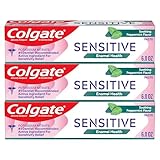
Colgate Sensitive Enamel Health
Colgate Sensitive Enamel Health
Best for: Budget-conscious shoppers, or anyone who wants a reliable, no-frills sensitive formula they can find anywhere
- 5% potassium nitrate, the strength Colgate says most sensitivity toothpastes carry
- Fluoride for cavity protection
- Whitening variant available
- Widely available at drugstores and online
- +5% potassium nitrate, which the label calls the #1 dentist-recommended active ingredient for sensitivity relief
- +Budget-friendly at around $15
- +Widely available at drugstores and online
- −The whitening version adds no extra sensitivity relief: the Colgate Sensitive Whitening label lists the same 5% potassium nitrate and 0.24% sodium fluoride as this tube, and like most whitening pastes (per the ADA) it lifts stains mainly with abrasives
- −Some users prefer a stronger flavor profile
(Affiliate link) · Free shipping on eligible Prime items
Why we recommend it: Colgate’s sensitive line has earned its reputation as a go-to budget-friendly option. With 5% potassium nitrate, the same desensitizing active and strength as the pricier Pronamel pick, it costs around $15 as of this writing for the 3-pack, a price point that won’t sting your wallet as much as it used to sting your teeth. The ADA’s toothpaste guidance cites a review recommending twice-daily self-applied potassium formulas for reducing dentin hypersensitivity pain.
Key features:
- 5% potassium nitrate, the strength Colgate says most sensitivity toothpastes carry
- Fluoride for cavity protection
- Whitening variant available
- Widely available at drugstores and online
Best for: Budget-conscious shoppers, or anyone who wants a reliable, no-frills sensitive formula they can find anywhere.
Potential downsides: Colgate also sells whitening versions of this sensitive line. Like most whitening toothpastes they lift surface stains mainly with abrasives, per the ADA, and the Colgate Sensitive Whitening label carries the same 5% potassium nitrate and 0.24% sodium fluoride as this tube, so choose between them on whitening, not on sensitivity strength. Some users prefer a stronger flavor profile.
(Affiliate link) · Free shipping on eligible Prime items
Sensodyne Clinical Repair Whiten & Shine
Sensodyne Clinical Repair Whiten & Shine
Best for: People who've given up on whitening toothpastes because of discomfort: specifically engineered for that frustrating situation
- Combines sensitivity relief with brightening action
- Sensodyne says it starts to repair sensitive areas of teeth after 60 seconds
- Fluoride-based enamel protection
- Stannous fluoride (0.454%) listed as the active on its Drug Facts label
- +Engineered to brighten teeth while addressing sensitivity, for people who can't normally tolerate whitening pastes
- +Sensodyne says it starts to repair sensitive areas of teeth after 60 seconds
- +Stannous fluoride (0.454%) listed as the active on its Drug Facts label
- +Sensodyne says it is clinically proven to provide long-lasting sensitivity relief
- −A single 2.3 oz tube at around $7 works out to about $3 an ounce, more per ounce than the multipacks on this list
(Affiliate link) · Free shipping on eligible Prime items
Why we recommend it: For those who’ve been told they simply can’t use whitening toothpaste due to sensitivity, this formula is worth a closer look. Sensodyne says it starts to repair sensitive areas after 60 seconds and describes its whitening as stain removal that is gentle on sensitive teeth. It’s one of the more sophisticated formulations on the market for people who feel like they have to choose between a whiter smile and a comfortable one, and it sells for around $7 as of this writing.
Key features:
- Combines sensitivity relief with brightening action
- Sensodyne says it starts to repair sensitive areas of teeth after 60 seconds
- Fluoride-based enamel protection
- Stannous fluoride (0.454%) listed as the active on its Drug Facts label
- Sensodyne says it is clinically proven to provide long-lasting sensitivity relief
Best for: People who’ve given up on whitening toothpastes because of discomfort: this one is specifically engineered for that frustrating situation.
Potential downsides: It comes as a single 2.3 oz tube at around $7, which works out to about $3 an ounce, more per ounce than the multipacks on this list.
(Affiliate link) · Free shipping on eligible Prime items
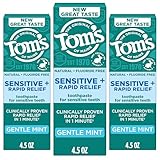
Tom’s of Maine Rapid Relief Sensitive Toothpaste (3-Pack)
Tom's of Maine Rapid Relief Sensitive Toothpaste (3-Pack)
Best for: Health-conscious consumers who want a more natural ingredient profile without sacrificing clinical credibility
- Arginine as the active ingredient, which Tom's lists as arginine bicarbonate derived from sugar cane
- Calcium carbonate, which Tom's lists as a mild, mineral-derived abrasive and pairs with arginine to seal open nerve channels
- No artificial preservatives, sweeteners, or dyes
- Fluoride-free: arginine, not fluoride, is the active ingredient
- +Arginine physically occludes exposed dentin tubules, a mechanism that works differently from potassium nitrate
- +Cleaner label with no artificial preservatives, sweeteners, or dyes
- +Fluoride-free formula for people who want arginine, not fluoride, doing the work
- −Arginine-based formulas may take time to build up tubule occlusion, and results can vary
- −Texture is slightly grittier than conventional toothpastes, and it runs around $15
(Affiliate link) · Free shipping on eligible Prime items
Why we recommend it: For shoppers who prefer cleaner-label products, Tom’s of Maine offers an effective formula using arginine and calcium carbonate, a mechanism that works differently from potassium nitrate. Arginine may help with sensitivity by physically occluding exposed dentin tubules, essentially plugging the pathways that allow pain signals to reach the nerve. Several other Tom’s of Maine toothpastes carry the ADA Seal of Acceptance, including Whiten+ Deep Clean Anticavity Toothpaste, but we found no ADA Seal of Acceptance listing for Rapid Relief Sensitive: judge it on its arginine formula rather than on a seal.
Key features:
- Arginine as the active ingredient, which Tom’s lists as arginine bicarbonate derived from sugar cane
- Calcium carbonate, which Tom’s lists as a mild, mineral-derived abrasive and pairs with arginine to seal open nerve channels
- No artificial preservatives, sweeteners, or dyes
- Fluoride-free: arginine, not fluoride, is the active ingredient
- Available in multiple flavors
Best for: Health-conscious consumers who want a more natural ingredient profile without sacrificing clinical credibility.
Potential downsides: Arginine-based formulas may take a bit of time to build up occlusion of dentin tubules, and results can vary. The texture is slightly grittier than conventional toothpastes, and it runs around $15 for the 3-pack.
(Affiliate link) · Free shipping on eligible Prime items
Buyer’s Guide: What to Look For
Active Desensitizing Ingredients
The ADA’s toothpaste guidance cites a review that recommends twice-daily self-applied stannous, potassium, or arginine formulas for reducing sensitivity pain:
- Potassium nitrate (5%): Works by calming the nerve inside the tooth over time with regular use.
- Stannous fluoride (0.454%): May help with sensitivity by physically blocking exposed dentin tubules and tends to act more quickly for some users.
- Arginine: A newer, naturally derived option that physically occludes the tubules. Found in Tom’s of Maine and some Colgate formulas.
ADA Seal of Acceptance
Always look for the ADA Seal on any toothpaste making efficacy claims. According to the ADA, this seal indicates the product has been independently evaluated for safety and effectiveness.
Fluoride Content
Sensitivity toothpaste should still contain fluoride unless you have a specific reason to avoid it. The American Dental Association calls fluoride safe and effective for preventing tooth decay in children and adults, recommends brushing with a fluoride toothpaste, and notes that fluoride remineralizes enamel into a more acid-resistant form.
Abrasivity (RDA Score)
Relative Dentin Abrasivity (RDA) is a lab score for how abrasive a toothpaste is, and it is not a Drug Facts field, so you will not find it on the label. The ADA treats any toothpaste with an RDA of 250 or below as safe and effective, requires that of every toothpaste carrying its Seal of Acceptance, and says RDA numbers under 250 should not be used to rank one toothpaste as safer than another, because those differences don’t translate into measurable wear on enamel. Where a maker describes a paste’s abrasivity in words, as Haleon does for Pronamel, we say so on the card.
Whitening Toothpastes and Sensitivity
It’s a common dilemma: you want whiter teeth, but whitening toothpastes often increase sensitivity. Look for formulas specifically labeled as both whitening and sensitivity-safe, like the Sensodyne Pronamel Gentle Whitening or the Crest Pro-Health line. If sensitivity relief isn’t your only priority, our broader best toothpaste roundup compares picks across whitening, gum health, and cavity protection too.
In our reading of ~193 Reddit threads across 16 sensitivity topics, wanting a dentist's endorsement before trusting a product was the corpus's most-repeated concern — ahead of price or ingredients.
FAQ
Q: How long does it take for sensitive toothpaste to work?
A: Most dentists recommend giving a sensitivity toothpaste at least two to four weeks of consistent, twice-daily use before evaluating results. Potassium nitrate-based formulas work cumulatively: the more consistently you use them, the more relief you may notice over time. Stannous fluoride formulas tend to provide somewhat faster relief for some users.
Q: Can I use sensitive toothpaste every day?
A: Yes—in fact, consistent daily use is how these toothpastes work best. The ADA’s MouthHealthy guide to sensitive teeth notes that desensitizing toothpaste usually needs several applications before sensitivity is reduced, which is why it is used as your everyday toothpaste. There’s no benefit to rotating between a regular toothpaste and a sensitive formula.
Q: Why are my teeth sensitive in the first place?
A: Sensitivity typically occurs when dentin—the layer beneath enamel—becomes exposed. This can happen due to enamel erosion from acidic foods and drinks, gum recession that exposes root surfaces, aggressive brushing habits, teeth grinding, or cavities. The ADA lists tooth decay, fractured teeth, worn fillings and gum disease among the possible causes of sensitivity, which is why persistent sensitivity is worth a dentist’s look: toothpaste alone can’t address those. If gum recession is contributing to your sensitivity, see our guide on how to fix receding gums and our picks for the best toothpaste for gum recession. And if grinding is the culprit, a toothpaste alone won’t stop the wear: our picks for the best night guard for teeth grinding address the cause directly.
Q: Are natural sensitive toothpastes as effective as traditional ones?
A: It depends on the formula. Natural toothpastes that carry the ADA Seal of Acceptance (like Tom’s of Maine Whiten+ Deep Clean Anticavity Toothpaste) have met independent efficacy standards. However, not all “natural” toothpastes carry that seal, so it’s worth checking. The active ingredient is what matters most, regardless of how the rest of the formula is composed.
Q: Can children use sensitive toothpaste?
A: Some sensitive toothpastes are appropriate for children, but it’s worth checking the age recommendations on the packaging and consulting a pediatric dentist. Fluoride amounts and certain active ingredients may vary for different age groups. According to the ADA, children under 3 should use a smear of fluoride toothpaste about the size of a grain of rice, and children aged 3 to 6 a pea-sized amount, with an adult supervising.
Q: Should I stop using whitening products if I have sensitive teeth?
A: Not necessarily. Some whitening toothpastes are specifically formulated for sensitive teeth, and using a sensitivity formula regularly may actually make whitening treatments more tolerable over time. If you want to explore at-home whitening options that work for reactive teeth, our guide to the best at-home teeth whitening kits covers the gentlest approaches available. That said, if you’re using whitening trays or strips alongside your toothpaste, see our picks for the best whitening strips for sensitive teeth, and discuss the combination with your dentist to find an approach that doesn’t overload your teeth.
Q: How is this different from your whitening toothpaste for sensitive teeth guide?
A: This page ranks toothpastes on sensitivity relief: which active ingredient they use, at what concentration, and how quickly it works. Our best whitening toothpaste for sensitive teeth roundup ranks on stain removal instead, with sensitivity protection as the requirement each pick has to meet. If pain is your main problem, stay here. If the color of your teeth is, go there.
Our Methodology
At Dental Roundup, we take a research-first approach to all our product evaluations. For this roundup, we:
- Reviewed publicly available clinical and dental literature on active desensitizing ingredients, cross-referencing findings with ADA guidelines and position statements.
- Consulted multiple third-party recommendation roundups from sources including Health.com, NBC Select, Everyday Health, and New York Magazine’s Strategist to identify patterns in dentist recommendations.
- Verified ADA Seal status for each product included in the final list, prioritizing products that have met independent efficacy and safety standards.
- Evaluated ingredient lists for each product, with attention to active desensitizing agents, fluoride levels, and abrasivity considerations.
- Assessed user accessibility including price range, availability, flavor options, and special formulation needs (natural, whitening, SLS-free).
We do not accept payment from brands in exchange for inclusion or favorable coverage. Some links in this article are affiliate links, meaning we may earn a small commission if you purchase through them, at no additional cost to you. This never influences our editorial recommendations. Our only agenda is helping you find a toothpaste that actually works for your teeth.
As always, if you’re experiencing severe or sudden tooth sensitivity, we recommend scheduling a visit with your dentist. Sometimes sensitivity signals something a toothpaste alone can’t fix, and catching it early makes all the difference.