
Enamel erosion is different from cavities, and the toothpaste you need is different too. Cavities are caused by bacteria; erosion is caused by acid: from citrus fruits, carbonated drinks, wine, GERD, or vomiting. Once enamel dissolves, it doesn’t grow back. But the right toothpaste can help slow erosion by strengthening what’s left and reducing how long your teeth sit in an acidic environment. The two factors most people overlook: abrasivity (measured by RDA) and pH. The ADA’s erosion guidance pairs a soft brush with a low-abrasion fluoride toothpaste, yet most of the big brands on this page don’t give a clear abrasivity figure for their US pastes. We focused on acid-protective fluoride formulas and checked what each maker actually publishes about abrasivity. If you’re looking for toothpastes that actively rebuild lost enamel, see our enamel repair toothpaste guide; this page focuses on preventing further loss.
How We Evaluated Toothpastes for Enamel Erosion
We focused on four criteria specific to acid erosion:
- Relative Dentin Abrasivity (RDA): The ADA treats any toothpaste at or under RDA 250 as safe and says numbers below that shouldn’t be used to rank one paste as safer than another. Its erosion guidance still pairs a soft brush with a low-abrasion fluoride paste, so we noted what each maker publishes rather than ranking picks by a number that Haleon and Colgate don’t give for their US pastes and that Arm & Hammer’s own pages don’t agree on.
- Fluoride type: Both types help. Conventional fluorides leave a calcium fluoride layer on enamel, while tin-containing products leave metal-rich surface precipitates that a 2011 review considers possibly the best approach to preventing erosion, so we note which paste carries stannous fluoride.
- pH management: A paste that buffers acid rather than adding to it is the idea here. A baking soda paste raised plaque pH around brushing in intraoral tests, and CariFree describes its gel as pH-supporting, though neither maker publishes a pH figure for the tube.
- Complementary ingredients: Nano-hydroxyapatite, xylitol, and potassium nitrate address the downstream effects of erosion: sensitivity, mineral loss, and cavity risk.
Curious what dental communities actually say? Our community research analysis covers 1,486 Reddit threads across 209 subreddits, including the sensitivity pastes this page leans on.
Evidence Receipt
- Brushing softened enamel without fluoride makes erosion worse. In a five-subject in situ crossover study, brushing eroded enamel with a fluoride-free paste raised enamel loss from about 45 to 79 micrometers, while brushing with a fluoride paste held loss at roughly the acid-only level and a two-hour wait protected nothing.
- A 2011 review leans toward tin-containing fluoride against acid. A 2011 review of fluoride in dental erosion finds that conventional fluorides leave a calcium fluoride layer while tin-containing products leave metal-rich surface precipitates, and concludes they might provide the best approach for preventing erosion.
- The ADA’s erosion advice is a soft brush and a low-abrasion fluoride paste. Its dental erosion topic page tells patients to rinse with water rather than brush right after acidic drinks, to rinse with water, a sodium bicarbonate rinse or milk after vomiting, and treats normal brushing with a soft brush and a low-abrasion fluoride toothpaste as unlikely to cause erosive wear.
- RDA is a safety ceiling, not a ranking. The ADA’s toothpastes page considers any toothpaste at or under RDA 250 safe and effective, and says values below 250 cannot be used to rank the safety of toothpastes.
- The 5.5 “critical pH” is not a fixed number. Enamel’s dissolution threshold rises or falls with the calcium and phosphate in the fluid around the tooth, which is why saliva composition matters too.
- Baking soda pastes measurably buffer plaque acid. In Colgate-Palmolive’s intraoral work, a bicarbonate/fluoride dentifrice raised resting plaque pH and left less measurable plaque acid than a fluoride-only paste after a glucose challenge.
- Label facts on this page come from DailyMed. Pronamel Daily Protection (potassium nitrate 5%, sodium fluoride 0.25%, no SLS), Repair & Protect Whitening (stannous fluoride 0.454%), Colgate Sensitive Enamel Health (potassium nitrate 5%, sodium fluoride 0.24%) and Arm & Hammer Sensitive Teeth & Gums (potassium nitrate 5%, sodium fluoride 0.24%, labeled low abrasion); CariFree Gel 1100 is not on DailyMed, so its facts come from its own ingredient page.
Sensodyne Pronamel Daily Protection
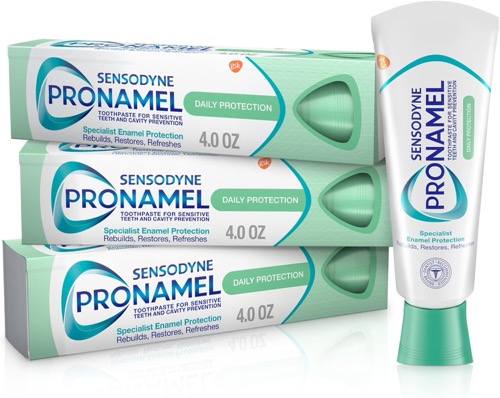
Sensodyne Pronamel Daily Protection (Mint Essence, 3-pack of 4 oz tubes)
Best for: Anyone with acid erosion from diet or reflux: an optimized-fluoride formula Haleon built for acid-weakened enamel and describes as low-abrasion
- Haleon describes it as a low-abrasion formula
- Sodium fluoride formula Haleon says is optimized for acid-weakened enamel
- Haleon markets it as the #1 dentist-recommended brand for strengthening and protecting enamel
- Potassium nitrate 5% plus sodium fluoride 0.25% on the US label
- Mint Essence flavor
- +Low-abrasion formula, in Haleon's description, for brushing acid-weakened enamel
- +Sodium fluoride formula Haleon says is optimized for acid-weakened enamel
- +SLS-free per its DailyMed inactive list (it foams with cocamidopropyl betaine instead)
- −Uses sodium fluoride rather than the tin-containing fluoride the erosion review leans toward
- −Protection claims only: Haleon markets Intensive Enamel Repair, not this tube, for enamel that is already weakened
(Affiliate link) · Free shipping on eligible Prime items
Why We Recommend It
Haleon positions Pronamel around acid erosion. While most toothpastes are marketed around cavities (a bacterial problem), Pronamel is the line Haleon built for enamel weakened by acid exposure; its US label lists sensitivity and cavity protection as the uses. Haleon describes Pronamel as a low-abrasion formula but gives no abrasivity figure for the US paste on its US product pages or label, and the ADA treats any toothpaste at or under 250 on its abrasivity scale as safe. Gentle cleaning still matters with erosion, because brushing acid-softened enamel can add to the loss.
The US Drug Facts list two actives, potassium nitrate 5% for sensitivity and sodium fluoride 0.25% for cavities, and the Daily Protection inactive list carries no sodium lauryl sulfate, which is where its SLS-free claim comes from. Haleon says the fluoride is delivered in a formula built for acid-damaged surfaces, with minerals penetrating the enamel surface to re-harden it each time you brush; that is the maker’s description of the mechanism, not a clinical finding. For people with GERD, frequent citrus consumption, or other acid exposure, this daily protection approach is more practical than trying to avoid all acid contact. Haleon also markets Pronamel as the #1 dentist-recommended brand for strengthening and protecting enamel; that ranking is the maker’s own claim, not a clinical guideline.
Key Features
- Low-abrasion formula, in Haleon’s description
- Sodium fluoride formula Haleon says is optimized for acid-weakened enamel
- SLS-free per the DailyMed inactive list, which names cocamidopropyl betaine as the foaming agent instead
- Potassium nitrate 5% plus sodium fluoride 0.25% on the US label
- Available in most pharmacies and grocery stores
Who It’s Best For
Anyone whose dentist has identified early enamel erosion, people with GERD or acid reflux, frequent consumers of citrus/wine/carbonated beverages, and anyone who wants a daily toothpaste built around acid wear. This is the “do no harm while doing good” option: a fluoride paste its maker designed for acid-weakened enamel and describes as low-abrasion.
Potential Downsides
Amazon currently sells this paste as a 3-pack of 4 oz tubes (around $17), which is the listing we link; the single-tube listing we first recommended went unavailable in September 2026. The 3-pack carries more than 11,000 reviews. It uses sodium fluoride rather than stannous fluoride, so it doesn’t leave the tin-rich surface deposits the erosion review credits to Sensodyne Repair & Protect. If you want active repair of already-damaged enamel rather than just protection, consider the Repair & Protect or see our enamel repair toothpaste guide.
(Affiliate link) · Free shipping on eligible Prime items
Sensodyne Repair & Protect Whitening
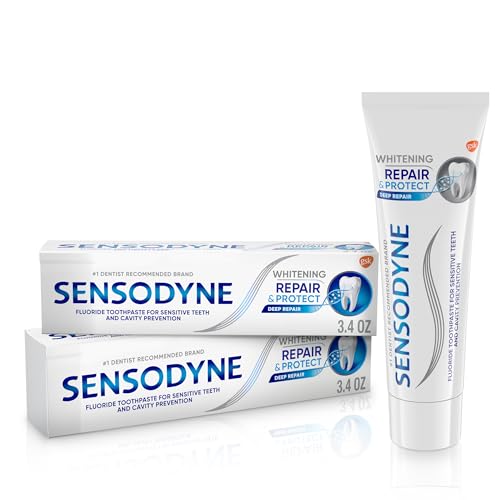
Sensodyne Repair & Protect Whitening (2-Pack, 3.4 oz each)
Best for: People who want the tin-containing fluoride a 2011 erosion review calls possibly the best approach against acid, in a paste Haleon says builds a repairing layer over sensitive areas
- Stannous fluoride 0.454%, the tin-containing type a 2011 erosion review leans toward
- Haleon says its stannous fluoride builds a repairing layer over vulnerable areas
- Whitening action alongside the stannous fluoride
- No peroxide among the whitening ingredients on its label
- 47,000+ reviews — the most-reviewed product on this page
- +Tin-containing fluoride, which a 2011 erosion review suggests might protect best against acid
- +Haleon says its stannous fluoride builds a repairing layer over sensitive areas
- +Adds whitening action to the stannous fluoride formula
- −Stannous fluoride can cause cosmetic surface staining between cleanings
- −No abrasivity figure on Haleon's US product pages or label, and the US formula lacks NovaMin
(Affiliate link) · Free shipping on eligible Prime items
Why We Recommend It
Stannous fluoride is the key differentiator here. While all fluoride toothpastes help with remineralization, stannous fluoride leaves a tin-rich surface precipitate on enamel rather than the calcium fluoride layer sodium fluoride forms, and the 2011 review that describes those deposits suggests tin-containing products might be the best approach to preventing erosion, while asking for more clinical work to size the difference. For erosion patients (people whose primary threat is acid, not bacteria), that is the reason to pick this tube over a sodium fluoride paste.
The “Repair & Protect” name is Haleon’s: it says the stannous fluoride builds a repairing layer over sensitive areas where enamel has thinned, and the tin deposits described above are the protect half. Lost enamel itself does not grow back, as the FAQ below explains. At 47,000+ reviews with a 4.8 rating, the real-world feedback is extensive and overwhelmingly positive. The two-pack runs around $13, roughly $6.70 per 3.4 oz tube. Its US label lists stannous fluoride 0.454% as the only active, and hydrated silica and pentasodium triphosphate but no peroxide among the whitening ingredients, so the whitening isn’t peroxide bleaching. Haleon gives no abrasivity figure for this whitening version on its US product pages or label, so we picked it for the stannous fluoride, not for how gently it cleans.
Key Features
- Stannous fluoride, the tin-containing type the erosion review leans toward
- A repairing layer over sensitive areas, in Haleon’s description
- Whitening action alongside the stannous fluoride
- 2-pack for extended supply
- NovaMin-free US formula (uses stannous fluoride instead)
Who It’s Best For
People with active acid erosion who want both protection and repair in one product. Particularly good for GERD patients, people recovering from eating disorders, or anyone whose dentist has flagged both erosion and sensitivity. If you’re choosing between this and Pronamel, this is the stannous option: a sensitivity paste with the tin-containing fluoride that the erosion research above calls possibly the best approach against acid; Pronamel is the sodium fluoride paste built around acid wear.
Potential Downsides
Stannous fluoride can cause surface staining on teeth, a brownish discoloration that’s cosmetic, not structural. It’s removable at dental cleanings but can be frustrating between visits. Haleon gives no abrasivity figure for the US formula on its product pages or label, so there’s no sourced way to compare it with Pronamel on that score. The US formula lacks NovaMin (bioactive glass), which is available in the UK version; US buyers don’t get the most advanced version of this product. The Whitening version’s inactive list also includes sodium lauryl sulfate, so of the two Sensodynes here only Pronamel is SLS-free.
(Affiliate link) · Free shipping on eligible Prime items
CariFree Gel 1100
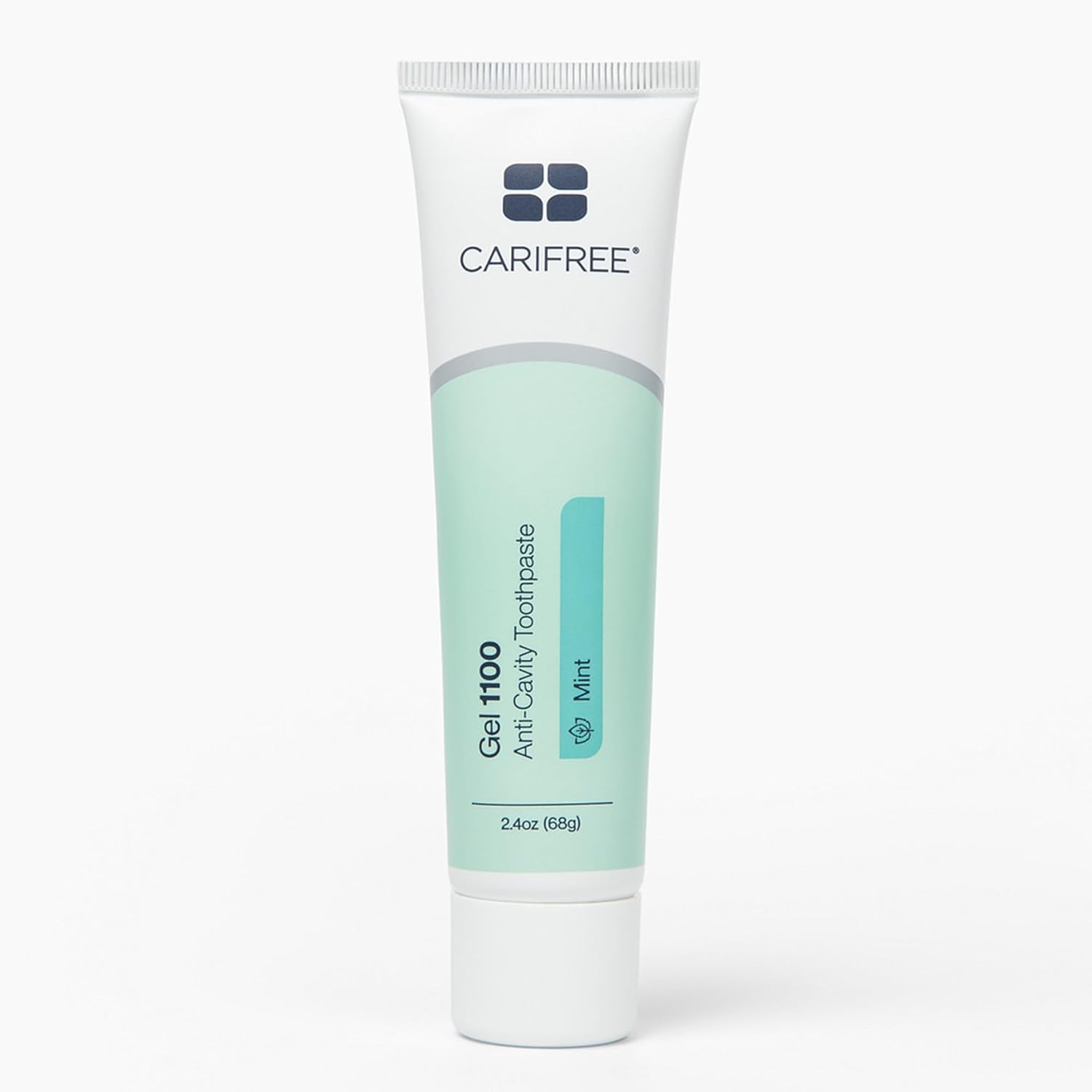
CariFree Gel 1100 (Mint, 2.4 oz)
Best for: High-risk patients with active erosion and cavities: a pH-support formula CariFree says leaves the mouth less acidic after brushing, while nano-hydroxyapatite and fluoride supply mineral
- pH-support formula CariFree says helps the mouth stay less acidic after brushing
- Nano-hydroxyapatite (nHAp) delivers minerals directly to enamel
- 1100 ppm fluoride for remineralization
- 25% xylitol, which CariFree says supports a tooth-friendly oral environment
- Published RDA of 40, the only abrasivity figure on this page its maker publishes as a single number
- +pH-support formula that CariFree says helps the mouth stay less acidic after brushing
- +Dual remineralization from nano-hydroxyapatite plus 1100 ppm fluoride
- +25% xylitol, which CariFree says supports a tooth-friendly oral environment
- −Most expensive per ounce on this page, in a small tube that needs frequent repurchasing
- −Contains SLS, and CariFree does not publish how much nano-hydroxyapatite is in the tube
(Affiliate link) · Free shipping on eligible Prime items
Why We Recommend It
CariFree takes a different approach: alongside strengthening enamel against acid, it goes after the acid itself. CariFree calls this its pH-support technology, which it says is designed to help the mouth stay at a healthier pH after brushing; the company publishes no pH figure for the gel. The idea is that your enamel spends less time below the pH at which mineral starts leaving the surface. That threshold gets quoted as 5.5, but it is not a fixed number: it shifts with the calcium and phosphate concentrations in the fluid around the tooth, so saliva richer in those ions lets enamel hold out at a lower pH. On top of that, it delivers nano-hydroxyapatite (the actual mineral your enamel is made of) plus sodium fluoride 0.24%, or 1100 ppm, for a dual remineralization approach. What CariFree does not say is how much nano-hydroxyapatite the gel contains: hydroxyapatite sits in its “other ingredients” list with no percentage, so the mineral half of the formula can’t be sized against the 10% pastes on our hydroxyapatite toothpaste page. The company was founded in 2004 by a dentist, Dr. V. Kim Kutsch, and CariFree’s site says its products were created by a dentist for his cavity-prone patients.
The 25% xylitol is another layer: CariFree says it supports a tooth-friendly oral environment, which is a cavity-side claim rather than an erosion one, since erosion is acid arriving from outside the mouth, but the two problems travel together in high-risk patients. This multi-pronged approach (pH support + mineral delivery + xylitol) gives it the widest mix of approaches on this page, though at a higher price point. Pairs well with a dedicated dry mouth toothpaste if reduced saliva is contributing to your erosion.
Key Features
- pH-support formula, in CariFree’s description, for a less acidic mouth after brushing
- Dual remineralization: nano-hydroxyapatite + 1100 ppm fluoride
- 25% xylitol, which CariFree says supports a tooth-friendly oral environment
- Published RDA of 40, the only abrasivity figure on this page its maker publishes as a single number
- Small 2.4 oz tube; contains SLS
Who It’s Best For
Patients whose dentist has flagged them as high-risk for both erosion and cavities. Particularly valuable for people with dry mouth (reduced saliva means less natural pH buffering), GERD patients, and anyone with a history of rapid cavity development alongside erosion. This is the “heavy artillery” option, sold through CariFree’s own store, dentists that carry it, and Amazon.
Potential Downsides
At around $18 for a 2.4 oz tube (about $7.50 per ounce), it’s significantly more expensive per ounce than the other options on this page. The small tube size means frequent repurchasing. CariFree sells it through its own store and a dentist finder, and it is on Amazon; the company lists no drugstore chains. Its ingredient list also includes sodium lauryl sulfate, the foaming agent Pronamel leaves out, so it is not the pick if SLS irritates your mouth. At 1100 ppm fluoride, it’s lower concentration than prescription-strength toothpastes (5000 ppm), which your dentist may recommend if erosion is severe.
(Affiliate link) · Free shipping on eligible Prime items
Colgate Sensitive Enamel Health
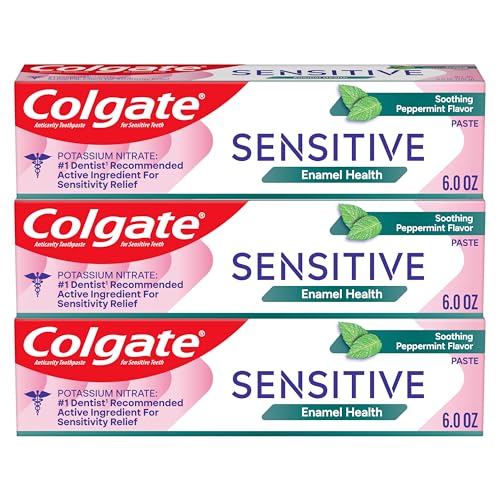
Colgate Sensitive Enamel Health (3-Pack, 6 oz each)
Best for: Budget-conscious buyers who need both sensitivity relief and enamel protection: 5% potassium nitrate with fluoride in an 18 oz three-pack
- 5% potassium nitrate on the US label, matching Pronamel and Arm & Hammer
- Sodium fluoride for enamel remineralization and protection
- 3-pack (18 oz total) for the best per-ounce value
- Addresses the sensitivity that accompanies erosion
- Soothing peppermint flavor
- +5% potassium nitrate for erosion-related sensitivity, the same strength as Pronamel and Arm & Hammer
- +Sodium fluoride for enamel remineralization and protection
- +3-pack delivers the most affordable per-ounce price on the page
- −Sodium fluoride rather than the tin-containing fluoride the erosion review leans toward
- −Contains SLS, and we found no abrasivity figure from Colgate for it
(Affiliate link) · Free shipping on eligible Prime items
Why We Recommend It
Enamel erosion and sensitivity go hand in hand: as enamel thins, the dentin underneath becomes exposed, and dentin contains microscopic tubules that transmit temperature and pressure directly to the nerve. Colgate Sensitive Enamel Health addresses both problems: the 5% potassium nitrate, the same strength Pronamel and Arm & Hammer list, is there for what the label calls increasing protection against sensitivity to cold, heat, acids, sweets or contact, while the fluoride works on the remaining enamel.
The 3-pack pricing (around $15 for 18 ounces total, well under $1 per ounce) makes it narrowly the most affordable per-ounce option on this page, just ahead of Arm & Hammer’s two-pack. For people managing erosion long-term (which is essentially everyone with erosion, since it’s a chronic condition), cost sustainability matters. This isn’t the most specialized formula, but it covers the two most important bases (sensitivity relief + fluoride protection) at a price point that doesn’t discourage consistent use. For complementary approaches to sensitivity, see our sensitive teeth toothpaste guide.
Key Features
- 5% potassium nitrate, the same strength as Pronamel and Arm & Hammer
- Sodium fluoride for enamel protection
- 3-pack with 6 oz tubes (18 oz total)
- Most affordable per-ounce on this page
- Widely available at pharmacies and grocery stores
Who It’s Best For
Budget-conscious people whose primary complaint is the sensitivity that erosion causes, and who want a reliable, widely available toothpaste they can use long-term without financial strain. Also good for families where multiple members need enamel-protective toothpaste.
Potential Downsides
It uses sodium fluoride rather than stannous fluoride, so it doesn’t leave the tin-rich deposits the erosion review credits to Sensodyne Repair & Protect. We found no abrasivity figure from Colgate for this paste either, so there’s no sourced way to compare it with Pronamel on that score. It doesn’t include any of the advanced ingredients (nHAp, pH support, xylitol) found in CariFree. Its label lists sodium lauryl sulfate among the inactives, the foaming agent that can irritate sensitive tissue in some people with erosion-related sensitivity.
(Affiliate link) · Free shipping on eligible Prime items
Arm & Hammer Sensitive Teeth & Gums
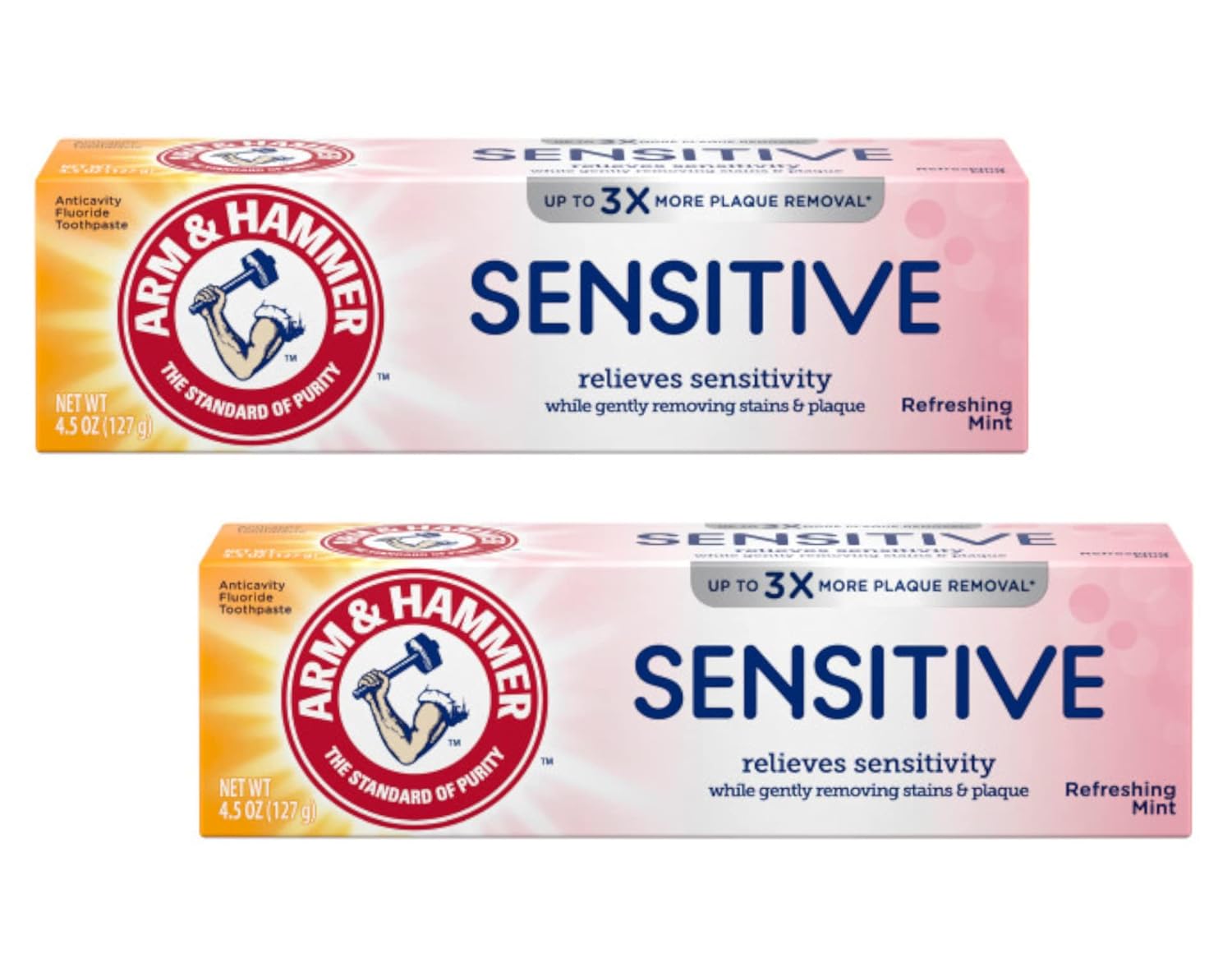
Arm & Hammer Sensitive Teeth & Gums (2-Pack, 4.5 oz each)
Best for: People who want a baking soda paste: in intraoral tests a bicarbonate paste raised plaque pH and left less plaque acid behind, and this one adds potassium nitrate and fluoride
- Baking soda base, the kind shown to raise plaque pH in intraoral tests
- Labeled low abrasion on the carton; Arm & Hammer calls baking soda one of the least abrasive tooth-cleaning materials
- Potassium nitrate 5% for sensitivity relief
- Sodium fluoride 0.24% for enamel protection and remineralization
- 2-pack, one of the most affordable options on this page
- +Baking soda base, the kind that raised plaque pH and cut measurable plaque acid in intraoral tests
- +Labeled low abrasion on the carton, and cleans with baking soda, which Arm & Hammer calls one of the least abrasive materials for teeth
- +Potassium nitrate plus fluoride for sensitivity relief and remineralization
- −The buffering evidence is plaque acid measured around brushing, not dietary or reflux acid
- −Less targeted erosion protection than the specialized formulas above
(Affiliate link) · Free shipping on eligible Prime items
Why We Recommend It
Baking soda (sodium bicarbonate) is the defining ingredient here, and it is a buffer: it neutralises acid it meets. The evidence for what that does in the mouth is narrower than the marketing. Intraoral plaque-pH work found that a bicarbonate/fluoride dentifrice raised resting plaque pH, blunted the pH drop after a sugar challenge, and left significantly less measurable plaque acid than the fluoride-only dentifrice. That is bacterial acid measured around brushing, not the citrus or reflux acid that drives erosion, and the study came out of Colgate-Palmolive’s own research group, so read it as a demonstration of the buffering mechanism rather than proof against dietary acid or a verdict on which tube wins.
Arm & Hammer calls baking soda one of the least abrasive materials you can clean your teeth with, though its own pages don’t agree on an abrasivity figure for this sensitive paste, so we don’t quote one. Combined with potassium nitrate for the sensitivity that accompanies erosion, and fluoride for mineral protection, this is a straightforward formula that comes at the problem differently from the Sensodyne pastes: buffering acid at brushing time rather than tin deposits on the enamel. The two-pack runs around $8, about $4 per tube.
Key Features
- Sodium bicarbonate base, a buffer shown to raise plaque pH in intraoral tests
- Labeled low abrasion on the carton; Arm & Hammer calls baking soda one of the least abrasive tooth-cleaning materials
- Potassium nitrate 5% for sensitivity relief
- Sodium fluoride 0.24% for enamel remineralization
- 2-pack, one of the most affordable options on this page
Who It’s Best For
People who want the lowest-priced pack on this page that still carries 5% potassium nitrate and fluoride, and anyone who wants a baking soda paste with a low-abrasion label. Nothing in the study we cite separates dietary acid from reflux, so pick it for the formula and the price, not for the source of your acid.
Potential Downsides
The buffering in the study we cite was measured around brushing against bacterial acid; nothing in it shows protection hours later or against a glass of orange juice. It doesn’t contain stannous fluoride or CariFree’s pH-support formula, so its erosion case rests on the low-abrasion label, the fluoride and the price. The “sensitive” branding can be misleading: potassium nitrate is there for sensitivity relief, and nothing in the tube targets acid wear beyond the fluoride every paste here carries. Its inactive list includes sodium lauryl sulfate, and its carton carries the strictest form of the potassium nitrate warning (see the four-week question in the FAQ).
(Affiliate link) · Free shipping on eligible Prime items
Buyer’s Guide: How to Choose a Toothpaste for Enamel Erosion
Erosion vs. Cavities: Why the Toothpaste Matters
Cavities and erosion damage enamel through different mechanisms, and they need different protection:
| Factor | Cavities | Erosion |
|---|---|---|
| Cause | Bacterial acid from plaque | Dietary acid, GERD, vomiting |
| Pattern | Localized (between teeth, in grooves) | Widespread (across surfaces exposed to acid) |
| Key protection | Fluoride, plaque removal | Low abrasivity, fluoride, tin-containing fluoride |
| Biggest toothpaste risk | Insufficient fluoride | Brushing softened enamel with a fluoride-free paste |
A toothpaste chosen for cavity prevention isn’t automatically the right one for erosion. The critical difference: on acid-softened enamel the brush itself does damage. In a five-subject in situ crossover study, brushing eroded enamel with a fluoride-free paste immediately after the acid exposure significantly increased enamel loss compared with the acid alone. Only the fluoride-containing pastes brought loss back down to erosion-only levels, so the fluoride in the paste is what does the protective work.
Understanding RDA (Relative Dentin Abrasivity)
RDA measures how much a toothpaste wears down dentin in laboratory testing, scored against a reference abrasive set at 100. Three things are worth knowing:
- What the ADA says: it treats any toothpaste at or under 250 as safe and effective, and every paste with its Seal of Acceptance must meet that.
- What it warns against: using numbers under 250 to rank one toothpaste as safer than another, because those differences don’t translate into measurable wear on enamel.
- What’s published: very little. CariFree gives an RDA of 40 for Gel 1100; we found no figure from Haleon or Colgate for the US versions of their pastes on this page, and Arm & Hammer’s pages don’t agree on one for its sensitive formula.
The practical takeaway is to brush gently with a soft brush and a paste its maker describes as low-abrasion, rather than to hunt for the smallest number.
Stannous Fluoride vs. Sodium Fluoride
Both types of fluoride help remineralize enamel, but they work differently against erosion:
- Stannous fluoride leaves tin-rich deposits on the enamel surface, which the 2011 review we cite suggests might be the best approach against acid challenges such as GERD and dietary acid.
- Sodium fluoride leaves a calcium fluoride surface layer instead. That layer is protective too, but the one review we cite leans toward the tin-containing formulas when the challenge is acid. Still a sound choice for daily use.
If acid exposure is your primary concern, the review we cite leans toward stannous fluoride, though it also asks for more clinical studies before the difference is settled. If abrasivity is your concern, the fluoride type won’t tell you much: look for a paste its maker describes as low-abrasion, as Haleon does for Pronamel.
Brushing After Acid: Rinse, Wait, Then Use the Right Paste
The rule most people have heard is don’t brush for 30 minutes after anything acidic, and it still has official backing: the ADA tells erosion patients to rinse with water rather than brush immediately after acidic drinks, and its consumer guidance puts the wait at an hour. What the lab data adds is where the credit belongs: in the five-subject in situ study above, waiting two full hours protected no better than brushing straight away (81.7 micrometers of enamel lost against 79.3, a gap inside the measurement spread), while a fluoride paste brought loss back down to roughly the acid-only level. One small study is no reason to drop the wait, but it does tell you which step to defend when your routine gets in the way:
- Rinse with plain water right after acid exposure
- Wait 30 to 60 minutes when you can
- Brush gently with a soft brush and a low-abrasion fluoride toothpaste, never a fluoride-free one: the ADA’s erosion guidance considers that combination unlikely to add erosive wear
Step 3 does the protecting, which matters most with GERD or morning sickness: acid exposure there is unpredictable and waiting out every episode is not realistic. After vomiting, the ADA’s erosion page adds a rinse with water, a sodium bicarbonate rinse, or milk, and one commenter in an r/GERD thread describes the same order for reflux episodes: rinse with baking-soda water, wait at least 30 minutes, and ask a dentist about a stronger prescription fluoride paste.
Frequently Asked Questions
Can toothpaste actually repair eroded enamel?
No toothpaste can regenerate enamel that’s been lost: enamel doesn’t contain living cells, so it can’t regrow. However, toothpaste can strengthen the enamel that remains by depositing minerals (fluoride, hydroxyapatite) into the surface, making it more resistant to further acid damage. Products like CariFree Gel 1100 and Sensodyne Repair & Protect are designed for this remineralization process. For options specifically focused on rebuilding mineral content, see our enamel repair toothpaste guide.
Is whitening toothpaste safe if I have enamel erosion?
We found no abrasivity figure from Haleon or Colgate for their US pastes on this page, so you can’t check how hard those scrub, and the ADA’s erosion guidance considers a soft brush with a low-abrasion fluoride paste unlikely to add erosive wear. Sensodyne Repair & Protect Whitening is on this page for its stannous fluoride, and its label lists no peroxide; Haleon’s US product pages and label give no abrasivity figure for it either. If whitening is a priority, ask your dentist about professional treatments rather than abrasive daily toothpastes.
Should I use a prescription fluoride toothpaste for erosion?
If your erosion is moderate to severe, your dentist may prescribe a 5000 ppm fluoride toothpaste (like PreviDent). The products on this page contain about 1,100 to 1,150 ppm fluoride (Haleon puts Pronamel at 1,150 ppm; the others work out to about 1,100 from their labels), which is the everyday over-the-counter range. Ask your dentist whether a 5,000 ppm prescription paste fits your erosion and what concentration is right for your situation.
Is hydroxyapatite toothpaste better than fluoride for enamel erosion?
Fluoride is the ingredient with the deepest evidence for acid protection and the one the ADA’s erosion guidance names; its toothpastes page notes that fluoride compounds are the only anticaries agents in the FDA monograph. Hydroxyapatite has promising remineralization evidence, but a study that found 10% hydroxyapatite comparable to a 500 ppm children’s paste looked at early caries lesions in primary-tooth enamel, a cavity result rather than an erosion one, and most US hydroxyapatite tubes don’t publish their concentration. You don’t have to choose: CariFree Gel 1100 on this page carries both, and some people in the hydroxyapatite threads alternate a fluoride paste with a hydroxyapatite one. The full comparison is in our fluoride vs hydroxyapatite guide, and the hydroxyapatite pastes themselves are ranked on our hydroxyapatite toothpaste page.
Which Pronamel is best for enamel erosion?
Daily Protection, the pick on this page, is the baseline Pronamel for acid wear. Intensive Enamel Repair is the one Haleon markets as actively repairing acid-weakened enamel, but on the US labels the two list the same actives, potassium nitrate 5% and sodium fluoride 0.25% (Daily Protection, Intensive Enamel Repair), and neither lists SLS, so the difference is in Haleon’s positioning and the inactive formulation rather than the drug facts. Gentle Whitening shares the same actives too. The line-by-line breakdown is on our Sensodyne toothpaste guide.
The box says not to use it for more than four weeks. Is that a problem?
That line travels with the sensitivity actives: potassium nitrate in Pronamel, Colgate Sensitive Enamel Health and Arm & Hammer, and stannous fluoride in Repair & Protect, whose label carries the same wording. The wording varies by brand: Arm & Hammer’s label says do not use longer than 4 weeks unless recommended by a dentist or physician, while Colgate’s and Sensodyne’s say to visit your dentist if pain or sensitivity still persists after 4 weeks. All four add that sensitive teeth may indicate a serious problem that may need prompt care by a dentist. So Arm & Hammer asks you to stop at four weeks unless a dentist says otherwise, and the others ask for a check-up if the pain persists. One commenter in an r/askdentists thread about this exact carton explains the warning as keeping a paste from masking the start of a cavity or new recession, which is the plain-English reason to book the visit.
What causes enamel erosion?
The most common causes are dietary acid (citrus fruits, vinegar, carbonated drinks, wine), gastroesophageal reflux disease (GERD), eating disorders involving vomiting, medications that reduce saliva, and occupational exposure (wine tasters, swimmers in poorly maintained pools). Unlike cavities, erosion is not caused by bacteria: it’s a chemical process where acid directly dissolves enamel minerals.
How do I know if I have enamel erosion?
Early signs include increased sensitivity to hot, cold, or sweet foods; a yellowish tint as enamel thins and dentin shows through; smooth, shiny surfaces on teeth (loss of natural texture); and slight transparency at the edges of front teeth. Your dentist can identify erosion during a routine exam, often before you notice symptoms. If you suspect erosion, schedule a dental visit rather than self-diagnosing.