
Best Toothpaste for Braces in 2026: Prevent White Spots & Protect Brackets
Wearing braces is a big investment: in time, money, and patience. The last thing anyone wants after the brackets come off is to reveal a smile riddled with white spot lesions, cavities, or weakened enamel. Choosing the right toothpaste is one of the simplest things you can do to protect your teeth throughout orthodontic treatment. According to the ADA’s toothpaste guidance, fluoride strengthens teeth and helps prevent decay by remineralizing enamel, so a fluoride paste is the first thing to get right during treatment. Still deciding between treatment types? Our Invisalign vs braces and clear braces vs metal braces comparisons break down the key trade-offs.
The challenge is that not every toothpaste is a good fit for braces. Whitening formulas rely on abrasives, which the ADA says may whiten by physically removing surface stains, or on peroxides; neither does anything for the enamel hidden under each bracket. Some specialty pastes leave out the one ingredient—fluoride—that matters most when your teeth are more vulnerable to acid attacks.
We’ve dug into the research, surveyed orthodontist recommendations, and evaluated the most popular options on the market to bring you this guide. Whether you’re a teen in metal braces, an adult in ceramic brackets, or a parent shopping for your child, there’s a solid pick here for you. For a complete orthodontic oral care routine, also see our picks for the best electric toothbrush for braces and the best mouthwash for braces.
How We Evaluated
When building this roundup, we focused on criteria that matter most during orthodontic treatment:
- Fluoride content: The American Dental Association calls fluoride safe and effective for preventing tooth decay in children and adults, and recommends brushing with a fluoride toothpaste. We only included fluoride pastes, and we flag the one that sits below the 1,000 to 1,500 ppm range the ADA gives for US over-the-counter pastes.
- Abrasivity (RDA score): The ADA treats any toothpaste with an RDA (a lab abrasiveness score) of 250 or below as safe and effective, and says scores under 250 should not be used to rank one paste as safer than another. We found a published RDA for only one of our picks, so we did not rank on it and leaned on the whitening and charcoal checks instead.
- Whitening additives: We flagged products with aggressive whitening agents (high-concentration hydrogen peroxide, charcoal) because they can bleach uneven patches around brackets and leave visible lines post-treatment.
- Sensitivity-friendly formulas: Brackets and wires can make gum tissue and enamel more reactive. Pastes with potassium nitrate or stannous fluoride earn extra marks here.
- Real-world usability: Taste, texture, and availability all matter when you’re brushing 2–3 times a day for one to three years.
Sensodyne Pronamel Daily Protection
Sensodyne Pronamel Daily Protection (3-pack of 4 oz tubes)
Best for: Braces wearers who experience sensitivity
- Active ingredients: sodium fluoride 0.25% (1,150 ppm fluoride, per Haleon) plus potassium nitrate 5%
- Low-abrasion formula, in Haleon's own description
- Formulated to help remineralize softened enamel
- Free from harsh whitening agents
- +Haleon describes Pronamel as a low-abrasion formula that helps maintain the enamel surface
- +Contains 1,150 ppm fluoride by Haleon's figure (sodium fluoride 0.25% on the US label), inside the 1,000 to 1,500 ppm range the ADA gives for US over-the-counter pastes
- +Formulated to remineralize softened enamel and free from harsh whitening agents
- −No extra gum-care or antibacterial ingredients; pair with a rinse if gums are inflamed
- −Mild flavor isn't for everyone; sold on Amazon as a 3-pack of 4 oz tubes
(Affiliate link) · Free shipping on eligible Prime items
Why We Recommend It
Sensodyne Pronamel is consistently mentioned by orthodontists as a top recommendation for braces wearers, and it’s easy to see why. The formula is built specifically to protect and remineralize enamel, which is exactly what you need when brackets create nooks where acid-producing bacteria love to hide. Haleon describes Pronamel as a low-abrasion formula with 1,150 ppm fluoride (sodium fluoride 0.25% on the US label, alongside 5% potassium nitrate for sensitivity), inside the 1,000 to 1,500 ppm range the ADA gives for US over-the-counter fluoride pastes. Amazon currently sells it as a 3-pack of 4 oz tubes, which is the listing we link.
Key Features
- Active ingredients: sodium fluoride 0.25% (1,150 ppm fluoride, per Haleon) plus potassium nitrate 5%
- Low-abrasion formula, in Haleon’s own description
- Formulated to help remineralize softened enamel
- Free from harsh whitening agents
- Available in several mild flavor options
Who It’s Best For
Anyone with braces who experiences sensitivity, which is most people at some point during treatment. It’s also an excellent everyday option if you want a well-rounded, dentist-recommended formula without overpaying.
Potential Downsides
The mild flavor isn’t for everyone, and it doesn’t include any extra gum-care or antibacterial ingredients. If you have significant gum inflammation, you may want to pair it with an antiseptic rinse.
(Affiliate link) · Free shipping on eligible Prime items
Crest Pro-Health Advanced
Crest Pro-Health Advanced
Best for: Adults in braces who want comprehensive protection in a single step
- Active ingredient: Stannous fluoride (0.454%)
- Antibacterial action against plaque around brackets and the gumline
- May help with gingivitis, cavities, and tooth sensitivity
- Includes tartar control
- +Stannous fluoride may help with cavities, gingivitis, and sensitivity in one step
- +Antibacterial stannous fluoride targets the plaque that collects around brackets
- +Tartar control in a stannous fluoride paste, at around $5 a tube
- −Stannous fluoride can occasionally cause minor, reversible surface staining
(Affiliate link) · Free shipping on eligible Prime items
Why We Recommend It
Crest Pro-Health Advanced is a workhorse formula that covers a lot of ground in one tube. It uses stannous fluoride, which the ADA’s toothpaste guidance lists as an anticavity agent and, citing a 2023 review, as an option for reducing sensitivity pain; stannous pastes that carry the Seal, such as Colgate Total SF below, also hold ADA findings for gingivitis. For braces wearers (who are statistically more prone to gum inflammation), that coverage in one tube is useful (its US label calls it an anticavity, antigingivitis, antisensitivity toothpaste), especially at around $5 a tube as of this writing. One note on certifications: this Advanced Deep Clean Mint variant earned the ADA Seal back in 2017 but no longer appears on the ADA’s live accepted-products roster (checked August 2026); the plain Crest Pro-Health Toothpaste is the version currently listed, so treat this pick as standing on its stannous fluoride formula rather than on a current Seal.
Key Features
- Active ingredient: Stannous fluoride (0.454%)
- Antibacterial action against plaque around brackets and the gumline
- May help with gingivitis, cavities, and tooth sensitivity
- Includes tartar control
- Widely available and reasonably priced
Who It’s Best For
Adults in braces who want comprehensive protection in a single step. It’s also a smart choice if your orthodontist has flagged early gum issues; braces wearers are especially prone to gingivitis, and our guide on how to fix gingivitis covers what you can do beyond brushing.
Potential Downsides
Stannous fluoride can occasionally cause surface staining on teeth in some users; it’s worth being aware of, though it’s typically minor and reversible with professional cleaning.
(Affiliate link) · Free shipping on eligible Prime items
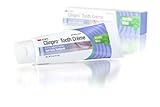
3M Clinpro Tooth Creme
3M Clinpro Tooth Creme
Best for: Braces wearers whose orthodontist wants a calcium-phosphate remineralizing paste without a prescription
- 0.21% sodium fluoride (950 ppm) + functionalized tri-calcium phosphate (fTCP)
- Calcium and phosphate delivered alongside fluoride (maker-claimed white-spot remineralization support)
- Over-the-counter; the prescription Clinpro 5000 is a separate product
- RDA of 59.58 in 3M's own testing; mild vanilla-mint taste
- +Functionalized tri-calcium phosphate (fTCP) releases calcium and phosphate alongside fluoride; the maker positions it for early white-spot remineralization
- +Over-the-counter sibling of the prescription Clinpro 5000, from the same maker
- +3M's own lab testing puts its RDA at 59.58, well under the ADA's 250 limit; mild vanilla-mint flavor
- −At 950 ppm its fluoride is slightly below the standard 1,000-1,500 ppm OTC range; the value is the fTCP, not extra fluoride
- −Costs more per tube (around $19) and it is not the prescription 5,000 ppm Clinpro 5000 that orthodontists often prescribe for white-spot risk
(Affiliate link) · Free shipping on eligible Prime items
Why We Recommend It
First, be clear on which product this is, because the names are easy to confuse: this entry is the over-the-counter Clinpro Tooth Creme, formulated with 0.21% sodium fluoride (950 ppm fluoride ion) plus functionalized tri-calcium phosphate, per Solventum’s product page. Clinpro 5000, the prescription 5,000 ppm version from the same maker, is the one orthodontists often prescribe for white-spot risk; it requires a prescription and is covered in the FAQ below.
What the Tooth Creme offers braces wearers is the fTCP chemistry: calcium and phosphate delivered alongside fluoride to the demineralized enamel around brackets. Its fluoride content is actually slightly below the standard over-the-counter band, so you are choosing it for the calcium-phosphate approach, not for extra fluoride. If your orthodontist has flagged early white spots, ask specifically whether they mean this product or the prescription 5000.
Key Features
- 0.21% sodium fluoride (950 ppm) + functionalized tri-calcium phosphate (fTCP)
- Calcium and phosphate delivered alongside fluoride (maker-claimed white-spot remineralization support)
- Over-the-counter; the prescription Clinpro 5000 is a separate product
- RDA of 59.58 in 3M’s own testing; mild vanilla-mint taste
Who It’s Best For
Braces wearers whose orthodontist has suggested a calcium-phosphate remineralizing paste, or anyone watching early white spots who wants the fTCP approach without a prescription. If your provider identified high cavity risk, ask about the prescription 5,000 ppm paste instead.
Potential Downsides
It costs more per tube than drugstore pastes (around $19) and is usually bought online. Its 950 ppm fluoride content is below the standard OTC band, and it is easy to confuse with the prescription Clinpro 5000, which is a different, stronger product.
(Affiliate link) · Free shipping on eligible Prime items
Colgate Total SF
Colgate Total SF Deep Clean
Best for: Braces wearers who want whole-mouth antibacterial coverage
- Active ingredient: Stannous fluoride (0.454%)
- ADA Seal of Acceptance
- Targets bacteria on teeth, tongue, cheeks, and gums
- Its ADA Seal also means it meets the ADA's abrasivity limit of an RDA of 250 or less
- +Stannous fluoride formula carrying the ADA Seal of Acceptance for cavities, gingivitis, and plaque
- +Whole-mouth antibacterial action targets teeth, tongue, cheeks, and gums
- +Its ADA Seal also means it meets the ADA's abrasivity limit of an RDA of 250 or less
- −Small chance of surface staining with prolonged use
- −Texture differs slightly from traditional sodium fluoride pastes
(Affiliate link) · Free shipping on eligible Prime items
Why We Recommend It
Colgate Total SF (Sugar Acid Neutralizer) updated its formula to include stannous fluoride and carries the ADA Seal of Acceptance, with a finding that covers preventing tooth decay, reducing gingivitis and plaque above the gumline, and reducing bad breath. Its broad-spectrum antibacterial action may help with the gum health challenges that commonly come with wearing brackets and wires. That gingivitis and plaque finding comes from the ADA’s own Seal review of this product, not only from Colgate’s marketing.
Key Features
- Active ingredient: Stannous fluoride (0.454%)
- Carries the ADA Seal of Acceptance
- Targets bacteria on teeth, tongue, cheeks, and gums
- Meets the ADA’s abrasivity limit for Seal products (an RDA of 250 or less)
- Multiple flavor options
Who It’s Best For
Braces wearers who want a familiar, easy-to-find brand with strong clinical backing and whole-mouth antibacterial coverage.
Potential Downsides
Like other stannous fluoride pastes, there’s a small chance of surface staining with prolonged use. Some users also find the texture slightly different from traditional sodium fluoride toothpastes.
(Affiliate link) · Free shipping on eligible Prime items
Tom’s of Maine Anticavity Fluoride Toothpaste

Tom's of Maine Anticavity Fluoride Toothpaste
Best for: Anyone who prefers natural or clean personal care products without sacrificing fluoride protection
- Active ingredient: Sodium monofluorophosphate 0.76% (about 1,000 ppm fluoride), an FDA-recognized anticavity ingredient
- Free from artificial colors, flavors, and preservatives
- +Delivers anticavity protection from sodium monofluorophosphate (about 1,000 ppm fluoride) while skipping artificial colors, flavors, and preservatives
- +Genuinely mild flavors, a plus when gums are tender after an adjustment
- +Sold as a 3-pack for about $19, which works out to around $6.39 per tube
- −Fluoride concentration is slightly lower, at about 1,000 ppm
- −May not be the strongest choice for high-risk patients
(Affiliate link) · Free shipping on eligible Prime items
Why We Recommend It
For those who prefer a cleaner ingredient list, Tom’s of Maine Anticavity is one of the few natural-leaning options that still delivers real cavity protection. It uses sodium monofluorophosphate at 0.76% (about 1,000 ppm fluoride), inside the FDA monograph’s anticavity range for that ingredient, while skipping artificial sweeteners and preservatives, and comes in flavors that are mild, a plus when gums are tender after an adjustment appointment. This listing is a 3-pack for about $19, so the effective cost is around $6.39 per tube, competitive with single-tube pastes on this list.
Key Features
- Active ingredient: Sodium monofluorophosphate 0.76% (about 1,000 ppm fluoride), an FDA-recognized anticavity ingredient
- Free from artificial colors, flavors, and preservatives
- Recyclable packaging
Who It’s Best For
Anyone who prefers natural or “clean” personal care products without sacrificing fluoride protection. Also a good pick for those with sensitivity to artificial additives.
Potential Downsides
The fluoride concentration is slightly lower than premium options at about 1,000 ppm. It may not be the strongest choice for high-risk patients, though it’s perfectly adequate for most healthy-mouth braces wearers.
(Affiliate link) · Free shipping on eligible Prime items
ACT Kids Anticavity Fluoride Toothpaste

ACT Kids Anticavity Fluoride Toothpaste
Best for: Children and teens in braces who need flavor-based motivation to take brushing seriously
- Active ingredient: Sodium fluoride 0.24% (about 1,100 ppm fluoride ion)
- Kid-friendly flavors encourage compliance
- Fluoride level inside the ADA's stated over-the-counter range
- +Kid-friendly flavors encourage compliance and full two-minute brushing
- +About 1,100 ppm fluoride ion (sodium fluoride 0.24% on the US label), inside the 1,000 to 1,500 ppm range the ADA gives for US over-the-counter pastes
- +Least expensive pick at around $3 a tube
- −No ACT Kids toothpaste is on the ADA's accepted-products roster, so it carries no Seal
- −Sweet, kid-targeted flavors may not appeal to older teens and adults
- −At about 1,100 ppm, its fluoride sits in the lower part of the 1,000 to 1,500 ppm range the ADA gives for US over-the-counter pastes
(Affiliate link) · Free shipping on eligible Prime items
Why We Recommend It
Braces aren’t just for adults—many patients are between 10 and 17 years old, and getting kids to brush thoroughly is already a challenge. ACT Kids delivers fluoride in a bubble gum or watermelon flavor that most children enjoy, which means they’re more likely to brush for the full two minutes. The US label lists sodium fluoride 0.24% (DailyMed), about 1,100 ppm fluoride ion, which sits in the lower part of the 1,000 to 1,500 ppm range the ADA gives for US over-the-counter pastes. At around $3 a tube, it’s also the least expensive pick on this list. The ADA recommends supervised, twice-daily brushing for children (source). One note on certifications: no ACT Kids toothpaste appears on the ADA’s live accepted-products roster (checked August 2026), so this pick stands on its fluoride content and kid-compliance value, not a Seal.
Key Features
- Active ingredient: Sodium fluoride 0.24% (about 1,100 ppm fluoride ion)
- Kid-friendly flavors encourage compliance
- Fluoride level (about 1,100 ppm) in the lower part of the 1,000 to 1,500 ppm range the ADA gives for US over-the-counter pastes
- Alcohol-free and dye-reduced options available
Who It’s Best For
Children and teens in braces who need a bit of flavor-based motivation to take brushing seriously. Also a gentle option for adults who find minty flavors too intense after an orthodontic wire tightening.
Potential Downsides
Its fluoride, about 1,100 ppm, sits in the lower part of the 1,000 to 1,500 ppm range the ADA gives for US over-the-counter pastes, and no ACT Kids toothpaste appears on the ADA’s accepted-products roster. The sweet, kid-targeted flavors may not appeal to older teens and adults, who can pick any fluoride paste in that range.
(Affiliate link) · Free shipping on eligible Prime items
Buyer’s Guide: What to Look For
Fluoride — Non-Negotiable
This is the starting point. According to the ADA’s toothpaste guidance, fluoride strengthens teeth to help prevent decay and remineralizes enamel in the early stages of decay, and the ADA’s fluoride guidance puts US over-the-counter pastes at 1,000 to 1,500 ppm. During orthodontic treatment, your enamel is under more stress from trapped food, bacteria, and acid; fluoride helps remineralize weakened spots before they become full cavities. Skip fluoride-free “natural” pastes during braces treatment.
ADA Seal of Acceptance
The ADA Seal means the maker submitted data and publications that the ADA’s Council on Scientific Affairs reviewed against set requirements for safety and efficacy, along with laboratory studies such as the amount of available fluoride and how much fluoride is released in one minute; a Seal toothpaste making a cavity-protection claim must contain fluoride, and every Seal toothpaste must have an RDA of 250 or less. It’s one of the easiest shortcuts for evaluating toothpaste quality without reading every clinical study yourself.
Avoid Aggressive Whitening Formulas
Whitening toothpastes are appealing: who doesn’t want a brighter smile? But during braces treatment, they can cause uneven lightening. The area under and around each bracket is protected from the bleaching agents, which means when your braces come off, you could be left with a checkerboard pattern of lighter and darker patches. Save the whitening paste for after treatment.
Watch Out for Charcoal
Charcoal toothpastes have had a big moment on social media, but the ADA’s whitening review finds insufficient evidence that charcoal products whiten teeth with adequate safety and effectiveness, and it cites a report of deep abrasion on front teeth after brushing with a charcoal-and-salt mix.
Abrasivity (RDA)
RDA is a lab score for how abrasive a paste is, but we found a published figure for only one of our picks: 3M measures Clinpro Tooth Creme at 59.58. The ADA treats any toothpaste at an RDA of 250 or below as safe and effective, requires that of every Seal paste, and says scores under 250 should not be used to rank one toothpaste as safer than another, because those differences do not translate into measurable wear on enamel.
Sensitivity Ingredients
Potassium nitrate and stannous fluoride are the two main ingredients that may help with tooth sensitivity, according to manufacturers and clinical research. Both are worth seeking out if your teeth are reactive after adjustments.
FAQ
Q: Can I use whitening toothpaste with braces?
We’d recommend against it. The brackets physically block the whitening agents from reaching the enamel underneath, which can lead to visible discoloration patterns when your braces are removed. It’s better to stick to a standard fluoride formula during treatment and consider whitening options afterward.
Q: How often should I brush with braces?
According to orthodontist guidelines widely shared across practices, brushing after every meal (or at minimum twice a day) is strongly recommended with braces. Food and plaque accumulate around brackets and wires much more readily than on bare teeth, increasing cavity and gum disease risk. Adding a water flosser to your routine helps clear debris from around brackets and under the archwire between brushings.
Q: Is prescription fluoride toothpaste like Clinpro 5000 worth it?
For most healthy patients with good hygiene habits, a standard fluoride toothpaste will be sufficient. However, if your dentist or orthodontist has identified a high cavity risk, early white spots, or poor oral hygiene compliance, prescription-strength fluoride (5,000 ppm) may be beneficial. Always defer to your provider’s recommendation.
Q: Are “natural” toothpastes safe to use with braces?
Natural toothpastes can be perfectly fine, as long as they contain fluoride at an effective concentration; an ADA Seal is a useful bonus signal when present, but its absence doesn’t disqualify an otherwise well-formulated paste. Fluoride-free versions, no matter how “natural” or well-marketed, are not recommended during orthodontic treatment when cavity risk is elevated.
Q: Do I need a special toothpaste for ceramic or clear braces?
The same core rules apply: adequate fluoride, no charcoal, no aggressive whitening agents. Some orthodontists suggest being especially careful with staining ingredients (like those in certain flavored pastes) near ceramic brackets, but a standard fluoride formula will serve you well regardless of bracket type.
Q: Can kids use adult toothpaste during orthodontic treatment?
The ADA advises no more than a smear (about the size of a grain of rice) of fluoride toothpaste for children younger than 3 and no more than a pea-sized amount for ages 3 to 6, with an adult supervising. For older children and teens in braces, a full-strength adult formula (1,000 to 1,500 ppm, the range the ADA gives for US over-the-counter pastes) is generally appropriate and often recommended by orthodontists, but confirm with your provider.
Our Methodology
We compiled this guide by reviewing recommendations from multiple orthodontic practice blogs, ADA guidance on fluoride and toothpaste selection, product formulation data, and consumer feedback. We evaluated each product against criteria including fluoride concentration, published abrasivity data where the maker provides it, ADA Seal status, presence of potentially problematic whitening agents, and suitability for the specific demands of braces wearers.
We do not accept payment from brands to appear in our roundups. Some links in this article are affiliate links, meaning we may earn a small commission if you purchase through them, at no extra cost to you. This helps support the editorial work we do at Dental Roundup, and our recommendations remain independent of those relationships.
We recommend consulting your orthodontist or dentist for personalized advice, especially if you have a high cavity risk, existing sensitivity, or other specific oral health considerations. This article is intended for informational purposes and does not constitute dental or medical advice.