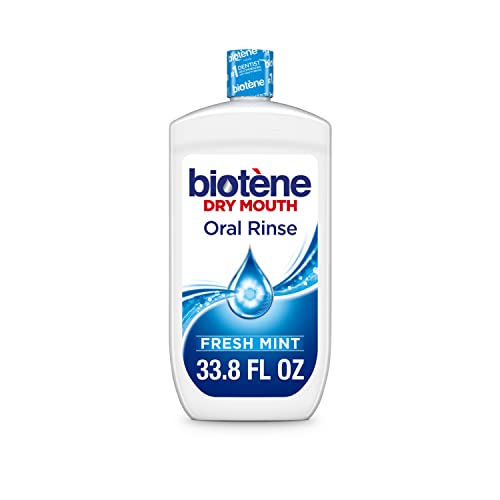
Dry mouth isn’t just uncomfortable: it’s a cavity accelerator. Saliva neutralizes acid, washes away food debris, and delivers the calcium and phosphate your enamel needs to repair itself. When that flow drops, whether from medication, Sjogren’s syndrome, CPAP use, or radiation therapy, your teeth lose their primary defense. The wrong toothpaste makes it worse: sodium lauryl sulfate (SLS), the foaming agent in most toothpastes, has desquamation and irritation of the oral lining among its documented side effects, which is the last thing already-dry tissue needs. We compared SLS-free, high-xylitol, and specialty cavity-fighting formulas to find the best options for each type of dry mouth sufferer. For complementary products, see our guides on mouthwash for dry mouth and alcohol-free mouthwash.
How We Evaluated Dry Mouth Toothpastes
We focused on five criteria specific to xerostomia:
- SLS-free formula: desquamation and irritation of the oral lining are documented side effects of SLS. Five of the six picks are SLS-free; the exception is CariFree Gel 1100, whose own ingredient page lists sodium lauryl sulfate, and it stays on the list for its cavity-prevention case with that flagged in its downsides.
- Active ingredients for dry mouth: Xylitol (suppresses cavity-causing bacteria), fluoride (compensates for lost remineralization), nano-hydroxyapatite (provides minerals saliva normally delivers), and enzyme systems.
- Cavity prevention strength: Dry mouth patients develop cavities at dramatically higher rates. Fluoride concentration and pH balance matter more here than for typical users.
- Gentleness: Dry, irritated tissue reacts to strong flavors and detergents. We prioritized mild-flavor, low-foam formulas, and noted where a maker publishes an abrasivity figure.
- Real-world feedback: We researched what dry mouth communities (Sjogren’s forums, CPAP groups, medication side-effect discussions) actually report about each product, not just what the labels claim.
Biotene Fluoride Toothpaste
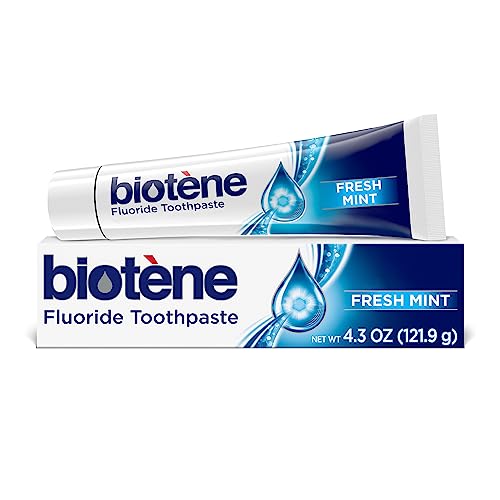
Biotene Fluoride Toothpaste (Fresh Mint, 4.3 oz, 2-Pack)
Best for: Most dry mouth sufferers: an SLS-free fluoride paste with a mild mint, labeled 'GENTLE FORMULA'
- SLS-free and pH-balanced to match natural saliva
- Fluoride for cavity prevention in saliva-depleted mouths
- Fresh Mint flavor on a formula Biotene labels as made to not irritate
- From the #1 dentist-recommended dry mouth brand
- +SLS-free and pH-balanced to mimic natural saliva
- +Includes fluoride to compensate for lost remineralization, with a mild mint flavor chosen for dry tissue
- +Most affordable, widely available pick: under $7 and stocked in most pharmacies
- −Reformulated after GSK's 2012 acquisition removed the original enzyme system long-time users valued
- −Contains no xylitol, the ingredient several other picks here add to target cavity-causing bacteria
(Affiliate link) · Free shipping on eligible Prime items
Why We Recommend It
Biotene is the name most dentists reach for when a patient reports dry mouth, and for good reason. The formula is specifically designed around the problems xerostomia creates: it’s SLS-free, pH-balanced to mimic natural saliva, and includes fluoride to compensate for the remineralization your reduced saliva can’t provide. At about $14 for a 2-pack of 4.3 oz tubes (just under $7 a tube), it’s also the most accessible entry point for anyone just learning they need a different toothpaste.
The Fresh Mint flavor is mild—not the aggressive mint that makes dry tissue burn. For people on medications that cause xerostomia (antidepressants, antihistamines, blood pressure drugs), this is often the first product that feels comfortable rather than punishing.
Key Features
- SLS-free, pH-balanced formula
- Fluoride anticavity protection (sodium fluoride, 0.15% w/v fluoride ion on the Drug Facts panel)
- Gentle mint flavor designed for sensitive dry tissue
- Available in most pharmacies and grocery stores
- Compatible with other Biotene dry mouth products (rinse, gel, spray)
Who It’s Best For
The everyday dry mouth sufferer who needs a reliable, affordable toothpaste that won’t make things worse. Particularly good as a first switch for people whose dentist just told them they have dry mouth.
Potential Downsides
Biotene’s formula changed significantly after GSK acquired the brand from Laclede in 2012: the original enzyme system (lactoperoxidase, lysozyme, lactoferrin) that many long-time users loved was removed. If you used old-formula Biotene and found it more effective, the current version is a different product. Some users in Sjogren’s communities report the new formula causes mild burning, though this isn’t a widespread complaint. It also doesn’t contain xylitol, which four of the other five picks here include; a systematic review of randomized trials found habitual xylitol use lowers counts of cavity-causing mutans streptococci.
(Affiliate link) · Free shipping on eligible Prime items
CloSYS Fluoride Toothpaste
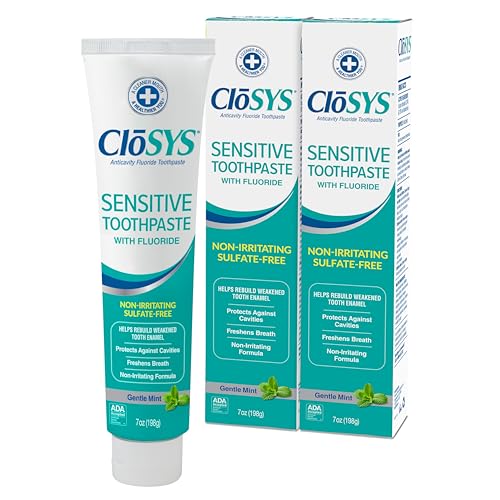
CloSYS Fluoride Toothpaste (Gentle Mint, 2-Pack)
Best for: People with extremely sensitive mouths: sulfate-free, low-foaming, and pH-balanced for tissue that can't tolerate most toothpastes
- Sulfate-free and SLS-free — a mild sarcosinate detergent instead
- pH-balanced Cloralstan formula, labeled non-irritating
- Fluoride for cavity prevention
- Low-foaming for comfort on irritated tissue
- +Completely sulfate-free with barely any foam, ideal for tissue that burns with every other toothpaste
- +Cloralstan antimicrobial technology plus fluoride covers both gentleness and cavity protection
- +Frequently recommended by hygienists for oral surgery, cancer treatment, and severely sensitive mouths
- −Avoids making dryness worse rather than actively moisturizing dry tissue
- −Minimal flavor and low foam take adjustment, and the 2-pack costs more per tube than Biotene
(Affiliate link) · Free shipping on eligible Prime items
Why We Recommend It
If every toothpaste you’ve tried burns, stings, or leaves your mouth feeling raw, CloSYS is likely the answer. It’s not just SLS-free—it’s sulfate-free entirely; its detergent is a mild coconut-derived sarcosinate (sarkosyl on the DailyMed label) rather than a sulfate. The formula barely foams, which feels odd at first but is exactly what dry, irritated oral tissue needs. The Cloralstan (stabilized chlorine dioxide) technology provides antimicrobial action without the harshness of conventional antibacterial agents.
Dental hygienists frequently recommend CloSYS for patients recovering from oral surgery, undergoing cancer treatment, or managing conditions that leave the mouth extremely sensitive. For dry mouth patients, the combination of sulfate-free gentleness with fluoride protection covers the two most important bases.
Key Features
- Completely sulfate-free (beyond SLS-free)
- Cloralstan antimicrobial technology
- 0.24% sodium fluoride for cavity prevention
- Hydrated silica cleaning agent and no peroxide on the label; the carton makes no whitening claim, though the Amazon listing title does
- pH-balanced to neutral
- Gluten-free, triclosan-free
Who It’s Best For
People with the most sensitive mouths: cancer patients with oral mucositis, Sjogren’s patients with severely compromised tissue, and anyone who’s tried multiple “gentle” toothpastes and still experiences burning or irritation.
Potential Downsides
The ultra-gentle nature means CloSYS doesn’t have much flavor impact; some users describe it as “brushing with nothing.” The low foam also takes adjustment. While the gentleness is the point, users looking for a toothpaste that actively moisturizes may find it doesn’t address dryness directly: it avoids making things worse rather than actively improving moisture. The 2-pack at $19.99 makes it pricier per tube than Biotene.
(Affiliate link) · Free shipping on eligible Prime items
CariFree Gel 1100
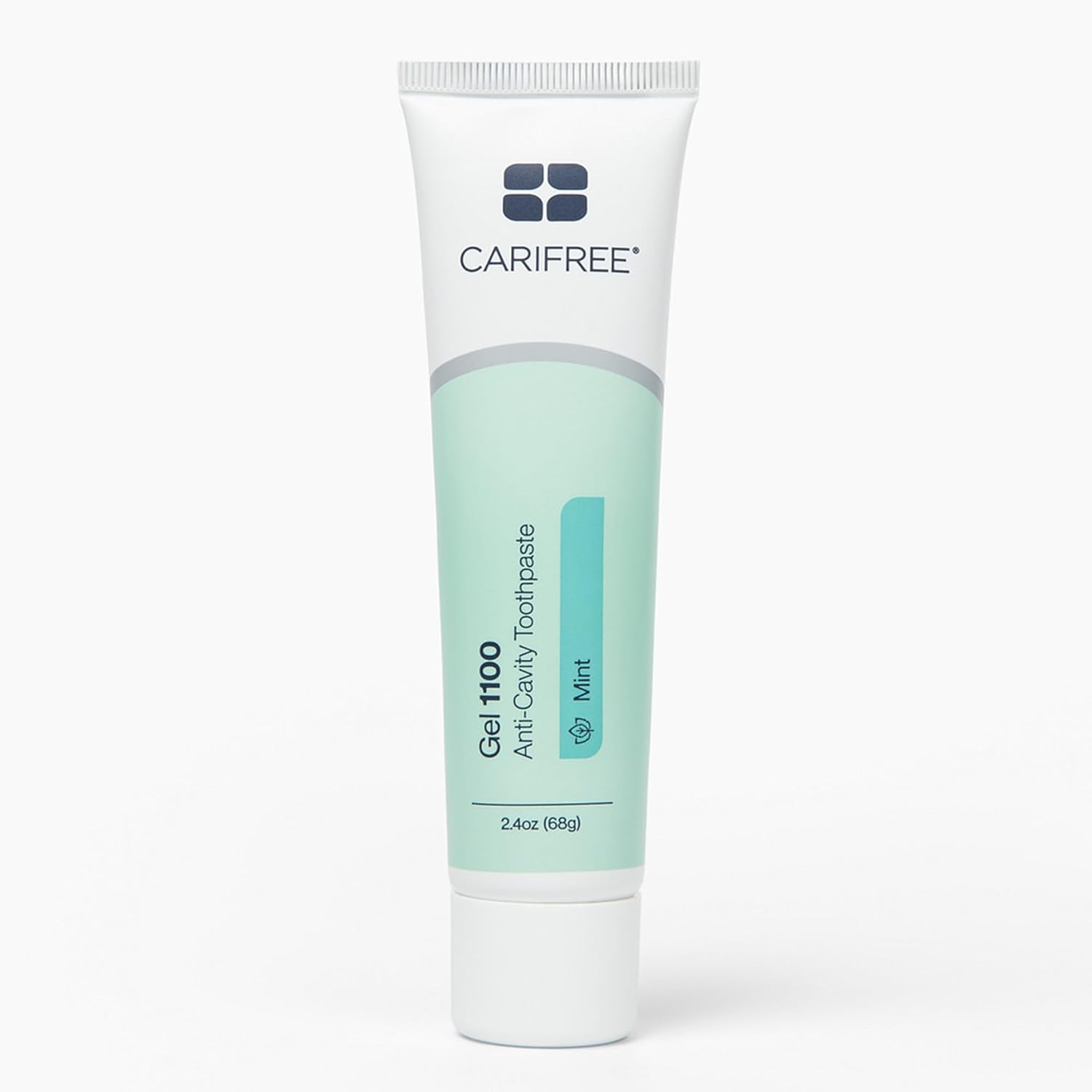
CariFree Gel 1100 (Mint, 2.4 oz)
Best for: High-risk patients: combines nano-hydroxyapatite and fluoride with elevated pH to fight the accelerated cavity formation dry mouth causes
- Nano-hydroxyapatite + 1100 ppm fluoride for dual remineralization
- 25% xylitol to suppress cavity-causing bacteria
- Elevated pH technology neutralizes acid in saliva-depleted mouths
- Low abrasion: RDA 40, per CariFree
- +Pairs nano-hydroxyapatite with 1100 ppm fluoride to supply the calcium and phosphate reduced saliva can't deliver
- +25% xylitol works against cavity-causing bacteria while elevated-pH technology neutralizes accumulated acid
- +Dentist-developed, low-abrasion gel (RDA 40) that CariFree says stays gentle on enamel
- −Contains SLS, the one pick on this page that does, and the small 2.4 oz tube makes it one of the most expensive options per ounce
- −We could not find a trial testing the nHAp + fluoride combination against fluoride alone, and CariFree's product page claims no ADA Seal of Acceptance for the gel
(Affiliate link) · Free shipping on eligible Prime items
Why We Recommend It
Here’s the problem with standard fluoride toothpaste for dry mouth: fluoride needs calcium and phosphate from your saliva to form the protective fluorapatite layer on your teeth. When saliva flow is reduced, fluoride alone is less effective. CariFree Gel 1100 solves this by combining fluoride with nano-hydroxyapatite: essentially providing the calcium and phosphate that your missing saliva can’t deliver. That is the design logic rather than a proven head-to-head result.
The 25% xylitol content adds a bacterial front to the mineral one, since habitual xylitol use lowers counts of the mutans streptococci that do the damage when saliva stops buffering acid. The elevated pH technology helps neutralize the acid that accumulates when saliva isn’t doing its buffering job. Ingredient for ingredient, it’s the most precisely targeted formula on this list.
Key Features
- Nano-hydroxyapatite provides minerals without requiring saliva
- 1100 ppm fluoride for cavity prevention
- 25% xylitol to suppress cavity-causing bacteria
- pH+ technology raises oral pH to counteract acid
- Low-abrasion gel (RDA 40), per CariFree
- Dentist-developed
Who It’s Best For
Dry mouth patients at high cavity risk: particularly Sjogren’s patients, radiation therapy survivors, and anyone whose dentist has flagged accelerating decay. Also a strong option for people whose cavity rate has increased despite using fluoride toothpaste, because the nHAp is meant to address the mineral gap that reduced saliva creates.
Potential Downsides
The 2.4 oz tube is small and runs out quickly at about $18 (about $7.50/oz), making it one of the more expensive options per ounce. Some users find the gel texture unfamiliar compared to traditional paste. Each half of the formula has evidence behind it; the pairing itself does not. A 2025 systematic review and meta-analysis of in-situ randomized trials found fluoride-free hydroxyapatite toothpastes performed comparably to conventional fluoride pastes on lesion development and progression in children, adolescents, and young adults under 25. What we could not find is a trial putting nHAp plus fluoride up against fluoride alone, and CariFree’s product page claims no ADA Seal of Acceptance for the gel. That same ingredient page lists sodium lauryl sulfate, which makes this the one pick here that breaks the SLS-free rule above; we keep it for the nHAp-plus-fluoride case and flag it for anyone whose dry mouth reacts to SLS.
(Affiliate link) · Free shipping on eligible Prime items
Spry Natural Xylitol Toothpaste
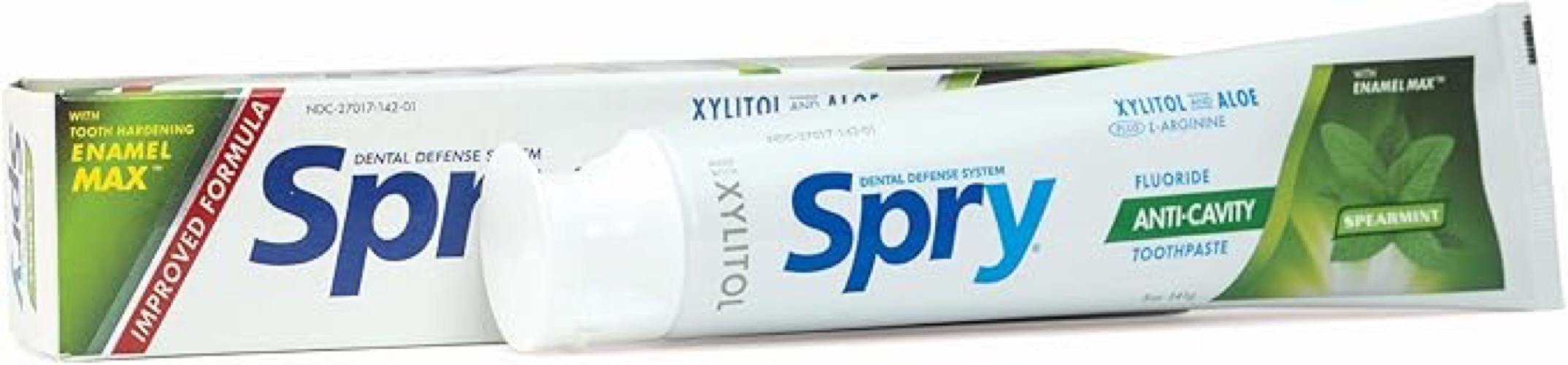
Spry Natural Xylitol Toothpaste with Fluoride (Spearmint, 5 oz)
Best for: People who want a natural approach to dry mouth: xylitol curbs cavity-causing bacteria while fluoride handles remineralization
- High xylitol content to hold down cavity-causing bacteria
- Fluoride for cavity prevention
- SLS-free natural formula
- Mouth-moisturizing ingredients
- +Built around xylitol, a sugar alcohol studied for its effect on cavity-causing bacteria, plus fluoride that many natural toothpastes skip
- +SLS-free natural formula with moisturizing ingredients and a pleasant, non-aggressive spearmint
- +Integrates with other Spry xylitol products (gum, mints, mouthwash) for a full routine
- −Spry's label and Amazon listing give no xylitol percentage, unlike Squigle's stated 36%
- −Some users find the natural flavor mild to the point of feeling like it's not doing anything
(Affiliate link) · Free shipping on eligible Prime items
Why We Recommend It
Xylitol has a real clinical record in oral care, though not for the reason it usually gets sold on. A systematic review of randomized trials found habitual xylitol use lowers counts of cavity-causing mutans streptococci, while leaving the wider oral microbiota unchanged. Saliva stimulation is the shakier half of the pitch: in a randomized trial in 80 Sjogren’s patients, a xylitol-and-malic-acid gustatory stimulant and a citric-acid one both raised salivary output with no significant difference between them, so nothing there credits the xylitol itself. Spry builds its formula around xylitol, and for a dry mouth the cavity-suppression half is the half that matters most. Unlike some natural toothpastes that skip fluoride, Spry includes it, which matters enormously for dry mouth patients whose cavity risk is already elevated.
The formula is SLS-free with a natural ingredient profile that appeals to people who want to minimize synthetic chemicals in their oral care routine. The spearmint flavor is pleasant without being aggressive, and the moisturizing ingredients help maintain the hydration that dry tissue needs.
Key Features
- Xylitol-rich formula to suppress cavity-causing bacteria
- Fluoride (0.24% sodium fluoride) for cavity prevention
- SLS-free, mild sarcosinate detergent
- Natural spearmint flavor
- Moisturizing ingredients for dry tissue comfort
- Also available in fluoride-free version
Who It’s Best For
People who prefer natural products but don’t want to sacrifice fluoride protection. Particularly good for mild to moderate dry mouth from medication side effects, where cavity risk starts climbing well before the dryness itself feels severe. The crossover with other Spry xylitol products (gum, mints, mouthwash) makes it easy to build a full xylitol-based routine.
Potential Downsides
While Spry has meaningful xylitol content, the exact percentage isn’t prominently disclosed; unlike Squigle’s 36%, you’re relying on its position in the ingredient list. At 1,862 reviews, it has a smaller evidence base than Biotene or CloSYS, though the reviews are strongly positive. Some users find the natural flavor profile mild to the point of feeling like it’s not “doing anything” compared to conventional toothpastes.
(Affiliate link) · Free shipping on eligible Prime items
Squigle Enamel Saver Toothpaste
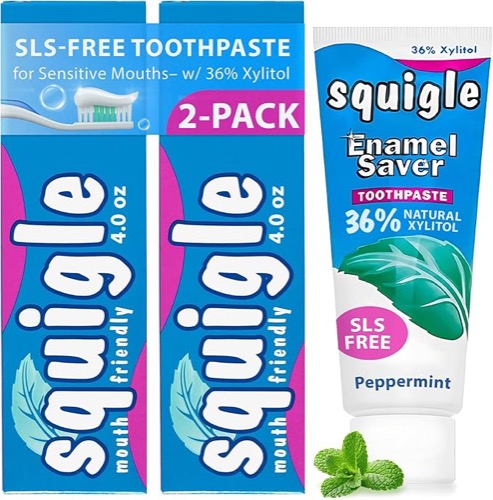
Squigle Enamel Saver Toothpaste (2-Pack)
Best for: People who deal with both dry mouth and canker sores: 36% xylitol by weight and SLS-free formula addresses both conditions
- 36% xylitol by weight — highest of any mainstream toothpaste
- SLS-free to prevent canker sore flare-ups
- Fluoride for cavity prevention
- Made without harsh abrasives, per Squigle
- +Highest xylitol of any widely available toothpaste at 36% by weight, aimed at the bacteria that drive decay in a dry mouth
- +SLS-free, the formula change linked to fewer and shorter canker sores in recurrent-ulcer patients
- +Includes fluoride, and Squigle says it whitens without harsh abrasives
- −One of the pricier options on the list at $23.99 for a 2-pack
- −Small brand with limited retail availability, so you'll likely need to order online
(Affiliate link) · Free shipping on eligible Prime items
Why We Recommend It
There’s a significant overlap between dry mouth and canker sores, and SLS is the common suspect. In a three-month switch study, ten patients with recurrent aphthous ulcers averaged 14.3 ulcers on a 1.2% SLS toothpaste and 5.1 over the following three months on an SLS-free one; the authors attributed the drop to SLS denaturing the mucin layer that coats oral tissue and leaving the epithelium beneath it exposed. A later scoping review of SLS side effects found limited evidence that people with recurrent ulcers benefit from an SLS-free paste on all three counts: how many ulcers they get, how long each one lasts, and how much it hurts.
Squigle’s differentiator is its 36% xylitol content by weight—the highest of any widely available toothpaste. What xylitol has been shown to do is hold down cavity-causing bacteria with habitual use, which is the risk that climbs fastest in a dry mouth. The formula also includes fluoride, and Squigle says it whitens gently without harsh abrasives and calls the formula low-abrasion in its Amazon brand copy; we found no published abrasivity figure on its site.
Key Features
- 36% xylitol by weight (highest available concentration)
- SLS-free formula
- Fluoride for cavity prevention
- Made without harsh abrasives, per Squigle
- Also helps prevent perioral dermatitis and chapped lips
Who It’s Best For
The dual dry-mouth-and-canker-sore sufferer, a larger group than you’d expect. If you get recurrent canker sores and also deal with xerostomia, this toothpaste covers both: SLS-free for the ulcers, 36% xylitol for the cavity risk. Also worth a look for dry mouth patients with enamel erosion who want fluoride without an SLS detergent.
Potential Downsides
At $23.99 for a 2-pack, Squigle is one of the pricier options on this list. It’s a small brand with limited retail availability; you’ll likely need to order it online. The unflavored version (the most popular for canker sore sufferers) has virtually no taste, which some people find off-putting. Its review count, about 1,700 on Amazon, is solid but reflects its niche positioning compared to mass-market brands.
(Affiliate link) · Free shipping on eligible Prime items
TheraBreath Fresh Breath Toothpaste
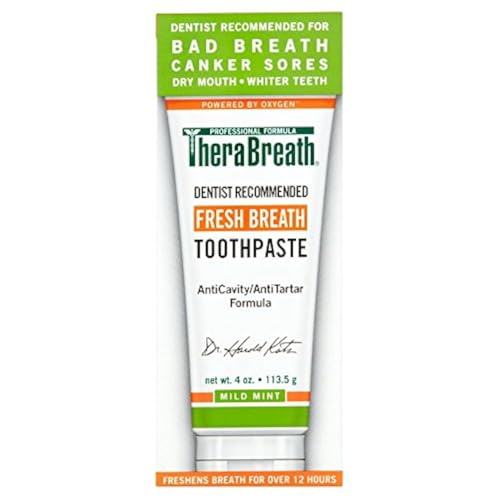
TheraBreath Fresh Breath Toothpaste (Mild Mint, 2-Pack)
Best for: People whose dry mouth is causing persistent halitosis: targets the sulfur-producing bacteria that thrive when saliva flow drops
- OXYD-8 (sodium chlorite) neutralizes sulfur compounds
- SLS-free to protect dry, sensitive tissue
- Fluoride for cavity prevention
- 12-hour fresh breath formula
- +OXYD-8, TheraBreath's sodium chlorite formula, neutralizes the volatile sulfur compounds dry mouth lets flourish
- +SLS-free and dentist-formulated, in the label's Mild Mint flavor
- +Adds fluoride cavity protection and a 12-hour fresh breath claim
- −Lowest rating on the list at 4.3 stars, with some users finding the breath improvement temporary
- −Primarily a breath product that happens to be SLS-free, not a purpose-built dry mouth formula
Currently unavailable on Amazon (September 2026)
Why We Recommend It
Here’s something most dry mouth toothpastes don’t address: the halitosis. Reduced saliva flow creates an ideal environment for anaerobic bacteria that produce volatile sulfur compounds, the molecules responsible for bad breath. You can moisturize and protect your teeth all day, but if you’re not targeting those bacteria, the bad breath persists. TheraBreath’s OXYD-8 (sodium chlorite on the Drug Facts label) specifically neutralizes these compounds at their source.
The formula is SLS-free and dentist-formulated by Dr. Harold Katz, who built the brand around halitosis treatment. Mild Mint is the label’s own name for the flavor, and the 0.24% sodium fluoride provides cavity protection.
Key Features
- OXYD-8 technology neutralizes volatile sulfur compounds
- SLS-free formula safe for dry mouth tissue
- 0.24% sodium fluoride for cavity prevention
- Mild Mint flavor (the label’s own name for it)
- 12-hour fresh breath claim
- Dentist-formulated
Who It’s Best For
Anyone whose dry mouth has created a bad breath problem, which, frankly, is most dry mouth sufferers. Particularly useful for medication-induced xerostomia where the underlying condition isn’t going away and halitosis has become a social concern. Pairs well with TheraBreath mouthwash for a complete halitosis management routine.
Potential Downsides
At 4.3 stars, TheraBreath has the lowest rating on this list. Some users report that the halitosis improvement is temporary or that the toothpaste doesn’t address their specific type of bad breath. The Mild Mint flavor, while gentle, strikes some users as medicinal. TheraBreath is primarily a breath product that happens to be SLS-free, rather than a purpose-built dry mouth formula; if bad breath isn’t your primary concern, Biotene or Spry may serve you better.
Availability, September 2026: Amazon lists this product as currently unavailable, with no restock date, at our September 18 read, so the buy button is off this card. TheraBreath now sells a reformulated toothpaste line that we have not reviewed; the other picks on this page are in stock.
Buyer’s Guide: How to Choose a Dry Mouth Toothpaste
Why Your Standard Toothpaste Is Making It Worse
Most conventional toothpastes contain sodium lauryl sulfate (SLS), the detergent responsible for foaming. Its documented oral side effects include desquamation and irritation of the mucosa, and the mechanism researchers have proposed is denaturing of the mucin layer that lines your oral tissue—the same layer that retains moisture and protects against irritation. For people with normal saliva flow, this isn’t much of a problem: saliva keeps re-coating the tissue between brushings. But if you have reduced saliva, there is less flow to do that repair work, so an irritant most people shrug off lands harder on a mouth that is already dry.
Switching to an SLS-free toothpaste is the change dry mouth sufferers report the most relief from. Every product on this list is SLS-free.
The Ingredients That Actually Help
Not all dry mouth toothpastes work the same way. Understanding the key ingredients helps you pick the right one for your situation:
- Xylitol: A sugar alcohol whose documented benefit is bacterial rather than moisturizing: habitual use lowers counts of cavity-causing mutans streptococci. Concentrations are worth comparing on that basis (Squigle 36%, CariFree 25%). The saliva-stimulating reputation is thinner than the marketing suggests, because the trials that raised salivary flow used chewing gum or gustatory-stimulant tablets and the xylitol formulations did not beat the non-xylitol ones.
- Fluoride: Critical for dry mouth patients because your teeth are losing their primary source of remineralization (saliva). Over-the-counter pastes in the U.S. generally contain 1,000 to 1,500 ppm, per the ADA, and the picks here that list a sodium fluoride percentage work out to about 1,100 ppm; prescription PreviDent 5000 offers 5000 ppm for severe cases.
- Nano-hydroxyapatite (nHAp): Provides the calcium and phosphate that fluoride needs to build protective fluorapatite, minerals that would normally come from saliva. That rationale carries most weight when saliva flow is severely reduced, though it stays a mechanism argument: we could not find a trial comparing nHAp plus fluoride with fluoride alone. See our hydroxyapatite toothpaste guide for more detail.
- Enzyme systems: Lactoperoxidase, lysozyme, and lactoferrin mimic the antimicrobial enzymes in natural saliva. The original Biotene formula had these; they were removed after GSK’s acquisition. Salivea (made by Biotene’s original creators) still includes them.
Matching Toothpaste to Your Type of Dry Mouth
The cause of your dry mouth determines which formula helps most:
| Cause | Primary Concern | Best Fit |
|---|---|---|
| Medication side effects | Ongoing management, cavity prevention | Biotene or Spry (affordable daily use) |
| Sjogren’s syndrome | Severe dryness, high cavity risk | CariFree (nHAp + fluoride) or Squigle (36% xylitol) |
| CPAP use | Nighttime dryness specifically | Biotene before bed + XyliMelts overnight |
| Radiation/chemotherapy | Extreme sensitivity, tissue damage | CloSYS (sulfate-free, labeled non-irritating) or CariFree |
| Canker sore crossover | Both dryness and ulcers | Squigle (SLS-free for the ulcers, 36% xylitol for the cavity risk) |
| Aging/reduced saliva | Gradual increase in cavities | Biotene or Spry (easy transition from conventional toothpaste) |
When to Ask About Prescription Toothpaste
If you’re getting new cavities every dental visit despite using SLS-free toothpaste, ask your dentist about PreviDent 5000 Dry Mouth, a prescription-strength toothpaste with 5000 ppm fluoride (about 4.5 times the roughly 1,100 ppm of the sodium fluoride picks here). In a two-year randomized trial in 345 community-dwelling older adults, brushing with a 5,000 ppm fluoride dentifrice prevented and arrested root caries far better than a standard 1,450 ppm paste: the share of teeth with active lesions fell from 29.7% to 3.7% in the high-fluoride group, while it climbed from 24.3% to 40.5% in the control group. It’s typically used once daily (usually before bed), with a regular dry mouth toothpaste for morning brushing. Custom fluoride trays are another option your dentist may recommend for severe xerostomia.
Building a Full Dry Mouth Routine
Toothpaste is one piece of the puzzle. A complete dry mouth management routine typically includes:
- SLS-free toothpaste (this page): twice daily
- Alcohol-free mouthwash: see our alcohol-free mouthwash guide and dry mouth mouthwash picks
- Xylitol products throughout the day: gum, mints, or lozenges — the chewing and sucking are what raise flow, and the xylitol keeps working on cavity-causing bacteria between brushings; our xylitol gum picks cover the chewable option in more depth
- Saliva substitute gel or spray: for overnight or during extended dry periods
- Humidifier: especially for CPAP users and nighttime dry mouth
- Regular dental checkups: every 3-4 months instead of 6 for high-risk patients
Frequently Asked Questions
Does SLS actually cause dry mouth, or just make it worse?
SLS doesn’t cause xerostomia: that’s driven by medications, medical conditions, radiation, or aging. What it has against it is a documented record of irritating the oral lining, which would amplify whatever dryness you already have. Switching won’t restore your saliva flow, but it removes a plausible aggravating factor, and dry mouth communities consistently describe the switch as a comfort improvement. SLS shows up as the same suspect in recurrent canker sores, so if sores are part of your pattern too, our guide to clearing up a canker sore covers that side of the overlap.
Can I use hydroxyapatite toothpaste instead of fluoride for dry mouth?
You can, but the evidence behind that swap does not reach this audience: the 2025 meta-analysis cited above pooled in-situ trials in people under 25, not adults with reduced saliva, and it detected no difference either way (RR 0.98). For a mouth at elevated cavity risk, keep the fluoride and raise any substitution with your dentist first. Running both is the more defensible move here, on mechanism rather than trial data: nHAp supplies the calcium and phosphate that fluoride needs and a dry mouth’s saliva no longer delivers. CariFree Gel 1100 does that. If you specifically want to avoid fluoride, a fluoride-free nHAp toothpaste with high xylitol content is a reasonable alternative, though the ADA hasn’t endorsed nHAp as a fluoride substitute.
What happened to the old Biotene formula?
GSK acquired Biotene from Laclede in 2012 and reformulated it, removing the enzyme system (lactoperoxidase, lysozyme, lactoferrin) that mimicked natural saliva’s antimicrobial properties. The current formula is still SLS-free and pH-balanced, but it works differently. Salivea, a product made by Biotene’s original creators after their non-compete expired, contains the original enzyme system, though it has limited availability on Amazon.
Is dry mouth toothpaste enough on its own?
For mild dry mouth (occasional dryness from antihistamines or mild medication side effects), switching to SLS-free toothpaste may be sufficient. For moderate to severe xerostomia (Sjogren’s, radiation, multiple medications), toothpaste should be part of a broader routine including alcohol-free mouthwash, xylitol products throughout the day, saliva substitutes, and more frequent dental visits. Talk to your dentist about what level of management your specific situation requires.
What toothpaste should I use before bed with my CPAP?
Biotene or Spry are good pre-CPAP options: both are SLS-free and won’t leave residue that dries out further overnight. Many CPAP users also benefit from a saliva substitute gel (like Biotene OralBalance Gel) applied after brushing to maintain moisture through the night. XyliMelts, slow-dissolving xylitol discs that adhere to your gums, are another option CPAP communities frequently recommend for overnight dryness.
Can toothpaste itself cause dry mouth?
No. SLS toothpaste can leave dry tissue more irritated, but it does not switch off saliva production. New-onset dryness usually traces to a medication change, a medical condition, or dehydration. If your mouth suddenly feels dry and you haven’t changed toothpaste recently, talk to your doctor: xerostomia is a common side effect of over 500 medications.