
Hydroxyapatite toothpaste has become the leading fluoride-free option for parents who want active enamel support—not just a “natural” label—for their children’s teeth. If you’ve already decided on HAp over other fluoride-free kids’ toothpastes (xylitol-only, organic, etc.), the remaining questions are practical: which concentration, nano or micro, and whether your child can spit yet. We compared six kids’ HAp toothpastes across disclosed concentration, swallowing safety, ingredient transparency, and value.
How We Evaluated
We researched more than a dozen kids’ hydroxyapatite toothpastes—including Himalaya’s kids’ line and several smaller Amazon-only brands that we set aside for thin review counts or unclear ingredient disclosure—and narrowed to six based on these criteria:
- HAp form and concentration — Does the product use nano-hydroxyapatite or micro-crystalline HAp? Does it disclose the percentage? Clinical research on children has used concentrations around 10% microcrystalline HAp, so disclosure matters.
- Swallowing safety — Children under age 3-4 swallow most of their toothpaste. We prioritized products explicitly designed with this in mind—food-grade ingredients, no SLS, no artificial preservatives.
- Consumer track record — Star ratings, review counts, and the specific complaints parents report. All six of our picks have over 1,000 Amazon reviews.
- Ingredient transparency — Does the brand publish its HAp concentration, or does it ask you to trust the label without numbers?
- Value — Price matters when you’re buying toothpaste for a child who uses a pea-sized amount. We note both sticker price and practical cost.
Our Picks
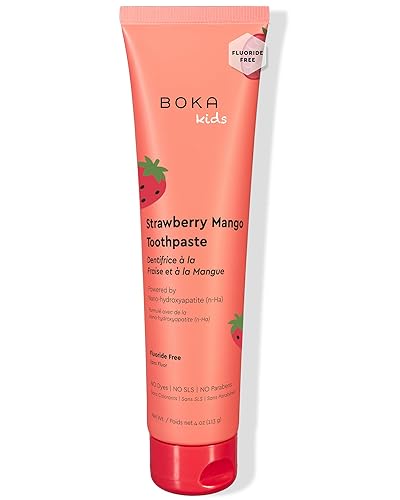
Boka Kids Strawberry Mango nHAP Toothpaste
Best for: Parents who want a well-reviewed nHAP toothpaste safe for toddlers who still swallow
- Nano-hydroxyapatite (nHAP) gel for enamel support
- Designed as safe to swallow for ages 1+
- SLS-free, paraben-free, PETA-certified cruelty-free
- Strawberry mango flavor
- Fluoride-free
- +Largest review base in this lineup by a wide margin, with nearly 12,000 reviews at 4.6 stars
- +Designed as safe to swallow for children ages 1 and up—addresses the primary concern for toddler toothpaste
- +PETA-certified cruelty-free, SLS-free, paraben-free
- −Does not disclose nHAP concentration on the packaging
- −Strawberry mango flavor may encourage over-squeezing in younger children
(Affiliate link) · Free shipping on eligible Prime items
Boka Kids Strawberry Mango — Editor’s Pick
Boka’s kids’ formula uses nano-hydroxyapatite in a gel designed for children ages 1 and up, with a clean ingredient list free of SLS, parabens, and artificial dyes. It also carries the largest review base in this lineup by a wide margin—nearly 12,000 reviews at 4.6 stars.
Why we picked it: When a product carries this volume of reviews at this rating, it means thousands of parents have used it and kept buying it. Boka’s formulation prioritizes swallowing safety—the single biggest concern for parents of toddlers who cannot spit reliably—and the ingredient list is short enough to evaluate quickly. The PETA certification and SLS-free formula matter to parents shopping in this category. Among the kids’ HAp toothpastes we compared, Boka has the most consistent combination of consumer confidence and clean formulation.
Potential downsides: Boka does not disclose the concentration of nHAP in the formula. If knowing exactly how much hydroxyapatite your child’s toothpaste contains matters to you—and it reasonably should—Mouthology (5%) or Happy Tooth (10%) are more transparent options. The strawberry mango flavor is popular with kids but can lead to over-squeezing in younger children who treat toothpaste like a snack.
(Affiliate link) · Free shipping on eligible Prime items
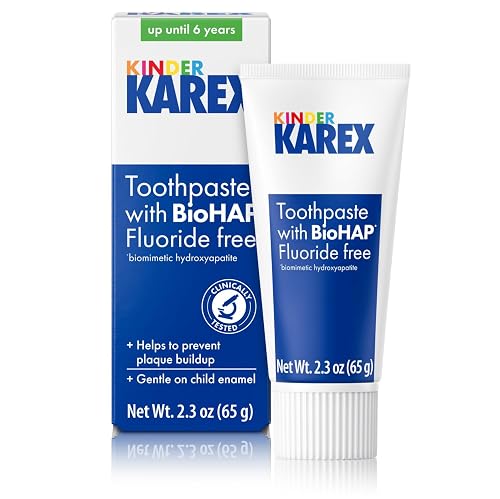
Kinder Karex Kids Hydroxyapatite Toothpaste
Best for: Families looking for a manufacturer-tested European HAp formula at the lowest price
- HAp formula from Dr. Kurt Wolff (Germany) with manufacturer-published clinical testing
- Fluoride-free, SLS-free
- Flavorless option available for sensory-sensitive children
- 2.3 oz tube
- Established European pharmaceutical brand
- +Lowest price in this lineup at under $9—strong value for a formula with manufacturer-published clinical testing
- +Backed by Dr. Kurt Wolff, a German pharmaceutical company with decades in oral care
- +Flavorless option available—uncommon in kids' toothpaste and helpful for children with sensory sensitivities
- −Smaller tube (2.3 oz) means less product per purchase than standard 4 oz tubes
- −Less widely known in the US market compared to Boka or RiseWell
(Affiliate link) · Free shipping on eligible Prime items
Kinder Karex — Best Budget
Kinder Karex comes from Dr. Kurt Wolff, a German pharmaceutical company that has manufactured oral care products for decades. The formula uses hydroxyapatite the manufacturer says it has clinically tested, and the brand offers a flavorless variant—a genuine rarity in kids’ toothpaste that matters for children who find mint, fruit, or candy flavors overwhelming.
Why we picked it: At under $9, Kinder Karex is the most affordable HAp toothpaste in this lineup, and the European pharmaceutical pedigree adds credibility that younger DTC brands are still building. The clinical testing claim is backed by the manufacturer’s published research program. The flavorless option is a meaningful differentiator—children with autism or sensory processing differences often reject flavored toothpastes entirely, and most “kids’” brands assume every child wants bubblegum or strawberry.
Potential downsides: The 2.3 oz tube is smaller than the standard 4 oz, which partially offsets the lower sticker price. Kinder Karex has less brand recognition in the US than Boka or RiseWell, and with 1,756 reviews it has a smaller but still solid consumer track record. The brand does not disclose the exact HAp concentration on the US packaging.
(Affiliate link) · Free shipping on eligible Prime items
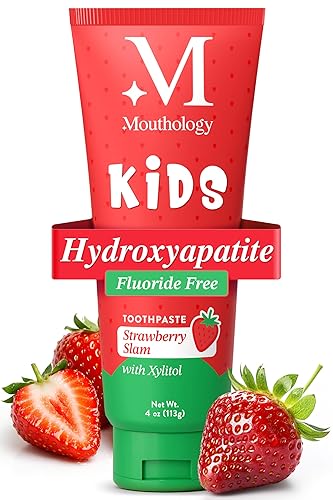
Mouthology Kids Strawberry nHAP Toothpaste
Best for: Parents who want to know exactly how much HAp is in their child's toothpaste
- 5% HAp concentration disclosed on packaging
- Xylitol for additional bacterial balance support
- SLS-free, formulated for ages 1-12, labeled safe to swallow
- Strawberry or watermelon flavor
- Fluoride-free
- +Discloses 5% HAp concentration on packaging—a level of transparency rare in this category
- +Over 6,600 reviews at 4.5 stars—second-largest review base in this lineup
- +Contains xylitol alongside HAp, SLS-free, formulated for ages 1-12
- −5% HAp is on the lower end of concentrations used in clinical studies
- −4.5-star average sits a notch below the 4.6-star picks in this lineup
(Affiliate link) · Free shipping on eligible Prime items
Mouthology Kids Strawberry — Best for Transparency
Mouthology is one of the few kids’ HAp brands that prints its hydroxyapatite concentration directly on the packaging: 5%. In a category where most brands treat concentration as proprietary, that disclosure alone is a differentiator. The formula also includes xylitol, which may help reduce cavity-causing bacteria, and is SLS-free for ages 1-12. The kids’ line comes in two flavors, strawberry and watermelon, which gives you somewhere to go if your child rejects the first one. (Affiliate link)
Why we picked it: Transparency is the reason. When you’re choosing a toothpaste based on a specific active ingredient, knowing how much of that ingredient is in the product is fundamental. Mouthology’s 5% HAp disclosure lets you compare directly to clinical research concentrations, which typically range from 5% to 10%. The 6,600+ review base at 4.5 stars is the second-largest here, and the addition of xylitol means the formula addresses two mechanisms—mineral deposition and bacterial balance—rather than one.
Potential downsides: The 5% concentration, while honestly disclosed, sits at the lower end of what clinical studies have used. The 2021 children’s caries trial that found HAp non-inferior to fluoride used 10% microcrystalline HAp—double Mouthology’s stated concentration, and a different form (micro vs. nano). At 4.5 stars it also sits just below the 4.6-star picks here, though across a much larger review base than most of them.
(Affiliate link) · Free shipping on eligible Prime items
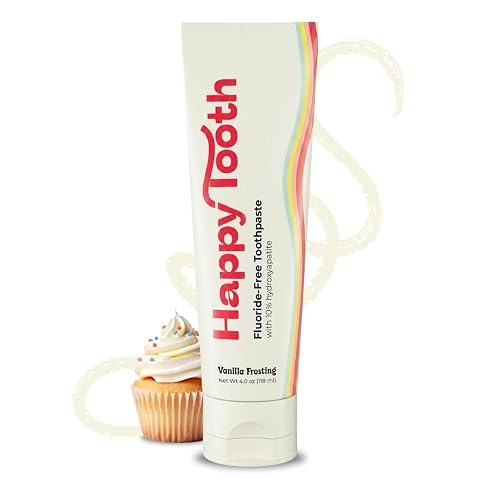
Happy Tooth Vanilla Frosting Kids Toothpaste
Best for: Parents prioritizing the highest disclosed HAp concentration in a kids' formula
- 10% micro-HAp disclosed on every tube
- Developed by pediatric dentist Dr. Tyler Hanks
- SLS-free
- Vanilla frosting flavor
- Fluoride-free
- +Highest disclosed HAp concentration in this lineup at 10% micro-HAp—matching the concentration used in clinical research
- +Developed by a pediatric dentist, Dr. Tyler Hanks
- +SLS-free with a vanilla frosting flavor that avoids the typical mint or fruit spectrum
- −4.3-star rating is the lowest in this lineup—some parents report texture complaints
- −Newer brand without the review depth of Boka or Mouthology
(Affiliate link) · Free shipping on eligible Prime items
Happy Tooth Vanilla Frosting — Best HAp Concentration
Happy Tooth publishes what most brands in this category will not: the exact HAp concentration on every tube. At 10% micro-HAp, it matches the concentration used in the 2021 randomized clinical trial that found hydroxyapatite toothpaste non-inferior to fluoride toothpaste at preventing early childhood caries. The formula was developed by pediatric dentist Dr. Tyler Hanks.
Why we picked it: The 10% micro-HAp concentration is the highest disclosed in this lineup and directly aligns with the published clinical evidence. That matters because HAp concentration is not regulated in the US the way fluoride concentration is—without disclosure, you have no way to know whether a product contains a clinically relevant amount. A pediatric dentist behind the formula is a relevant credential for a product designed for children. The vanilla frosting flavor is a genuine differentiator from the strawberry-and-bubblegum standard.
Potential downsides: Happy Tooth’s 4.3-star average is the lowest in this lineup. It carries 1,539 reviews—a reasonable sample, but some parents report a texture they find unusual compared to conventional paste. Our recommendation here is grounded on the product’s label claims and formulation characteristics—this is a newer brand without the extensive consumer track record of Boka or Mouthology.
(Affiliate link) · Free shipping on eligible Prime items
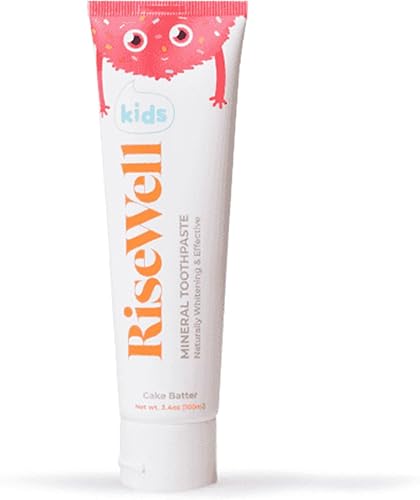
RiseWell Kids Cake Batter Mineral Toothpaste
Best for: Families willing to pay more for an EWG-verified formula with a clean ingredient list
- Micro-crystalline HAp (not nano-particles)
- EWG-verified; manufacturer describes as dentist-formulated
- Xylitol, SLS-free, safe to swallow
- Cake batter flavor, 3.4 oz tube
- Fluoride-free
- +EWG-verified for ingredient safety—the only product in this lineup with that certification
- +Uses micro-crystalline HAp rather than nano-particles, if you would rather avoid nanoparticle ingredients
- +Manufacturer describes as dentist-formulated, SLS-free, safe to swallow
- −Second-highest price in this lineup at nearly $19
- −Smallest review base in this lineup (1,035 reviews)
(Affiliate link) · Free shipping on eligible Prime items
RiseWell Kids Cake Batter — Best Premium
RiseWell uses micro-crystalline hydroxyapatite—not nano-particles—and is the only product in this lineup carrying EWG (Environmental Working Group) verification. The formula pairs HAp with xylitol, is SLS-free, and comes in a cake batter flavor.
Why we picked it: The EWG verification is the real differentiator—no other product here carries that kind of third-party ingredient review. The micro-crystalline HAp is a formulation preference rather than a safety necessity: the European Commission’s Scientific Committee on Consumer Safety (SCCS) reassessed rod-shaped nano-hydroxyapatite in June 2025 and found it safe in toothpaste at up to 29.5%, concluding that it does not pose a mutagenic hazard or cause cytotoxic or inflammatory effects even at high concentrations in a lab model of the cheek lining. If you would still rather your child’s toothpaste contained no nanoparticles at all, RiseWell answers that plainly, and it is the pick to buy on that basis. The 3.4 oz tube provides more product per purchase than Kinder Karex’s 2.3 oz, though less than a standard 4 oz tube.
Potential downsides: At nearly $19, RiseWell is the second-priciest pick in this lineup—roughly $10 more than Kinder Karex, and about a dollar under NOBS Jr. With 1,035 reviews, it has the smallest review base here. RiseWell does not disclose its exact HAp concentration.
(Affiliate link) · Free shipping on eligible Prime items
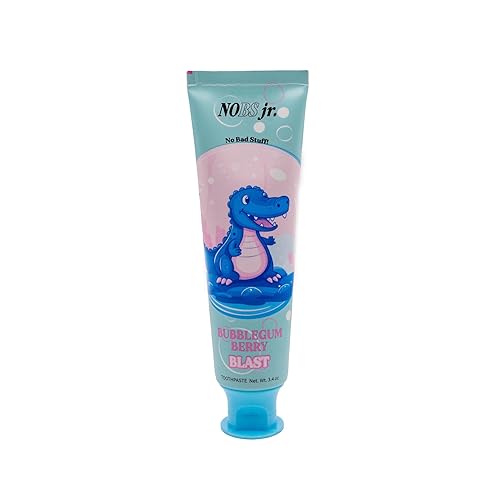
NOBS Jr. Bubblegum Berry Kids Toothpaste
Best for: Parents who want a disclosed nHAP concentration in a US-made kids' paste
- 5% nHAP concentration disclosed
- Manufacturer describes as dentist-formulated
- SLS-free, made in the USA
- Bubblegum berry flavor, 3.4 oz tube
- Labeled for ages 2 and up, fluoride-free
- +Discloses 5% nHAP concentration, manufacturer describes as dentist-formulated, made in the USA
- +4.6-star rating across more than 1,600 reviews—matching the highest rating in this lineup
- +SLS-free and fluoride-free, in a bubblegum berry flavor aimed at reluctant brushers
- −Highest price in this lineup at $20, and the 3.4 oz tube holds less than a standard 4 oz
- −Labeled for ages 2 and up, so it does not cover the youngest toddlers
(Affiliate link) · Free shipping on eligible Prime items
NOBS Jr. Bubblegum Berry — Made in the USA
NOBS Jr. is a conventional paste in a 3.4 oz tube—a pea-sized amount on a soft brush, the same routine as every other tube on this list. What sets the label apart is what it prints: 5% nano-hydroxyapatite, stated outright, alongside SLS-free, fluoride-free, and made-in-the-USA manufacturing.
Why we picked it: Concentration disclosure is the thing this category is worst at, and NOBS Jr. publishes its number. At 5% nHAP it sits level with Mouthology and below Happy Tooth’s 10%, but it is a figure you can check against the research rather than a label asking to be trusted. The manufacturer describes the formula as dentist-formulated and makes it in the USA, which matters to parents who want to know where a product their child partly swallows is actually produced. The 4.6-star average across 1,649 reviews matches the highest rating in this lineup.
Potential downsides: At $20, NOBS Jr. is the most expensive pick here, and its 3.4 oz tube holds less than a standard 4 oz—the highest sticker price does not buy the most paste. Mouthology discloses the same 5% nHAP for about half the money, so the premium is paying for the US manufacturing and the brand, not for more active ingredient. The label is for ages 2 and up, which leaves out the youngest toddlers; Boka’s ages-1+ formulation is the better fit there.
(Affiliate link) · Free shipping on eligible Prime items
What parents in online communities say about kids’ HAp toothpaste: Discussions in parenting communities like r/moderatelygranolamoms and r/ScienceBasedParenting show that the primary driver for choosing HAp toothpaste is swallowing safety—not ideology. Parents of toddlers who cannot spit reliably want an active ingredient that provides enamel support without the fluorosis concern that comes with swallowing fluoride paste. The clinical research supporting HAp is acknowledged as newer and smaller than the fluoride evidence base, and some parents describe using HAp for daytime brushing alongside a fluoride toothpaste at bedtime—a combination approach that some dentists have suggested as reasonable for fluoride-free patients.
Buyer’s Guide
Nano vs. Micro Hydroxyapatite: What’s the Difference?
You will see two forms of HAp across kids’ toothpaste labels: nano-hydroxyapatite (nHAP) and micro-crystalline hydroxyapatite (mHAP). Both are synthetic versions of the mineral that makes up roughly 97% of tooth enamel by weight, but they differ in particle size. For the wider picture of how enamel loses and regains mineral, see our guide to remineralizing teeth.
Nano-hydroxyapatite particles are smaller—typically under 100 nanometers—and can penetrate deeper into enamel surface defects. Most of the Japanese and some European research that established HAp as a cavity-prevention ingredient used nano-sized particles. Boka, Mouthology, and NOBS Jr. use nano-HAp.
Micro-crystalline hydroxyapatite particles are larger. The 2021 randomized clinical trial on children that found HAp toothpaste non-inferior to 500 ppm fluoride toothpaste at preventing early childhood caries used 10% micro-crystalline HAp. For context, 500 ppm is roughly half the fluoride concentration in standard US children’s toothpaste (typically 1,000 ppm). RiseWell and Happy Tooth use micro-crystalline forms.
The EU’s Scientific Committee on Consumer Safety (SCCS) has now assessed rod-shaped nano-hydroxyapatite twice. Its 2023 opinion found the ingredient safe in toothpaste at up to 10%; its June 2025 opinion raised that ceiling to 29.5% and stated that the material does not pose a mutagenic hazard or cause cytotoxic or inflammatory effects, even at high concentrations in a lab model of the cheek lining. Both opinions cover rod-shaped particles only and say so explicitly—needle-shaped particles were outside what the committee reviewed, which is a limit on the scope of the assessment rather than a finding against them. Most consumer products do not disclose nanoparticle shape, so parents cannot independently verify which nano-HAp form a product uses.
For parents: both forms have research support, and neither has been identified as unsafe in oral care products. If you would rather avoid nanoparticles regardless, RiseWell and Happy Tooth use micro-crystalline HAp. If you prioritize the broader body of research on nano-HAp, Boka and Mouthology are well-reviewed options.
Swallowing Safety: The Real Purchase Driver
Children under age 3-4 swallow most of their toothpaste. The American Academy of Pediatric Dentistry recommends using only a rice-grain smear of fluoride toothpaste for children under 3, precisely because swallowing is expected. This is the context that makes HAp toothpaste appealing to many parents—hydroxyapatite is a mineral that already exists in teeth and bones, so the ingredient itself does not carry the ingestion concerns that fluoride does at higher doses.
That said, “safe to swallow” on a kids’ toothpaste label is a manufacturer claim, not an independent clinical verdict. The three products in this lineup that make it—Boka, Mouthology, and RiseWell—are each stating that the formula uses ingredients considered safe if swallowed, not that the product has been specifically tested for safety when ingested regularly. For toddlers, use the same rice-grain amount you would with any toothpaste.
HAp Concentration: Why It Matters
Not all HAp toothpastes contain the same amount of hydroxyapatite, and most brands treat the concentration as proprietary. In this lineup:
- Happy Tooth: 10% micro-HAp (disclosed)
- Mouthology: 5% HAp (disclosed)
- NOBS Jr.: 5% nHAP (disclosed)
- Boka, Kinder Karex, RiseWell: concentration not disclosed
The clinical research that found HAp non-inferior to fluoride used 10% micro-crystalline HAp. This does not mean lower concentrations are ineffective—5% may provide meaningful enamel support—but it does mean the strongest direct clinical evidence aligns with 10%. When a brand does not disclose its concentration, you cannot evaluate whether the product contains a clinically relevant amount.
When to Consider Fluoride Instead
We want to be direct about this: fluoride remains the better-evidenced default for preventing cavities in children. The American Academy of Pediatric Dentistry’s fluoride therapy guidance tells parents how much fluoride toothpaste a child under 3 should use—a rice-grain smear—rather than whether to use it at all, and the American Dental Association keeps topical fluoride among its standing oral-health topics. Decades of research support fluoride’s ability to prevent cavities in children. No kids’ HAp toothpaste carries the ADA Seal of Acceptance.
Hydroxyapatite is the strongest fluoride-free alternative, not a proven superior. The best available evidence—a single randomized clinical trial in children—found 10% micro-HAp non-inferior to fluoride, not better than fluoride. The HAp evidence base in pediatric dentistry is newer, smaller, and less replicated than the fluoride evidence base.
If your child’s dentist has identified active cavities or a high caries risk (family history of early cavities, high-sugar diet, visible white spots on teeth), switching away from fluoride removes a protective tool with strong evidence behind it. Some families use HAp toothpaste during the day and fluoride toothpaste at bedtime as a compromise—an approach that maintains fluoride’s proven protection while reducing total fluoride ingestion. If your child’s teeth are healthy and you’ve made an informed decision to go fluoride-free, HAp is the most research-supported alternative available. Discuss it with your child’s dentist. For a fuller side-by-side of the two ingredients, see our fluoride vs. hydroxyapatite comparison.
A Note on Xylitol and Pets
Several products in this lineup contain xylitol, which is toxic to dogs. If you have dogs in your home, store xylitol-containing toothpaste where pets cannot reach it, and supervise your child’s brushing to prevent dropped toothpaste or rinsing cups from being accessible. Mouthology, RiseWell, and NOBS Jr. contain xylitol. This is not a reason to avoid these products—xylitol is safe and potentially beneficial for human teeth—but it does require household awareness.
Frequently Asked Questions
Is hydroxyapatite toothpaste safe for toddlers?
Hydroxyapatite is a mineral that naturally occurs in teeth and bones. The ingredient itself does not carry the ingestion concerns associated with fluoride at higher doses, which is why some parents choose HAp toothpaste for children who cannot spit reliably. However, “safe to swallow” is a manufacturer claim based on ingredient safety, not a clinical finding from ingestion studies. Use a rice-grain amount for toddlers regardless of which toothpaste you choose—HAp or fluoride.
Does hydroxyapatite toothpaste actually prevent cavities in kids?
One randomized clinical trial found that 10% microcrystalline HAp toothpaste was non-inferior to 500 ppm fluoride toothpaste (roughly half the concentration in standard US kids’ toothpaste) at preventing early childhood caries over one year. That is a promising result, but it is a single study—the fluoride evidence base includes decades of replicated research across populations. HAp may prevent cavities, but the evidence is not yet as deep as it is for fluoride.
What concentration of HAp should I look for?
The clinical trial that demonstrated non-inferiority to fluoride used 10% micro-crystalline HAp. Three products in this lineup disclose concentrations: Happy Tooth at 10%, Mouthology at 5%, and NOBS Jr. at 5%. When a product does not disclose its HAp concentration, there is no way for you—or your dentist—to evaluate whether it contains a clinically meaningful amount.
What’s the difference between this page and the fluoride-free kids’ toothpaste page?
Our fluoride-free kids’ toothpaste roundup covers all fluoride-free options: xylitol-only, organic, enzyme-based, and HAp-containing. This page focuses specifically on hydroxyapatite products for parents who have already decided on HAp as their active ingredient. If you are still comparing fluoride-free approaches—not just HAp—start with the broader page.
Can I use HAp toothpaste alongside fluoride toothpaste?
Yes. Some families brush with HAp toothpaste during the day and fluoride toothpaste at bedtime. This approach maintains fluoride exposure for cavity prevention while reducing the total amount of fluoride your child swallows during the day. Some dentists describe this combination as a reasonable option for parents who prefer to limit fluoride ingestion. For the adult version of this category, see our hydroxyapatite toothpaste roundup.
Which picks here are labeled for the youngest children?
Boka’s kids’ formula is labeled for ages 1 and up and Mouthology’s for ages 1 to 12; NOBS Jr. is labeled for ages 2 and up. Boka, Mouthology, and RiseWell also describe their formulas as safe to swallow. That description comes from the manufacturers rather than from independent ingestion studies, so use a rice-grain smear for any child who cannot spit reliably, whichever paste you choose.