


Your tongue is “one of the main sources of bad breath and oral bacteria,” as a dentist quoted by CNN Underscored puts it, and it is the part of a daily routine that is easiest to skip. The ADA’s bad-breath guidance notes that “hundreds of types of bad breath-causing bacteria” live naturally in your mouth, feeding on food left behind after you eat and leaving a foul-smelling waste product. A dedicated tongue scraper is a more direct way to clear that coating than brushing your tongue with a toothbrush. Paired with the best mouthwash for bad breath and a solid toothpaste for bad breath, a tongue scraper rounds out a comprehensive approach to fresher breath.
We researched and compared the most popular tongue scrapers on the market (stainless steel and bristle-style) to help you find the right one. Here’s what stood out.
Evidence basis: Product details verified via Amazon (September 2026). Editorial guidance from the ADA (MouthHealthy), Mayo Clinic, Cleveland Clinic, and CNN Underscored. User experience patterns drawn from Reddit communities (r/badbreath, r/oralhealth, r/askdentists) and iHerb product reviews. We did not test these products hands-on.
How We Evaluated
Not all tongue scrapers are created equal. A thin piece of bent metal from a dollar store is not the same as a well-designed, medical-grade instrument. We evaluated each product across five criteria:
- Material quality: Is it medical-grade stainless steel, pure copper, or BPA-free plastic? The material affects durability, hygiene, and how the scraper feels against your tongue.
- Effectiveness: Does it actually remove the coating of bacteria, dead cells, and food debris from the tongue surface in one or two passes?
- Comfort and gag reflex: A poorly shaped scraper will trigger gagging and get abandoned within a week. We prioritized designs that sit comfortably and work without reaching too far back.
- Durability and hygiene: Metal scrapers can be sterilized and last for years. Plastic ones need replacing. We weighed longevity against cost.
- Value: We considered multi-packs, included accessories (like travel cases), and overall cost per unit.
We also reviewed dentist and hygienist recommendations and cross-referenced hundreds of user reviews to identify consistent patterns in real-world use.
In the bad-breath threads we read for this guide, the material question is settled and the brand question never comes up: people describe metal scrapers, stainless or copper, as the default and plastic as the thing they moved on from, usually without naming a brand at all. What they do argue about is technique. The recurring breakthrough is reaching further back without gagging, and the recurring correction is that a scraper handles the coating, not the cause: 'I recommend you using a tongue scraper to the back of your tongue and even further. Do it everyday and eventually you'll get to the back of your throat.'
Evidence Receipt
- Daily tongue cleaning is mainstream guidance, not a niche ritual. The NHS tells people to “gently clean your tongue once a day using a tongue scraper or cleaner”.
- Cleveland Clinic gives the same instruction, “Clean your tongue with a tongue scraper”, on the grounds that bacteria and food debris “can hide out there”.
- A scraper only reaches one of the causes on the list. The ADA’s MouthHealthy bad-breath page attributes bad breath to “hundreds of types of bad breath-causing bacteria that naturally lives in your mouth”, and then names dry mouth, gum disease, tobacco and medical conditions such as gastric reflux alongside it. Cleveland Clinic adds tonsil stones and infections in the nose, throat or lungs.
- Every star rating and review count on this page was read from the product’s US Amazon listing on 5 September 2026, except the Mouthology copper scraper, whose rating, count, category rank and bought-in-past-month figure were read on 17 September 2026 and re-read on 1 October 2026 (the card shows the October figures).
MasterMedi Tongue Scraper (2-Pack, Stainless Steel)
MasterMedi Tongue Scraper (2-Pack, Stainless Steel)
Best for: Most adults wanting an effective, affordable starter scraper
- 100% stainless steel with an ergonomic U-shape design
- Two scrapers, each with its own travel case
- Stainless steel the listing calls resistant to rust and buildup
- Wide enough to cover the full tongue in one pass
- +U-shape design covers the full width of the tongue in a single pass
- +100% stainless steel that resists rust and buildup, and can go in the dishwasher
- +Two-pack lets you keep one at home and one for travel
- −Bare metal handles, without the rubber grips Dr. Tung's has
- −Cleaning is dishwasher or hand-wash only, not boiling-water sterilization
(Affiliate link) · Free shipping on eligible Prime items
Why We Recommend It
The MasterMedi stainless steel scraper is our top pick for a simple reason: it does exactly what a tongue scraper should do, with no unnecessary complexity. Mayo Clinic lists the tongue among the places that trap odor-causing bacteria, which is the whole job here. The U-shape design lets you cover the full width of your tongue in a single pass, and the listing describes the stainless steel as rust-resistant and dishwasher-friendly, so it is easy to keep clean and hard to wear out.
Key Features
- 100% stainless steel that resists rust and buildup
- Classic U-shape design provides full tongue coverage
- Dishwasher-safe, per the listing
- Two-pack means you can keep one at home and one for travel
- An edge the listing calls ultra-smooth
Who It’s Best For
This is our top pick for most people. If you’ve never used a tongue scraper before, start here. It’s effective, affordable, easy to use, and built to last. It also works well for experienced users who simply want a reliable daily tool without overthinking it.
Potential Downsides
The handles are bare metal rather than rubber-gripped like Dr. Tung’s, and the listing calls it a comfortable size for adults, so it is not the one to pick for a small mouth. The minimalist design also means cleaning is dishwasher or hand-wash only, since the listing doesn’t call for boiling-water sterilization.
(Affiliate link) · Free shipping on eligible Prime items
Dr. Tung’s Stainless Steel Tongue Scraper
Dr. Tung's Stainless Steel Tongue Scraper
Best for: People who want adjustable width and a comfort grip in a single scraper
- Comfort-grip handles with adjustable width
- High-grade stainless steel construction, per the listing
- Curved cleaning edge for gentle scraping
- Named in one of the Reddit bad-breath threads behind our research, which almost never name a brand
- +Comfort-grip handles reduce slipping during use
- +Width adjusts by squeezing or spreading the handles to fit a range of mouth sizes
- +Includes a travel case
- −Costs about the same as the MasterMedi two-pack but includes one scraper instead of two
- −Rubber comfort grips add a surface that needs cleaning along with the metal
(Affiliate link) · Free shipping on eligible Prime items
Why We Recommend It
In CNN Underscored’s tongue scraper roundup, Dr. Richard Lipari, a cosmetic and general dentist, calls this scraper his go-to recommendation for most patients. It is also the one scraper brand named in the Reddit threads we read for this guide, where a commenter simply says “I use the one by Dr. Tung’s.” The comfort-grip handles and adjustable width set it apart from generic options. You can squeeze the arms together for a narrower profile or spread them for wider coverage, which makes it adaptable to different mouth sizes.
Key Features
- Comfort-grip handles reduce slipping during use
- Width adjusts by squeezing or spreading the handles: fits a range of mouth sizes
- Curved cleaning edge sits flush against the tongue for efficient debris removal
- High-grade stainless steel, per the listing
- Includes a travel case
Who It’s Best For
People who want an adjustable, rubber-gripped scraper and don’t mind getting one scraper rather than two for the money. It’s especially good for those who’ve tried cheaper scrapers and found them uncomfortable or awkward to hold. The adjustable width also makes it a smart choice for households where multiple people might share a design preference but have different mouth sizes.
Potential Downsides
At around $10 it costs about what the MasterMedi two-pack costs, and you get one scraper instead of two. The rubber comfort grips add a surface that needs cleaning along with the metal.
(Affiliate link) · Free shipping on eligible Prime items
Davids Tongue Scraper (Stainless Steel, Made in USA)
Davids Tongue Scraper (Stainless Steel, Made in USA)
Best for: People who want a premium, sustainably made scraper from a trusted oral care brand
- 100% medical-grade stainless steel, manufactured in the USA
- One-handed grip design, per Davids, rather than the standard two-handle U-shape
- Smooth, rounded scraping edge to prevent nicking
- From Davids, maker of the nano-hydroxyapatite toothpaste we recommend elsewhere
- +100% medical-grade stainless steel, built for a lifetime of use rather than disposal
- +Made in the USA and packaged in FSC-certified materials, per Davids
- +One-handed grip design that some users prefer for control
- −At around $20 for a single scraper, it's the most expensive option on this page
- −Doesn't include a travel case, a miss at this price point
(Affiliate link) · Free shipping on eligible Prime items
Why We Recommend It
Davids is best known for their nano-hydroxyapatite toothpaste, which we recommend on several pages across this site. Their tongue scraper brings the same philosophy (premium materials, Made in USA manufacturing, and sustainable packaging) to a tool that most brands treat as an afterthought. CNN Underscored featured it in their tongue scraper roundup, where a cosmetic dentist noted its professional feel and daily-use comfort. iHerb reviewers quoted in our research call it “sturdy and easy to clean” and “very gentle on the tongue.”
Key Features
- 100% medical-grade stainless steel, built for a lifetime of use rather than disposal
- One-handed grip design sits differently in the hand than the standard two-handle shape, which some users prefer for control
- Smooth, rounded edge designed for comfortable daily scraping
- Made in the USA and packaged in FSC-certified materials, per Davids
- Single scraper: a buy-it-once tool, not a disposable
Who It’s Best For
People who care about where their products are made and how they’re packaged, and who don’t mind paying more for a tool that reflects those values. Also a strong option for anyone already using Davids toothpaste who wants to keep their oral care routine within a brand they trust. The one-handed design may also suit users who’ve found two-handle scrapers awkward to grip.
Potential Downsides
At around $20 for a single scraper, it’s the most expensive option on this page by a wide margin: you could buy two MasterMedi 2-packs for the same price. It doesn’t include a travel case, which is a miss at this price point. With 210 reviews, it has a much smaller track record than the Mouthology or MasterMedi, which carry roughly 81,000 and over 100,000 ratings respectively, so there is less accumulated feedback to lean on here than anywhere else on this page. The one-handed design is a matter of preference: if you’re used to a standard U-shape, this may feel unfamiliar at first.
(Affiliate link) · Free shipping on eligible Prime items
DenTek Orabrush Tongue Scraper (2-Count)
DenTek Orabrush Tongue Scraper (2-Count)
Best for: People who find metal scrapers uncomfortable
- Ultrasoft micro-pointed bristles that flex to the shape of the tongue
- Built-in scraper edge behind the bristle head
- BPA-free, with a long handle for front-to-back reach
- Sold as a 2-count pack under the DenTek Orabrush name
- +Ultrasoft micro-pointed bristles that flex to the shape of the tongue, per the listing
- +Long handle and a head sized to fit any mouth without triggering the urge to gag
- +Built-in scraper behind the bristle head for a two-step cleaning action, and two brushes per pack
- −Plastic tool needs replacing every few months rather than lasting like stainless steel
- −Bristles wear down and become less effective over time
(Affiliate link) · Free shipping on eligible Prime items
Why We Recommend It
Not everyone tolerates a metal edge dragging across their tongue, and that’s perfectly fine. The Orabrush takes a different approach by using ultrasoft, micro-pointed bristles to loosen the biofilm of bacteria and debris, followed by a built-in scraper edge to sweep it away. In CNN Underscored’s roundup, Dr. Lipari recommends it as a good option for patients with a sensitive gag reflex. On the brush-plus-scraper idea itself, a 30-person crossover study in JADA found a combined brush-and-scraper tongue cleaner (a different brand) lowered mouth sulfur-gas readings slightly more than a plain scraper or a toothbrush, though no significant reduction lasted beyond 30 minutes.
One naming note: the listing now reads DenTek Orabrush Tongue Scraper and ships two brushes per pack rather than one. The tool itself is the same bristle-plus-scraper design.
Key Features
- Ultrasoft micro-pointed bristles reach into the tiny crevices of the tongue’s surface and flex to its shape
- Built-in scraper behind the bristle head for a two-step cleaning action
- Lightweight BPA-free plastic handle, long enough to work front to back
- Head sized to fit any mouth without setting off the urge to gag
- Two brushes per pack, cheap enough to replace on schedule (every 3-4 months)
Who It’s Best For
People with a sensitive gag reflex, those who have tried metal scrapers and found them harsh or uncomfortable, and anyone transitioning into tongue cleaning for the first time. The bristle design is also worth considering if you have a particularly textured or fissured tongue: a cosmetic dentist quoted by CNN Underscored says its bristles “reach uneven grooves that toothbrushes miss.”
Potential Downsides
As a plastic tool, it needs to be replaced every few months: it’s not a buy-once solution like stainless steel. The bristles can wear down and become less effective over time. It’s also less satisfying visually: you won’t see the same dramatic “scrape” results that metal users often photograph.
(Affiliate link) · Free shipping on eligible Prime items
Mouthology Tongue Scraper (2-Pack)
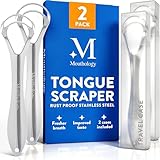
Mouthology Tongue Scraper (2-Pack)
Best for: People who have been nicked by a sharp-edged metal scraper and want a smoother one
- Stainless steel with a smooth edge rather than a cutting one
- Includes snap-close travel cases for both scrapers
- Ease of use praised in 1,260 of 1,281 comments about it
- U-shape design for full tongue coverage in one pass
- +Smooth edge rather than a sharp one, which one reviewer, whose previous metal scraper made their tongue bleed, singles out
- +Ease of use praised in 1,260 of 1,281 comments about it
- +Two scrapers per pack, each with its own snap-close travel case
- −Standard U-shape lacks the adjustable width of Dr. Tung's, so it may feel wide for smaller mouths
- −Steel rather than copper, the material a dentist quoted by CNN Underscored credits with natural antimicrobial properties
(Affiliate link) · Free shipping on eligible Prime items
Why We Recommend It
This one earns its slot on comfort rather than on volume. It sits at 4.6 stars across roughly 81,000 ratings, which is a large pool but not the largest here (the MasterMedi two-pack above is past 100,000), so the interesting number is the shape of the feedback rather than its size. Ease of use is positive in 1,260 of 1,281 comments about it. The review worth acting on comes from one owner whose previous metal scraper “had too sharp of an edge and it made my tongue bleed” and who calls this one a “great scraper.” If a previous scraper has cut you, that is the reason to pick this over the cheaper stainless options. Mouthology is the same brand behind the nHAP toothpaste we recommend on our hydroxyapatite toothpaste page.
Key Features
- 100% stainless steel that resists rust and corrosion
- A smooth edge rather than a cutting one, which one reviewer, whose previous metal scraper made their tongue bleed, singles out
- Two scrapers per pack, each with its own snap-close travel case
- Classic U-shape provides full tongue coverage in a single stroke
- Rinse, or soak with a cleaning tablet or lemon water, is the maker’s cleaning advice; one reviewer runs it through the dishwasher
Who It’s Best For
Anyone who has given up on a metal scraper because it felt harsh, and anyone who presses hard and wants an edge that will not punish them for it. The included travel cases also make it a strong pick for frequent travelers or anyone who keeps oral care supplies in multiple locations.
Potential Downsides
At around $10 for two scrapers it is priced almost exactly like the MasterMedi two-pack above, which also comes with a case for each scraper, so the choice between them comes down to how sensitive your tongue is rather than to cost. The design is a standard U-shape without the adjustable width of Dr. Tung’s, so it may feel slightly wide for people with smaller mouths. It is steel rather than copper, the material a dentist quoted by CNN Underscored credits with “natural antimicrobial properties,” though no study this page cites compares the two in use. Durability is the one soft spot in the feedback, negative in 119 of 466 comments about it, including reports of rust spots on a tool sold as stainless.
(Affiliate link) · Free shipping on eligible Prime items
Mouthology Copper Tongue Scraper: Best Copper Option

Mouthology Copper Tongue Scraper (2-Pack with Travel Cases)
Best for: People who want copper in the same two-pack, travel-case format as the brand's stainless scraper
- Copper U-shape scraper in the same format as the brand's stainless two-pack
- Two scrapers, each with its own travel case
- Lifetime replacement promised by the maker
- Rinse with soap and water and dry before it goes back in the case, per the listing
- +Rated 4.8 and sitting third in Amazon's tongue-scraper category with 1K+ bought in the past month, on a listing that has only been up since July 2024
- +Two scrapers, each with its own travel case, at about $5 a scraper
- +The maker promises a lifetime replacement if anything happens to the scraper
- −About 420 ratings is a small pool next to the 103,000-rating MasterMedi pick, so the 4.8 is an early read rather than a settled one
- −One of the listing's own bullets still calls it '100% stainless steel', a copy-paste slip that a buyer checking materials will notice
(Affiliate link) · Free shipping on eligible Prime items
Why We Recommend It
This is the copper option on the page, and it comes from the same brand as the stainless two-pack above. The format is identical: two U-shaped scrapers, a travel case for each, about $10 for the pair. What it changes is the metal. Everyday Health’s tongue-scraping guide tells readers who want to follow the Ayurvedic tradition to “opt for a horseshoe-shaped scraper made of copper,” so this is the one to pick if that tradition is part of why you scrape.
The numbers are good but young. The listing has been on Amazon since July 2024, holds a 4.8 across roughly 420 ratings, and sits third in Amazon’s tongue-scraper category with more than a thousand bought in the past month. Amazon’s AI summary of the review text is one-sided in its favour: all 22 customers who mention tongue cleaning are positive, all 11 who mention value, and eight of the nine who mention ease of use. That is a far smaller pool than the 100,000-rating MasterMedi pick, so treat the 4.8 as an early read. We carry it because the format and the price match the stainless version we already trust, and because the listing promises a lifetime replacement if anything happens to the scraper.
Key Features
- Copper U-shape scraper, the material Everyday Health’s guide points to for the Ayurvedic tradition
- Two scrapers per pack, each with its own travel case
- Lifetime replacement: the listing says the maker will replace the scraper if anything happens to it
- Cleaning per the listing: rinse with soap and water, dry thoroughly, then store in the case
Who It’s Best For
Readers who have decided they want copper and would rather have it in a format they already know than gamble on an unfamiliar brand. If you already like Mouthology’s stainless scraper, this is the same tool in a different metal.
Potential Downsides
Copper darkens over time, which is normal for the metal rather than a defect; the listing itself describes the copper as rust-proof, and says nothing about the patina. The review pool is small, about 420 ratings, so a bad batch would show up in the score faster than it would on a listing with 100,000. And one of the listing’s own bullets describes the scraper as “100% stainless steel”, which is plainly a copy-paste error on a product sold and pictured as copper, but it is the kind of slip that makes a careful buyer pause. As with every copper scraper, we found no published trial showing copper cleans better than stainless steel, so the case for it is material preference, not performance.
(Affiliate link) · Free shipping on eligible Prime items
GUM Dual-Action Tongue Cleaner
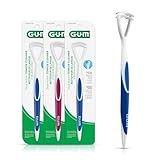
GUM Dual-Action Tongue Cleaner
Best for: People who want a combined scraper and brush in one tool
- Dual scraper + bristle brush design
- Low-profile head to reduce gag reflex
- Long, comfort-grip handle
- From Sunstar GUM — a trusted name in dental care
- +Combines bristles and a scraper edge in one tool, so you can try both without buying two
- +Thin, low-profile head minimizes gag reflex
- +Comes from Sunstar GUM, an established dental care brand
- +Ships as a 3-pack, about $3.33 per tool
- −Plastic tool that will need replacing every few months
- −Plastic scraper side: CNN Underscored's dentist source says metal scrapers typically remove buildup more thoroughly
(Affiliate link) · Free shipping on eligible Prime items
Why We Recommend It
The GUM Dual-Action Tongue Cleaner combines two cleaning methods into one tool: bristles on one side to loosen debris, and a scraper edge on the other to sweep it away. It comes from Sunstar GUM, an established dental care brand. It ships as a 3-pack for about $9.99, roughly $3.33 per tool, making it a low-cost way into tongue cleaning, and the listing says its narrow head “minimizes sensitivity and gag reflex.”
Key Features
- Dual-sided design with bristles on one side and a flat scraper on the other
- Thin, low-profile head minimizes gag reflex
- Ergonomic handle with a comfortable grip
- Long comfort-grip handle for reach to the back of the tongue
- Comes from Sunstar GUM, an established dental care brand
- Sold as a 3-pack (about $3.33 per tool)
Who It’s Best For
First-time tongue scraper users who aren’t sure whether they’ll prefer bristles or a scraper edge: this lets you try both without buying two tools. Also great for anyone on a budget who wants an effective tool from a reputable brand. Parents introducing tongue cleaning to older kids or teens may find the familiar toothbrush-like form factor easier to get buy-in on.
Potential Downsides
Like the Orabrush, it’s a plastic tool that will need replacing every few months. Its bristle side is a double-row brush, per the listing, rather than the Orabrush’s micro-pointed bristles. The scraper side is plastic rather than metal: CNN Underscored notes plastic and silicone tools “can be gentler,” but its dentist source says metal scrapers typically remove buildup more thoroughly, and one GUM reviewer called the plastic scraper side “very uncomfortable, actually painful” and “a bit sharp,” and found it ineffective even with light pressure.
(Affiliate link) · Free shipping on eligible Prime items
Buyer’s Guide: What to Look For
Material: Stainless Steel vs. Copper vs. Plastic
Your choice of material affects durability, hygiene, and daily experience:
- Stainless steel: The default in the bad-breath threads we read. It’s durable, easy to clean, resists rust, and lasts for years. The makers here describe their steel as medical-grade (Davids), high-grade (Dr. Tung’s) or 100% stainless (MasterMedi, Mouthology).
- Copper: Dr. Michael Wei, a cosmetic dentist quoted by CNN Underscored, says “copper has natural antimicrobial properties and can offer effective cleaning, though it may tarnish over time,” so expect more upkeep than steel. Just make sure it’s pure copper, not copper-coated.
- Plastic/bristle: Gentler on the tongue and less likely to trigger a gag reflex. However, plastic tools need regular replacement and can’t be sterilized as effectively as metal.
Shape and Design
The classic U-shape (or horseshoe shape) is the format most of the scrapers on this page use. It allows you to cover the full width of the tongue in a single stroke. Avoid narrow, flat scrapers that require multiple passes: they’re less efficient and more likely to cause gagging from repeated back-and-forth motion.
Gag Reflex Considerations
If you have a strong gag reflex, consider a low-profile tool like the GUM Dual-Action or the Orabrush. Starting with gentle pressure and gradually working further back over the course of a few weeks can also help your body adapt. Don’t force it, but don’t settle for the tip either: a 2015 Swiss study of 100 volunteers found the densest coating in the mid-back part of the tongue, so the goal is to move your starting point further back as your gag reflex adapts.
How to Use a Tongue Scraper
Proper technique is straightforward but worth getting right. According to Cleveland Clinic, bacteria and food debris can build up on the tongue, which is why cleaning it with a tongue scraper is recommended as part of daily oral hygiene.
- Stick your tongue out comfortably
- Place the scraper as far back as you can without gagging
- Apply gentle, even pressure and pull forward in one smooth stroke
- Rinse the scraper under running water
- Repeat 2-5 times until the tongue looks clean and pink
- Rinse your mouth with water or mouthwash afterward
For the best results, scrape your tongue every morning before eating or drinking. Building it into your brushing routine (especially alongside a thorough approach to removing plaque) helps make it a lasting habit. Some people also do their scraping right after an oil pulling session, since both are typically part of the same first-thing-in-the-morning ritual.
A Tongue Scraper Won’t Fix Everything
This is worth saying directly: if you have chronic bad breath that persists despite scraping, brushing, and flossing, a better tongue scraper is probably not the answer. In the r/badbreath threads we read for this guide, several people describe scraping daily while the white or yellow coating returns within hours. That often points to an underlying condition like acid reflux (GERD/LPR), post-nasal drip, tonsil stones, candida, or dry mouth. A tongue scraper treats the surface symptom, not the root cause. If your tongue coating keeps coming back despite consistent scraping, talk to your dentist or doctor about what might be driving it. If acid reflux (GERD/LPR) is the suspect, our bad breath from stomach guide walks through how to tell whether the smell is coming from your stomach rather than your mouth before that appointment. Some readers also add dental probiotics alongside scraping as a way to work on the bacterial load itself rather than just clearing the surface coating. For the surface-level maintenance that a scraper can address, pair it with a quality mouthwash for bad breath and a solid flossing routine.
When to Replace Your Scraper
Stainless steel and copper scrapers can last for years with proper care. Clean them after each use the way the maker says: the dishwasher or a hand wash for the MasterMedi, a rinse or a soak in water with a cleaning tablet or lemon for the stainless Mouthology, soap and water for the copper one. Plastic and bristle-style cleaners should be replaced every 3-4 months, similar to a toothbrush head.
FAQ
Q: Do tongue scrapers actually help with bad breath? For breath odour and tongue coating, the evidence is supportive but modest. A 2010 systematic review in the International Journal of Dental Hygiene found that tongue brushing or scraping has “the potential to successfully reduce breath odour” and tongue coating, but that data on chronic halitosis are insufficient. Bacteria on the tongue are one of the main sources of bad breath, so a daily scrape is a reasonable habit. That said, tongue scraping works best as part of a full routine that includes brushing, flossing, and rinsing with a quality mouthwash for bad breath.
Q: Is a tongue scraper better than brushing your tongue with a toothbrush? The small trials lean toward the scraper. In a 10-person crossover trial in the Journal of Periodontology, a tongue scraper cut sulfur-gas readings by 75% against 45% for a soft toothbrush, although both removed the coating, and a 2006 Cochrane review called the evidence for a small advantage of scrapers over toothbrushes “weak and unreliable.” Cochrane withdrew that review in 2016 and folded tongue scraping into a broader 2019 review of halitosis treatments, whose abstract rates the evidence for tongue cleaning against none as very uncertain. Brushing your tongue is still a worthwhile step: Cleveland Clinic calls it “an easy first step,” while the hygienist it quotes says scraping “can do a better job.”
Q: How often should I scrape my tongue? Once or twice a day. Cleveland Clinic’s tongue-scraping routine runs morning and night, and Davids suggests “once or twice a day, typically in the morning and at night.” The morning pass targets morning breath: Mayo Clinic notes that dry mouth “naturally occurs during sleep, leading to ‘morning breath,’” and that the tongue “can trap bacteria that produce odors.” Whichever you choose, keep the pressure light; Cleveland Clinic says scraping “shouldn’t hurt.”
Q: Can tongue scraping damage my taste buds? When done correctly with gentle pressure, tongue scraping is safe and should not damage taste buds. Several makers here, MasterMedi and Davids among them, say scraping enhances taste, though that is their claim rather than a tested result we hold. If you notice soreness or irritation, you’re pressing too hard.
Q: Is copper better than stainless steel for tongue scraping? Both do the mechanical job. The cosmetic dentist CNN Underscored consulted calls stainless steel an ideal choice for being durable and easy to sanitize, and says copper “has natural antimicrobial properties” but “may tarnish over time.” Neither study this page cites compares copper with steel scrapers, so choose on maintenance, taste and tradition.
Q: Should I scrape my tongue before or after brushing? The advice splits. Davids says “dentists usually recommend using a tongue scraper before brushing,” so your toothpaste works on a cleaner surface, while Cleveland Clinic’s routine has you brush, floss and rinse first and scrape last. The forum discussions behind this page show no strong consensus either, so pick the order you will keep doing.
Our Methodology
We compiled this roundup by reviewing dentist and hygienist recommendations from credible sources, including the ADA, dental practice blogs with verified clinical authors, and peer-reviewed studies on tongue cleaning efficacy. We evaluated products based on material quality and safety certification, effectiveness at removing tongue coating and reducing bacterial load, design considerations like gag reflex management and ergonomics, durability and long-term value, and consumer feedback patterns across major retail platforms.
We did not accept payment for product placement. Some links in this article are affiliate links, which means we may earn a small commission if you purchase through them, at no extra cost to you. Our editorial recommendations are made independently of any commercial relationships. When in doubt, we always encourage you to consult your dentist for personalized guidance.


