
A Dental Roundup reference
Interdental brush sizes, decoded.
The millimetre figures brands publish often aren't the size of gap the brush fits: TePe's US product names give the wire size, and GUM's size chart gives the brush width.
21 sizes from 4 brands · 6 product lines where we found no size figure from the maker · every figure sourced and dated
Figure · One brush, three gaps
TePe's US product name for its Original Blue says 0.6 mm. That is the wire. The gap it fits starts at 1.1 mm: the ring.
The bristles squeeze to fit a gap, but never smaller than the ring. That ring is the "fits a gap of" figure.
TePe Original Blue (ISO 3), drawn to scale from TePe's published figures; the parts TePe does not publish are drawn dashed. The ring is TePe's "PHD size" figure.
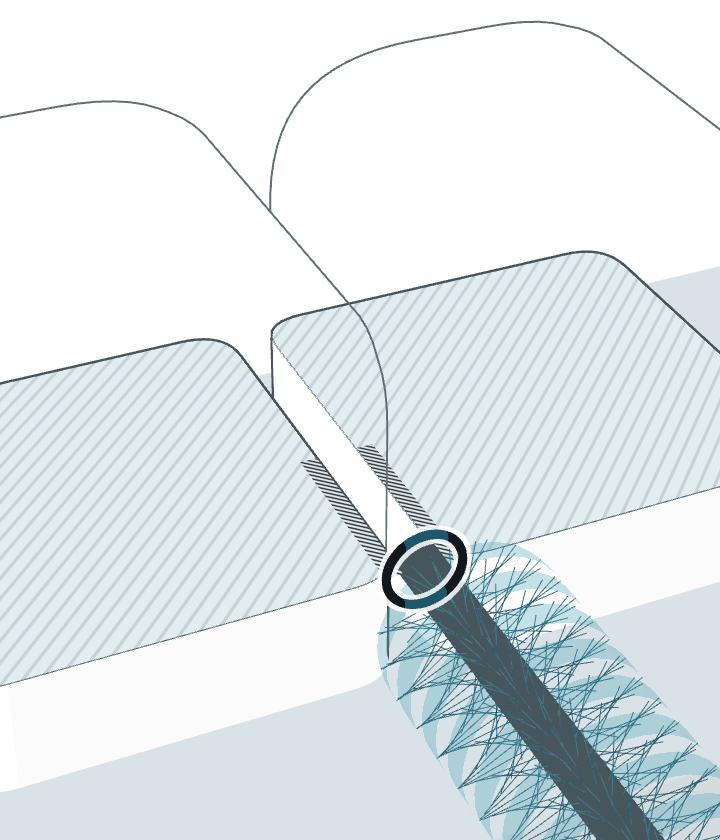
1Too tight.Gap narrower than 1.1 mm.The bristles cannot squeeze smaller than the ring, so the brush would have to be forced.
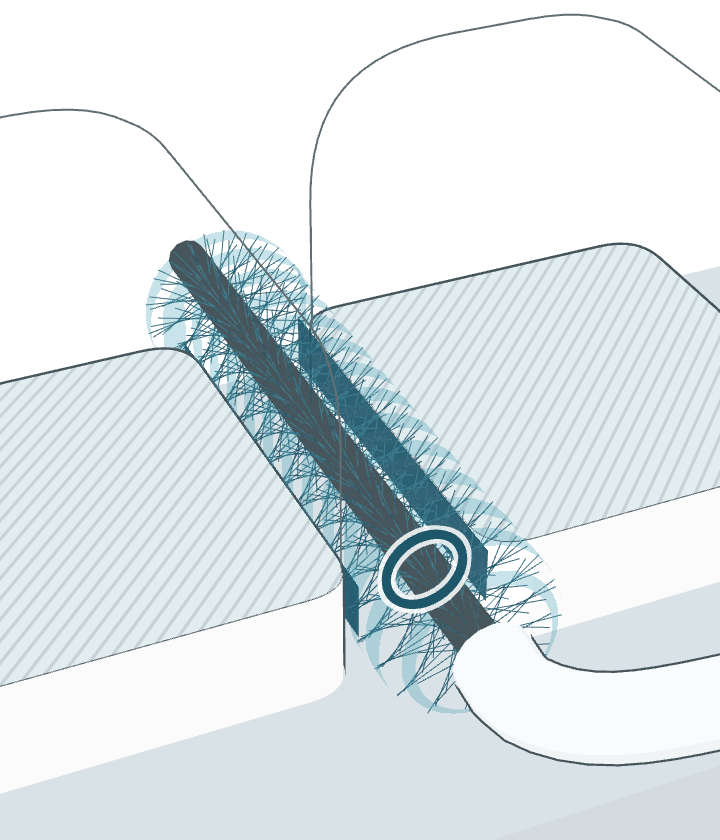
2Snug.Gap from 1.1 mm up to the bristle width.The bristles squeeze and touch both teeth. TePe does not publish the bristle width, so this edge is drawn schematically.
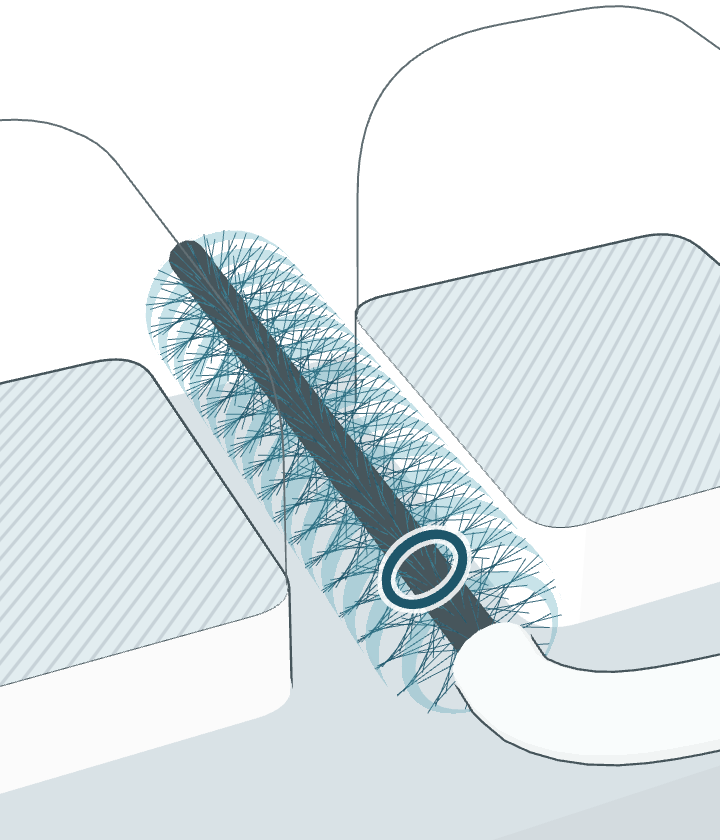
3Too loose.Gap wider than the bristles.The bristles do not touch the teeth. TePe does not publish the bristle width, so this edge is drawn schematically.
- Ring: fits a gap of 1.1 mm. The smallest hole this brush passes through. TePe calls it "PHD size". Source: TePe, UK product catalogue 2025, checked 2026-09-24.
- Wire: 0.6 mm. The mm figure in TePe's US product name for this brush. TePe calls it "Wire size". Sources: TePe, Interdental Brushes Original Blue product page (US), checked 2026-09-24; TePe, UK product catalogue 2025, checked 2026-09-24.
- Bristles: width not published. TePe does not publish how wide the bristles are, so they are drawn dashed, to an assumed width.
Drag sideways to turn it, or select it and use the arrow keys. Up and down arrows tilt it.
Schematic, not a clinical drawing. Colour marks nothing about size.
What the millimetre figure measures
- TePethe gap it fits, plus the wire thickness
- The PHD size figure in TePe's catalogue: the gap it fits, labelled "PHD size" on tepe.com · TePe, checked 2026-09-24
- The wire size figure in TePe's catalogue: the wire thickness, labelled "Wire size" on tepe.com · TePe, checked 2026-09-24
- The mm figure in TePe's US product names, which matches the wire size in TePe's catalogue: the wire thickness · TePe, checked 2026-09-24
- CuraproxIts own websites disagree
- The first mm figure Curaprox gives for a CPS prime brush: the gap it fits, labelled "accessibility" on curaprox.us · Curaprox, checked 2026-09-24
- The first mm figure Curaprox gives for a CPS prime brush: the wire thickness, labelled "Wire diameter" on curaprox.co.uk · Curaprox, checked 2026-09-24
- The second mm figure Curaprox gives for a CPS prime brush: the bristle width, labelled "effectiveness" on curaprox.us · Curaprox, checked 2026-09-24
- The second mm figure Curaprox gives for a CPS prime brush: the bristle width, labelled "Brush diameter" on curaprox.co.uk · Curaprox, checked 2026-09-24
One figure, two labels: curaprox.us calls it "accessibility" (the gap it fits); curaprox.co.uk calls it "Wire diameter" (the wire thickness). The chart files it under "fits a gap of", marked with an asterisk.
- GUMthe bristle width, plus an unlabelled figure
- The two figures on GUM's US size chart, drawn across the bristles: the bristle width · GUM (Sunstar), checked 2026-09-24
- The bottom mm figure beside each brush on GUM's US size chart: a figure the maker does not label · GUM (Sunstar), checked 2026-09-24
- DenTekan unlabelled figure
- The mm figure beside each ISO size on DenTek's EU site: a figure the maker does not label · DenTek, checked 2026-09-24
Sizes, brand by brand
"Fits a gap of" is the passage-hole diameter (PHD): the smallest hole the brush passes through, and the figure to compare across brands. ISO size is the size number from the international standard for interdental brushes; each ISO number covers a small range of gap sizes, so it is coarser than the gap figure. Colours are each brand's own code, not a shared one. Each table shows only the figures that maker publishes; the line under its name lists what it leaves out. The "View on Amazon" buttons are affiliate links: if you buy through one, we may earn a commission at no extra cost to you.
| Colour | Fits a gap of | ISO size | Wire | Buy |
|---|---|---|---|---|
| Pink | 0.6 mm | 0 | 0.4 mm | View on Amazon(Affiliate link) |
| Orange | 0.7 mm | 1 | 0.45 mm | View on Amazon(Affiliate link) |
| Red | 0.9 mm | 2 | 0.5 mm | View on Amazon(Affiliate link) |
| Blue | 1.1 mm | 3 | 0.6 mm | View on Amazon(Affiliate link) |
| Yellow | 1.3 mm | 4 | 0.7 mm | View on Amazon(Affiliate link) |
| Green | 1.6 mm | 5 | 0.8 mm | View on Amazon(Affiliate link) |
| Purple | 2.0 mm | 6 | 1.1 mm | View on Amazon(Affiliate link) |
| Grey | 2.6 mm | 7 | 1.3 mm | View on Amazon(Affiliate link) |
| Black | 3.4 mm | 8 | 1.5 mm | View on Amazon(Affiliate link) |
| Size | Colour | Fits a gap of | Brush width | Buy |
|---|---|---|---|---|
| CPS 06 Prime | Blue | 0.6 mm* | 2.2 mm | View on Amazon(Affiliate link) |
| CPS 07 Prime | Red | 0.7 mm* | 2.5 mm | View on Amazon(Affiliate link) |
| CPS 08 Prime | Pink | 0.8 mm* | 3.2 mm | |
| CPS 09 Prime | Yellow | 0.9 mm* | 4.0 mm | View on Amazon(Affiliate link) |
| CPS 011 Prime | Green | 1.1 mm* | 5.0 mm |
| Size | Brush width | Other figure (unlabelled) | Buy |
|---|---|---|---|
| Ultra Tight | 2.30 mm | 0.48 mm | View on Amazon(Affiliate link) |
| Tight | 2.31 to 2.79 mm | 0.48 mm | View on Amazon(Affiliate link) |
| Moderate | 3.70 to 4.30 mm | 0.67 mm | View on Amazon(Affiliate link) |
| Wide | 3.79 to 6.86 mm | 0.67 mm | View on Amazon(Affiliate link) |
| ISO size | Other figure (unlabelled) |
|---|---|
| 1 | 0.45 mm |
| 2 | 0.5 mm |
| 3 | 0.6 mm |
* The maker's own websites disagree on what this figure measures (see above).
Size figures we could not find from the maker
- GUM Soft-Picks: not published by the maker (checked 2026-09-24).
- Piksters Interdental brushes (its own chart uses size numbers 000 to 9 with no mm figure): not published by the maker (checked 2026-09-24).
- DenTek US Easy Brush and Slim Brush (we could not confirm they share the EU sizes): not published by the maker (checked 2026-09-24).
- Plackers Interdental brushes: not published by the maker (checked 2026-09-24).
- Oral-B Manual interdental brushes (US): not published by the maker (checked 2026-09-24).
- Store brands Equate and CVS Health interdental brushes: not published by the maker (checked 2026-09-24).
Brand names are trademarks of their owners. Dental Roundup is not affiliated with, sponsored by, or endorsed by any manufacturer named here; we restate their published figures.
How to find your size
The simplest route is to ask your hygienist or dentist to size your gaps at your next cleaning. The British Society of Periodontology says your hygienist or dentist will advise you on the type and size, and that you will likely need several sizes to clean your whole mouth.
Without a sizing, TePe's own guide suggests starting with a mixed pack and working up from the smallest size until you feel the bristles touch the tooth and the gum. The fit should be snug (NHS). Never force a brush into a gap: GUM's advice is to go down a size instead.
Gaps vary around the mouth, so expect to end up with more than one size. GUM notes that the gaps between back teeth may need larger heads than those between front teeth.
Where no size fits without forcing, clean that gap with floss instead: the British Society of Periodontology gives floss that role for spaces too tight for a brush.
Your gums may bleed when you start. TePe's guide says not to stop, because bleeding is a sign of inflammation caused by plaque. If the bleeding is heavy or keeps going, GUM's advice is to see your dental professional.
Once you know your sizes, compare brands on the "fits a gap of" column. It is the one figure measured the same way across brands, under the ISO standard for interdental brushes, for the brands that publish it. In this chart that is TePe's PHD size; Curaprox's figure carries an asterisk because its own websites label it differently.
For which brushes to buy, see our interdental brush roundup.
How we built this
We read each maker's own product pages and catalogues, saved a dated copy of every page a size figure comes from, and checked every figure against that copy. A figure appears here only if the maker or a peer-reviewed paper publishes it; we never take a size from a store listing. Last checked September 24, 2026.
The gap problem is not ours alone: a 2020 study that mapped 24 manufacturers' ranges found that a third stated the ISO size and a quarter stated the passage size.
As an Amazon Associate we earn from qualifying purchases. Buy links in the chart are marked.