
Sensodyne makes over a dozen toothpaste formulas, and the differences between them are confusing. Some use potassium nitrate, others use stannous fluoride. “Pronamel” is a sub-brand within Sensodyne that targets enamel erosion specifically, but that distinction isn’t obvious from the packaging. We compared every current Sensodyne formula to identify which one matches your specific concern, because the right Sensodyne depends entirely on whether you’re dealing with sensitivity, enamel erosion, gum problems, or some combination. For a broader look at sensitivity toothpastes across brands, see our best toothpaste for sensitive teeth roundup.
How We Evaluated Sensodyne Formulas
Active ingredient mechanism. Sensodyne uses two distinct desensitizing approaches: potassium nitrate (which calms the nerve inside the tooth) and stannous fluoride (which physically blocks the exposed dentin tubules). Understanding this distinction is essential for choosing the right formula: they work differently and are better suited to different types of sensitivity.
Specificity of purpose. Each Sensodyne formula targets a different combination of concerns. We evaluated how well each product delivers on its specific promise rather than treating them as interchangeable sensitivity toothpastes.
User feedback patterns. We reviewed thousands of Amazon reviews and dental community discussions to identify which formulas consistently deliver on their claims and which ones generate recurring complaints, particularly around taste, texture, and staining.
Clinical backing. We prioritized formulas with documented clinical evidence for their specific claims, working from peer-reviewed trials and manufacturer-published studies. The individual papers are cited inline at the claims they support, rather than gestured at in a methodology note.
Value relative to alternatives. Some Sensodyne formulas cost significantly more than others. We evaluated whether the premium formulas justify their price through different ingredients or just repositioned marketing.
Sensodyne Repair & Protect Whitening — Editor’s Pick
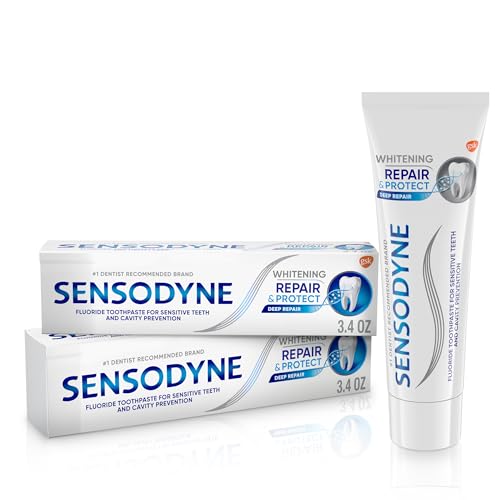
Sensodyne Repair & Protect Whitening
Best for: Most people with sensitivity who want a single toothpaste that repairs, protects, and whitens
- Stannous fluoride (0.454%) actively blocks exposed dentin tubules, addressing the root cause of sensitivity rather than just masking pain
- The same stannous fluoride helps repair deep inside exposed tubules, building increasing protection against sensitivity with continued use
- Whitening action lifts surface stains; Haleon gives no abrasivity figure on its US product page or label
- One of the most-reviewed Sensodyne products with consistently high ratings across tens of thousands of users
- +Stannous fluoride blocks exposed dentin tubules, addressing the cause of sensitivity
- +Protection against painful sensitivity builds with continued twice-daily use
- +Addresses sensitivity, enamel repair, and whitening in a single tube
- −Stannous fluoride can build up extrinsic surface stain with continued daily use
- −Some users find the texture slightly gritty compared to regular toothpaste
(Affiliate link) · Free shipping on eligible Prime items
Why We Recommend It
Repair & Protect Whitening is the most versatile Sensodyne formula because it addresses sensitivity, enamel repair, and whitening in a single tube. The stannous fluoride base blocks exposed dentin tubules (the tiny channels in your teeth that transmit pain signals when enamel wears thin), and with continued use it helps repair deep inside those tubules, building increasing protection against sensitivity over time.
With more than 48,000 ratings at 4.8 stars, this is the most-reviewed pick in this lineup by a wide margin. The consistent thread in user reviews is that sensitivity relief builds over the first two weeks and remains effective with continued use. Commenters in dental subreddits often suggest Repair & Protect as the default starting point because it covers the widest range of sensitivity scenarios without requiring users to diagnose their specific issue first.
The whitening component is modest (don’t expect dramatic results), but it’s enough to keep everyday surface stain in check between cleanings. For people who want one Sensodyne and don’t want to overthink which formula they need, this is the straightforward choice, and at around $12.50 for a twin pack, it’s one of the more affordable ways into the lineup.
Key Features
- Stannous fluoride (0.454%) for tubule-blocking sensitivity relief
- Builds increasing protection against sensitivity with continued use
- Surface-stain whitening
- Cavity protection and fresh breath
- Available in multiple pack sizes
Who It’s Best For
Repair & Protect Whitening is the right choice if you experience general sensitivity (to cold, hot, sweet, or pressure) and want a single toothpaste that addresses it without sacrificing whitening. It’s also the formula we’d recommend if you’re new to Sensodyne and aren’t sure which product line to start with.
Potential Downsides
Stannous fluoride can build up extrinsic surface stain with continued use. This is a measured effect in toothpaste trials, not just a review-section grumble — the buyer’s guide below has the trial and the numbers. The stain sits on the tooth surface rather than inside it, so it comes off during a professional cleaning, but it’s worth knowing about. Some users also find the texture slightly gritty compared to regular toothpaste. If staining is a concern, the Pronamel line (which uses potassium nitrate or sodium fluoride) avoids this issue entirely.
(Affiliate link) · Free shipping on eligible Prime items
Sensodyne Pronamel Intensive Enamel Repair — Best for Enamel Repair
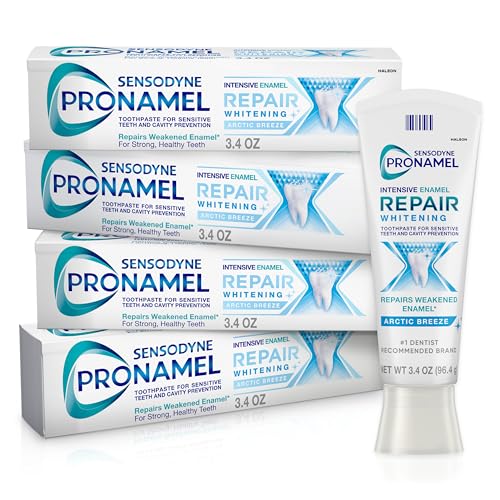
Sensodyne Pronamel Intensive Enamel Repair
Best for: People with early signs of enamel erosion from acidic foods, drinks, or acid reflux
- Pronamel's most repair-focused formula, aimed at active remineralization rather than just protection
- Optimized-pH formula designed to work specifically on acid-softened enamel
- Haleon describes it as a uniquely formulated low-abrasion toothpaste
- Actively helps reharden weakened enamel rather than just preventing further damage
- +Targets active remineralization of acid-softened enamel, not just protection from further damage
- +Optimized pH formula actively helps reharden acid-softened enamel
- +Potassium nitrate relief without the staining risk of stannous fluoride
- −Linked listing is a 4-pack of the Whitening variant, so the upfront cost sits near the top of this lineup
- −Potassium nitrate relief builds over about two weeks, slower than the stannous fluoride formulas
(Affiliate link) · Free shipping on eligible Prime items
Why We Recommend It
Pronamel Intensive Enamel Repair is the most targeted formula in Sensodyne’s lineup for enamel erosion. While all Pronamel products focus on acid protection, the Intensive version is formulated with an optimized pH specifically designed to help reharden enamel that’s already been softened by acids, not just prevent future damage.
This distinction matters. Regular Pronamel (like Daily Protection) focuses on shielding enamel from acid exposure. The Intensive formula goes a step further by actively promoting remineralization of enamel that has begun to erode. If your dentist has pointed out early signs of enamel erosion, or you consume acidic foods and drinks regularly (citrus, coffee, wine, carbonated beverages), this formula targets that specific problem.
The trade-off is that Intensive Enamel Repair uses potassium nitrate for sensitivity rather than stannous fluoride, so you get nerve-calming relief but not the tubule-blocking mechanism of Repair & Protect. For most people with acid erosion, this is the better fit: the priority is rebuilding enamel, and potassium nitrate handles the sensitivity component without the staining risk of stannous fluoride. For a broader comparison of enamel-focused options across brands, see our best enamel repair toothpaste roundup.
Key Features
- Pronamel’s most repair-focused formula
- Optimized pH for maximum remineralization of acid-damaged enamel
- Potassium nitrate for sensitivity relief
- Low-abrasion formula, in Haleon’s description
- Cavity protection
Who It’s Best For
This is the right Sensodyne if your primary concern is enamel erosion rather than general sensitivity. Ideal for people with acid reflux (GERD), heavy citrus or soda consumption, or those whose dentist has flagged early-stage enamel loss. Also a strong choice for anyone who wants maximum enamel protection without the staining potential of stannous fluoride formulas.
Potential Downsides
The listing we link is the Whitening variant of Intensive Enamel Repair, sold as a 4-pack of 3.4 oz tubes: about $23 upfront, which works out to under $6 a tube but puts the outlay near the top of this lineup alongside the Gentle Whitening 4-pack. Some users report a less satisfying “clean” feeling compared to stannous fluoride formulas: potassium nitrate formulas generally feel milder. If your sensitivity is severe rather than mild-to-moderate, the tubule-blocking approach of Repair & Protect may provide faster relief.
(Affiliate link) · Free shipping on eligible Prime items
Sensodyne Pronamel Gentle Whitening — Best for Whitening + Sensitivity
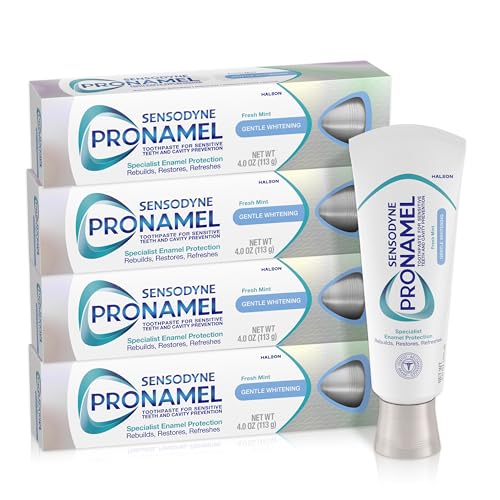
Sensodyne Pronamel Gentle Whitening
Best for: People who want gradual whitening without aggravating sensitivity or weakening enamel
- Potassium nitrate (5%) calms tooth nerve sensitivity over time with regular use
- Whitening formula Haleon says removes stains gently, from a line it calls low-abrasion
- Pronamel acid-protection technology shields enamel from dietary acid damage
- SLS-free formulation, which suits people who react to sodium lauryl sulfate
- +Haleon says it removes stains gently, with potassium nitrate for sensitivity
- +SLS-free formulation that Haleon says is specially formulated to protect teeth against the effects of acid erosion
- +Frequently the Editor's Pick on our best whitening toothpaste for sensitive teeth roundup
- −Whitening results are modest, a maintenance whitener rather than a transformation product
- −Relief isn't immediate; needs about two weeks of twice-daily use
(Affiliate link) · Free shipping on eligible Prime items
Why We Recommend It
Pronamel Gentle Whitening occupies a specific niche: it’s the Sensodyne for people who want whiter teeth but can’t tolerate standard whitening toothpastes. Whitening toothpastes lift stains mainly with abrasives, per the ADA, and Haleon gives no abrasivity number for this one on its US product page or label. What it does say is that Pronamel is a low-abrasion formula and that Gentle Whitening removes stains “gently, yet effectively”: a polish that works gradually rather than a bleach.
The active ingredient is potassium nitrate (5%), which works by calming the nerve inside the tooth rather than blocking dentin tubules. This means sensitivity relief builds over about two weeks of consistent use: it’s not instant, and the trial evidence for potassium nitrate is mixed, as the buyer’s guide below explains. A note on certification, verified against the ADA’s live roster in August 2026: no Pronamel product currently appears on the ADA Seal of Acceptance roster. Within the Sensodyne range, the Seal sits on the original Sensodyne Toothpaste entry, whose packaging shows the Fresh Mint and Fresh Impact tubes. Gentle Whitening stands on its formula instead: SLS-free whitening that Haleon describes as low-abrasion, built on Pronamel’s acid-erosion protection.
This is one of Sensodyne’s most popular formulas and frequently appears as the “Editor’s Pick” on our best whitening toothpaste for sensitive teeth roundup. It won’t deliver dramatic whitening results (for that you’d need a dedicated whitening treatment), but it’s effective at maintaining a clean, unstained appearance while keeping sensitivity under control.
Key Features
- Potassium nitrate (5%) for nerve-calming sensitivity relief
- Low-abrasion whitening, in Haleon’s description (no abrasivity figure on its US product page or label)
- Pronamel acid-protection formula
- SLS-free formulation
- Pleasant mint flavor that doesn’t overpower
Who It’s Best For
Gentle Whitening is the right choice if cosmetic appearance matters to you but standard whitening products cause pain or sensitivity. Particularly well-suited for coffee and tea drinkers who want to manage surface staining without switching to a dedicated whitening product. Also a strong daily driver for people with mild sensitivity who don’t need the more aggressive repair-focused formulas.
Potential Downsides
Whitening results are modest: users expecting visible shade changes will be disappointed. This is a maintenance whitener, not a transformation product, which is worth weighing even though the linked 4-pack of 4 oz tubes runs about $23, under $6 a tube. The potassium nitrate mechanism also means relief isn’t immediate; you need about two weeks of twice-daily use before sensitivity reduction becomes noticeable. If you need faster relief, the stannous fluoride formulas (Repair & Protect, Sensitivity & Gum) block tubules more quickly.
(Affiliate link) · Free shipping on eligible Prime items
Sensodyne Sensitivity & Gum — Best for Gum Health
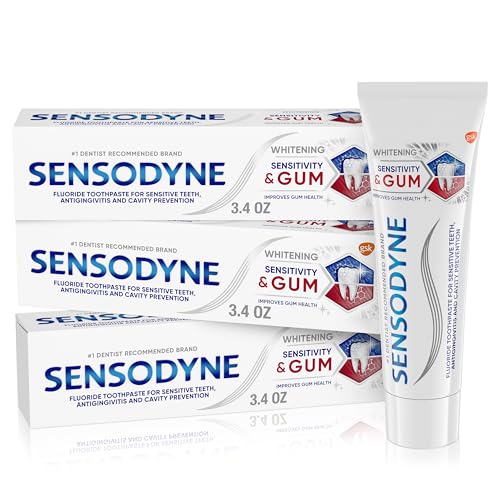
Sensodyne Sensitivity & Gum
Best for: People who deal with both tooth sensitivity and bleeding or inflamed gums
- Stannous fluoride addresses both sensitivity and gum inflammation — a dual-action formula for dual-concern users
- Formulated to help reduce bleeding gums with regular use
- Blocks exposed dentin tubules for sensitivity relief while providing antibacterial gum protection
- Designed for the specific overlap where sensitivity and gingivitis coexist
- +Stannous fluoride blocks dentin tubules while providing antibacterial gum protection
- +Formulated to help reduce bleeding gums with regular use
- +Targets the overlap of sensitivity and gum issues in one tube
- −Potential for extrinsic surface stain buildup from the stannous fluoride
- −Taste is divisive; some find the stannous fluoride flavor metallic or medicinal
(Affiliate link) · Free shipping on eligible Prime items
Why We Recommend It
Sensitivity & Gum exists because sensitivity and gum problems frequently overlap: receding gums expose root surfaces that lack enamel protection, causing sensitivity that’s distinct from regular enamel sensitivity. If you’re dealing with both bleeding gums and tooth sensitivity, this formula targets that specific intersection rather than addressing only one issue.
The stannous fluoride base does double duty here: it blocks exposed dentin tubules (sensitivity relief) and provides antibacterial action against the bacteria that cause gum inflammation. The ADA’s professional guidance cites a 2023 review that lists twice-daily stannous toothpastes among the options for reducing dentin hypersensitivity pain, and this formula’s US label also carries antigingivitis uses (helps control bleeding gums).
Forum discussions consistently highlight that people with both sensitivity and gum problems often cycle between a sensitivity toothpaste and a gum-health toothpaste, never fully addressing either concern. Sensitivity & Gum eliminates that compromise. The listing we link is the Whitening variant of the formula in a 3-pack: about $19.50, which works out to roughly $6.50 a tube.
Key Features
- Stannous fluoride (0.454%) for both sensitivity and gum health
- Antibacterial properties help reduce gum inflammation and bleeding
- Blocks dentin tubules for sensitivity relief
- Cavity protection
- Designed for dual-concern use
Who It’s Best For
This is the right Sensodyne if you notice both sensitivity (to cold, hot, or sweet) and gum symptoms (bleeding when brushing, redness, or puffiness). It’s particularly relevant for people with early gum recession, where the root surface becomes exposed and causes a type of sensitivity that enamel-focused products don’t fully address.
Potential Downsides
Like all stannous fluoride formulas, there’s a potential for extrinsic surface staining, which is an unwelcome trade-off if bleeding gums already have you self-conscious about your smile. The taste is divisive: some users find the stannous fluoride flavor metallic or medicinal compared to the milder Pronamel line. If your gum issues are your primary concern (without significant sensitivity), a dedicated anti-gingivitis toothpaste may be more effective.
(Affiliate link) · Free shipping on eligible Prime items
Sensodyne Pronamel Daily Protection — Best for Prevention
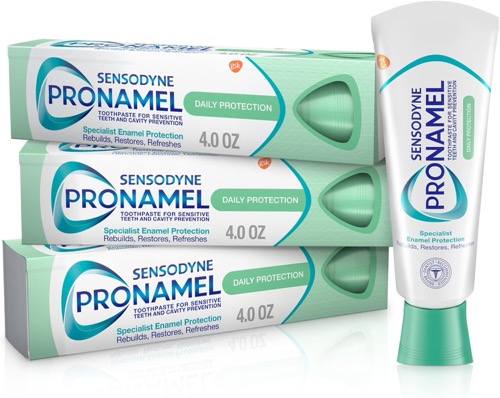
Sensodyne Pronamel Daily Protection (3-pack of 4 oz tubes)
Best for: People with mild sensitivity who want daily enamel protection and cavity prevention without a specialty feel
- Sodium fluoride with optimized pH formula protects enamel from everyday acid exposure
- Made for daily use, in a Pronamel formula Haleon describes as low-abrasion and says helps maintain the structural integrity of the enamel surface
- Cavity prevention that matches standard fluoride toothpastes
- Mild enough to use as a daily driver while still providing meaningful enamel protection
- +Made for daily use, in a Pronamel formula Haleon describes as low-abrasion and says helps maintain the structural integrity of the enamel surface
- +Protects enamel from daily acid exposure while providing cavity-fighting fluoride
- +Brushes and tastes like a standard fluoride toothpaste, no specialty feel
- −Potassium nitrate relief builds over about two weeks; it does not block tubules the way stannous fluoride does
- −Sold on Amazon as a 3-pack of 4 oz tubes (about $17.48), so the upfront cost is higher than a single tube
(Affiliate link) · Free shipping on eligible Prime items
Why We Recommend It
Pronamel Daily Protection is the Sensodyne for people who want preventive enamel care without the specialty-product feel. It’s the most “normal toothpaste” in the lineup; it brushes and tastes like a standard fluoride toothpaste while providing Pronamel’s acid-protection technology and what Haleon describes as a low-abrasion formulation.
The US label lists two active ingredients, potassium nitrate 5% for sensitivity and sodium fluoride 0.25% for cavities (DailyMed, checked September 2026), so it uses the slower potassium nitrate route to sensitivity relief rather than the stannous fluoride that blocks tubules in Repair & Protect. Its real job is protecting enamel from the daily acid attacks that cause erosion in the first place, from coffee, citrus, wine, carbonated drinks, and acidic foods. Think of it as the maintenance formula: if your enamel is currently healthy but you want to keep it that way, Daily Protection provides that shield without the stronger active ingredients of the treatment-oriented formulas. Amazon currently sells it as a 3-pack of 4 oz tubes, which is the listing we link.
It’s worth noting this formula already appears on our best toothpaste for cavities roundup, where its cavity-prevention credentials are evaluated against non-Sensodyne alternatives. Within the Sensodyne lineup specifically, Daily Protection is the right choice when enamel maintenance and cavity prevention are the priority, and sensitivity is mild or absent.
Key Features
- Sodium fluoride for cavity protection
- Pronamel optimized-pH acid-protection formula
- Low-abrasion formula, per Haleon
- Clean, mild mint flavor
- Suitable as a daily-use toothpaste
Who It’s Best For
Daily Protection is the right Sensodyne for people who don’t have active sensitivity but want to prevent enamel erosion and cavities. Ideal for anyone who’s been told their enamel is thinning, or who consumes a high-acid diet and wants proactive protection. Also a good fit for people who’ve used a treatment Sensodyne (like Repair & Protect) and want to transition to a lighter maintenance formula.
Potential Downsides
This is a maintenance product first. Its potassium nitrate does calm sensitivity, but only after a couple of weeks of twice-daily use, and it has no stannous fluoride, so it will not block open tubules the way Repair & Protect does. Users expecting fast relief may be disappointed. For faster relief of active sensitivity, choose a stannous fluoride formula such as Repair & Protect or Sensitivity & Gum instead. The 3-pack format also means a higher upfront price than a single tube, though the per-tube cost is lower.
(Affiliate link) · Free shipping on eligible Prime items
Sensodyne Extra Whitening (Cool Mint, 4-Pack) — Best Whitening Value
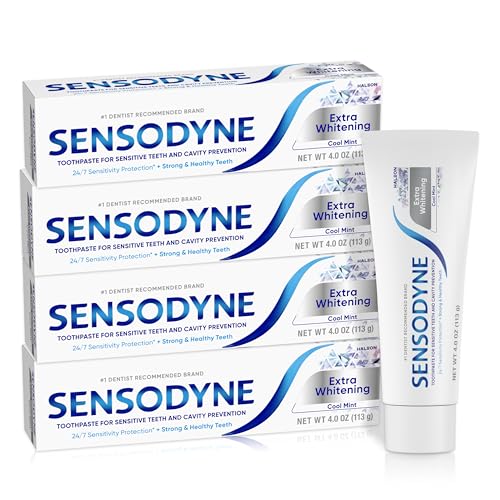
Sensodyne Extra Whitening (Cool Mint, 4-Pack)
Best for: People who want extra surface-stain whitening with sensitivity protection in a value 4-pack
- Four 4 oz tubes — roughly $5 per tube at our latest price check, the lowest per-tube cost in this lineup
- Extra-whitening fluoride formula that lifts surface stains
- Exclusive Cool Mint flavor for a fresh finish
- Fluoride cavity protection alongside sensitivity relief
- +Roughly $5 per tube at our latest price check, the lowest per-tube cost in this lineup
- +Extra-whitening formula lifts everyday surface stains
- +Pairs sensitivity protection with fluoride cavity protection
- −Upfront cost is higher than a single tube even though the per-tube price is lower
- −Whitening is surface-stain focused, not a substitute for a dedicated whitening treatment
(Affiliate link) · Free shipping on eligible Prime items
Why We Recommend It
Sensodyne Extra Whitening Cool Mint is the value play in the whitening corner of the lineup: four 4 oz tubes in one Amazon-exclusive pack, which works out to roughly $5 per tube at our latest price check, the lowest per-tube cost of any pick in this lineup.
It pairs Sensodyne’s sensitivity protection with an extra-whitening formula that lifts everyday surface stains, alongside standard fluoride cavity protection, in an exclusive Cool Mint flavor. In practical terms, that makes it a sensible stock-up option for sensitivity sufferers who also want to manage everyday surface staining without switching to a dedicated whitening paste.
Who It’s Best For
The right pick if you already know Sensodyne works for your sensitivity and you want to keep a whitening formula on hand without reordering every few weeks. Also a fit for Cool Mint flavor fans who find the standard mint formulas a little flat.
Potential Downsides
It’s a multipack, so the upfront cost is higher than a single tube even though the per-tube price is lower. The whitening is surface-stain focused: good for maintenance, not a substitute for a dedicated whitening treatment if you’re after a visible shade change. And Cool Mint is polarizing: some users love the stronger mint, others prefer the milder original.
(Affiliate link) · Free shipping on eligible Prime items
Sensodyne Fresh Mint (Original) — Best Budget
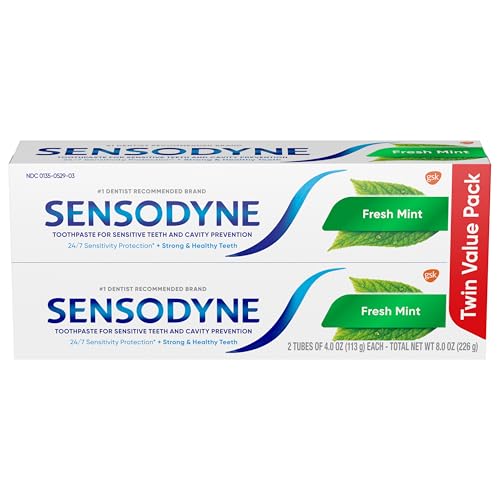
Sensodyne Fresh Mint (Original)
Best for: People who want basic sensitivity relief in an ADA-accepted, affordable formula without specialty features
- Potassium nitrate (5%) — the original Sensodyne active ingredient with decades of clinical evidence
- Fluoride for cavity protection (0.15% w/v fluoride ion)
- No-frills formula that does exactly what Sensodyne was originally designed to do: reduce sensitivity
- One of the most affordable Sensodyne options
- +Potassium nitrate active ingredient with decades of clinical study behind it
- +ADA Accepted (Seal of Acceptance) for sensitivity relief and cavity protection
- +One of the most affordable ways into the Sensodyne lineup
- −Basic formula: no enamel repair, whitening, or gum-health benefits
- −Requires about two weeks of consistent use before relief becomes noticeable
(Affiliate link) · Free shipping on eligible Prime items
Why We Recommend It
Fresh Mint is the original Sensodyne formula—potassium nitrate for sensitivity, fluoride for cavities, nothing else. No enamel repair claims, no whitening, no gum-health positioning. It’s the most straightforward product in the lineup and one of the least expensive.
Potassium nitrate works by reducing the excitability of the nerve inside the tooth. It doesn’t physically block dentin tubules like stannous fluoride does; instead, it calms the nerve’s response to stimuli. Potassium nitrate is one of the most widely used desensitizing ingredients, though a Cochrane review found the trial evidence mixed: objective sensitivity measures (air-blast and touch) improved in small trials, but patient-reported relief showed no significant effect. It carries the advantage of not causing the surface staining associated with stannous fluoride.
For someone who wants sensitivity relief without the premium pricing or specialty positioning of the Pronamel or Repair & Protect lines, Fresh Mint delivers the core Sensodyne benefit at one of the lowest entry prices in the lineup: around $12.50 for a 2-pack. It also carries the one ADA Seal of Acceptance in this lineup: the roster’s Sensodyne Toothpaste entry, accepted for sensitivity relief and cavity protection, shows the original Fresh Mint packaging (verified against the live roster, August 2026). And it’s a formula frequently suggested on dental forums as a starting point for people who ask “which Sensodyne should I start with?”, because it’s simple, ADA-accepted, and affordable.
Key Features
- Potassium nitrate (5%) for nerve-calming sensitivity relief
- Fluoride for cavity protection (sodium fluoride, 0.15% w/v fluoride ion)
- ADA Accepted (Seal of Acceptance) for sensitivity relief and cavity protection
- No staining risk from stannous fluoride
- One of the most affordable Sensodyne options
Who It’s Best For
Fresh Mint is the right choice if you want basic sensitivity relief without paying for specialty features you don’t need. Ideal for first-time Sensodyne users who want to see if sensitivity toothpaste works for them before investing in a more targeted formula. Also a solid option for people who’ve had staining issues with stannous fluoride products and want effective sensitivity relief without that side effect.
Potential Downsides
The formula is basic: no enamel repair, no whitening, no gum-health benefits beyond standard fluoride. If you have multiple dental concerns (sensitivity plus enamel erosion, or sensitivity plus gum issues), one of the specialty formulas will serve you better. Potassium nitrate also requires about two weeks of consistent use before sensitivity relief becomes noticeable, which can feel slow if you’re experiencing acute pain.
(Affiliate link) · Free shipping on eligible Prime items
Buyer’s Guide: Choosing the Right Sensodyne
Understanding the Two Active Ingredients
The single most important distinction across Sensodyne’s lineup is the active desensitizing ingredient, and understanding it eliminates most of the confusion.
Potassium nitrate (used in every Pronamel toothpaste in this lineup and in Fresh Mint) works by calming the nerve inside the tooth. It seeps into the dentin and reduces the nerve’s ability to transmit pain signals. Relief builds gradually over about two weeks of consistent use. The advantage: no staining risk and a milder, more pleasant brushing experience. The limitation: it masks the pain rather than blocking the physical pathway that causes it.
Stannous fluoride (used in Repair & Protect and Sensitivity & Gum) works differently: it forms a physical barrier over exposed dentin tubules, blocking the channels that transmit pain to the nerve. This tends to provide faster, more noticeable relief. The trade-off is extrinsic staining: stannous ions precipitate dietary chromogens onto the tooth surface, and a five-week randomized trial measured significantly more surface stain on a 0.454% stannous fluoride toothpaste, the same concentration Repair & Protect uses, than on the pastes it was compared against. A 2025 laboratory study of tin-containing toothpastes also measured a shift toward yellower enamel after three weeks of staining-and-brushing cycles. How much stain a given paste leaves depends heavily on how it’s formulated, so the risk varies by product. The stain sits on the tooth surface rather than inside it, so it comes off during a professional cleaning, but it’s a common enough complaint that it’s worth factoring into your choice.
Neither approach is universally better. If your sensitivity is mild and staining concerns you, potassium nitrate formulas are the safer bet. If your sensitivity is moderate-to-severe and you want faster relief, stannous fluoride is typically more effective.
What “Pronamel” Actually Means
Pronamel is not a different brand: it’s Sensodyne’s sub-line focused specifically on enamel erosion from acid exposure. All Pronamel products share these characteristics: optimized pH formulas, what Haleon calls a low abrasion formula, and an emphasis on protecting or repairing acid-damaged enamel.
The confusion arises because Pronamel products also reduce sensitivity, making them seem interchangeable with the non-Pronamel Sensodyne formulas. The key difference: Pronamel products prioritize enamel protection over sensitivity treatment. If your dentist says your enamel is thinning, Pronamel is the sub-line to look at. If your primary issue is pain from cold or hot stimuli, the non-Pronamel formulas (Repair & Protect, Sensitivity & Gum, Fresh Mint) target sensitivity more directly.
Decision Tree: Which Sensodyne Should You Buy?
Primary concern is sensitivity (pain from cold, hot, sweet):
- Mild sensitivity → Fresh Mint (affordable, ADA-accepted)
- Moderate-to-severe sensitivity → Repair & Protect Whitening (fastest relief)
- Sensitivity + bleeding gums → Sensitivity & Gum
Primary concern is enamel erosion:
- Active erosion / dentist flagged enamel loss → Pronamel Intensive Enamel Repair
- Preventive maintenance → Pronamel Daily Protection
Primary concern is whitening:
- Whitening + sensitivity → Pronamel Gentle Whitening
- Whitening + repair → Repair & Protect Whitening
Long-Term Use: What to Expect
A recurring question on dental forums is whether Sensodyne is safe for long-term daily use. Within the Sensodyne range, the ADA Seal of Acceptance currently sits on the original Sensodyne Toothpaste entry (its packaging shows the Fresh Mint and Fresh Impact tubes; checked against the live roster in August 2026), which means the ADA Council on Scientific Affairs has reviewed that formula’s safety and efficacy data. Beyond the Seal, both potassium nitrate and stannous fluoride have well-established long-term safety profiles even though the evidence on how consistently patients feel relief is mixed.
The one caveat is the staining potential of stannous fluoride formulas. If you use Repair & Protect or Sensitivity & Gum long-term, periodic professional cleanings become more important to manage any cosmetic staining. Switching to a potassium nitrate formula (Pronamel or Fresh Mint) for a few months can also help reduce staining accumulation.
Some users report that sensitivity returns within a few weeks of stopping Sensodyne. This is expected: potassium nitrate and stannous fluoride manage sensitivity rather than permanently curing it. If your underlying cause (enamel erosion, gum recession, exposed dentin) hasn’t been resolved, sensitivity will return when you stop treatment.
When Sensodyne Isn’t Enough
Sensodyne is designed for mild-to-moderate sensitivity from enamel wear, acid erosion, or exposed dentin. It’s not a treatment for:
- Cracked teeth: sensitivity from a crack requires dental treatment, not toothpaste
- Cavities: active decay causes sensitivity that toothpaste can’t resolve
- Severe gum disease: advanced periodontitis needs professional treatment
- Post-procedure sensitivity: temporary sensitivity after fillings or whitening treatments typically resolves on its own
Sensodyne’s own label says to stop and ask a dentist if sensitivity still persists after four weeks of use, and the Mayo Clinic advises seeing your dentist to identify or rule out causes of tooth pain that need treatment.
Evidence Receipt
- The only Sensodyne entry on the ADA’s live Seal of Acceptance roster is the original Sensodyne Toothpaste, accepted for sensitivity relief and cavity protection; the entry’s packaging images show the Fresh Mint and Fresh Impact tubes. No Pronamel product appears on the roster. Checked 2026-08-26.
- Stannous fluoride staining is measured, not anecdotal: a five-week randomized trial recorded significantly more extrinsic surface stain on a 0.454% stannous fluoride toothpaste than on its comparators, and a 2025 laboratory study of tin-containing toothpastes measured a shift toward yellower enamel after three weeks of staining-and-brushing cycles.
- Potassium nitrate’s evidence is mixed at the patient level: a Cochrane review found objective sensitivity measures improved in small trials while patient-reported relief showed no significant effect.
- The ADA’s professional guidance on toothpastes lists twice-daily self-applied potassium and stannous formulas among the options for reducing dentin hypersensitivity pain.
- Ratings, review counts, prices, and pack sizes for all seven picks were re-verified against the live US Amazon listings on 2026-08-26.
- The Sensodyne labels on DailyMed say to stop and ask a dentist if pain or sensitivity still persists after four weeks of use; the Mayo Clinic’s guidance is to see your dentist to identify or rule out possible causes.
Frequently Asked Questions
Does Sensodyne actually work for sensitivity?
Yes. The ADA’s professional guidance on toothpastes lists twice-daily self-applied potassium and stannous formulas among the options for reducing dentin hypersensitivity pain. The two work through different mechanisms and at different speeds, though. Stannous fluoride (Repair & Protect, Sensitivity & Gum) tends to act faster because it physically blocks dentin tubules; many users report relief within the first week or two. Potassium nitrate (Pronamel, Fresh Mint) usually takes about two weeks of twice-daily use to build up enough concentration to calm the tooth nerve. Consistency matters more than which formula you choose: skipping days resets the process.
What’s the difference between Sensodyne and Sensodyne Pronamel?
Pronamel is a sub-brand within Sensodyne focused specifically on acid erosion and enamel protection. Regular Sensodyne products (Repair & Protect, Sensitivity & Gum, Fresh Mint) prioritize sensitivity relief. Pronamel products (Intensive Enamel Repair, Gentle Whitening, Daily Protection) prioritize enamel protection from dietary acids. Both address sensitivity, with different primary goals; Pronamel and Fresh Mint rely on potassium nitrate, while Repair & Protect and Sensitivity & Gum use stannous fluoride. If your dentist mentions enamel erosion, look at Pronamel. If sensitivity is your main complaint, regular Sensodyne is typically more effective.
Does stannous fluoride really stain teeth?
It can. Stannous fluoride can build up extrinsic surface stain, and a five-week randomized trial measured more of it on a 0.454% stannous fluoride toothpaste than on the pastes it was compared against; separate laboratory work on tin-containing toothpastes measured a shift toward yellower enamel. Both are linked in the buyer’s guide above. The staining is cosmetic (not structural damage), and it’s removable during professional cleanings. Not everyone experiences it, and the severity varies. If you’re prone to staining or concerned about it, the Pronamel line and Fresh Mint use potassium nitrate and sodium fluoride instead, which don’t carry this risk.
Can I use Sensodyne if I don’t have sensitive teeth?
Yes. Every Sensodyne formula provides standard fluoride cavity protection, so it functions as a regular toothpaste regardless of whether you have sensitivity. The Pronamel line is particularly useful for people without sensitivity who want enamel protection from acidic diets. You won’t experience any negative effects from using Sensodyne without sensitivity: the desensitizing agents simply won’t have anything to do.
How long does it take for Sensodyne to work?
It depends on the active ingredient. Stannous fluoride formulas (Repair & Protect, Sensitivity & Gum) often bring relief within the first week or two of use as they build up a physical barrier over exposed dentin. Potassium nitrate formulas (Pronamel, Fresh Mint) typically need about two weeks of consistent twice-daily use before the nerve-calming effect becomes noticeable. If you don’t notice improvement after 4 weeks of consistent use, consult your dentist: persistent sensitivity may indicate an underlying issue that toothpaste alone can’t address.
Is it safe to use Sensodyne every day long-term?
Yes. Both potassium nitrate and stannous fluoride have extensive long-term safety data. Dental professionals generally recommend continued use for as long as sensitivity is present, since the desensitizing effect requires ongoing application. The only long-term consideration is the staining potential of stannous fluoride formulas, which can be managed with regular dental cleanings or by alternating with a potassium nitrate formula periodically.