

If your dentist has flagged gum recession, the first change they usually ask for is a gentler brush, and for most people that means an electric one with a pressure sensor. The ADA recommends a soft-bristled brush and gentle pressure, both of which it says “may help reduce the risk” of gum injury. What the research will not do is promise a sensor stops recession: the largest systematic review on brushing and recession, which our electric toothbrush guide reads in full, found the data on that link largely inconclusive. The sensor’s job is narrower than the marketing and still worth paying for. Most people cannot judge their own brushing force, and the sensor is the only part of a toothbrush that tells you.
An electric brush also takes over the scrubbing motion, which is the motion most likely to go wrong. The ADA notes that both manual and powered toothbrushes can be used effectively, and that people with limited dexterity, or with braces, may find a powered brush easier to use. Pair whichever you buy with the best toothpaste for receding gums and a mouthwash for receding gums.
Five brushes are carded below. Four have a pressure sensor, the feature this page is built around, and no two of those sensors behave the same way; the buyer’s guide sets them side by side. The fifth has no sensor and earns its slot on price and its brand’s ADA Seal, which its card says plainly. The top pick changed in September 2026, when Amazon stopped stocking the Sonicare ProtectiveClean 6100; its review is still here, without a buy button.
On a tight budget? The cheapest picks here that carry a pressure sensor are the Oral-B Pro 1000 at about $50 and the Sonicare 4100 at about $56; the Aquasonic Black Series is cheaper still at about $40 if you want the lowest running cost and trust your own pressure. Price should not be the reason you keep using a worn-out manual brush after a recession warning.
How We Evaluated
The criteria, in the order the evidence ranks them:
- Pressure sensor first, then a timer, before modes. The sensor is the one feature owners, hygienists and self-identified dentists in our research all endorse; a hygienist there asks for a two-minute timer alongside it. One brush here has no sensor; it is the last card and labelled as such.
- Modes as a comfort preference, not a cleaning upgrade. A Gum Care or Sensitive setting is easier on tender gums, and that is a fair reason to want one. We found no evidence that any mode cleans better, and no independent study showing a pricier model out-cleans its own brand’s entry model.
- Bristle softness. Soft bristles are what the ADA recommends, and the head in the box does not always match that: the 6100’s own listing describes its included head as medium. Soft is also not the same as a soft feel, since one r/DentalHygiene poster in our research switched to Oral-B’s “soft” iO heads and found them “still really hard”. That is why technique gets its own section below, and why a replacement head is worth budgeting for.
- An owner record we can quote. We would rather card a handle real owners have written about than a cheaper one nobody has, and we say plainly which brushes have no record at all.
- Total cost with heads included. Over a few years the heads cost more than the handle did, so each pick states its per-head price from our read of the head listing.
- Ratings read on the exact listing our link points at, not carried across from a similar-looking model.
In our community research for this page (10 Reddit threads read in full across r/DentalHygiene and r/askdentists, July 2026), the recession signal cuts both ways: two r/DentalHygiene users independently reported gum recession while using an Oral-B iO Series 5 (one “loved it until I started noticing gum recession”), an r/askdentists poster's gums improved after switching to the Sonicare ProtectiveClean 6100, and a self-identified periodontist in a separate thread credits bristle softness and personal fit over brand, while a reply to the recession complaint says near-zero-pressure technique matters regardless of brush; we hold both below. Our community research analysis covers 1,486 Reddit threads across 209 subreddits, including a dedicated gum-disease section.
Evidence Receipt
- Powered brushes out-clean manual ones on plaque and gingivitis. The 2014 Cochrane review of powered versus manual toothbrushing found an 11% plaque reduction at 1–3 months (21% beyond 3 months) and a 6% gingivitis reduction at 1–3 months (11% beyond), with rotation-oscillation the most-studied design.
- Sonic brushes match manual on inflammation and win on hard-to-reach plaque. In a Journal of Clinical Periodontology trial, a sonic brush reduced gingival inflammation as effectively as a manual brush and removed more plaque from hard-to-reach areas.
- Bristle firmness matters more than brand. The ADA’s MouthHealthy toothbrush guidance says firm or even medium-strength bristles may cause damage to your gums and enamel, tells you not to scrub vigorously, and recommends replacing a brush every three to four months, or sooner if the bristles are frayed.
- Brushing force is a named gum-injury risk, and its link to recession is not settled. The ADA recommends a soft-bristled brush and gentle pressure because both “may help reduce the risk of gingival injury”, and recommends soft bristles specifically because they minimize the risk of gingival abrasion. The largest systematic review on brushing and recession, cited in our electric toothbrush guide, found the data on that link largely inconclusive. Pressure sensing still leads our scoring, because most people have no way to gauge their own force.
- No brush head cleans between teeth. A 2019 Cochrane review found interdental brushes may reduce gingivitis more than floss, with the plaque comparison inconsistent, and the EFP’s public guidance recommends them wherever the space between teeth allows insertion without trauma.
Oral-B Pro 1000 — Editor’s Pick
Oral-B Pro 1000
Best for: Anyone told they brush too hard: the cheapest brush here whose sensor cuts the pulsations instead of only warning you, with the ADA Seal by model name
- Gum pressure control that automatically stops the brush pulsations when you brush too hard, per the listing
- Three cleaning modes, including a sensitive one, per the listing
- Round brush head that reaches where a rectangular manual head does not
- Handle-integrated quadrant timer that alerts every 30 seconds
- Listed by model name on the ADA Seal of Acceptance
- +Listed by model name on the ADA's Seal of Acceptance, with the largest review base of the two major brands here at more than 105,000 ratings
- +Cheapest to keep running of the two major brands: CrossAction heads worked out at about $4.60 each at our read
- +Owners tie its longevity to a nickel-metal-hydride battery that tolerates being left on the charger better than lithium cells
- −Louder and, by many accounts, harsher-feeling than a sonic brush; some owners with sensitive gums prefer the Sonicare feel
- −The sensor stops the pulsation rather than lighting up, so it is easy to miss that it fired
(Affiliate link) · Free shipping on eligible Prime items
Why We Recommend It
Four of the five brushes here have a pressure sensor, and three of those sensors do more than warn you. At about $50 the Pro 1000 is the cheapest of the three and the cheapest sensor brush on this page. Its listing describes a gum pressure control that automatically stops the brush pulsations when you brush too hard, which on a recession page is the behaviour that counts: it takes power away rather than asking you to notice a signal. The two Sonicares with sensors turn their vibration down rather than stopping it, per Philips. On a gumline that is already thin, an alert you can brush straight through is worth less than one that takes the power out of your hands. The Sonicare ProtectiveClean 6100 further down held this slot until September 2026, when Amazon stopped stocking it.
It is also the most-reviewed of the two major brands on this page, at more than 105,000 ratings and 4.5 stars, and it ships with three cleaning modes including a sensitive one, per the listing, and a quadrant timer that prompts you every 30 seconds.
It has the paperwork too. The ADA lists the Pro 1000 by name among the models covered by its Seal of Acceptance for Oral-B’s oscillating-rotating-pulsating brushes (ADA Seal listing), which neither Sonicare handle on this page can say. And it is the cheapest of the two majors to keep running: CrossAction heads worked out at about $4.60 each at our read, less than half what Sonicare and iO heads cost.
Owners tie its longevity to the older battery chemistry rather than to the motor. In a thread mourning a twenty-year-old Braun handle, the reply pointing at this model gave a reason: “The reason these last so long is the NiMH battery, much more robust and tolerant to over-discharging than a lithium ion battery.”
Key Features
- Gum pressure control that automatically stops the brush pulsations when you brush too hard, per the listing
- Three cleaning modes, including a sensitive one, per the listing
- Round brush head that reaches where a rectangular manual head does not
- Handle-integrated quadrant timer that alerts every 30 seconds
- Listed by model name on the ADA Seal of Acceptance
- Takes the full Oral-B round-head range
Who It’s Best For
Anyone who has been told they brush too hard and suspects they would brush straight through a warning, and first-time electric brushers generally. One button, a mode you never have to leave, and a sensor that acts without being interpreted. It is also the pick for anyone who wants the ADA Seal against a model name rather than a product line, and the cheapest of the two major brands here to keep in heads.
Potential Downsides
Feel is the main one. Oscillating heads are louder and, by many accounts, harsher-feeling than a sonic brush, and several owners with gum sensitivity moved to a Sonicare for that reason; our sensitive teeth picks go into that choice. The sensor stops the pulsation rather than lighting up, so it is easy to miss that it fired. And the hollow round heads collect mold faster than flat sonic heads if you do not pull the head off and let both parts dry. If the oscillating feel is the dealbreaker, the Sonicare 4100 below is the sonic alternative for about $6 more, with a sensor that turns the vibration down, per Philips, rather than stopping the pulsations.
(Affiliate link) · Free shipping on eligible Prime items
Philips Sonicare 4100 — Best Value Sonic
Philips Sonicare 4100
Best for: The cheapest Sonicare here with a pressure sensor, the model the owners in our research name most often, and the class of handle the hygienists there recommend
- Pressure sensor that changes the handle's vibration when you press too hard, per the listing
- Two intensity settings, low and high, cycled with the power button
- SmarTimer at two minutes with a 30-second QuadPacer
- Brush head replacement reminder, per the listing
- C2 Optimal Plaque Control head in the box
- +About $56, less than half the price of the iO Series 5 here, with the one feature that puts a brush on this page
- +A self-identified hygienist in our research uses this model and recommends it to most of their patients
- +Takes every Sonicare click-on head, so you can shop heads by price rather than by model
- −Two intensity settings rather than a Gum Care mode, and the single power button cycles them, which one owner in our research found annoying
- −The sensor's warning is a felt change in vibration rather than a visible light like the iO's ring
(Affiliate link) · Free shipping on eligible Prime items
Why We Recommend It
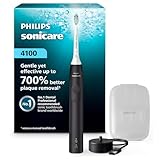
The 4100 is the cheapest Sonicare on this page with a pressure sensor, and the one the people in our research actually recommend. As of September 2026 Amazon sells it as a bundle of the same handle with a brush head case, on a listing carrying about 600 ratings where the one it replaced had gathered about 23,000. Its listing puts the sensor plainly: apply too much pressure and the handle will change its vibration. Philips’ spec page adds that the sensor warns you and reduces the toothbrush vibrations automatically to help protect your gums. You also get the two-minute SmarTimer, the 30-second QuadPacer and a brush head replacement reminder.
A self-identified hygienist on r/DentalHygiene volunteered the endorsement: “as a hygienist who has used many electric brushes, I love it and recommend it to most my patients”. The same comment carries the technique tip that matters more than the model does, “glide along the gumline… don’t make brushing motions or you’re counteracting what it’s doing for you”, and our receding gums toothbrush picks go further into the technique side.
One spec worth getting right before you buy: the 4100 has two intensity settings, low and high, rather than a named Sensitive or Gum Care mode, and the single power button cycles them, which one owner in our research found annoying. If a dedicated Gum Care mode is what you want, that was the 6100 further down, at about $75 more when Amazon stocked it.
Key Features
- Pressure sensor that changes the handle’s vibration when you press too hard, per the listing
- Two intensity settings, low and high, cycled with the power button
- SmarTimer at two minutes with a 30-second QuadPacer
- Brush head replacement reminder, per the listing
- EasyStart, which raises the power gradually over the first brushes, per the handle’s earlier listing
- Takes every Sonicare click-on head
Who It’s Best For
Anyone who wants the sonic feel. If a dentist has told you to ease off and an oscillating head feels too harsh on sore gums, this is the cheapest Sonicare here that carries the feature, and the roughly $64 you save against the iO Series 5 buys six replacement heads at the C2 price our electric toothbrush guide read.
Potential Downsides
The case in the box holds brush heads rather than the handle. Two intensity settings and no Gum Care mode. And its warning is a felt change in vibration rather than a visible light like the iO’s ring, and it turns the vibration down rather than stopping the pulsations the way the Pro 1000 above does.
(Affiliate link) · Free shipping on eligible Prime items
Oral-B iO Series 5 — Best Visible Pressure Ring
Oral-B iO Series 5
Best for: People who ignore a buzz but not a colour: the iO light ring shows your pressure while you brush
- iO pressure sensor that signals whether you are brushing too hard, too soft or just right, per the listing
- Five cleaning settings, per the listing
- iO light ring timer for the two-minute brushing time, plus a brush-head change alert, per the listing
- One replacement brush head and a travel case in the box
- Oral-B app that tracks how and where you brush, per the listing
- +The sensor reports as a colour on the light ring rather than a buzz in the handle, which is harder to brush straight through
- +Five cleaning settings and the light ring's two-minute timer, per the listing, with a replacement head and a travel case in the box
- +The ADA's Seal of Acceptance covers the iO Series as a line
- −Around $120, and the cheaper iO3 runs the same drive behind the same ring for about $10 less; what this tier adds is the app owners in our research describe abandoning
- −Two owners in our research reported gum recession while using this model, so the ring is feedback rather than a brake
- −This white listing carries about 400 ratings, a thin base to read anything into; a Limited Deep Clean listing of the same model carries about 4,400 at around $150
(Affiliate link) · Free shipping on eligible Prime items
Why We Recommend It
A buzz in the handle is easy to ignore. A colour is harder. The iO5’s listing describes a pressure sensor that signals whether you are brushing too hard, too soft or just right, and that ring is the reason this handle is carded. It is not a reason to buy this tier in particular. Oral-B sells every iO tier on the same drive behind the same ring, so the cheaper iO3 gives you the identical feedback and the tiers above add more modes, the app and, from the iO6 up, a handle display (Electric Teeth’s hands-on iO5 review notes this tier has none), rather than a different clean. Our Oral-B model guide goes tier by tier, and the ADA’s Seal covers the iO Series as a line (ADA Seal listing). What this tier adds on top of the ring is the Oral-B app, which the listing describes as tracking how and where you brush, and the owners in the research behind our electric toothbrush guide are candid about where that ends up: “the novelty quickly wore off after maybe less than 5 uses, so I never used the app again.”
One listing note, said plainly. This white Ultimate White listing carries about 400 ratings, which is a thin base to read anything into, and a Limited Deep Clean listing of the same model carries about 4,400 ratings at around $150; we link the cheaper one, at about $120. Amazon counts each listing’s ratings in its own pool, so the thin number here reflects how the pool is split rather than a worse brush. Read the star rating on this listing as directional and lean on the tier reasoning above instead.
The caution belongs on the card rather than in a footnote. The two clearest recession complaints in our research came from owners of this exact model. One “loved it until I started noticing gum recession”, switched to the “soft” heads and found them “still really hard”; a second poster in the same thread reported the same thing months later: “I had the same response the same toothbrush. Two of my teeth have very noticeable gum recession now”. A reply there put it the way the professionals in our research keep putting it: “even with the extra soft oral b heads, you still need to apply NO pressure and just rest it lightly without dragging or scrubbing. This advice is the same regardless what toothbrush”. The ring tells you what your hand is doing. It does not stop your hand.
Key Features
- iO pressure sensor that signals whether you are brushing too hard, too soft or just right, per the listing
- Five cleaning settings, per the listing
- iO light ring timer for the two-minute brushing time, plus a brush-head change alert, per the listing
- One replacement brush head and a travel case in the box
- Oral-B app that tracks how and where you brush, per the listing
Who It’s Best For
People who respond to a visual cue more than a tactile one, and anyone who prefers Oral-B’s small round head to a sonic brush’s flat one. If the app is not a draw, the same ring sits on the cheaper iO3, and our Oral-B model guide sets the tiers side by side.
Potential Downsides
Heads are the recurring cost complaint on the iO line, and it turned up in our research for this page too, with one buyer close to returning a two-pack of this model over head pricing before deciding the sensor justified it. They ran about $9.60 each at our read, roughly double Oral-B’s CrossAction heads. Our Oral-B brush head guide covers the cheaper iO options. Mold is the other one, reported more for iO than for the older Pro line: owners in two communities describe mold inside both the head and the handle stem unless you pull them apart and let them dry. And the price step is worth naming: at about $120 this handle sits roughly $10 above the iO3, and that $10 buys the app on top of a ring the iO3 already carries.
(Affiliate link) · Free shipping on eligible Prime items
Philips Sonicare ProtectiveClean 6100 — Premium Sonic

Philips Sonicare ProtectiveClean 6100
Best for: Anyone told they brush too hard who wants a sensor that takes the power out of the brush, not just one that beeps at you
- Pressure sensor that detects your pressure, warns you, and reduces the brush vibrations, per the listing
- Clean, White and Gum Care modes, plus three intensity levels, per the listing
- Up to 62,000 brush movements per minute, per the listing
- Travel case included; charging base rated for 14 days of regular use
- White handle, one brush head in the box
- +Per the listing, the sensor detects the pressure you apply, warns you, and reduces the toothbrush vibrations, rather than only alerting you
- +Clean, White and Gum Care modes with three intensity levels, so you can take the power down on tender days
- +The one model in our community research an owner credits by name with a recession that stopped getting worse
- −Around $130 when Amazon stocked it, more than twice the 4100 above, and the extra money buys modes and intensity levels rather than a better clean
- −Philips' Sonicare handles do not appear on the ADA's Seal of Acceptance roster at our late-August read of the full list
Not stocked by Amazon (September 2026)
Why We Recommend It
The 6100 was this page’s top pick until Amazon stopped stocking it, and the reason was what its sensor does after it notices. Its listing describes a sensor that detects the pressure you apply, warns you, and reduces the toothbrush vibrations. Philips’ spec page describes the same response for the cheaper 4100 above.
It is also the only model in our community research that an owner credits with a change for the better. An r/askdentists poster who blamed an aggressive Oral-B for their recession wrote “since I switched to Sonicare my situation has gotten better, so I vote Sonicare”, with the ProtectiveClean 6100 named as the replacement brush. That is one person rather than a study, and we hold it next to the finding that runs the other way: two r/DentalHygiene posters reported recession while using an Oral-B iO handle. Both stories are about technique at least as much as hardware.
Be clear-eyed about what the extra money buys. At the roughly $130 Amazon sold it for, against the 4100’s roughly $56, the extra money buys three modes including Gum Care, three intensity levels rather than two, and a travel case. It does not buy a better clean. We could find no independent study showing that a pricier model from one brand out-cleans its entry model, which is why our electric toothbrush guide puts the $40 handle first. If Gum Care mode and a lower intensity are what keep you brushing gently for two full minutes, that is a reasonable thing to pay for.
Key Features
- Pressure sensor that detects your pressure, warns you, and reduces the brush vibrations, per the listing
- Clean, White and Gum Care modes, plus three intensity levels, per the listing
- Up to 62,000 brush movements per minute, per the listing
- Travel case included, and a charging base rated for 14 days of regular use
- White handle with one brush head in the box
Who It’s Best For
People who already know they brush too hard and have not managed to stop by concentrating harder. Its sensor takes the vibration down instead of only signalling, as the 4100’s does per Philips, which is the same instinct as the Pro 1000’s pulsation cut-out at the top of this page, and the Gum Care mode gives you somewhere gentler to go on days when the gumline is sore.
Potential Downsides
Around $130 is the headline. Philips’ Sonicare handles also do not appear on the ADA’s Seal of Acceptance roster at our late-August read of the full list, while the Oral-B Pro 1000 above and the Aquasonic below both hold it. And it takes Sonicare click-on heads, which our electric toothbrush guide priced at about $10.25 each for the everyday C2 on the day it read the head listing; three or four of those a year is the real running cost, and our Sonicare brush head guide covers the cheaper options.
Availability, September 2026: Amazon no longer stocks the 6100 itself. At our September 18 read the only offers on the listing were two marketplace resellers at about $209, roughly $80 over the price this review was written at, so the buy button is off this card until it is back at a normal price. Do not pay reseller prices for it. The two brushes at the top of this page respond to pressure for far less: the Oral-B Pro 1000 (about $50) stops its pulsations, per its listing, and the Sonicare 4100 (about $56) turns its vibration down, per Philips.
Aquasonic Black Series — Cheapest to Own
Aquasonic Black Series
Best for: Buyers who want the ADA Seal and eight heads for around $40, and whose brushing pressure is already under control
- ADA-accepted sonic brush, 40,000 vibrations per minute, per the listing
- Eight DuPont brush heads and a hard travel case in the box
- Four modes with a vibrating timer, per the listing
- Wireless charging, with four weeks of use per charge, per the listing
- No pressure sensor
- +The AquaSonic toothbrush holds the ADA Seal of Acceptance, which is more than Philips' own Sonicare handles can say at our late-August read of the roster (the ADA's entry names the brand's toothbrush, not individual models)
- +Eight heads in the box cover two years or more at the ADA's replacement interval, and replacement packs work out at about $2.50 a head
- +Owners with four- and five-year handles turned up in the threads we read, and it accepts Sonicare-style heads
- −No pressure sensor, which is the first thing this page looks for; it is the one sensorless pick here and the last card for that reason
- −Some of the highest-scoring praise for this brand carried affiliate links, so we counted only the plain ownership reports
(Affiliate link) · Free shipping on eligible Prime items
Why We Recommend It
This is the one pick here without a pressure sensor, so on a page whose first criterion is the sensor it needs a reason to exist. It has two. The AquaSonic toothbrush holds the ADA Seal of Acceptance (ADA Seal listing), a pass-or-fail bar for safety and for plaque and gingivitis efficacy that Philips’ Sonicare handles do not currently appear on. Read that Seal at brand level rather than model level: the ADA’s entry names the brand’s toothbrush and lists no individual models. And nothing else here is close on cost of ownership: eight DuPont heads and a travel case in the box, per the listing, with replacement packs at about $2.50 a head at our read, a quarter of what a Sonicare or iO head costs.
It also has an owner record, which most cheap sonic brushes do not. Setting aside every comment that carried a link, the research behind our electric toothbrush guide was left with plain reports like “I’m on year five with mine” and “I bought an AquaSonic toothbrush and it’s lasted me 4 years with no issues”, plus the practical note that the handle takes Sonicare-style heads.
Key Features
- ADA-accepted sonic brush at 40,000 vibrations per minute, per the listing
- Eight DuPont brush heads and a hard travel case in the box
- Four modes with a vibrating timer, per the listing
- Wireless charging, with four weeks of use per charge, per the listing
- No pressure sensor
Who It’s Best For
Readers whose pressure is not the problem: you brush gently, you have been told your technique is fine, and the thing standing between you and a powered brush is the running cost. Also a sensible second handle for travel, and the cheapest way here to stop stretching a frayed head, since there are eight of them in the box.
Potential Downsides
No pressure sensor. If a dentist has flagged recession or told you that you brush too hard, that is the whole reason this page exists, and the Oral-B Pro 1000 at the top of this page has one for about $10 more. Treat this as the cheap-to-own pick for someone whose pressure is already under control.
The other caveat is about the praise. Some of the highest-scoring comments about this brand carried affiliate links, so we counted only the plain ownership reports. The 137,000-plus ratings on the listing are real, but a rating pool that large on a lesser-known brand is worth reading a few pages of rather than admiring.
(Affiliate link) · Free shipping on eligible Prime items
Buyer’s Guide: How to Choose an Electric Toothbrush for Receding Gums
Why Electric Over Manual?
You can absolutely manage receding gums with a manual toothbrush, but most people don’t use the correct technique consistently. Electric toothbrushes automate the brushing motion, which means you’re less likely to use the aggressive back-and-forth scrubbing motion that contributes to recession. The 2014 Cochrane review of powered versus manual toothbrushing found that powered toothbrushes reduced plaque and gingivitis more effectively than manual brushing in the short and long term, with oscillating-rotating designs the most-studied type.
Cochrane’s own caution belongs alongside those numbers: the review added that “the clinical importance of these findings remains unclear”, a hedge our electric toothbrush guide carries in the same breath as the percentages. The advantage is real and modest. What an electric brush reliably changes is how long you brush and how hard, and those are the two habits that matter most once the gumline has started to move.
The Single Most Important Feature: Pressure Sensing
Brushing force is the one thing about a receding gumline that a toothbrush can act on, and the authorities are careful about how far they take it. What the ADA will say is that soft bristles and gentle pressure “may help reduce the risk” of gum injury, hedged on purpose, and its MouthHealthy guidance tells you not to scrub vigorously and to brush only hard enough to clean the film off your teeth. The largest systematic review on brushing and recession, cited in our electric toothbrush guide, found the data on that link largely inconclusive. No brush prevents recession. What a sensor does is tell you something you cannot otherwise know.
The four sensors here are not equivalent, and the difference is worth more than the price difference between them:
- The Oral-B Pro 1000 stops the pulsations automatically, per its listing, with no signal you have to notice.
- The Sonicare 6100 warns you and reduces the brush vibrations, per its listing, and it is the one Amazon did not stock at our September read.
- The Oral-B iO Series 5 signals on its light ring whether you are brushing too hard, too soft or just right, per its listing: the clearest signal here, and the one that leaves the brush running.
- The Sonicare 4100 changes the handle’s vibration when you press too hard, per its listing, and Philips’ spec page says it reduces the vibration as well: the same response as the 6100, at less than half the 6100’s old price.
The Aquasonic Black Series has none of that, which is why it is the last card.
Sonic or Oscillating-Rotating: Does It Matter?
Not on the evidence we could find. Our electric toothbrush guide reads the two independent syntheses in full: a 2021 systematic review in the ADA’s own journal, pooling 24 trials, found little to no difference between oscillating-rotating and side-to-side brushes on plaque and gum-index reduction, and an independent 2022 network meta-analysis put oscillating brushes first while sizing the edge as a very small benefit, measured on plaque after a single supervised brushing. The much larger numbers you will see quoted for oscillating brushes come from a meta-analysis of the manufacturer’s own trial archive, written by its employees.
Recession-specific advice splits the same way, and a reader is entitled to know that. A poster in our research got opposite answers from two periodontists, one saying oscillating brushes are more abrasive to gum tissue, the other recommending an Oral-B anyway. The self-identified periodontist who answered in that thread would not take either side: “I haven’t seen or read anything that oscillating/sonic is more abrasive… It really comes down to personal preference… it’s tough to really link the type of toothbrush to recession/trauma”. Choose on head shape and feel, and buy the one you will use for two minutes twice a day. Our Oral-B versus Sonicare comparison goes deeper on the two systems.
Modes: Comfort, Not a Better Clean
For receding gums, a Sensitive or Gum Care setting is worth having if it is what gets you brushing gently through a sore fortnight. It is not worth paying for as a cleaning upgrade: we found no evidence that a mode cleans better than the standard one, and the professionals in our research asked for a sensor and a timer, not a mode list. What each pick actually offers: the 6100 has Clean, White and Gum Care with three intensity levels; the iO Series 5 has five cleaning settings; the Pro 1000 has three modes including a sensitive one; the 4100 has two intensity settings; the Aquasonic has four modes.
Not Carded: the Cheapest Sonic Handles
Below about $30 the shelf fills with lookalike sonic brushes, and the Bitvae D2 and the COSLUS C30 are two of the most visible. Neither carries a pressure sensor, which is the first thing this page looks for. Neither has an owner record we could find either: searches across the dental and buy-it-for-life subreddits, plus a separate web search for each handle, returned no discussion of either brush, so there is nothing we can tell you about how they hold up past the first month. And on the Bitvae listing, some visible reviews are dated before the listing itself went up, which means the rating total cannot be read as a count for this brush.
Two sensorless picks on a page about brushing pressure is one too many, so the cheap slot here belongs to a handle with a Seal and multi-year owner reports behind it. If price is the binding constraint, our budget electric toothbrush picks take that shelf on its own terms.
The One Job Your Electric Brush Can’t Do
However good its motor, no brush head cleans the surfaces between your teeth. Sonic vibrations and oscillating heads work the outer and inner faces of each tooth, but the interproximal zone stays untouched, and when interdental spaces have widened, those are exactly the tooth-root surfaces that collect plaque. That’s why an interdental pass belongs alongside even the best electric brush.
For wider interdental spaces, the evidence favors interdental brushes: a 2019 Cochrane review found they may reduce gingivitis more than floss, with the plaque comparison inconsistent, and the European Federation of Periodontology’s public guidance recommends them wherever the space allows the brush to slide in without trauma; where it doesn’t fit, floss that gap instead, and never force a size. Expect some bleeding and tenderness in the first two weeks as inflamed tissue heals. In the threads we researched, users quit rather than push through that adjustment window; escalating pain or a visibly widening gap is the actual signal to stop and see your dentist. Our interdental brush guide covers picks and how sizing works.
What Else Should You Pair With Your Toothbrush?
An electric toothbrush is one piece of a gum health routine. Consider pairing yours with:
- An interdental brush: the between-teeth clean no brush head delivers, covered above
- A toothpaste formulated for receding gums: typically containing stannous fluoride or potassium nitrate
- A mouthwash for receding gums: especially CPC or cetylpyridinium chloride formulas
- A water flosser: another way to clean below the gumline, though the professionals in the threads we read described interdental brushes as reaching more surface area than one
Frequently Asked Questions
Can an electric toothbrush make receding gums worse?
It can, if used incorrectly. Pressing too hard with any toothbrush, manual or electric, can contribute to further recession, which is why four of our five picks have a pressure sensor and the fifth says on its card that it has none. The brush itself is rarely the risk; brushing technique is.
Is a Sonicare or Oral-B better for receding gums?
Neither, on the independent evidence. A 2021 systematic review in the ADA’s own journal, cited in our electric toothbrush guide, found little to no difference between the two designs on plaque and gum-index reduction, and the self-identified periodontist in our research who was asked this directly said “it’s tough to really link the type of toothbrush to recession/trauma” and pointed at bristle softness and personal fit instead. Choose the head shape you will actually use twice a day: Sonicare’s elongated head that buzzes, or Oral-B’s small round head that spins.
How often should I replace my brush head if I have receding gums?
Every three to four months, or sooner if the bristles look matted or frayed, which is the ADA’s advice as cited above. Worn bristles lose their softness and get harsher on gum tissue. The Sonicare 4100 has a brush head replacement reminder that tells you when it is time, per its listing; for the others, a calendar reminder does the same job. Since this page mixes an iO handle with the Pro 1000 and two Sonicares, it is worth confirming compatibility first: we map which heads fit which Oral-B handles and which heads fit which Sonicare handles.
Should I use the gentlest setting all the time?
If your gums are actively inflamed or very sore, starting on the lowest intensity or a Gum Care mode is a reasonable approach, and it is one of the few things a mode list is good for. As the gums settle you can move back up. There is no cleaning penalty either way that we could find evidence for, so treat it as comfort, and let your dentist tell you when to increase the intensity.
Do I still need to see a dentist if I switch to an electric toothbrush?
Yes, always. An electric toothbrush is a home care tool, not a treatment for gum disease. If your gums are receding, regular dental visits are essential for monitoring the progression and determining if professional treatment (like scaling, root planing, or grafting) is needed. The ADA recommends a visit frequency tailored to your individual oral health needs rather than a one-size-fits-all schedule.
Is a cheap electric toothbrush safe for receding gums?
Price is not the problem; a missing sensor is. The Aquasonic Black Series, at around $40, is sold under a brand whose toothbrush holds the ADA Seal, and it has no pressure sensor, so it suits someone whose pressure is already under control rather than someone who has just been told they brush too hard. For about $10 more the Oral-B Pro 1000 has both a sensor and the Seal by model name, and the Sonicare 4100, at about $16 more, has the sensor and no Seal. Below about $30 you are mostly buying handles with neither, and no owner record to check them against.
Is a pressure sensor enough to stop me from damaging my gums?
No. Treat it as a backstop, not a guarantee. In our community research, two r/DentalHygiene posters reported gum recession while using a pressure-sensing brush, which they attributed to the sensor’s threshold not catching their heavy-handed brushing, even on soft heads. The consistent advice in those threads and from the professionals in our wider research applies to every model on this list: rest the head lightly against the tooth with essentially no added pressure and let the motor work. If the sensor fires regularly, that’s useful feedback that your baseline pressure needs to come down.
My gums look smaller since I started cleaning between my teeth. Is that recession?
Usually not. In the threads we researched, readers who started interdental cleaning described puffy, inflamed tissue shrinking back to a healthy contour over roughly two weeks, which can look like the gumline receding when it is inflammation resolving. The pattern to take to your dentist is the opposite one: pain that escalates instead of subsiding, or a gap between teeth that keeps visibly widening.