
Price is not what decides whether an electric toothbrush is worth owning. A pressure sensor and a two-minute timer are, and both are available for under $50. The picks below run from about $20 to about $56, and the buyer’s guide underneath says which of them has a sensor, what the heads cost to keep buying, and where the ADA Seal actually sits on this shelf. Powered brushes as a class beat manual brushing by a modest margin, and no single model here has an efficacy trial of its own. For specific situations, see our guides on electric toothbrushes for sensitive teeth and electric toothbrushes for braces. Our main electric toothbrush guide carries the full evidence read and the mid and premium tiers this page leaves out.
How We Evaluated Budget Electric Toothbrushes
A pressure sensor and a paced timer, ahead of modes. These are the two features that owners, hygienists and self-identified dentists agreed on across the research behind our main guide. Two of the four picks here have pressure feedback. The two that do not say so on their cards and have to earn their place another way.
The ADA Seal checked against the ADA’s own roster, not the listing badge. The ADA’s toothbrush guidance sets out how manual and powered brushes are assessed for plaque removal and gingivitis. On this lineup the Seal belongs to the Oral-B Pro 1000 by model name and to the AquaSonic toothbrush, the name the ADA’s roster entry carries. Philips’ Sonicare handles did not appear on the roster when we read the full list in late August, so neither Sonicare on this page carries it. Seal status does not track price here, which is why the page does not use it as a proxy for cheapness.
Total cost with heads included. A handle is a one-off; heads are forever. Every pick below carries a per-head cost figure from a same-day read of the genuine head listing, plus the heads-in-box count where the listing states one, and the cheapest handle to buy is not the cheapest to keep.
What the community record can and cannot support. Ratings and star averages tell you a listing is popular, not that a brush lasts. Where multi-year owner reports exist we say so and quote them. Where they do not exist, we say that too rather than dressing a star average up as a durability record.
Price against what the money actually buys. Between about $20 and about $56 the money buys pressure feedback, pacing and heads in the box. Above that it buys modes, screens and apps, and we could find no independent trial showing those clean better.
Philips Sonicare 4100 Series Electric Toothbrush (Black) — Editor’s Pick
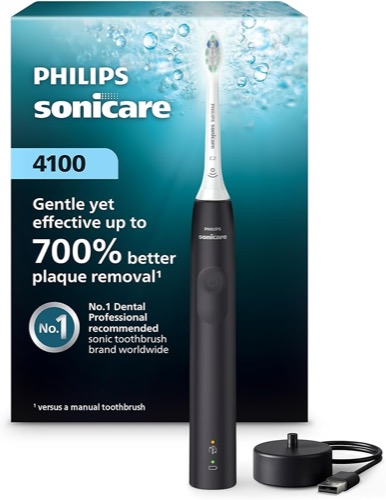
Philips Sonicare 4100 Series Electric Toothbrush (Black)
Best for: Most people: the cheapest sonic handle here with both a pressure sensor and a quadrant-paced two-minute timer
- Pressure sensor that changes the handle's vibration when you press too hard, per the listing
- SmarTimer at two minutes plus QuadPacer at 30 seconds a quadrant, per the listing
- Brush head replacement reminder, per the listing
- Accepts every Sonicare click-on head
- About $56, with one brush head and a head case in the box
- +The single most-recommended model across the 71 owner threads behind our main electric toothbrush guide, and the one an r/Dentistry commenter names outright
- +Pressure sensor plus a two-minute timer with 30-second quadrant pacing, per the listing: the two features owners and professionals in that research agree on
- +Takes every Sonicare click-on head, so the running cost is set by which head you buy rather than by the handle
- −The one power button also cycles intensity, which one owner called annoying
- −Philips' Sonicare handles did not appear on the ADA Seal of Acceptance roster at our late-August read of the full list
(Affiliate link) · Free shipping on eligible Prime items
The 4100 leads this page because it is the cheapest Sonicare on this page that carries both features the evidence supports, and because it is the model the owner research behind our main guide named most often: 79 mentions across 29 threads. A commenter in r/Dentistry, a sub that removes patient questions so the answers that survive come from practitioners, put the whole case in one line: “Get the cheapest Sonicare or oral B you can find that has a pressure sensor.” That is what this handle is.
Per the listing, the handle changes its vibration when you press too hard, SmarTimer signals when you have reached two minutes, QuadPacer breaks that into four 30-second quadrants, and a replacement reminder tells you when the head is due. Advanced Sonic Technology is Philips’ name for the motion: the head buzzes rather than spins and pushes fluid between the teeth and along the gumline. It has two intensity settings rather than a menu of modes.
The handle takes any Sonicare click-on head, so what you spend from here is set by the head you choose. The everyday C2 head worked out at about $10.25 each at the read behind our main guide, which is the real price of choosing Sonicare over the Pro 1000 and its roughly $4.60 CrossAction heads. One fact Philips does not put on the box: its Sonicare handles did not appear on the ADA’s Seal of Acceptance roster when we read the full list in late August, though the Pro 1000 and the Aquasonic below both did.
One listing note, said plainly: as of September 2026 Amazon sells the 4100 as a bundle with a brush head case, and that listing carries 595 ratings where the one it replaced had gathered about 23,000. The handle is the same; the star average here is an early read on a newer page.
Potential downside: the single power button also cycles intensity, an ergonomic complaint one owner raised. Longevity reports split, and we could not reconcile them from the threads. The owners recommending the 4100 expect five years or more; one reports handles dying at around 18 months.
(Affiliate link) · Free shipping on eligible Prime items
Oral-B Pro 1000 Rechargeable Electric Toothbrush — Best Oscillating
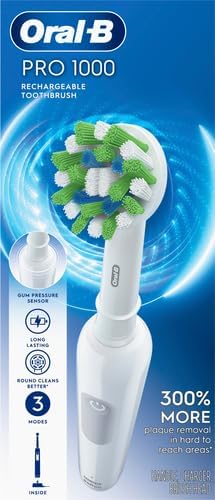
Oral-B Pro 1000 Rechargeable Electric Toothbrush
Best for: Anyone who prefers the small round oscillating head and wants the ADA Seal by model name
- Oscillating-rotating round head that spins back and forth and pulses
- Pressure control that stops the brush's pulsations when you press too hard, per the listing
- In-handle timer for a two-minute brush, with a quadrant alert every 30 seconds, per the listing
- Listed by model name on the ADA Seal of Acceptance
- Around $50
- +Named by model on the ADA Seal of Acceptance, and the largest review base of the two major brands here at more than 105,000 ratings
- +One well-upvoted owner ties its durability to a nickel-metal-hydride battery, more tolerant of over-discharging than a lithium cell
- +Cheapest heads of the two majors: CrossAction heads worked out at about $4.60 each at our read
- −Louder and, by many owner accounts, harsher-feeling than a sonic brush
- −Proprietary two-pin charging stand rather than USB, one more item to track while traveling
(Affiliate link) · Free shipping on eligible Prime items
The Pro 1000 is the oscillating equivalent of the 4100, and on the published evidence the two are interchangeable. A 2021 systematic review in the Journal of the American Dental Association pooled 24 trials and found little to no difference between oscillating-rotating and side-to-side brushes on plaque and gum measures at four weeks. An independent 2022 network meta-analysis ranked oscillating first but sized the edge as a very small benefit, measured on plaque after one supervised brushing. The much larger figures you will see quoted for oscillating brushes come from a meta-analysis run on Procter & Gamble’s own trial archive by its own employees. All three are cited in full in our main electric toothbrush guide.
What the Pro 1000 has that the 4100 does not is the strongest durability argument in that research. In a thread mourning a twenty-year-old Braun handle, a 74-upvote reply pointed straight at this model and gave the mechanism with it: the older nickel-metal-hydride battery tolerates over-discharging better than a sealed lithium cell. One counter-example belongs next to it, because it is in the same corpus: another owner turned up looking for a replacement after five years.
It carries 4.5 stars across about 105,900 ratings, the largest review base of the two major brands on this page, and it is listed by model name on the ADA Seal of Acceptance (ADA Seal listing). CrossAction heads worked out at about $4.60 each at our read, the cheapest of the two majors, and a hygienist in that research picked Oral-B and Sonicare precisely because their replacement heads are the easiest to find. For the full rundown on this exact model, our dedicated Oral-B Pro 1000 review goes deeper.
Potential downside: it is louder than a sonic brush and, by many owner accounts, harsher-feeling, and some people with sensitive gums prefer the Sonicare feel. Owners and r/DentalHygiene members report the hollow round heads growing mold faster than flat sonic heads unless you pull the head off and let both dry. The charging stand is a proprietary two-pin dock rather than USB.
(Affiliate link) · Free shipping on eligible Prime items
Aquasonic Black Series Ultra Whitening Toothbrush — Cheapest to Own
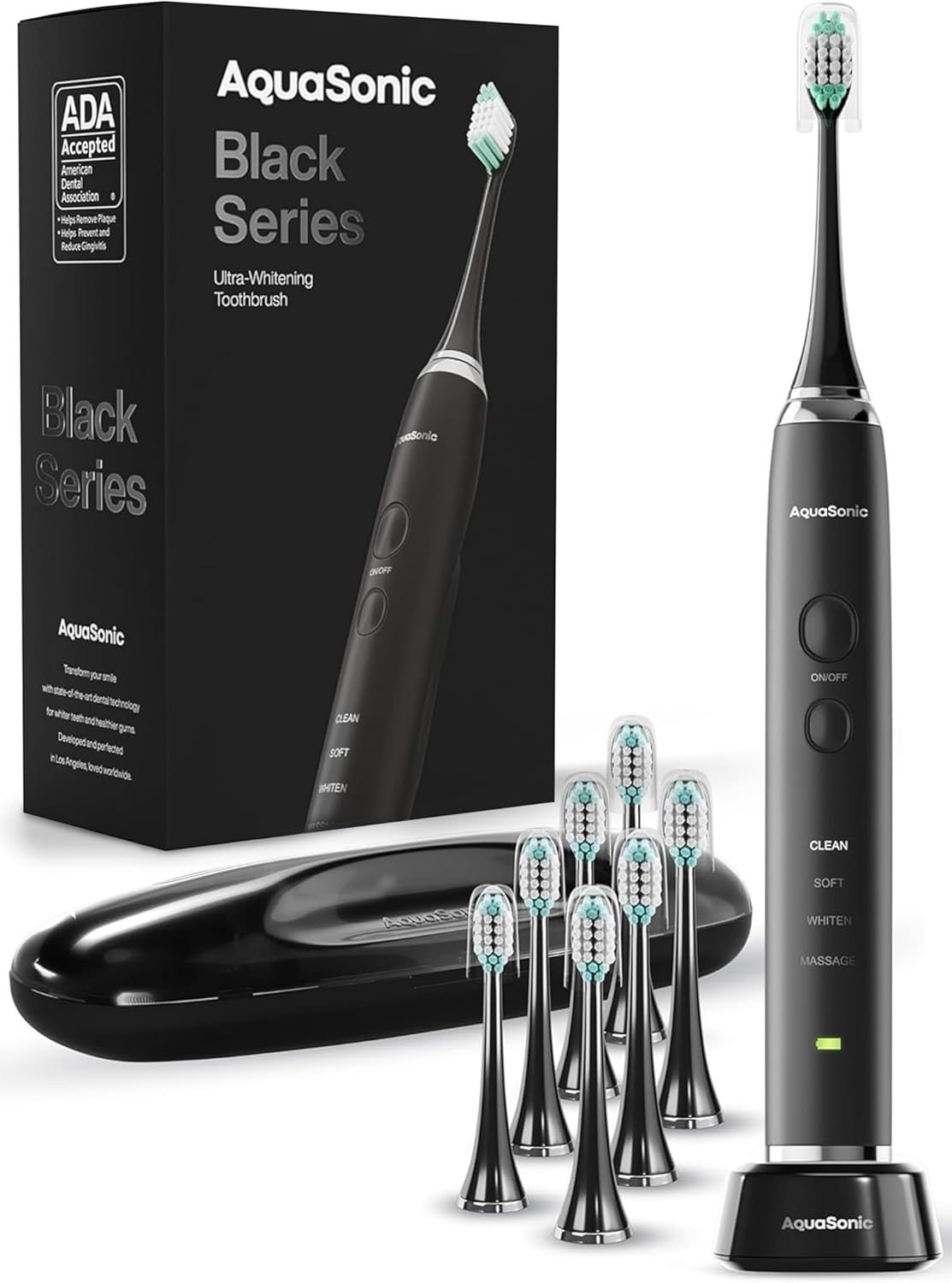
Aquasonic Black Series
Best for: Buyers who want the ADA Seal for around $40 and the cheapest heads on this page, and will do without a pressure sensor
- Holds the ADA Seal of Acceptance
- Eight brush heads and a travel case in the box
- Replacement heads about $2.50 each
- Four modes with a vibrating timer; no pressure sensor
- Around $40
- +Holds the ADA Seal of Acceptance, which is more than Philips' own Sonicare handles can say at our late-August read of the roster
- +Eight heads in the box covers two years or more at the ADA's replacement interval, and replacement packs work out at about $2.50 a head
- +Owners with four- and five-year units turn up in the threads behind our main guide, and one owner reports the handle taking Sonicare-style heads
- −No pressure sensor, the one feature owners, hygienists and self-identified dentists in that research all endorse
- −The highest-scoring praise for this brand arrived with affiliate links attached, so we counted only the plain ownership reports
(Affiliate link) · Free shipping on eligible Prime items
The Aquasonic is the cheapest brush here to keep rather than the cheapest to buy. Eight heads come in the box, and replacement packs worked out at about $2.50 a head at the read behind our main guide, roughly a quarter of a Sonicare C2 and about half a CrossAction. Over five years the head bill on a Sonicare is larger than the handle was, so on a strict cost-of-ownership test this is the pick that wins.
It also holds the ADA Seal of Acceptance (ADA Seal listing), a pass-or-fail bar for safety and for plaque and gingivitis efficacy, which Philips’ Sonicare handles did not appear against at our roster read. Per the listing it is a sonic handle running 40,000 vibrations per minute, with four modes, a vibrating timer, wireless charging, a travel case and four weeks of brushing per charge.
The brand has a real if thin owner record, and it is the reason a lesser-known name sits on this page at all. Setting aside every comment that carried a link, the plain reports include “I’m on year five with mine” and “I bought an AquaSonic toothbrush and it’s lasted me 4 years with no issues”, plus the practical point that makes the brand useful: one owner reports the handle taking Sonicare-style heads, so the cheap head shelf may not be proprietary. The listing itself states no head compatibility, so that is one owner’s report rather than a spec.
Potential downside: no pressure sensor. That is the one feature the owners, hygienists and self-identified dentists in that research all endorse, and it is why this brush sits third here rather than first. If you know you brush hard, or a dentist has raised recession with you, spend the extra on the 4100 or the Pro 1000. The praise needs a caveat of its own: several of the highest-scoring Aquasonic comments carried affiliate links, so we counted only the plain ownership reports, and a 137,000-rating count on a lesser-known brand is worth reading a few pages of rather than admiring.
(Affiliate link) · Free shipping on eligible Prime items
Philips Sonicare 1100 Series Electric Toothbrush (White) — Best Under $20
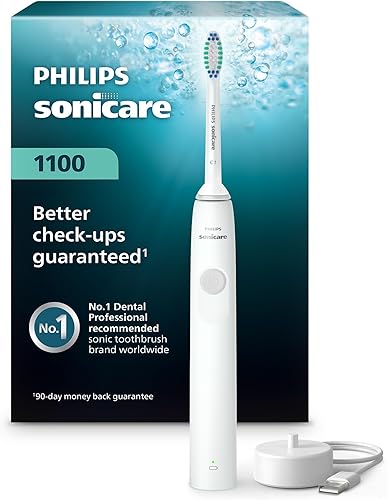
Philips Sonicare 1100 Series Electric Toothbrush (White)
Best for: First-time buyers who want a Sonicare handle at the cheapest Sonicare price we found and will accept no pressure sensor
- Advanced Sonic Technology that pulses fluid between the teeth and along the gumline, per the listing
- EasyStart raises brushing power gradually, per the listing
- SmarTimer at two minutes plus QuadPacer at 30 seconds a quadrant, per the listing
- Up to 14 days of regular brushing per charge, per the listing
- Accepts every Sonicare click-on head
- +The cheapest Sonicare handle we priced, at about $36 under the 4100
- +SmarTimer and a 30-second QuadPacer, per the listing, so the pacing survives the price cut
- +Takes every Sonicare click-on head, the same shelf as the 4100
- −No pressure sensor, so nothing on the handle tells you when you are pressing too hard
- −Philips' Sonicare handles did not appear on the ADA Seal roster at our late-August read of the full list
(Affiliate link) · Free shipping on eligible Prime items
The 1100 is the floor of this page at around $20, and the cheapest Sonicare handle we priced. Per the listing it runs the same Advanced Sonic Technology as the 4100, with EasyStart raising power gradually over the first uses, SmarTimer at two minutes, QuadPacer at 30 seconds a quadrant, and up to 14 days of regular brushing per charge. It takes every Sonicare click-on head, so the head shelf and the upgrade path are the 4100’s.
What the extra roughly $36 to the 4100 buys is the pressure sensor and the head-replacement reminder, both named on the 4100’s listing and absent from the 1100’s. If you have never used an electric brush and are not certain you will stick with it, the 1100 is the low-risk way to find out. If a dentist has already told you that you press too hard, skip it and buy the 4100, because the sensor is the whole reason that advice exists.
It carries 4.4 stars across about 9,600 ratings at our read. Like every Philips handle, it was not on the ADA Seal roster when we read the full list in late August; on this page the Seal belongs to the Pro 1000 and the Aquasonic.
Potential downside: the missing pressure sensor is the real one, and nothing else on the handle substitutes for it. EasyStart softens the first fortnight, which helps if you have brushed by hand for decades, but it tells you nothing about force.
(Affiliate link) · Free shipping on eligible Prime items
Buyer’s Guide: Choosing a Budget Electric Toothbrush
Oscillating or Sonic, and Which of These Is Which
Oral-B’s oscillating-rotating heads are small and round: they spin back and forth and pulse. Sonic handles, which on this page means the two Sonicares and the Aquasonic, carry a brush-shaped head that buzzes rather than spins and drives fluid between the teeth. Price bracket does not tell you which of the two you are getting: read the head shape in the listing photos rather than the word sonic in the title.
On the published evidence the choice between the two motions barely matters. The 2021 systematic review in the Journal of the American Dental Association pooled 24 trials and found little to no difference between oscillating-rotating and side-to-side brushes on plaque and gum measures at four weeks, and little to no difference in adverse events either. An independent 2022 network meta-analysis ranked oscillating first but sized the edge as a very small benefit, and only for plaque after a single supervised brushing. The much larger numbers quoted for oscillating brushes come from a meta-analysis of Procter & Gamble’s private trial archive by its own employees, which does not make them wrong but does not make them independent. All three papers are cited in full in our main electric toothbrush guide. So choose on feel, and treat the common claim that sonic is gentler on gums as unsettled rather than established.
Against a manual brush the picture is different, and still modest. The Cochrane review of powered versus manual brushing found powered brushes reduce plaque by about 11% at one to three months and added that the clinical importance of that finding remains unclear, and the ADA’s position is that either manual or powered brushes can be used effectively. No single model on this page has an efficacy trial of its own.
What Features Are Worth Having at the Budget Level
Pressure feedback first. The ADA recommends soft bristles and gentle pressure because both may help reduce the risk of gingival injury, hedged deliberately, and a 2015 systematic review in the Journal of Clinical Periodontology calls the evidence on brushing and gum recession largely inconclusive. The practical argument is simpler than the clinical one: most people cannot gauge their own brushing force, and the sensor is the thing that tells them. On this page the Pro 1000 and the 4100 have a pressure sensor, per their listings, and the Aquasonic and the 1100 have neither.
A paced two-minute timer second. Per their listings the 4100 and the 1100 both carry SmarTimer plus a 30-second QuadPacer, and the Pro 1000 has an in-handle two-minute timer with a quadrant alert every 30 seconds. The Aquasonic’s listing names four modes and a smart vibrating timer but no quadrant pacer, so it is the one pick here where quadrant pacing is unconfirmed. If you want the pacer, the other three are the shortlist.
Modes last, or not at all. Most people run the default setting every day. Do not pay extra for modes you are unlikely to use, and if sensitivity is the reason you are looking at them, the sensitive teeth page is the better guide.
Why the Floor Here Is the Sonicare 1100
One floor, not three: the Sonicare 1100 at around $20. It is the cheapest handle on this page from a brand with a long review record and the head shelf a hygienist in that research called the easiest to find replacements for, and it keeps the pacing features. We have not researched a set of sub-$15 listings for this page, so we are not going to rank one or tell you what the whole tier is like. What we can say is that the 1100 is the cheapest handle here we could check against a review base and a head supply.
The feature test is more useful than a dollar line anyway, and the community’s version of it, from the research behind our main guide, was blunt: “Above $40 you are paying for features that don’t matter to the average person and marketing.” If $20 is still the wrong number for you, a well-chosen manual toothbrush used gently for two minutes is a better buy than an electric you stop charging, and the ADA’s own position is that either can be used effectively.
Replacement Brush Head Cost
Heads, not handles, are the running cost. At the ADA’s replacement interval of every three to four months, or sooner if the bristles are visibly matted or frayed, that is three to four heads a year per person. From the same-day head reads behind our main guide: Oral-B CrossAction about $4.60 a head, Sonicare C2 about $10.25, Aquasonic genuine standard about $2.50. The Aquasonic’s eight heads in the box cover two years or more at the ADA interval, which is what makes it the cheapest pick here to keep rather than the cheapest to buy.
The Pro 1000 uses Oral-B’s standard head system and the two Sonicares use the modern click-on system, so you avoid the iO, Philips One and screw-on compatibility splits. We map which heads fit which Oral-B handles and which heads fit which Sonicare handles if you want to check before stocking up.
Frequently Asked Questions
Are budget electric toothbrushes actually effective?
As a class, powered brushes beat manual brushing by a modest margin: the Cochrane review found about an 11% plaque reduction at one to three months and said the clinical importance of that remains unclear, and the ADA’s position is that either manual or powered brushes can be used effectively. What the price tier changes is features, not the motion. None of these four has a model-specific efficacy trial; the Pro 1000 and the Aquasonic carry the ADA Seal, which is the closest thing to an independent check any pick here has.
What’s the minimum you should spend on an electric toothbrush?
Around $20, for the Philips Sonicare 1100. The reasons are its review record, its head supply and its timer, not the ADA Seal: on this page the Seal belongs to the roughly $50 Pro 1000 and the roughly $40 Aquasonic, and Philips’ Sonicare handles were not on the roster at our late-August read. Seal status does not track price, so do not treat a low price as evidence of a missing Seal or the reverse.
Do I need a pressure sensor?
If a dentist has told you that you brush too hard, or you have had recession or sensitivity, it is the feature to buy first. The evidence is more cautious than the marketing: the ADA recommends gentle pressure because it may help reduce the risk of gingival injury, and a 2015 systematic review in the Journal of Clinical Periodontology calls the evidence on brushing and recession largely inconclusive. The everyday case is that most people cannot judge their own force. The Pro 1000 and the 4100 have a sensor, per their listings; the Aquasonic and the 1100 do not.
How often do I need to replace brush heads?
Every three to four months, per the ADA, or sooner if the bristles look matted or frayed. The Aquasonic ships with eight heads, which covers two years or more at that interval.
Is the Oral-B Pro 1000 worth more than the Sonicare 4100?
They are equivalent on the evidence. Both have a pressure sensor and a paced two-minute timer, both sit in the $40 to $50 band, and no independent trial separates the two motions by more than a very small single-brushing margin. Choose on feel and on head price: the Oral-B’s round head is louder and its heads are cheaper, the Sonicare buzzes rather than spins and its heads cost about twice as much. The one difference that is not about feel is the Seal, which the Pro 1000 holds by model name.
Can a budget electric toothbrush replace a professional cleaning?
No. Professional cleanings remove calculus, the hardened plaque a brush cannot shift, and reach areas home brushing does not. An electric brush reduces plaque buildup between cleanings; it does not replace them.