
Oral-B’s electric toothbrush lineup runs from the $50 Pro 1000 up past $350, and the differences between models are harder to parse than they should be. The fundamental split is between the Pro/Smart line (traditional oscillating-rotating motor) and the iO line (magnetic drive motor): two different technologies at very different price points. Within the iO line, every listing we read, from the iO2 to the iO9, describes the same micro-vibrating action, so most of the money above the entry tier buys a display, more modes and an app. Five models earn a card below; the flagship iO Series 9 does not, and the buyer’s guide explains why. For the Philips alternative, see our best Sonicare toothbrush comparison. If you are still choosing between Oral-B and Sonicare, our electric toothbrush guide lays out the independent evidence on the two systems and the picks at each price.
How We Evaluated Oral-B Models
Cleaning technology. Oral-B uses oscillating-rotating-pulsating action. The Cochrane review of powered brushes is the reason to use a powered brush at all, and it compares powered with manual brushing rather than Oral-B with Sonicare. Head to head, the independent evidence is thinner than the marketing: a 2021 systematic review in the Journal of the American Dental Association concluded that “the evidence does not suggest the superiority of either OR or SS toothbrushes for plaque or gingival index reduction”, and an academic 2022 network meta-analysis, not run by either manufacturer, ranked oscillating first but sized the edge as “a very small benefit”, measured on plaque after a single brushing. The much larger figures quoted for oscillating brushes come from a meta-analysis of Procter & Gamble’s own trial archive, funded by the company and written mostly by its employees. Our electric toothbrush guide links and quotes all three papers side by side.
Features that justify the price. A pressure sensor and a two-minute timer are the whole list the professionals in our research ask for. The sensor’s case is more cautious than the packaging: the ADA recommends soft bristles and gentle pressure because both “may help reduce the risk of gingival injury” (ADA), hedged deliberately, and a 2015 systematic review of brushing and recession in the Journal of Clinical Periodontology, which our electric toothbrush guide links, calls the evidence “largely inconclusive”. What the sensor reliably does is tell you something you cannot feel. Multiple cleaning modes are useful if you have a specific reason to want one. App connectivity helps some people and is the first feature owners in our research report abandoning.
Price-to-value ratio. Everything the professionals in our research ask for sits at the bottom of the range: a sensor, a timer, and a head you can buy anywhere. Above that, we looked for what each step actually adds to the object in your hand, and said so when the answer was a screen.
Long-term cost of ownership. This is where Oral-B gets complicated. The Pro/Smart line takes standard Oral-B heads; a four-pack of CrossAction heads was about $18 when we checked, about $4.50 each. The iO line uses a completely different, incompatible system: iO Ultimate Clean heads were about $19 for two, about $9.50 each, roughly double. Once you buy into iO, your replacement head cost stays at that level. Our Oral-B fitment page keeps the manufacturer’s own head-to-handle compatibility rules mapped and dated if you want to double-check before stocking up, and our Oral-B brush head guide covers the cheaper options in each system.
Evidence Receipt
- Powered toothbrushes remove more plaque and reduce gingivitis more than manual brushing, per the Cochrane review of powered versus manual toothbrushing; it compares powered with manual brushing, not one brand with another.
- Head to head, a 2021 systematic review of 24 trials in the Journal of the American Dental Association, comparing oscillating-rotating (OR) with side-to-side (SS) powered brushes, concluded that “the evidence does not suggest the superiority of either OR or SS toothbrushes for plaque or gingival index reduction” (JADA review).
- The ADA’s Seal record for Oral-B’s oscillating-rotating-pulsating brushes names the Pro 1000 and the Smart 1500 by model (ADA Seal listing).
- The ADA Seal covers the Oral-B iO Series as a product line (ADA Seal listing).
- The ADA recommends a soft-bristled brush and gentle pressure, “both of which may help reduce the risk of gingival injury”, and replacing the brush “every three to four months or more often if the bristles are visibly matted or frayed” (ADA toothbrush guidance).
- The same ADA guidance says to store a brush upright and let it air-dry, because “storing a moist toothbrush in a closed container promotes microbial growth more so than leaving it exposed to the open air”.
- A 2015 systematic review in the Journal of Clinical Periodontology found the evidence linking toothbrushing to gum recession “largely inconclusive” (J Clin Periodontol review).
- Oral-B’s product page says the Smart 1500’s 360-degree visible pressure sensor “stops pulsation movements when you brush too hard” and lists three modes: Daily Clean, Whitening and Sensitive (Oral-B).
Oral-B Pro 1000 Rechargeable Electric Toothbrush — Editor’s Pick
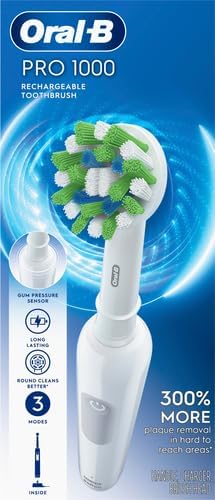
Oral-B Pro 1000 Rechargeable Electric Toothbrush
Best for: Most people: the most-studied powered-brush design, with a pressure sensor, at under $50
- Oscillating-rotating-pulsating round head, the most-studied powered-brush design
- Gum pressure control that automatically stops the brush pulsations when you press too hard, per the listing
- Handle-integrated quadrant timer that prompts you every 30 seconds, per the listing
- Takes every standard Oral-B replacement head, sold in pharmacies and supermarkets
- Listed by model name on the ADA Seal of Acceptance
- +Listed by model name on the ADA Seal of Acceptance, and the largest review base on this page at more than 105,000 ratings
- +One widely upvoted owner ties this handle's long life to its nickel-metal-hydride battery (Electric Teeth's review also names one), calling it more tolerant of being run flat than a lithium cell
- +Cheapest heads of the two majors: CrossAction heads work out at about $4.50 each
- −Louder and, by several accounts, harsher-feeling than a sonic brush, and a week to ten days between charges, shorter than the two weeks the Smart 1500 and Sonicare's listings claim
- −The sensor stops the pulsation rather than lighting up, so it is easier to miss than the iO light ring
(Affiliate link) · Free shipping on eligible Prime items
Why We Recommend It
The Pro 1000 is the most-discussed Oral-B in the threads we read, 73 mentions across 27 threads and most of them favourable, and the only model ahead of it across both brands is the Sonicare 4100 at 79. The case owners make for it is durability, and it comes from a thread mourning a twenty-year-old Braun handle, where a 74-upvote reply pointed to Braun’s current Oral-B-branded brush at about $50 and explained why these handles last: “The reason these last so long is the NiMH battery, much more robust and tolerant to over-discharging than a lithium ion battery.” A later reply in the same thread named the Oral-B 1000 outright and put the buying advice more bluntly: “don’t let them upsell you on a more expensive model tbh, the $49.99 version does everything you need.”
It also has the paperwork. The ADA lists the Pro 1000 by name among the models covered by its Seal of Acceptance for Oral-B’s oscillating-rotating-pulsating brushes (ADA Seal listing), a roster entry we read directly, naming this model rather than the brand.
The pressure sensor is the feature the professionals and owners in our research most consistently ask for, and it is worth knowing how this one behaves: the listing describes gum pressure control that automatically stops the brush pulsations when you press too hard. There is no light ring, so the feedback is a change in feel, which is easier to miss than the iO’s colour ring. What the sensor cannot do is prevent recession. The ADA’s own wording on gentle pressure is hedged, the systematic-review evidence on brushing and recession is inconclusive. What the sensor can claim is narrower: most people have no way to gauge their own force, and this tells them.
With more than 105,000 ratings at 4.5 stars, the Pro 1000 has the largest review base on this page. Multi-year ownership reports are common: “Oral-B is the safe bet honestly. I’ve had the Pro 1000 for like 4 years now and it’s still going strong,” one wrote. The other side of the record belongs here too. One owner arrived in a thread “searching for a replacement of my oral b1000 after just five years”, and a three-year unit was reported in our own research with battery degradation and a loud rattle. Replacement heads, at least, are available everywhere, with no online-only ordering or waiting for restocks.
Key Features
- Oscillating-rotating-pulsating round head
- Gum pressure control that stops the pulsations when you press too hard, per the listing
- Handle-integrated quadrant timer, prompting every 30 seconds, per the listing
- Compatible with all standard Oral-B brush heads (CrossAction, FlossAction, Sensitive, 3D White)
- Nickel-metal-hydride battery, per Electric Teeth’s hands-on review, which measured 10 days per charge (Amazon’s product details for this listing say lithium polymer); owners report a week to ten days, less as it ages
- Listed by model name on the ADA Seal of Acceptance
Who It’s Best For
The Pro 1000 is the right choice for most people buying an Oral-B. Unless you have a specific reason to want app data or the quieter feel of the iO magnetic drive, it delivers the two features the professionals in our research ask for at the lowest price of the five models on this page. It is also what they describe when they answer this question: “I’m a hygienist and I always suggest the least expensive model of sonicare or oral-b that includes a pressure sensor,” wrote one self-identified hygienist, and another poster in r/DentalHygiene named the model outright: “honestly for a first electric toothbrush the Oral-b pro 1000 is all you need since it has the pressure sensor and timer without any of the unnecessary extra stuff that just inflates the price.” For a broader comparison including Sonicare and budget brands, see our budget electric toothbrush roundup. For a closer look at this exact model, our standalone Pro 1000 review goes deeper on long-term ownership.
Potential Downsides
Feel is the main one. Oscillating heads are louder, and in the words of a self-identified retired dentist who prefers the other camp, “the cleaning is harsher”; one owner in our research who blamed an Oral-B for their gum recession describes switching to a Sonicare and seeing it improve, and our sensitive teeth picks go into that choice. It charges on a proprietary two-pin stand rather than a magnetic dock, and owners describe the runtime as roughly a week to ten days, shortening with age.
The other recurring complaint is mold, and it is a head problem on this line rather than a handle problem: “Just be aware the oral b heads are hollow and they grow mold inside very quickly, you have to clean them religiously,” one owner wrote. Pull the head off after brushing and let both parts dry.
(Affiliate link) · Free shipping on eligible Prime items
Oral-B Smart 1500 Electric Toothbrush (Black): Best for Heavy Brushers
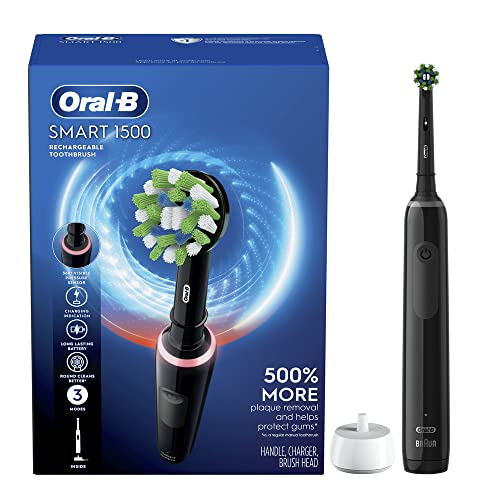
Oral-B Smart 1500 Electric Toothbrush (Black)
Best for: Buyers who want a pressure warning they can see, and a longer-lasting battery, on top of the Pro 1000's cleaning action
- The same oscillating-rotating-pulsating cleaning action as the Pro 1000
- Three modes: Daily Clean, Whitening and Sensitive, per Oral-B's product page
- Visible 360-degree gum pressure control that lights up when you brush too hard, per the listing
- Handle-integrated quadrant timer, prompting every 30 seconds, per the listing
- Takes every standard Oral-B replacement head
- +The same oscillating-rotating cleaning as the Pro 1000, with a listed battery life of 14 days against the Pro 1000's week to ten days
- +Visible 360-degree pressure ring that lights up when you press too hard, per the listing, which is harder to miss than the Pro 1000's pulse cut
- +Takes every standard Oral-B head, so the running cost matches the Pro 1000's
- −Same motor noise as the Pro 1000, and no app despite the Smart name
- −The roughly $23 step buys the pressure light and the battery rather than a better clean, and the few owner reports we found are split, one describing water getting in past a worn plug at the base of the handle
(Affiliate link) · Free shipping on eligible Prime items
Why We Recommend It
The Smart 1500 is a Pro 1000 with a pressure warning you can see and a longer-lasting battery. That is not a dismissal, it is the pitch, and for some buyers it is the right one. The cleaning action, the head compatibility and the running cost are the same. The listing describes a visible 360-degree gum pressure control that lights up when you brush too hard, and Oral-B’s own product page says the sensor also stops the pulsations, where the Pro 1000 only cuts its pulsations with no light. One thing the name gets wrong: despite “Smart”, this handle has no Bluetooth and no app. Neither Oral-B’s page nor the Amazon listing mentions one, and Electric Teeth’s hands-on review says so outright.
Owner reports on this model are thin. A pass through archived copies of Reddit threads in September 2026 turned up four, split down the middle. One owner six months in wrote that it “is working well”, and another lists it, without complaint, in a post-braces routine. Against that, one owner’s brush “died due to the plug at the bottom wearing out and water getting into the main housing”, and another, shopping for an upgrade, found theirs “too loud, intense, had poor battery life, no USB C”. Four reports are too few to rate a brush on, so the rest of this section leans on the listing, Oral-B’s page and the Pro 1000’s record, because underneath the light ring they are the same cleaning action.
At 4.6 stars across more than 20,000 ratings, it is the higher-rated of the two on Amazon, a little above the Pro 1000’s 4.5, on a review base large enough to read properly. The step up was about $23 when we checked, which is small enough to be tempting if you know you press too hard and would miss the Pro 1000’s silent cut-out. On battery, the listing says 14 days between charges, and Electric Teeth’s reviewer measured 19 to 20 days.
Key Features
- Oscillating-rotating-pulsating cleaning action, the same as the Pro 1000
- Three modes: Daily Clean, Whitening and Sensitive, per Oral-B’s product page (the Amazon listing’s bullets count four)
- No Bluetooth or app, despite the Smart name
- Visible 360-degree pressure ring that lights up when you brush too hard, per the listing
- Handle-integrated quadrant timer, prompting every 30 seconds, per the listing
- Compatible with all standard Oral-B replacement heads
Who It’s Best For
The Smart 1500 makes sense if you want a pressure warning you can see without moving to the iO head system. It is most useful for people whose dentist has flagged brushing too hard, because the ring lights up in the mirror at the moment it happens. It is also a reasonable choice for a parent teaching a teenager to ease off. If the teenager wears braces, ask the orthodontist first: practices differ, and in the threads behind our electric toothbrush for braces roundup one orthodontist prescribed an electric brush while another banned it after a broken bracket.
Potential Downsides
Same motor noise as the Pro 1000. There is no app: if brushing data is what you want, that starts at the iO tiers below, and the owners in our research are candid about how that goes (“the novelty quickly wore off after maybe less than 5 uses, so I never used the app again,” wrote one iO owner). If your pressure is already under control, this is about $23 for a light you will rarely see.
(Affiliate link) · Free shipping on eligible Prime items
Oral-B iO Series 3 Limited Deep Clean (White): Best iO to Buy
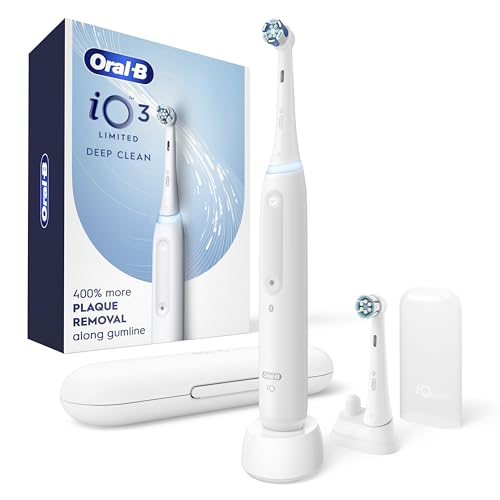
Oral-B iO Series 3 Limited Deep Clean (White)
Best for: Readers who want the quieter iO magnetic drive without the display or the app
- iO magnetic drive behind the round Oral-B head, per the listing
- Visible iO pressure sensor that signals whether you are applying the right pressure, per the listing
- Three cleaning modes: Daily Clean, Sensitive and Whitening, per the listing
- iO light ring timer for the two-minute brush, with a refill-change alert, per the listing
- Covered by the ADA Seal for the iO Series
- +The iO tier one commenter in our research called 'the sweet spot': the same drive as the flagship, without the display and app owners report abandoning
- +Covered by the ADA Seal for the iO Series, and the cheapest of the three iO picks on this page
- +Three cleaning modes and the iO light ring timer with a refill-change alert, per the listing
- −iO heads cost roughly double Oral-B's CrossAction heads, about $9.50 each when we checked
- −Slow to charge (up to 16 hours for a full recharge, per Electric Teeth's review), and owners in several threads report mold in the heads and handles unless both are dried after every use
(Affiliate link) · Free shipping on eligible Prime items
Why We Recommend It
The iO line is Oral-B’s newer magnetic drive, and owners who have used both describe the difference mostly in feel. A ten-year Oral-B owner a year into an iO3 claimed more than that: “Gentler on gums while cleaning better and doesn’t drip toothpaste out the little hole on the base of the brush head. Quieter also.” The reason to buy this tier rather than a higher one is that every iO listing we read describes the same drive; they differ in modes, display and app, and one owner in our research summed the range up as “the same mechanical action” between the iO3 and the iO9. Another answered the value question in a 2025 comment, posted before that thread filled with promotional replies: “For me Oral-B iO3 is the sweet spot, great cleaning, no pointless gimmicks, and doesn’t cost stupid money.”
One listing note, said plainly. The listing we recommend is the white Limited Deep Clean box, which carries about 19,000 ratings at about $110. Oral-B sells the same iO3 handle in several boxes that differ in what is packed with it, as a commenter in an archived r/oralbtoothbrush thread pointed out; the Limited Deep Clean box carries two brush heads and a travel case, per the listing. The ADA’s Seal covers the iO Series as a line (ADA Seal listing).
The pressure sensor is the other reason to step up from the Pro 1000. Per the listing, the iO sensor signals whether you are applying the right pressure, where the Pro 1000 answers by cutting its pulsation instead, which is the difference between feedback you notice and feedback you can brush straight through. The three modes, per the listing, are Daily Clean, Sensitive and Whitening, named for what each is pitched at; gums that bleed or stay inflamed are a reason to see a dentist rather than to change mode.
Key Features
- iO magnetic drive behind the round Oral-B head, per the listing
- Visible iO pressure sensor signalling whether you are applying the right pressure, per the listing
- Three cleaning modes: Daily Clean, Sensitive, Whitening, per the listing
- iO light ring timer for the two-minute brush, with a refill-change alert, per the listing
- Two brush heads and a travel case in the box, per the listing, which the identically priced black Limited Deep Clean box also names
- Covered by the ADA Seal for the iO Series
Who It’s Best For
The iO3 is the right iO if you want the magnetic drive and nothing else on the spec sheet. It is also the natural step for a Pro 1000 owner who finds that motor buzzy. The community’s own summary is worth taking at face value: “You can get the cheapest or find some on offer, they all clean the same. You don’t need any other gizmos.” For a broader look at options for sensitive gums, see our electric toothbrush for sensitive teeth roundup.
Potential Downsides
Heads, first. iO Ultimate Clean heads were about $19 for two when we checked, about $9.50 each, roughly double the Pro 1000’s CrossAction heads, and they are not interchangeable in either direction.
Mold is the second, and on the iO it reaches the handle rather than just the head. An r/DentalHygiene member drew the line for us: “The current IOs have an issue of mold growing in both the toothbrush head and handle. I haven’t seen the issue with the Pro.” It is the first thing prospective iO3 buyers ask about, in almost those words: “Amazon reviews say there are a ton of mold issues with the oral b io3.” Pull the head off, rinse the stem, and let both dry apart.
Three smaller things. The pressure light is bright, and not everyone wants it: “It’s like having a Christmas tree in your mouth. I have to close my eyes while brushing to not feel like I’m in a nightclub,” wrote one owner who liked the motor and went looking for a model with the same drive and no light ring. The handle does not show which mode is on: one new owner asked in an archived r/oralbtoothbrush thread whether there is any way “to find out what mode it is on”, and Electric Teeth’s review confirms there are no icons or labels, so “you have to remember the order”. And charging is slow: Electric Teeth puts a full recharge at up to 16 hours, which matches the one measured owner report in our research, on an iO6, where 13 to 14 hours on the charger produced no usable gain.
(Affiliate link) · Free shipping on eligible Prime items
Oral-B iO Series 5 Ultimate White: Cheapest With the App
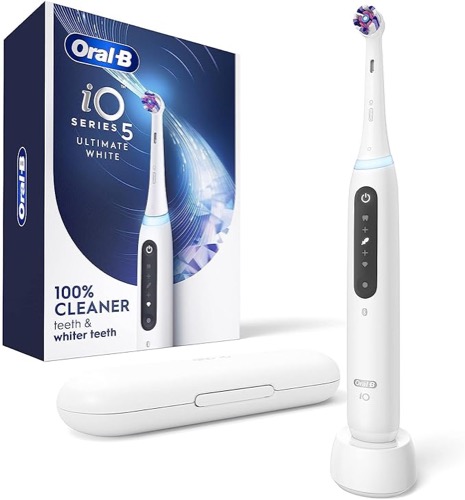
Oral-B iO Series 5 Ultimate White (White)
Best for: Buyers who want the Oral-B app and five settings, the cheapest handle on this page with both, and who know what the step costs
- Five cleaning settings, per the listing
- Visible pressure sensor that signals too hard, too soft or just right, per the listing
- Oral-B app that tracks how and where you brush in real time, per the listing
- iO light ring timer for the two-minute brush, with a head-change alert, per the listing
- One replacement head and a travel case in the box, per the listing
- +Five cleaning settings and a visible pressure sensor that signals too hard, too soft or just right, per the listing
- +One replacement head and a travel case in the box, per the listing
- +The Oral-B app that tracks how and where you brush in real time, per the listing
- −The iO3 Limited Deep Clean runs the same iO drive for about $10 less, so this tier buys the app, two more settings and mode icons rather than a better clean, and the app is the feature owners in our research most often say they stopped using
- −This white listing carries about 400 ratings, a thin base to read anything into; the same model's Limited Deep Clean & Whiten listing carries about 4,400 at around $150
(Affiliate link) · Free shipping on eligible Prime items
Why It Has a Card
This card answers a question readers keep asking, which is what the step above the iO3 actually buys. It is not us telling you to buy it. The iO5 sits between the iO3 and the iO 7G on the same magnetic drive; what it adds is the Oral-B app, five settings instead of three, and backlit icons on the handle that show which setting is on, which the iO3 lacks. It has no screen: per Electric Teeth’s hands-on review, the handle display starts at the iO6, and on this page it arrives with the iO 7G. Both boxes name a travel case, so that is not part of the step.
Get the app question straight first, because it is the spec most often reported wrongly for this tier. The iO5 has the Oral-B app: per the listing, it tracks how and where you brush in real time. An owner in our research placed the cut-off while explaining why the feature stopped mattering to them: “The main reason was because I was curious about the app feature. The bluetooth/app connectivity starts with iO 4 and up (no app feature with iO 3 and 2). But the novelty quickly wore off after maybe less than 5 uses, so I never used the app again.” Another owner in our research says the iO3 “does have an app”, but it does not: Electric Teeth’s iO3 review says it has no Bluetooth and “does not connect to a smartphone via an app”, and Oral-B’s own comparison chart on its Amazon listings marks the app from the iO5 up. The iO5’s listing describes the app in almost the same words Oral-B uses on the iO 7G.
Owner signal at this tier is thin and mixed. “I got an oral-b io5 a few weeks ago. I really like it,” wrote one, comparing it favourably with a 2015 Sonicare on feel alone. A commenter in r/Dentistry who owns three brushes preferred the iO5 to the others. Against those, one owner in an archived r/oralbtoothbrush thread reported the brush cutting out after about a minute unless pressed hard, a single report with no replies; two commenters in one r/DentalHygiene thread in our receding-gums research blamed an iO5 for gum recession, one finding even the soft heads too hard; and the mold reports in the maintenance section below include an iO5. No owner reported it cleaning better than the cheaper iO3, which is the point: the iO3 does the same job for about $10 less, and the money here buys the app, two extra settings and icons that show which one is on.
One listing note, said plainly. This white Ultimate White listing carries about 400 ratings, which is a thin base to read anything into, and a Limited Deep Clean & Whiten listing of the same model carries about 4,400 ratings at around $150; we link the cheaper white one at about $120. As with the iO3, Amazon counts each listing’s ratings on its own, so the thin number here reflects how the pool is split rather than a worse brush. Read the star rating on this listing as directional and lean on the tier reasoning above instead.
Key Features
- iO magnetic drive, the same as the iO3 and iO 7G
- Five cleaning settings, per the listing
- Visible pressure sensor signalling too hard, too soft or just right, per the listing
- Oral-B app tracking how and where you brush in real time, per the listing
- iO light ring timer for the two-minute brush, with a head-change alert, per the listing
- One replacement head and a travel case in the box, per the listing
Who It’s Best For
Someone who wants the app, or wants to see which mode is on without counting button presses, and has read the paragraph above anyway. If the deciding factor is the travel case, the iO3 box names one too, so it is not a reason to pay the extra $10. If the deciding factor is the app, the iO5 is the cheapest handle on this page whose listing describes one.
Potential Downsides
The step over the iO3 is about $10 for the app, two more settings and mode icons, on an identical drive, with a travel case named on both boxes. The tracking is what this tier is for, and one owner in an archived r/oralbtoothbrush thread found it “completely inaccurate” in the first week of use; that is one report, not a pattern. Charging is the same slow arrangement as the iO3, with the fast charger arriving at the iO 7G. iO heads cost about $9.50 each when we checked, and the mold routine is the same: dry the head and the handle stem after every brush.
(Affiliate link) · Free shipping on eligible Prime items
Oral-B iO Series 7G Electric Toothbrush (Black Onyx): Best Smart Tier
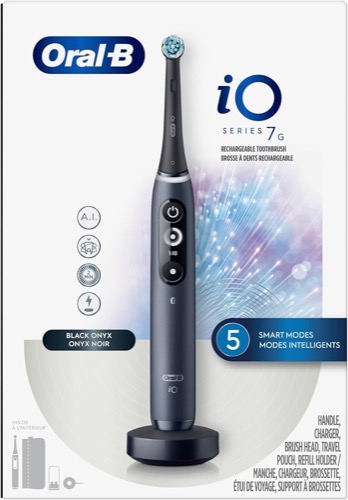
Oral-B iO Series 7G Electric Toothbrush (Black Onyx)
Best for: People who want the app and the fast charger, and accept that no evidence shows it cleaning better than the iO3
- Oral-B app that tracks how and where you brush in real time, per the listing
- Five cleaning modes selected from the handle display, per the listing
- Visible iO pressure sensor signalling too hard, too soft or just right, per the listing
- 3-hour fast charger and travel case, per the listing
- Ships with one replacement brush head, per the listing
- +The 3-hour fast charger and a travel case, per the listing, where the cheaper iO tiers charge overnight and then some
- +The iO tier with owner reports reaching five years and counting, from two owners in separate threads
- +Five modes on the handle display and a pressure ring that signals too hard, too soft or just right, per the listing
- −No independent evidence that it cleans better than the iO3 below it; the higher tiers add a display, modes and an app on the same iO drive
- −At more than four times the Pro 1000's price, the premium is the smart layer, and owners repeatedly report stopping using it
(Affiliate link) · Free shipping on eligible Prime items
Why We Recommend It
The listing’s own pitch for this tier is the app: it tracks how and where you brush in real time. That is almost the same sentence Oral-B prints on the iO5 listing, with “A.I. powered” added, so nothing we read shows the tracking itself getting better here. What does change is the handle, which gains a display for choosing modes and checking the battery, and the charger, 3 hours instead of the overnight-and-then-some the cheaper iO tiers need. Whether that is worth about $217 depends on whether you will use the app.
Its better argument is longevity, and it is the one iO tier with a five-year record to point at; a five-year record needs five years on the market, so the silence on the other tiers is not evidence against them. “I can’t speak to other brands and models (because the one I have has lasted so long!), but my Oral-B iO Series 7 has served me well for 5 years and counting,” one owner wrote; “I’ve been using Oral b io7 for like 5 years and going very strong,” wrote another, independently, and a third in the dedicated Oral-B community: “I’ve been using the io7 for years. No complaints.” Against that, one owner reported a battery giving up sooner: “I bought in 2022, and the battery is no longer properly charging. I guess four years isn’t bad, but I was hoping it would last longer.”
If a dentist has flagged gum disease or recession and told you to change how you brush, coaching that shows which zones you missed is a plausible way to build the habit; that is as far as the claim goes. We found no independent evidence that this tier cleans better than the iO3 below it, and the only study claiming a premium Oral-B outperforms its entry models comes from the manufacturer’s own funded analysis of its own trials, linked under How We Evaluated above. Buy this for the tracking, the fast charger and the record, not for a better clean. For cross-brand options aimed at recession, see our electric toothbrush for receding gums roundup.
Key Features
- iO magnetic drive, the same as the iO3 and iO5
- Oral-B app that tracks how and where you brush in real time, per the listing
- Five cleaning modes selected from the handle display, per the listing
- Visible iO pressure sensor signalling too hard, too soft or just right, per the listing
- 3-hour fast charger and travel case, per the listing
- One replacement brush head in the box, per the listing
Who It’s Best For
People who will actually open the app, and people for whom a 3-hour charge instead of an overnight one is worth real money. It is also the tier to buy if you were considering the flagship: the iO9 listing we priced is about $380, runs the same drive, and has the weaker owner record of the two, which the buyer’s guide covers below.
Potential Downsides
The tracking needs the phone. Without it, this is an iO5 with a display and a faster charger at a higher price, and the pattern in our research is that owners stop reaching for the app: the most-upvoted iO7 comment we found is about the clean and dismisses the software in passing. At about $217, this is more than four times the Pro 1000, and no independent trial we could find separates the two lines on cleaning. The iO head cost and the handle-mold routine apply here as they do at every iO tier.
(Affiliate link) · Free shipping on eligible Prime items
Buyer’s Guide: Choosing the Right Oral-B Model
Pro/Smart vs. iO: The Fundamental Decision
The Oral-B lineup splits into two product lines with different technology:
Pro/Smart line (Pro 1000, Smart 1500): Traditional oscillating-rotating motor. Louder, more tactile feel. Takes standard Oral-B heads at about $4.50 each. Both the Pro 1000 and the Smart 1500 are named on the ADA Seal roster; no magnetic drive, no handle display.
iO line (Series 2, 3, 5, 7, 9): Magnetic drive motor. Quieter, smoother oscillation. The ladder starts one rung below anything we pick: an iO Series 2 Limited Simple Clean was listed at around $70 on the day we read it, with three modes, a pressure sensor and a travel case per its listing. The only trace of it in our research is one owner’s aside that the iO2 and iO3 have no app, so we name it rather than pick it. Uses iO-specific heads at about $9.50 each, incompatible with standard heads. Owners who have used both lines describe the difference as feel rather than result, and the ADA Seal covers the iO Series as a line.
No independent trial we could find separates the two lines on cleaning. The iO feels better to use: quieter, smoother, less vibration in the handle. Whether that upgrade justifies roughly double to four times the price depends on how much motor noise bothers you and how much the doubled head cost matters over five years. Some owners weigh the iO3 against Oral-B’s Pro 3 rather than the Pro 1000, and they split: in one archived r/oralbtoothbrush thread, one wrote “I’d pick Pro 3. Cleans the teeth just as well. Brush heads are half the cost of those for the iO3,” while a later reply called the iO3 “far superior to the Pro 3”. We have not given the Pro 3 a card; the trade-off is the same one this section describes.
Where the Price Jumps Actually Matter
$50 to about $73 (Pro 1000 to Smart 1500): Adds a pressure light you can see and a longer-lasting battery. Worth it if you press too hard and would miss a silent cut-out, skippable if you do not. The cleaning is identical and the heads are the same price.
About $70, where the iO line starts (iO Series 2): The cheapest iO handle when we checked was the Series 2 Limited Simple Clean at around $70, with three modes, a pressure sensor and a travel case per its listing. Nobody in our research reports owning one, so it is a rung on the ladder here rather than a pick.
About $73 to about $110 (Smart 1500 to iO3): Switches from the traditional motor to the magnetic drive for about $37, and this is the largest change in feel in the whole lineup. The three modes and a visible pressure warning are on the Smart 1500 already. You give up the cheap head system, and move to heads that cost roughly double, which is where this step really costs you.
About $110 to about $120 (iO3 to iO5): Adds the Oral-B app, two more settings and backlit icons that show which setting is on. Both boxes name a travel case, so that is not what the step buys. Same drive, same clean.
About $120 to about $217 (iO5 to iO 7G): Adds a handle display and swaps the slow charge for a 3-hour fast charger, per the listing. Both listings describe the same app tracking, so the display and the charger are the parts of this step you will notice.
Above that: the iO9 tier, which we do not pick. See the note at the end of this guide.
Brush Head Compatibility and Cost
This is the largest long-term cost difference between the two lines, and it came up in 25 of the 40 threads in our Oral-B research:
- Standard Oral-B heads (CrossAction, FlossAction, Sensitive) fit the Pro 1000 and Smart 1500. A four-pack of CrossAction heads was about $18 when we checked, about $4.50 each, and they are sold everywhere.
- iO heads (Ultimate Clean, Gentle Care, Radiant White) fit only iO models. iO Ultimate Clean was about $19 for two when we checked, about $9.50 each, roughly double, and mostly bought online.
- The two systems are completely incompatible. Once you buy into the iO line, you cannot use standard heads, and vice versa.
The ADA’s replacement interval is “every three to four months or more often if the bristles are visibly matted or frayed” (ADA), which is three to four heads a year: about $14 to $18 a year on the Pro/Smart line, about $29 to $38 on iO. Over five years the head bill on an iO handle runs about $143 to $190, more than the iO3 handle itself cost.
When App Connectivity Actually Matters
The iO5 and the iO 7G carry the Oral-B app, per their listings, which describe it in almost the same words: it tracks how and where you brush. The iO3 and iO2 do not: Oral-B’s own comparison chart on its Amazon listings marks the app from the iO5 up, and Electric Teeth’s iO3 review confirms the iO3 has no Bluetooth. The app is worth considering if you:
- Have been told by a dentist to change your brushing technique, duration or pressure
- Respond well to data-driven habit tracking, the way some people do to fitness trackers
- Have a dentist or hygienist who has asked you to track your brushing
It is not worth the premium if you already brush for two minutes twice a day and have no gum issues. The owners in our research are blunt about the arc: “the novelty quickly wore off after maybe less than 5 uses, so I never used the app again,” and a forum post comparing eight brushes reached the same place: “Skip the expensive flagship models unless you really want app connectivity.” The pressure sensor on the handle gives you the feedback that matters without a phone in the bathroom.
Charging Time: The Hidden iO Gotcha
The iO tiers below the 7G charge slowly. Electric Teeth’s iO3 review puts a full recharge at up to 16 hours, and the one measured owner report in our research, on an iO6, matches it: about 16 hours from empty, with 13 to 14 hours on the charger producing no usable gain. The iO 7G and above use a 3-hour fast charger, per the listing. Slow charging only bites when the battery runs flat, and then it means waiting overnight and then some.
Electric Teeth’s hands-on review describes the Pro 1000’s battery as nickel-metal-hydride and measured 10 days from a full charge, in line with the week to ten days owners report, so it visits the stand more often; the Smart 1500’s listing describes a lithium-ion battery at 14 days. Amazon’s product details for this listing name a lithium polymer battery instead, so the two sources disagree; the durability reputation rests on one widely upvoted owner, who credits a nickel-metal-hydride cell as more tolerant of being run flat than a lithium one.
Maintenance: Preventing Mold Buildup
Mold has two separate versions on this lineup, and it is worth knowing which one you are buying into. Oral-B’s round heads are hollow, and they grow mold inside if you leave them wet: “Just be aware the oral b heads are hollow and they grow mold inside very quickly, you have to clean them religiously,” one owner wrote. Mold in the handle and stem is the iO-specific complaint, and a member of r/DentalHygiene drew the same line: “The current IOs have an issue of mold growing in both the toothbrush head and handle. I haven’t seen the issue with the Pro.”
Not every owner runs into it, and not every report is mold. In one archived r/oralbtoothbrush thread, an iO3 owner reported “no mold” after three months of taking the head off to air-dry, while another commenter in the same thread wrote “I’ve 2 io3’s, both have mold”; in a separate iO5 thread, other commenters argued the buildup was “old dried toothpaste mixed with plaque” rather than mold. Either way the prevention is the same, and it matches the ADA’s toothbrush guidance, which says a brush stored moist in a closed container grows more microbes than one left to air-dry.
The fix is the same for both: remove the brush head after each use, rinse the head and the metal shaft, and let them air dry separately. It takes five seconds. The two highest-scoring threads in our Oral-B research, at 264 and 133 upvotes, are both about 3D-printing holders that stop an iO handle trapping water, which tells you how much the design annoys people.
Oral-B vs. Sonicare: A Quick Note
This page is about choosing between Oral-B models, but readers ask the cross-brand question too, so here is where the evidence stands. The professionals disagree on record. A self-identified retired dentist in our research is unequivocal: “Do you like your gums? Then stick with Sonicare style brushes.” A commenter who identifies as a dentist with ten years running clinical trials pushes back that multiple reviews “haven’t found a meaningful difference in gum recession outcomes between the two.” Neither side has a head-to-head recession trial behind it: the 2021 JADA review found that “the evidence does not suggest the superiority of either” design, but it measured plaque and gum-index reduction rather than recession, and a 2015 systematic review in the Journal of Clinical Periodontology found the evidence linking brushing of any kind to recession largely inconclusive. Both reviews are linked in the Evidence Receipt above.
Our own Oral-B research carries the sharper version of the complaint, and it belongs on this page. “I will tell you what both my dentist and hygienist told me. They prefer Sonicare or sonic-type over Oral B as the latter tends to tear the gums,” one user relayed, in the strongest secondhand professional opinion in that batch of threads. Another was more specific: “I used an Oral B for years and ended up having to have a gingivectomy (no fun, I promise) because the Oral B hastened my gum recession.” Those are owner reports, not evidence of a mechanism, and the reviews above say the difference is not established either way. Brush gently, use the sensor, and pick the head shape you will use for two minutes. Our electric toothbrush guide lays out the full disagreement with sources, our Sonicare model roundup covers the other brand model by model, and our Oral-B vs Sonicare comparison goes deeper on the two systems.
A question that runs through the Oral-B threads behind this guide is whether a pressure sensor is worth paying for, and the answer that recurs, most strongly from people who have had gum recession, is yes: 'Definitely get one with a pressure sensor,' one r/DentalHygiene commenter wrote. The same thread carries a measured take on Oral-B versus Sonicare, from a commenter recalling their school-days reading of the studies that oscillating brushes have a slight benefit over sonic ones, which is close to where the independent network meta-analysis lands. Our community research covers 1,486 Reddit threads across 209 subreddits, with a section on gum disease.
Why the iO Series 9 is not one of our picks
The flagship is not one of our picks here, and three findings decide it.
The owner record is mixed to negative once the promotional comments come out. The two most flattering iO9 comments in the threads we read were a verbatim duplicate pair posted by different accounts in the same thread, so we do not count them. What is left includes organic praise, one owner who got it “for Christmas a few years back and I absolutely love it”, and two independent battery failures: “I had the io 9, but the battery is now dead. I charge it fully, and I use it for about 15 seconds, and then the battery dies,” and, from another owner, “Oral B iO series aren’t worth the price tag! I had iO9 and never use any smart features… like who has the time… and it died after a year. Got a new replacement, and this one was on the way ou[t].” Our own Oral-B forum research adds nothing either way: not one thread in it contained an iO9 owner describing their experience.
Its listing describes the same micro-vibrating action as the iO3’s. What the flagship adds over the iO7, per Oral-B’s comparison chart on Amazon, is two more modes, a colour display, finer brushing tracking and a third head; over the iO3 and iO5 it also adds the 3-hour magnetic charger. One owner’s summary of the range was that the iO3 and the iO9 are “the same mechanical action”. No independent trial shows a pricier model from one brand cleaning better than that brand’s entry model; the only claim of the sort comes from the manufacturer’s own funded analysis, linked under How We Evaluated.
The tier below is the better buy. The iO 7G has the stronger owner record of the two and costs less. If you want the flagship anyway, read its own reviews for battery reports before you buy. We would rather point you at the 7G, or at the iO3 if what you want is the iO clean without the software.
Frequently Asked Questions
What’s the best Oral-B for most people?
The Pro 1000. It has the two features the professionals in our research actually ask for, a pressure sensor and a quadrant timer, at the lowest price of the five models on this page; it is named on the ADA Seal roster; and it carries the largest review base on this page, at more than 105,000 ratings. The iO line gives you a better brushing experience. No independent study we could find says it gives you a better clean; the only claim that it does comes from the manufacturer’s own funded analysis of its own trials, linked under How We Evaluated above.
Is the iO line worth the upgrade from the Pro 1000?
It depends on what you value. Owners who move to it from the Pro line describe the iO’s magnetic drive as noticeably quieter and smoother. But the cleaning motion is the same oscillating-rotating action, and the heads cost roughly double for as long as you own the handle. If the Pro 1000’s motor bothers you, the iO3 is the tier to try. If it does not, there is no clinical reason to move.
Can I use standard Oral-B brush heads on an iO toothbrush?
No. The iO line uses a different head attachment that is incompatible with standard Oral-B heads. Standard heads (CrossAction, FlossAction) fit every Oral-B rechargeable handle except the iO and Pulsonic lines; iO heads (Ultimate Clean, Gentle Care) fit only iO handles. Choosing a line is a long-term commitment to its head price.
Which iO model should I get if I’ve decided on the iO line?
The iO Series 3. Every iO listing we read describes the same drive, so the money above it buys a display, extra settings and an app that owners in our research repeatedly report abandoning. The ladder does start a rung lower, at the roughly $70 iO Series 2, but no owner of one turns up in our research, which is why the buyer’s guide above names it rather than picks it. Step up to the iO 7G only if you want the app and the 3-hour charger and know you will use them.
How long do Oral-B electric toothbrush batteries last?
Electric Teeth’s hands-on review describes the Pro 1000’s battery as nickel-metal-hydride and measured 10 days per charge, and owners report a week to ten days, shortening with age. The Smart 1500’s listing describes a lithium-ion battery at 14 days, and the same reviewers measured 19 to 20 days. The iO3 runs on a lithium-ion cell, per its listing; Electric Teeth measured 18 to 20 days on it and put a full recharge at up to 16 hours, and charging is slow on every iO tier below the 7G. One widely upvoted owner credits that older chemistry for the long service life, describing it as more tolerant of being run flat than a lithium cell; Amazon’s product details for the Pro 1000 name a lithium polymer battery instead. Battery failures turn up on both lines in the threads we read: in one archived r/BuyItForLife thread, two iO owners describe batteries fading at two to three years, one saying Oral-B told them it was “only designed to last 3 to 5 years”, alongside the iO7, iO9 and three-year-old Pro 1000 reports earlier on this page. That is too few reports to rank the lines.
Do I really need multiple cleaning modes?
For most people, a daily-clean setting handles everyday brushing. The sensitive and whitening settings are named for gentler brushing and surface stain; gums that bleed or stay inflamed are a reason to see a dentist first, not to change settings. Beyond those three, the settings serve narrow cases. Do not pay extra for modes you are unlikely to use.