Periodontitis, the advanced form of gum disease, affects nearly half (42%) of US adults aged 30 and older, according to the CDC. A mouthwash can help with one part of the problem, the plaque and inflamed gums, as part of your daily oral care routine; no rinse on this page is shown to treat the bone loss underneath. Whether you’re dealing with early-stage gingivitis (the reversible inflammation phase) or trying to stay ahead of more advanced periodontitis, Cleveland Clinic lists using an antibacterial mouthwash as one part of a gum-disease prevention routine, alongside brushing and flossing.
The key word, though, is part of your routine. According to MouthHealthy (the ADA’s consumer site), gingivitis can usually be eliminated by a professional cleaning followed by daily brushing and flossing, and its mouthwash page is clear that a rinse is not a replacement for brushing and flossing. Pairing your rinse with the best toothpaste for gum disease and a quality toothbrush gives you the most complete daily defence. With that in mind, we’ve rounded up the rinses people with gum disease are most often pointed to, and what each one is and is not labeled to do, so you can have an informed conversation with your dentist and make the best choice for your mouth.
How We Evaluated
We assessed each mouthwash across several criteria that matter most when gum health is the priority:
- Active ingredients: We looked for the antibacterial agents the American Dental Association lists as helping reduce plaque and gingivitis (essential oils, cetylpyridinium chloride (CPC) and chlorhexidine gluconate), plus two other actives used by picks below, hydrogen peroxide and chlorine dioxide, which the ADA page lists for whitening and bad breath rather than gum health.
- ADA Seal of Acceptance: A product carrying the Seal “has been objectively evaluated for safety and efficacy by an independent body of scientific experts,” in the words of the same ADA page. The Seal is granted claim by claim, so we checked what each product’s Seal is for: one pick here holds it for gingivitis and plaque, another for bad breath only.
- Alcohol content: Alcohol can be drying, which is why the ADA page suggests an alcohol-free rinse for people with dry mouth. We flagged alcohol-free options throughout.
- Ease of use and taste: A mouthwash only works if you actually use it consistently, so palatability matters.
- Price and availability: We favored options that are accessible at most pharmacies or online without requiring a specialist visit (with one important prescription exception).
- Real-world user feedback and practitioner mentions: We read 75 Reddit threads for this version, most of them on r/PeriodontalDisease and r/DentalHygiene (and 30 for an earlier version), and weighed which rinses people with gum disease and practicing hygienists name. Chlorhexidine, CloSYS, Listerine and TheraBreath are the rinses named most in those threads; Colgate Peroxyl comes up in three and Crest Pro-Health Clinical in two, so those two stand on their labels and the research instead.
Evidence Receipt
- Gum disease is widespread: the CDC’s fast facts on gum disease estimate that 42% of US adults aged 30 and older have some form of periodontitis.
- Listerine Clinical Solutions Gum Health Mouthwash is listed by the ADA Seal program as helping to prevent and reduce gingivitis and plaque above the gumline when used as directed.
- Peridex’s DailyMed label describes chlorhexidine gluconate 0.12% as providing antimicrobial activity during oral rinsing, while saying the clinical significance of that activity “is not clear”; roughly 30% of the active ingredient is retained in the oral cavity after rinsing.
- Colgate Peroxyl’s DailyMed label is for temporary use to cleanse canker sores, minor wounds and minor gum inflammation caused by dental work, dentures, braces or injury, with a stop-after-7-days instruction unless a dentist or doctor directs otherwise. It makes no plaque or gingivitis claim.
- A Cochrane review of 51 trials found chlorhexidine rinse produced a large reduction in plaque within 4 to 6 weeks, a small reduction in gingivitis in people with mild gum inflammation, and tooth staining after 4 weeks or more of use.
- A meta-analysis of 29 six-month trials, all of them industry-sponsored, found that adding an essential-oil rinse to brushing and cleaning between the teeth cut gingivitis by 16.0% and plaque by 27.7%.
- For cetylpyridinium chloride (CPC), a systematic review concluded that CPC rinses give “a small but significant additional benefit” for plaque and gum inflammation when added to brushing.
- For chlorine dioxide, the active in CloSYS, the one meta-analysis we found pooled five trials in healthy adults and called the evidence “very limited”.
- Crest Pro-Health Clinical’s Drug Facts label lists cetylpyridinium chloride at 0.1%; the standard Crest Pro-Health label lists 0.07%.
- No rinse here is shown to treat periodontitis itself. Peridex’s label says its effect on periodontitis “has not been determined”, and the European periodontitis treatment guideline treats an antiseptic rinse as something that “may be considered” in specific cases alongside professional cleaning, to help control gum inflammation.
Listerine Clinical Solutions Gum Health Mouthwash — Best Overall
Listerine Clinical Solutions Gum Health Mouthwash
Best for: A daily over-the-counter rinse with the ADA Seal for plaque and gingivitis
- Essential oil antiseptic blend with ADA Seal of Acceptance
- Labeled antiplaque/antigingivitis, with zinc added to the standard Listerine formula
- Four essential oil actives: thymol, eucalyptol, menthol, methyl salicylate
- 4.7★ average across 3,000+ Amazon ratings
- +Essential oil antiseptic blend carries the ADA Seal for reducing plaque and gingivitis
- +Available over the counter at around $10, priced for sustained daily use
- +The same four essential-oil actives as standard Listerine Antiseptic, with zinc added, per both Drug Facts labels
- −Some studies found prescription chlorhexidine gave better plaque control, though the ADA notes no difference for gingivitis
- −Contains alcohol (21.6% v/v per its Drug Facts label), which can sting on inflamed tissue
(Affiliate link) · Free shipping on eligible Prime items
Why We Recommend It
For most people looking for a gum-health rinse, Listerine Clinical Solutions makes the strongest everyday case of any over-the-counter pick here: it is the only one on this page whose ADA Seal covers gingivitis, in a formula you can buy without a prescription and whose label sets no limit on how long you use it. Its four essential oil antiseptic blend (thymol, eucalyptol, menthol, methyl salicylate) carries the ADA Seal of Acceptance for helping to prevent and reduce gingivitis and plaque above the gumline. Those four actives are the same ones, at the same strengths, as in standard Listerine Cool Mint Antiseptic; the notable addition on the Clinical Solutions label is zinc chloride. So the evidence behind it is the evidence for essential-oil rinses generally: a meta-analysis of 29 six-month trials found 16.0% less gingivitis and 27.7% less plaque than brushing and cleaning between the teeth alone, with the caveat that every one of those trials was industry-sponsored. A separate 2019 network meta-analysis of six-month trials points the same way: among mouth rinses, those containing essential oils “showed the greatest effect” on gum-inflammation scores.
Where chlorhexidine (see Peridex below) is the prescription-only rinse its label indicates for use between dental visits as part of a professional gingivitis treatment program, and one a 1997 review calls the gold standard other antiplaque rinses are measured against, Clinical Solutions fills the everyday role: the rinse you use between professional cleanings or after a chlorhexidine course. Its Amazon record (4.7★ across more than 3,000 ratings at our latest check) is strong, and at around $10 it is priced for daily use.
Key Features
- Essential oil antibacterial blend with ADA Seal of Acceptance
- ICY Mint flavor in a 1 L bottle sized for twice-daily use
- Positioned specifically for plaque buildup and gum health, not cavities
- Twice-daily maintenance regimen built into product instructions
Who It’s Best For
Anyone with gingivitis, or keeping gum inflammation down after periodontal treatment, who wants a daily OTC rinse labeled for plaque and gingivitis. Also the natural next step for patients who’ve finished a chlorhexidine course and need something to carry on with.
Potential Downsides
Essential oils are effective, though some studies found prescription chlorhexidine gave better plaque control (the ADA notes no difference in gingivitis control): if your periodontist says you need chlorhexidine, this won’t substitute. This formula also contains alcohol: its Drug Facts label lists 21.6% v/v, and it is not for children under 12. If alcohol rinses sting your inflamed tissue, look at the alcohol-free picks further down this list.
(Affiliate link) · Free shipping on eligible Prime items
Peridex Chlorhexidine Gluconate 0.12% — Best Prescription-Strength

Peridex Chlorhexidine Gluconate 0.12%
Best for: Gingivitis (red, swollen, bleeding gums) as part of a dentist's treatment program
- 0.12% chlorhexidine gluconate, prescription rinse labeled for gingivitis
- Prescription only; its label says to start it directly after a professional cleaning
- About 30% stays in the mouth after rinsing and is released slowly
- Heavily studied: a Cochrane review covers 51 trials
- +Better plaque control than essential-oil rinses in some studies, per the ADA
- +About 30% stays in the mouth after rinsing and is released slowly, per its label
- +Heavily studied: a Cochrane review covers 51 trials
- −Prescription only, requires a dentist or periodontist visit
- −Stains: in its label's six-month trial 56% of users had measurable extra tooth stain, against 35% of the comparison group, and it can change how food tastes
- −Contains alcohol (11.6% per its DailyMed label)
Prescription only — ask your dentist or periodontist
Why We Recommend It
Chlorhexidine gluconate is the prescription-strength option here: the ADA notes that some studies found it gave better plaque control than essential oils, though with no difference in gingivitis control. According to the ADA, chlorhexidine rinses help control plaque and gingivitis alongside daily brushing and flossing, and in the US they are prescription-only. It also has the largest review behind it on this page: a Cochrane review of 51 trials found a large reduction in plaque within 4 to 6 weeks, and a reduction in gingivitis in people with mild gum inflammation that was small enough that the reviewers did not consider it clinically relevant. For moderate or severe inflammation, the same review found too little evidence to say. In the forum threads we read, it is most often described as a short post-surgical or flare-up course rather than a daily product. Its label says about 30% of the chlorhexidine stays in the mouth after rinsing and is released slowly, a property dentists call substantivity. We include it here because anyone serious about gum disease should know it exists and discuss it with their dentist.
Key Features
- 0.12% chlorhexidine gluconate: stronger plaque control than essential-oil rinses in some studies, though the ADA notes no difference in gingivitis control
- Prescription only; requires a dentist or periodontist visit
- Started directly after a professional cleaning, per its label, then used as your dentist directs
- Labeled for gingivitis; the label says its effect on periodontitis has not been determined
Who It’s Best For
Patients with gingivitis under the active care of a dentist or periodontist, as part of their treatment program. This is not a rinse you pick up yourself: it is a prescription treatment used on your dentist’s instructions.
Potential Downsides
Requires a prescription: you can’t buy this over the counter or online without one, and pricing varies by pharmacy and insurance coverage, so we don’t list a typical price for it. Chlorhexidine can also stain teeth, fillings and the tongue: in the six-month trial on its label, 56% of users had measurable extra stain on the front teeth against 35% of the comparison group, and 15% developed heavy stain against 1%. It can alter taste perception during treatment (its label notes rare reports of permanent taste changes), and the label reports more tartar above the gumline in users than in the comparison group. Serious allergic reactions, including anaphylaxis, have been reported with chlorhexidine dental products: the label says anyone known to be hypersensitive to chlorhexidine or the rinse’s other ingredients should not use it, and to seek medical attention immediately for allergic symptoms such as a rash, swelling or breathing difficulty. In pregnancy, the label says it should be used “only if clearly needed”. The label sets no day limit but requires a re-check and professional cleaning at least every six months, and the European periodontitis guideline speaks of chlorhexidine rinses “for a limited period of time”: how long you use it is your dentist’s call. The label also reports that three months after people stopped, the bacteria in their plaque were back to where they started.
How to get it: Ask your dentist or periodontist about chlorhexidine gluconate at your next visit, especially if you’re scheduled for scaling and root planing. Keep its limits in view if you have been told your gum disease has moved past gingivitis: the label covers gingivitis, and says the effect on periodontitis has not been determined. It adds a caution for people who have both: whether gum inflammation is present after treatment with Peridex “should not be used as a major indicator of underlying periodontitis”. In plain terms, calmer gums on chlorhexidine do not show that the periodontitis underneath has gone.
ioRinse Ultra Periodontal Rinse — Best Perio-Specific
ioRinse Ultra Periodontal Rinse
Best for: Marketed specifically for gum disease, with molecular iodine chemistry
- Molecular iodine + xylitol periodontal rinse
- Alcohol-free, positioned for gum disease and bleeding gums
- 1L bottle sized for long-course therapy
- Distinct mechanism from CPC, chlorhexidine, or essential oils
- +Molecular iodine works via a different mechanism than CPC, chlorhexidine, or essential oils
- +Xylitol adds cavity co-protection alongside gum support
- +Alcohol-free 1L bottle sized for long-course therapy
- −Not appropriate for people with iodine sensitivity or thyroid conditions
- −Higher price than drugstore rinses, around $40 for the 1L bottle
(Affiliate link) · Free shipping on eligible Prime items
Why We Recommend It
ioRinse uses molecular iodine as its core antimicrobial: a chemistry different from the CPC, chlorhexidine, or essential-oil options most gum-disease rinses rely on. It’s alcohol-free, explicitly marketed around periodontal disease and bleeding gums, and paired with xylitol for the cavity-control angle that often runs alongside gum recession in periodontal patients. When conventional rinses aren’t moving the needle and prescription chlorhexidine isn’t a fit, the alternative mechanism is worth a real trial.
Key Features
- Molecular iodine active ingredient
- Xylitol for cavity co-protection
- Alcohol-free 1L clinical bottle
- Marketed specifically for gum disease rather than general oral hygiene
Who It’s Best For
Patients under a periodontist’s care looking for an alternative active ingredient to rotate with or replace their prior CPC / essential-oil rinse, particularly when those haven’t produced clinical improvement.
Potential Downsides
Iodine-based rinses are not appropriate for those with iodine sensitivity or thyroid conditions: clear it with your dentist and physician. Higher price point than drugstore rinses: the 1L bottle runs around $40. Its Amazon rating (4.4★ across roughly 4,300 ratings at our latest check) also sits a step below the other picks here; with no forum discussion of the product to draw on, its case rests on the ingredient evidence and the alternative-mechanism argument above.
(Affiliate link) · Free shipping on eligible Prime items
Crest Pro-Health Clinical CPC Deep Clean Rinse — Best Clinical CPC
Crest Pro-Health Clinical CPC Deep Clean Rinse
Best for: An alcohol-free rinse with a drug label for plaque and gingivitis, at the highest CPC strength here
- 0.1% cetylpyridinium chloride, labeled antigingivitis/antiplaque
- Alcohol-free
- 473 ml bottles, 4-count pack
- 3,700+ Amazon ratings at 4.6 stars
- +0.1% CPC, against 0.07% in standard Crest Pro-Health, per both Drug Facts labels
- +Alcohol-free
- +Labeled to help prevent and reduce plaque and gingivitis, no prescription needed
- −CPC rinses may cause brown staining of teeth and tongue, per the ADA
- −Comes as a 4-pack of 16-oz bottles on the listing we link, around $18: more to buy up front than a single bottle
(Affiliate link) · Free shipping on eligible Prime items
Why We Recommend It
Crest Pro-Health Clinical is the alcohol-free pick here whose gum-health drug label we could read: its Drug Facts list cetylpyridinium chloride (CPC) at 0.1% as an antigingivitis/antiplaque active, against 0.07% in standard Crest Pro-Health. Both labels make the same claim, to help prevent and reduce plaque and gingivitis, and we found no study comparing the two strengths, so read the higher number as more CPC rather than as proof of a stronger result. What CPC rinses as a group have is a systematic review concluding they add “a small but significant” benefit for plaque and gum inflammation on top of brushing, and a 2025 meta-analysis that found no overall difference between CPC and essential-oil rinses at one, three and six months. On plaque alone, a larger 2016 network meta-analysis of six-month trials ranked essential oils and chlorhexidine above CPC. For anyone who cannot use an alcohol rinse, this is still the closest alcohol-free counterpart to our top pick.
Key Features
- 0.1% cetylpyridinium chloride, labeled antigingivitis and antiplaque
- Alcohol-free deep clean mint
- 473 ml (16 fl oz) × 4 bottles
- Directions: 20 mL for 30 seconds twice a day, after brushing and flossing; not for children under 12
Who It’s Best For
Anyone with gingivitis who wants a labeled gum-health rinse without alcohol, including people who find Listerine stings.
Potential Downsides
The ADA’s mouthrinse page notes that CPC “may cause brown staining of teeth, tongue, and/or restorations”; Crest’s own label carries no staining line. One reader in the forum threads reports it with standard Crest Pro-Health (“I got terrible staining from crest pro health. Yes it comes off with a professional cleaning but looked terrible in the meantime.”), and a hygienist there says the brand “has some staining issues causing brown stains in the mouth”, so if you see brown marks building, stop and mention it at your next cleaning. The listing we link is a 16-oz 4-pack at around $18, about $4.55 per bottle.
(Affiliate link) · Free shipping on eligible Prime items
CloSYS Ultra Sensitive Mouthwash — Best Ultra-Gentle
CloSYS Ultra Sensitive Mouthwash
Best for: Mouths that cannot tolerate alcohol or strong flavors, alongside the cleaning routine that does the real work
- Stabilized chlorine dioxide formula
- Alcohol-free and sulfate-free
- Unflavored and pH-balanced, per its maker
- Flavor-adjustable with included mint drops
- +Alcohol-free, dye-free and unflavored: the maker describes it as pH-balanced and 'as gentle as water'
- +Named by dental professionals in the forum threads we read, some of them for its mild, water-like taste
- +Flavor-adjustable with the included mint flavor dropper
- −Thin evidence for plaque and gingivitis, and its ADA Seal covers bad breath only: not a stand-alone rinse for active gum disease
(Affiliate link) · Free shipping on eligible Prime items
Why We Recommend It
CloSYS uses stabilized chlorine dioxide, an antimicrobial the ADA’s mouthrinse page lists among the ingredients used against bad breath. It contains no alcohol, dye or sulfates, comes unflavored with an optional mint dropper, and its maker describes the formula as pH-balanced and “as gentle as water”. It is also one of the rinses dental professionals name in the forum threads we read: a commenter on r/DentalHygiene who described themselves as a practicing hygienist names it alongside TheraBreath as “a great anti microbial rinse,” a flaired hygienist describes it as a brand that “tastes pretty much like water,” and one long-time user on r/ProjectPan, trying cheaper alternatives, said it wasn’t going well and they may end up going back to it. Not everyone finds it tasteless: one reader in those threads reports “a chemical taste” that “lingers in my mouth for hours.” Expect to pay around $26 for the two-pack.
Be clear about what it is, though. Its ADA Seal is for reducing bad breath, not plaque or gingivitis, and the maker’s own claims for this bottle are about breath and gentleness. On gums, the one meta-analysis we found pooled five trials in healthy adults: chlorine dioxide did about as well as other rinses on plaque and gum scores, and the authors call that evidence “very limited”. This is the rinse for a mouth that cannot take alcohol or strong flavors, not a replacement for a labeled gum-health rinse.
Key Features
- Stabilized chlorine dioxide formula
- Alcohol-free and sulfate-free
- Unflavored and pH-balanced, per its maker
- Flavor-adjustable with included mint drops
Who It’s Best For
People who cannot tolerate alcohol or strong flavors, those who have reacted to other rinses, or patients who want a plain daily rinse between professional cleanings.
Potential Downsides
Chlorine dioxide has far less research behind it for plaque and gingivitis than chlorhexidine, essential oils or CPC, and this bottle’s ADA Seal is for bad breath. If you have active gum disease, do not rely on it alone: treat it as a comfortable daily rinse that sits beside brushing, cleaning between the teeth and whatever your dentist prescribes.
(Affiliate link) · Free shipping on eligible Prime items
Colgate Peroxyl Antiseptic Mouth Sore Rinse — Best for Irritated Gums
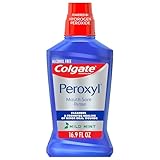
Colgate Peroxyl Antiseptic Mouth Sore Rinse
Best for: Short-term cleansing of irritated gums and mouth sores, including after dental work
- 1.5% hydrogen peroxide formula
- Alcohol-free, for short courses of up to 7 days (longer only if your dentist says so)
- Labeled as an oral wound cleanser
- Covers minor gum irritation from dental work, dentures or braces
- +Labeled to cleanse canker sores, minor wounds and minor gum irritation from dental work, dentures or braces
- +Alcohol-free, for short courses of up to 7 days (longer only if your dentist says so)
- +Inexpensive at around $12, easy to keep on hand for flare-ups
- −Its label says not to use it for more than 7 days unless a dentist or doctor tells you to
- −Not a plaque or gingivitis rinse: the label makes no such claim, and it says to stop and ask a doctor if sore-mouth symptoms have not improved within 7 days
(Affiliate link) · Free shipping on eligible Prime items
Why We Recommend It
Colgate Peroxyl is on this page for one job: a few days of cleansing when gums or the lining of the mouth are sore, for instance after a dental procedure. Its Drug Facts label classes the 1.5% hydrogen peroxide formula as an oral wound cleanser, for temporary use on canker sores, minor wounds and minor gum inflammation caused by dental work, dentures, braces or injury, with a stop-after-7-days instruction unless your dentist directs otherwise and a stop-and-ask-a-doctor line if irritation persists or worsens. It is not a gum-disease treatment and its label does not claim to be: the one systematic review we found of peroxide rinses says they “do not consistently prevent plaque accumulation” when used on their own for a short period. At around $12, it’s an inexpensive bottle to keep on hand for flare-ups, and its 4.7★ average across more than 42,000 Amazon ratings is the largest review base on this list.
Key Features
- 1.5% hydrogen peroxide formula
- Alcohol-free, for short courses of up to 7 days (longer only if your dentist says so)
- Labeled as an oral debriding agent and oral wound cleanser
- Directions: 10 mL for at least a minute, up to four times a day, after meals and at bedtime
Who It’s Best For
People with visibly irritated gums or mouth sores, or recovering from a dental cleaning or procedure, who want a short course of a cleansing rinse.
Potential Downsides
Its label says not to use it for more than 7 days unless a dentist or doctor tells you to, so it cannot be your daily gum-health rinse. Stop and see your dentist if sore-mouth symptoms haven’t improved within 7 days, or sooner if irritation, pain or redness gets worse, or if swelling, a rash or a fever develops.
(Affiliate link) · Free shipping on eligible Prime items
What the Research Shows, Ingredient by Ingredient
The ingredient matters more than the brand. This is what the reviews we read found for each active on this page, and how far each finding goes.
| Ingredient | Pick that uses it | What the research found | How solid it is |
|---|---|---|---|
| Chlorhexidine (prescription) | Peridex (0.12%) | A large reduction in plaque within 4 to 6 weeks, holding at 6 months; a small reduction in gingivitis in people with mild inflammation; tooth staining after 4 weeks or more (Cochrane review, 51 trials) | High-quality evidence for plaque. The reviewers did not consider the gingivitis reduction clinically relevant |
| Essential oils | Listerine Clinical Solutions | 16.0% less gingivitis and 27.7% less plaque at 6 months than brushing and cleaning between the teeth alone (meta-analysis, 29 trials); level with chlorhexidine on gum inflammation, behind it on plaque (review of 19 studies) | 29 trials, all of them industry-sponsored |
| Cetylpyridinium chloride (CPC) | Crest Pro-Health Clinical (0.1%) | “A small but significant additional benefit” for plaque and gum inflammation (systematic review); no overall difference from essential-oil rinses at one, three and six months (2025 meta-analysis of six trials); ranked below essential oils and chlorhexidine on plaque in a larger 2016 network meta-analysis | Eight publications in the review: fewer trials than essential oils or chlorhexidine |
| Stabilized chlorine dioxide | CloSYS Ultra Sensitive | No measured difference from other rinses on plaque or gum scores, in five trials of healthy adults (meta-analysis) | The authors call the evidence “very limited”. The ADA lists it for bad breath |
| Hydrogen peroxide 1.5% | Colgate Peroxyl | No consistent effect on plaque when used on its own for a short period; one six-month study found less gum redness (systematic review) | Weak for gum disease. Its label is for short-term wound cleansing |
| Two limits apply to every row. First, these studies measure plaque and gum inflammation (gingivitis). None of them shows a rinse stopping the bone loss that defines periodontitis: Peridex’s own label says its effect on periodontitis “has not been determined”, and the Listerine pick’s ADA Seal covers plaque “above the gumline”. Second, the European treatment guideline for periodontitis puts it in order of importance: “the basis of the management of gingival inflammation is self-performed mechanical removal of biofilm”, meaning brushing and cleaning between your teeth, and an antiseptic rinse is something that “may be considered” on top. If a rinse is used during supportive care after periodontitis treatment, that guideline suggests one containing chlorhexidine, essential oils or CPC. |
How to Use a Gum-Health Rinse
Follow the bottle you bought: the directions differ more than you might expect. These are from each product’s own label or carton.
| Rinse | Amount and time | How often | Other directions on the label |
|---|---|---|---|
| Listerine Clinical Solutions | 20 mL for 30 seconds | Morning and night | Do not swallow; not for children under 12 |
| Crest Pro-Health Clinical | 20 mL for 30 seconds | Twice a day | Use after brushing and flossing, and rinse the toothpaste out first; not for children under 12 |
| Peridex (prescription) | 15 mL for 30 seconds | Twice a day, after brushing | Do not rinse with water, brush or eat straight afterwards; not established for under-18s |
| CloSYS Ultra Sensitive | 30 seconds (its carton gives no amount) | Morning and evening, after brushing and flossing | Wait 20 minutes before eating or drinking |
| Colgate Peroxyl | 10 mL for at least 1 minute | Up to 4 times a day, after meals and at bedtime | No more than 7 days unless a dentist or doctor says so |
ioRinse Ultra is not in the table; its maker’s site says to use it twice a day, morning and night.
On whether to rinse before or after brushing, the ADA’s mouthrinse page says it “may depend on personal preference” unless the maker gives an order, and three of the labels above do: after brushing. The same page says mouthwash is not recommended for children under 6 unless a dentist directs it, because young children may swallow it. If you are pregnant or nursing, ask your dentist before starting a medicated rinse: the Peridex label, for one, says it should be used in pregnancy only if clearly needed.
How Long It Takes, and When to See a Dentist
The pooled trials behind these rinses mostly run from four weeks to six months, so judge a rinse over weeks, not days. One 2025 meta-analysis comparing essential-oil and CPC rinses found the essential-oil ones ahead on gingivitis at two weeks and level with them from one month on; chlorhexidine’s effect is measured at 4 to 6 weeks and is about the same at six months.
The more useful number is the one that tells you when to stop waiting. In 2003 the FDA published its dental advisory panel’s review of over-the-counter gum-health products. The warning the panel proposed for every one of them was to stop and ask a dentist if “gingivitis, bleeding, or redness persists for more than 2 weeks”, or if you have “painful or swollen gums, pus from the gum line, loose teeth, or increasing spacing between the teeth”, which it called possible signs of periodontitis. That proposal was never finalised, and the two picks here with a plaque-and-gingivitis drug label word it more loosely (both say to ask a dentist if symptoms persist or worsen after regular use), but the reading is the same: if bleeding or redness is still there after two weeks on a rinse, book the appointment, and do not wait at all for pain, swelling, pus, a loose tooth or teeth drifting apart.
What People With Gum Disease Ask About Rinses
These are the questions that came up again and again in the 75 Reddit threads we read for this page, answered from labels and published research where those exist, and from the dental professionals in the threads where they do not.
Do I need a rinse at all?
Not everyone does. “Most people don’t need a mouth rinse,” as one dental hygienist put it on r/DentalHygiene, and the European periodontitis guideline quoted above treats a rinse as an optional extra on top of brushing and cleaning between the teeth. A rinse earns its place when you have a reason for it: gingivitis that brushing and flossing have not settled, a dentist’s instruction after treatment, or a mouth too sore to clean properly for a few days.
Can a rinse reach my gum pockets?
Mostly not, which is one reason a rinse on its own is not a treatment for periodontitis. In a 1980 study that measured how far a dye travelled into periodontal pockets, “mouthrinsing failed to achieve any significant penetration of pockets.” A rinse works on the plaque at and above the gumline; the bacteria deeper down are what scaling and root planing is for. Even when antiseptics are flushed directly into the pockets during that deep cleaning, a 2026 meta-analysis of 16 trials found no added benefit over the cleaning alone, on evidence it rates low to very low. A hygienist in the threads said the same thing in plainer words: “A lot of the disease causing bacteria live under the gums where mouthwash struggles to reach.”
Does mouthwash kill the good bacteria too?
It can shift the balance, and the strength of the rinse matters. A recent systematic review of 14 studies found chlorhexidine disturbed the mouth’s bacterial mix the most, with milder effects from cetylpyridinium chloride. Whether that matters for the rest of your health is less clear than the forums suggest: a meta-analysis of five studies on chlorhexidine and blood pressure, one of the worries readers raise, concluded, with moderate confidence, that any change is “insignificant or very small”. For chlorhexidine itself, the Peridex label reports no “adverse changes in the oral microbial ecosystem” over six months of use. The practical reading: use the strong rinses for the reason and the period your dentist gives, and do not treat a daily antiseptic as a substitute for cleaning.
Chlorhexidine stained my teeth. Will it come off?
From natural teeth, usually yes, at a cleaning; from fillings, crowns or bonding with rough surfaces or edges, not always. The Peridex label says the stain “can be removed from most tooth surfaces by conventional professional prophylactic techniques”, and that it is worse in people with more plaque left on the teeth. On restorations with rough surfaces or margins, the label says stain “may be difficult to remove by dental prophylaxis and on rare occasions may necessitate replacement of these restorations”. A hygienist in the threads confirms both the speed and the fix (“the staining can happen VERY fast” and “It will def come off with a standard cleaning”), and a general dentist added the part people hope is not true: “The stains won’t go away on their own.” If you are on a course, brush and floss thoroughly, paying attention to any areas that start to discolor, and be ready for a polish afterwards: the label says not everyone stains visibly, but more than half of users in its trial picked up measurable stain.
How long should I stay on chlorhexidine?
Ask the person who prescribed it, because the professionals in the threads do not agree. The figure repeated most is about two weeks; a commenter who identified as a periodontal resident recommended “the first 7-10 days following your SRP and then one to two times per week to avoid staining your teeth”; and one reader was told to use it for life. The label sets no limit beyond a re-check every six months, and the European guideline says “a limited period of time”. If your instructions did not include an end date, that is a question worth a phone call.
Which CloSYS bottle is the right one?
This confuses a lot of people, because CloSYS sells several rinses that look alike. The one on this page, Ultra Sensitive, is the unflavored chlorine dioxide formula. CloSYS Silver Healthy Gums is a different product: its drug label lists cetylpyridinium chloride at 0.075% as an antigingivitis/antiplaque active, which makes it a CPC rinse like the Crest pick, staining caveat included. If a dental office hands you a CloSYS bottle, read which one it is before deciding it is the wrong one or the right one.
Can I put mouthwash in my water flosser?
Check your flosser’s manual first. Waterpik’s own guidance allows it within limits: for an antiseptic rinse, “add no more than a 1:1 ratio of antiseptic mouthwash to warm water”, then rinse the unit through with plain warm water afterwards. The same page says a standard or antiseptic mouthwash in the reservoir is “not clinically evaluated to determine any benefits beyond using water alone”, though it adds that there are studies supporting chlorhexidine, used on a dental professional’s instructions. Its do-not-use list includes iodine and, for cordless units, salt water. Hygienists in the threads split on whether to do it, and if you have had antibiotic placed in your pockets after a deep cleaning, ask before water-flossing near it at all. Our water flosser guide covers the machines.
Is salt water enough?
For a few sore days it is a reasonable comfort measure, and a hygienist in the threads suggests it for exactly that. It is not a plaque or gingivitis treatment; our guide on how to fix gingivitis covers the recipe and how thin the evidence is.
Buyer’s Guide: What to Look For
Alcohol vs. Alcohol-Free
Alcohol can be drying, which is why the ADA’s mouthrinse page suggests an alcohol-free rinse for people with dry mouth. Going alcohol-free does not mean giving up a labeled gum-health rinse: four picks on this list (Crest Pro-Health Clinical, ioRinse, Colgate Peroxyl, and CloSYS) are alcohol-free, and Crest Pro-Health Clinical carries an antigingivitis/antiplaque drug label. There is a small trade-off on the essential-oil side: a recent systematic review found alcohol-free essential-oil rinses did somewhat less for plaque than the versions with alcohol, with no clear difference for bleeding or gum scores. Be aware that our top pick cuts the other way: Listerine Clinical Solutions Gum Health carries the ADA Seal but contains 21.6% v/v alcohol per its Drug Facts label, and prescription Peridex also contains alcohol (11.6% per its DailyMed label). If you have dry mouth, are in recovery, or simply prefer a gentler experience, alcohol-free is a perfectly sound choice.
Look for the ADA Seal
The ADA Seal of Acceptance indicates that a product has passed independent review for both safety and the effectiveness claims on its label. Read which claim, though: the Seal is granted for a named benefit. On this page, Listerine Clinical Solutions holds it for gingivitis and plaque, while the CloSYS rinse holds it for bad breath. A Seal for breath says nothing about gums.
Mouthwash Is Supplemental, Not a Cure
This bears repeating: according to the ADA, using a mouthrinse does not take the place of brushing and flossing. If you have active gum disease, mouthwash alone is not a treatment plan. Regular professional cleanings and dentist oversight are essential. For a full picture of how to address gum disease at home, our guide on how to fix gingivitis walks through every step of an effective daily routine, and if your case has already progressed to periodontal disease, our toothpaste picks for periodontal disease round out the other half of the routine.
FAQ
Q: Can mouthwash alone reverse gum disease?
No. According to the ADA, using a mouthrinse does not take the place of brushing and flossing. A rinse may help with reducing plaque and gum inflammation, but reversing gingivitis takes consistent brushing, flossing, and professional dental cleanings. For moderate to advanced cases, your dentist or periodontist may recommend additional procedures.
Q: How often should I use mouthwash for gum disease?
Twice a day for the gum-health rinses here: the Listerine and Peridex labels say morning and night (or evening), the Crest label says twice a day, and the Crest and Peridex labels say after brushing. Colgate Peroxyl is the exception at up to four times a day, for no more than seven days. The label directions for each pick are in the table above; follow them and your dental provider’s guidance.
Q: Is it safe to swallow mouthwash?
No, mouthwash is not intended to be swallowed. Every label we read says not to swallow the rinse and to keep it out of reach of children.
Q: Should I use mouthwash before or after brushing?
The ADA’s mouthrinse guidance says the order can come down to personal preference and the product’s own directions, though an ADA consumer advisor, Dr. Edmond Hewlett, told CNET (as summarised by ADA News) that rinsing right after brushing can reduce the fluoride your toothpaste leaves on the teeth. For the gum-health rinses on this page the labels settle it: Crest Pro-Health Clinical, Peridex and CloSYS all say to use them after brushing, and the Crest label adds that you should rinse the toothpaste out of your mouth first.
Q: What’s the difference between gingivitis and periodontal disease?
Gingivitis is the early, reversible stage of gum disease characterized by inflammation, redness, and occasional bleeding. According to the ADA, gingivitis can typically be reversed with improved home care and professional cleaning. Periodontitis (periodontal disease) is a more advanced condition involving damage to the bone and connective tissue supporting the teeth, and requires professional treatment. If your dentist has already confirmed periodontitis, prescription chlorhexidine (Peridex, covered above) may come up, though its label is for gingivitis and says its effect on periodontitis has not been determined. At that stage, any rinse supports professional treatment rather than replacing it.
Q: What’s the best alcohol-free mouthwash for periodontitis?
Four of the six picks on this list are alcohol-free: Crest Pro-Health Clinical CPC, ioRinse, CloSYS, and Colgate Peroxyl. None of the four is labeled for periodontitis, and neither is any other label we read. Of them, Crest Pro-Health Clinical is our first reach: it is the one whose antigingivitis/antiplaque drug label we could read, at 0.1% CPC. If you cannot tolerate a flavored rinse at all, CloSYS is unflavored, with the caveat that its evidence and its ADA Seal are for bad breath rather than gums. ioRinse offers a different mechanism (molecular iodine) if neither has moved your bleeding index. Two picks here contain alcohol: our overall top pick, Listerine Clinical Solutions (21.6% v/v on its Drug Facts label), and prescription Peridex (11.6% alcohol per its DailyMed label).
Q: Is there an over-the-counter alternative to Peridex (chlorhexidine)?
Not a true equivalent: chlorhexidine is prescription-only, and some studies found it gave better plaque control than essential oils (the ADA notes no difference in gingivitis control). The closest over-the-counter options are the two on this page whose drug labels for plaque and gingivitis we could read: Listerine Clinical Solutions (ADA-Seal essential oils, which one review of 19 studies found level with chlorhexidine on gum inflammation though behind it on plaque) or Crest Pro-Health Clinical (0.1% CPC, alcohol-free). On CPC, a 2025 review of 14 studies found no significant difference between CPC and chlorhexidine rinses on plaque and gingivitis in people who kept brushing, with chlorhexidine tending to stain more. Worth hearing from the professional side, though: a commenter on r/DentalHygiene who works for a periodontist puts it bluntly: chlorhexidine “only kills the bacteria in the mouth temporarily,” and once you stop, they said, the bacteria start to colonize again and the problem comes back; their advice was a deep cleaning, then brushing twice and flossing once a day. The rinse tier matters less than the deep cleaning, brushing, and flossing underneath it.
Q: What should I rinse with after scaling and root planing (a deep cleaning)?
Follow your dentist’s protocol first: Peridex’s label says chlorhexidine therapy should start directly after a professional cleaning, in the forum threads we read it is most often described as a short course, and your dentist’s instructions outrank anything in a buying guide. The question most people actually face is what comes after the course ends, since the European periodontitis guideline speaks of chlorhexidine “for a limited period of time” and a Cochrane review found tooth staining after four weeks or more of use. That transition point is where the OTC picks on this page fit: an ADA-accepted daily rinse like Listerine Clinical Solutions, or an alcohol-free option if your tissue is still tender, carried forward as maintenance between professional cleanings.
Q: Are natural or herbal mouthwashes effective for gum disease?
Some natural ingredients like tea tree oil and aloe vera have shown antimicrobial properties in preliminary research, but the evidence base is considerably smaller than for established active ingredients like CPC or essential oils: a review of tea tree oil says further clinical trials are needed, and a review of six aloe vera trials calls the evidence inconclusive. We found no tea tree or aloe vera rinse named in the ADA Seal’s plaque and gingivitis category when we read it in October 2026, so if you prefer a natural formula, treat it as an extra and discuss it with your dentist.
Our Methodology
We compiled this guide through a combination of ingredient research, reading 75 Reddit threads on r/PeriodontalDisease, r/DentalHygiene and related forums for this version, and 30 for an earlier one (including product recommendations posted by practicing hygienists), review of ADA guidance on oral health products, each product’s drug label or carton, the published reviews linked above, and Amazon ratings. We do not accept products for review in exchange for favorable coverage. Where affiliate links are present, they are disclosed transparently and do not influence our editorial recommendations.
We prioritize products with:
- Clinically recognized active ingredients
- ADA Seal of Acceptance where available
- Documented practitioner mentions or ADA-recognized status where we could confirm them (and transparency where a product has neither)
- Transparent labeling and accessible pricing
We update this guide periodically to reflect new product releases, formulation changes, and evolving clinical guidance. If you have specific concerns about gum disease, we always recommend consulting a licensed dentist or periodontist—no roundup article replaces a professional evaluation.