Sensitive teeth and gums turn brushing into a guessing game. Press too hard and you aggravate tissue that is already sore; press too lightly and the plaque stays where it is. An electric toothbrush helps mostly because it can tell you which one you are doing: the pressure sensor is the feature owners, hygienists and dentists in our research all name, and it costs about $40 to get one. For the general question of which electric toothbrush to buy, our electric toothbrush guide covers both brands across every price tier.
Six picks below, ordered by who should buy them rather than by price. Two of the six have no owner reports at all in the discussions we read, and their cards say so instead of borrowing the brand’s reputation. If gum sensitivity is the wider problem, pairing a brush with the best toothpaste for sensitive teeth and the best mouthwash for sensitive teeth usually does more for day-to-day comfort than moving up a brush tier.
How We Evaluated
Four things that matter specifically for sensitive teeth, in the order our research puts them:
Pressure feedback, first. Brushing too hard is the problem owners in these discussions most often find in themselves, and most only notice it once a sensor flags it. One r/DentalHygiene poster described the moment it clicked: “I tested the red pressure sensor and it is really useful when brushing my teeth. It made me realize that I was using way too much force when brushing my teeth. I never realized how harsh I was.” What the sensor does differs by model, so each card says which: a change in the handle’s vibration, a light you can see, or pulsations that stop.
Brushing technology, chosen on feel. Sonic brushes pulse fluid between the teeth and along the gumline, in the Sonicare listing’s own words, and buzz rather than spin. Oscillating brushes drive a small round head with direct contact. The independent evidence does not separate the two on cleaning, so this page treats the choice as a comfort question and the buyer’s guide shows the working.
A mode you will actually use. A lower-intensity setting earns its place on the days when gums are inflamed or you have just had work done. The listings name these modes but publish no figure for how far they drop the intensity, so we describe them the way the listing does rather than quantifying them.
Heads, not handles. Replacement heads are the running cost and the part that touches your gums. Each card says what comes in the box, and the buyer’s guide covers head choice and when to throw one out.
Every rating, review count and price here comes from a read of the exact listing our link points at, on 2 September 2026, with one exception: the Oclean’s rating and count come from a 6 September 2026 read, and its price from our own signed-out US check of the linked white variant the same day. Two cautions we owe you: the dental professionals quoted from discussion threads are self-identified in their comments rather than credential-verified, and two of the six picks have no owner reports in those threads.
Philips Sonicare 4100: Editor’s Pick
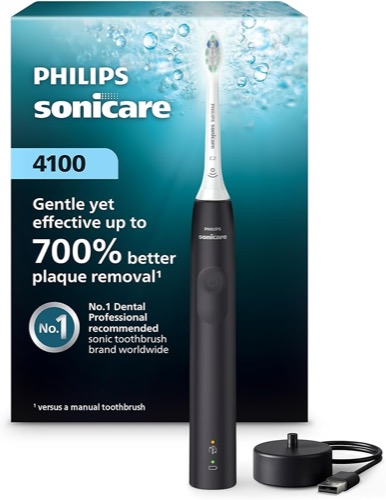
Philips Sonicare 4100 Rechargeable Electric Toothbrush
Best for: Most sensitive-teeth buyers: the cheapest Sonicare here with a pressure sensor, and the model long-term owners recommend most often
- Pressure sensor that changes the handle's vibration when you press too hard, per the listing
- EasyStart raises the brushing power gradually over the first brushes, per the handle's earlier listing
- SmarTimer at two minutes with a 30-second QuadPacer
- Brush-head replacement reminder; takes Sonicare click-on heads
- About $56, with one brush head and a head case in the box
- +Has the one feature owners, hygienists and dentists in our research all ask for, at the lowest price of any Sonicare on this page that has one
- +EasyStart raises the power gradually over the first brushes, per the handle's earlier listing, which suits gums that flinch at full intensity
- +The single most-recommended model across the 71 owner threads behind our main electric toothbrush guide
- −One button cycles power and intensity together, which several owners called awkward
- −Longevity reports split: most owners expect five years or more, one reports handles dying at around 18 months
(Affiliate link) · Free shipping on eligible Prime items
Everything a sensitive-teeth buyer needs sits on this $56 handle: a pressure sensor, a two-minute timer with a 30-second pacer, and a soft C2 head. Press too hard and the handle changes its vibration, per the listing. The pricier Sonicare below warns you as well, but its listing calls that sensor a visual one, so there you read a light rather than feel the vibration change, for about $55 more. It is also the specific model named most often across the 71 owner threads behind our main electric toothbrush guide, where a self-identified dentist put the case in one line: “Get the cheapest Sonicare or oral B you can find that has a pressure sensor.”
One feature worth naming, with its source said plainly. The earlier Amazon listing for this handle described EasyStart, which raises the brushing power gradually over your first 14 uses rather than starting at full intensity, and that is the stretch when a powered brush feels worst on gums that are already sore. The listing Amazon serves today does not mention it, so take it as a description of the model rather than a spec on the page you will buy from. The head system is the ordinary Sonicare one, so the running cost is set by which head you buy rather than by the handle: the everyday C2 head worked out at about $10 each at our read for the main guide.
Two limits worth knowing before you buy. The single power button doubles as the intensity switch, which several owners found awkward in daily use. And the longevity reports split: the owners recommending it expect five years or more, while one describes handles dying at around 18 months. One more fact for people who weigh it: Philips’ Sonicare handles did not appear on the ADA’s Seal of Acceptance roster at our late-August read of the full list, though the Oral-B Pro 1000 further down does.
Philips Sonicare 5300: Best for Gum Care Mode
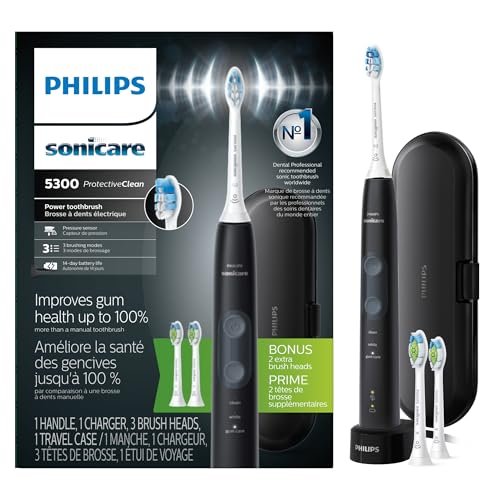
Philips Sonicare 5300
Best for: Sonicare buyers who want a Gum Care mode that adds a reduced-power minute for sore days, plus three heads and a case in the box
- Three modes: Clean, White and Gum Care
- Pressure sensor alerts you when you press too hard, per the listing
- BrushSync reminder for a worn head; up to two weeks per charge, per the listing
- Three brush heads and a travel case in the box
- Around $110
- +Gum Care adds an extra minute of reduced-power brushing to massage the gums, per the listing: the mode on this page aimed squarely at irritated gums
- +Three brush heads and a travel case in the box, and up to two weeks per charge, per the listing
- +Same click-on heads as the 4100, so the running cost does not change
- −The modes and the extra heads are what the roughly $55 over the 4100 buys, not a gentler or better clean
- −One owner reported a handle failing after about a year of two people swapping heads on it daily; a single report, but a plausible wear point
(Affiliate link) · Free shipping on eligible Prime items
The 5300 is on this page for one reason: Gum Care, which adds an extra minute of reduced-power brushing you can use on the days when your gums are sore. Nothing else about it cleans differently from the 4100 above. It uses the same click-on heads, the same two-minute pacer and a pressure sensor that alerts you when you press too hard, per the listing, and the owners and professionals in our research are consistent that the extra money buys modes and heads rather than a better clean.
What the money does buy is worth naming plainly. Three heads in the box cover the first nine months to a year of replacements at the ADA’s interval, the travel case saves packing a dock, and the BrushSync light tells you when a head is worn rather than leaving it to memory. Battery life runs up to two weeks per charge, per the listing. At around $110 it lands close to Oral-B’s mid iO tier, so if a lower-intensity mode is not what you are after, the money has better uses.
One durability report belongs here because it names a cause. A couple sharing a single handle, swapping heads every day, had theirs break after about a year. That is one report rather than a pattern, but if two of you are sharing a brush, two 4100s cost about what one 5300 costs and neither of you gives up the sensor.
Oral-B iO Series 7: Best Premium
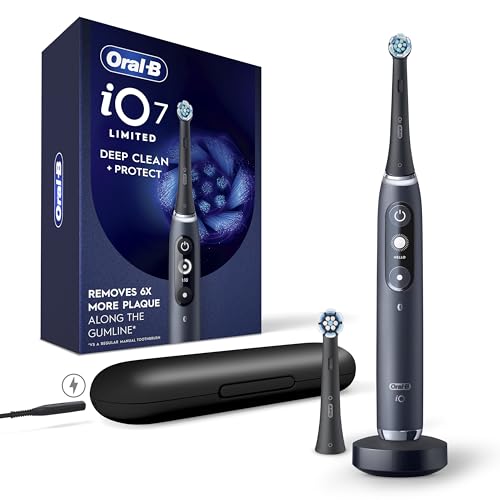
Oral-B iO7 Limited Deep Clean + Protect Electric Toothbrush
Best for: Brushers who want a sensor that reads too hard, too soft and just right, and will pay for the display and charging case
- iO pressure sensor signals too hard, too soft or just right, per the listing
- Five modes: Daily Clean, Sensitive, Whitening, Gum Care and Intense Clean
- Interactive display, plus the Oral-B app
- Two brush heads and a charging travel case in the box
- Around $230
- +The sensor signals too hard, too soft and just right, per the listing, rather than only warning you at the top end
- +The premium brush with the cleanest longevity record in our research: two owners independently report five years of daily use
- +Five modes including Sensitive and Gum Care, with two heads and a charging travel case in the box
- −Around $230, and iO heads cost roughly double Oral-B's older CrossAction heads and fit iO handles only
- −No independent evidence it cleans better than the cheaper iO tiers; the extra money buys the display, the modes and the case
(Affiliate link) · Free shipping on eligible Prime items
The iO7 has the most informative pressure feedback on this page. Instead of only warning you at the top end, it signals too hard, too soft or just right, per the listing, which is useful if you have overcorrected into brushing so lightly that plaque survives the two minutes. Worth knowing before the price tempts you upward or downward: Oral-B builds every iO tier on the same magnetic drive, so what the money above the entry iO buys is the display, the extra modes and the charging case, not a different clean. Our Oral-B model guide walks the tiers.
Its real case is longevity, and it is the cleanest record among the premium brushes in our research: two owners report five years of daily use, independently of each other. The app is the caveat. The owners who mention the app describe trying it and dropping it, and the most-upvoted iO7 comment in our corpus says exactly that while still liking the brush: “It cleans so much better than my old sonic care. I don’t use the app but there is one.” If zone-by-zone coverage tracking is the thing that would fix your technique, it is there. Expect to stop opening it.
The costs are the sticker and the heads. iO heads ran about $9.60 each at our read for the main guide, roughly double Oral-B’s older CrossAction heads, and they fit iO handles only. One owner’s 2022 unit stopped holding charge after four years, which is the single battery complaint on its record.
Oral-B Smart 5000: Best Mid-Range
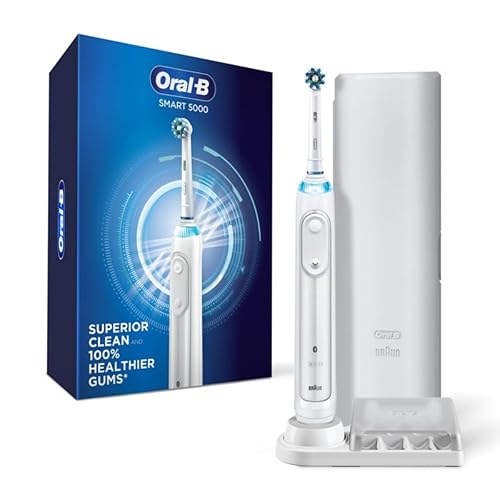
Oral-B Smart 5000
Best for: Mid-range shoppers who want a visible pressure ring and a five-mode set without the iO price tag
- Visible pressure sensor lights up on the handle when you brush too hard, per the listing
- Five modes: Daily Clean, Gum Care, Sensitive, Whitening and Deep Clean
- Bluetooth to the Oral-B app; travel case in the box
- Takes Oral-B's standard round heads, not iO heads
- Around $100
- +Visible pressure sensor lights up on the handle when you brush too hard, per the listing
- +Five modes including Sensitive and Gum Care, at about $100 against the iO7's $230
- +Takes Oral-B's standard round heads, the cheapest heads of the two major brands
- −Oral-B's older oscillating drive rather than the iO magnetic one; owners in our research describe the oscillating handles as louder and buzzier in the hand than a sonic brush
- −No owner reports for this model in the 40 discussion threads behind this page, and apps are the feature owners in our research dismiss most readily
(Affiliate link) · Free shipping on eligible Prime items
Take the app out of the Smart 5000’s pitch and a useful brush is still there: a pressure ring that lights up on the handle when you press too hard, five modes including Sensitive and Gum Care, a travel case, and Oral-B’s standard round heads, which are the cheapest heads of the two big brands. At about $100 against the iO7’s $230, that is the pressure feedback and the mode menu without the display tier.
The app is not the reason to buy it, and we would rather say so than sell it to you. The owners in our research who mention app coaching describe trying it for a few sessions and never opening it again. This page’s own research found no owner reports for the Smart 5000 at all, which is not a bad sign in itself, but it does mean the card above is the listing’s account of the brush with no long-term owner voice behind it.
The drive is Oral-B’s older oscillating one rather than the iO magnetic drive, and owners in our research describe the oscillating handles as louder and buzzier in the hand than a sonic brush. That matters here more than it would on a general roundup: if part of what makes brushing unpleasant for you is the vibration itself, a sonic brush is the better direction. The compensation is the heads, at about $4.60 each for standard CrossAction at our read against about $10 for iO and Sonicare heads.
Oral-B Pro 1000: Best Value Pressure Sensor
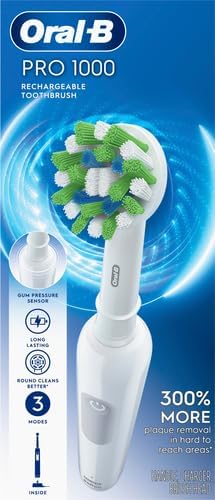
Oral-B Pro 1000
Best for: People who want the round oscillating head with a pressure sensor, and the ADA Seal by model name, at around $50
- Gum pressure control stops the brush pulsations when you brush too hard, per the listing
- Three cleaning modes including a sensitive one, per the listing
- Handle-integrated quadrant timer that alerts every 30 seconds
- Takes Oral-B's standard round heads at about $4.60 each
- Around $50
- +Pressure control stops the pulsations the moment you press too hard, per the listing: a physical cue rather than a light to interpret
- +Listed by model name on the ADA Seal of Acceptance, with more than 105,000 ratings behind it
- +Standard round heads at about $4.60 each, less than half what iO or Sonicare heads cost
- −Buzzier than a sonic brush, ships with one head, and has no travel case
- −Owners and hygienists in our research report the hollow round heads grow mold inside quickly, and say sonic heads do not: pull the head off after brushing and let both parts dry apart
(Affiliate link) · Free shipping on eligible Prime items
If you want the small round oscillating head rather than a sonic buzz, the Pro 1000 is the cheapest oscillating brush here with a pressure sensor, and its version of the feature is the bluntest: press too hard and the pulsations stop, per the listing. There is no light to read and no app to open, you feel the brush back off. It also has the paperwork. The ADA lists it by model name among the brushes covered by its Seal of Acceptance for Oral-B’s oscillating-rotating-pulsating brushes, which Philips’ Sonicare handles did not carry at our late-August read of the roster.
Owners tie its long life to an older nickel-metal-hydride battery, and a 74-upvote reply in our main guide’s research pointed straight at this model with the mechanism attached: that chemistry is “much more robust and tolerant to over-discharging than a lithium ion battery”. Three cleaning modes include a sensitive one, per the listing, and the handle takes Oral-B’s standard round heads, which is the cheapest ongoing cost of any brush on this page apart from generic sonic heads.
Two caveats for a sensitive mouth. Oscillating heads are louder and, in the words of a self-identified retired dentist in our research, “the cleaning is harsher”; some owners with tender gums prefer the sonic feel for that reason, and one said their dentist saw their gum health improve after they moved off an Oral-B. That is the trade the buyer’s guide below walks through. And owners and hygienists in our research report the hollow round heads grow mold inside quickly, and say sonic heads do not: pull the head off after brushing and let both parts dry apart. It ships with one head and no case, so budget for both.
Oclean Sonic Electric Toothbrush: Best for Travel
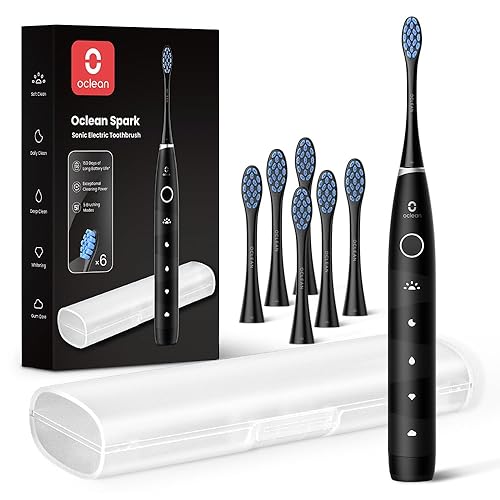
Oclean Sonic Electric Toothbrush
Best for: Frequent travellers who already brush gently and want months between charges
- Up to 150 days per charge, per the listing
- USB charging with five brushing modes
- Six replacement brush heads and a travel case in the box
- No pressure sensor named on its listing
- +Up to 150 days per charge, per the listing, which works out at two to three charges a year
- +Six replacement heads and a travel case in the box, and it charges over a USB cable rather than a proprietary dock
- +Small enough to travel with the case instead of a charging dock
- −Its listing names no pressure sensor, the feature this page treats as the one that matters most
- −Just over 1,200 ratings and no owner reports in the 40 threads behind this page, so the long-term record is thin
(Affiliate link) · Free shipping on eligible Prime items
The Oclean is here for one job: a brush you can throw in a bag and forget about. Its listing claims up to 150 days per charge, which works out at two to three charges a year rather than the fortnightly ritual a Sonicare asks for, and it charges over a USB cable instead of a proprietary dock. Five modes, six heads and a case come in the box. If travel rather than sensitivity is what brought you here, our travel electric toothbrush picks compare that category properly.
What its listing does not name is a pressure sensor, and on a page built around that feature, that puts it last. It is the only pick here whose listing names none, and it stays because the battery and the case solve a real problem that none of the sensor-equipped brushes solve as well. If a dentist has told you that you brush too hard, buy the 4100 and keep something like this for trips.
The record behind it is thin. Just over 1,200 ratings on the listing, and no owner reports at all in the 40 discussion threads behind this page, so nobody can tell you how one holds up in year three. Treat it as a travel accessory with a decent listing rather than a brush with a track record.
Buyer’s Guide: What to Look for in an Electric Toothbrush for Sensitive Teeth
Sonic vs. Oscillating: Which Is Gentler?
This question came up in most of the relevant threads we read, and the answer depends on what you mean by gentle. Sonic brushes, the Sonicare models here, pulse fluid between the teeth and along the gumline, in the listing’s own words, and feel like a buzz rather than a scrub. Plenty of owners with tender gums say that feels less aggressive. A few say the opposite, that the vibration itself is the problem: one self-identified dentist in the threads behind this page wrote that Sonicare “shakes my brain/nose too much and can’t use them”, and one dental student’s mother refuses hers because it “tickles and touches her cheek and feels like dental drilling even though it doesn’t hurt”.
Oscillating brushes, like Oral-B’s lineup, use a rotating, counter-rotating motion with direct contact against the tooth surface. Head-to-head, the systematic-review evidence is genuinely split: a 2020 JADA meta-analysis found oscillating-rotating brushes removed more whole-mouth plaque and left fewer bleeding sites than other powered brushes, sonic models specifically included, while a 2021 JADA review of 24 trials comparing oscillating-rotating with side-to-side powered brushes found little to no difference in plaque or gingival index at four weeks. The most recent single trial leans oscillating: a 2025 randomized controlled trial appraised in Evidence-Based Dentistry ran an entry-tier Oral-B iO2 against an advanced sonic brush (a usmile Marble-Art, not a Sonicare) for four weeks and found greater reductions in plaque and gingival inflammation for the oscillating-rotating brush, with more of its users reaching gingival health (fewer than 10% bleeding sites). Procter & Gamble, which owns Oral-B, funded that trial and three of its five authors are P&G employees, so read it as one data point in a split literature rather than the end of the argument.
The practical takeaway is to choose on feel, because that is where the difference you will notice actually lives. Across the reviews above, the measured gap between the two designs is small and inconsistent, and the largest pro-oscillating numbers in circulation come from a separate analysis of Procter & Gamble’s own trial archive, run by its own employees rather than from the 2020 review above; our main electric toothbrush guide sets that evidence out source by source. If your sensitivity is mostly about comfort, sonic is the easier adjustment for most people. If you prefer the small round head, or a dentist has told you to use one, the Pro 1000 gives you that with the sensor intact.
Why the Pressure Sensor Comes First
It is the feature the discussions behind this page return to most, and the one singled out in a widely upvoted r/BuyItForLife reply from a commenter who introduced themselves as a dentist, telling buyers to “make sure it has a pressure sensor that lights up if you brush too hard.” Owners most often describe discovering their own heavy hand only after a sensor flagged it. What the research will not give you is a clean causal story. The 2015 systematic review of brushing and gum recession in the Journal of Clinical Periodontology calls the evidence largely inconclusive, and the ADA’s guidance is hedged in the same direction, recommending soft bristles and gentle pressure because they “may help reduce the risk of gingival injury” (ADA). Our main electric toothbrush guide links the review itself. The ADA also recommends brushing twice daily for two minutes with a fluoride toothpaste, which is what the timer is for; that guidance does not spell out pressure or motion.
So take the sensor seriously because it tells you something about your own hand that you cannot otherwise know, not because a light on a handle has been shown to save your gums. Of the picks above, the 4100 changes the handle’s vibration, the 5300’s listing calls its alert a visual one, the iO7 signals too hard, too soft and just right, the Smart 5000 lights a ring, and the Pro 1000 stops pulsating. The Pro 1000 is the cheapest of them at about $50, with the 4100 just above it at about $56, and those two lead this page for that reason. The Oclean’s listing names none of that, and it is the one pick that gives up the feature this section is about.
Soft Bristles and Brush Head Choice
Bristle grade is set by the head you buy, not by the handle, which is the part of this decision most buyers skip. The 4100 ships with Philips’ C2 head, described on its listing as soft and flexible; the Oral-B handles here ship with a round head, and both brands sell alternatives aimed at sensitive mouths. If the head in the box still feels too firm after a fortnight, try a softer head before deciding the brush is wrong for you. Then replace it on time: the ADA’s own trigger is every three to four months, “or more often if the bristles are visibly matted or frayed” (ADA), and for sore gums the frayed-bristle half of that rule matters more than the calendar.
Head shape is a preference rather than a settled clinical question. Oral-B’s heads are small and round and clean roughly one tooth at a time; Sonicare’s are shaped like the head of a manual brush. Some dental professionals in our research prefer the round head, others steer sensitive-gum patients toward sonic, and the published head-to-head evidence does not separate the two designs; those professionals are self-identified in their comments rather than credential-verified. One practical fact does matter if you are comparing the picks above: iO heads fit iO handles only, while the Smart 5000 and the Pro 1000 both take Oral-B’s standard round heads. We map which brush heads fit which Oral-B handles if you are weighing one against the other.
Do You Need a Dedicated “Sensitive” Mode?
A lower-intensity mode is useful on the days when gums are inflamed or you have just had a cleaning or a procedure. It is not essential if your sensitivity is mild and steady. It is also worth knowing what the manufacturers do not tell you: the listings name these modes but publish no figure for how far they drop the intensity, so nobody, us included, can promise you that a Sensitive mode is measurably gentler than simply easing off.
Among the picks: the Pro 1000 lists three modes including a sensitive one, the Smart 5000 and the iO7 each list five including Sensitive and Gum Care, and the 5300’s Gum Care adds an extra minute of reduced-power brushing, per the listing. The 4100 has no mode menu at all. It has two intensity settings and one button that cycles them, which is the ergonomic complaint on its card and, on the evidence, no loss in cleaning.
Cheap Sonic Brushes and the Missing Record
Searches like this one surface a lot of $20 sonic brushes with five modes and eight heads in the box. We went looking for owner records behind those brands, Bitvae, usmile, VOOM and Marlincare among them, across the 71 threads behind our main guide and in a separate search, and found essentially nothing: a scattering of unranked mentions, one comment inside a thread we had already flagged for planted praise, and nothing at all for several of them. Fairywill is the one exception, and it is worth knowing: the only substantive report we found was an owner describing handles replaced several times under warranty after they powered up but stopped vibrating. Absence is not condemnation, but it means there is no long-term record to write from, and the cheap sonic handles we did examine mostly ship without a pressure sensor. If price is the binding constraint, our budget picks take that shelf on its own terms; if you can reach about $56, the 4100 gets you the sensor.
Frequently Asked Questions
Is a sonic or oscillating electric toothbrush better for sensitive teeth? Neither, on the evidence. The independent reviews put the measured gap between the two designs at small and inconsistent, so pick the one you will use for two minutes twice a day. Sonic brushes buzz and many people with tender gums prefer that feel; oscillating brushes use a small round head with direct contact, and if that is what your dentist recommended, the Pro 1000 gives it to you with the pressure sensor intact.
Can an electric toothbrush damage sensitive gums? Pressing hard with one can irritate gums, and so can a head you have kept too long. The ADA’s position is that “either manual or powered toothbrushes can be used effectively” (ADA); the motor does the motion, so you do not need to scrub, and the risk comes from adding manual-brushing force on top of the motor’s work. That is the habit a pressure sensor is built to catch, which is why five of our six picks have one.
Do I need a pressure sensor if I already have sensitive teeth? If a dentist has told you that you brush too hard, yes. It is the one feature that tells you something about your own habit instead of adding a setting. If your sensitivity has another cause, the sensor is still worth having, but a softer head and a conversation with your dentist will do more for the pain than a brush upgrade will.
What’s the best budget electric toothbrush for sensitive teeth? The Sonicare 4100, at about $56, or the Oral-B Pro 1000 at about $50 if you get on with the small round head. Those are the two cheapest brushes on this page with a pressure sensor and a two-minute pacer, and the 4100 is the model the long-term owners in our research recommend most often. Below about $50 you are usually giving up the sensor, which is a poor trade when sensitivity is the reason you are shopping; our budget picks cover what is on that shelf if neither price is available.
How often should I replace my electric toothbrush head? The ADA says every three to four months, “or more often if the bristles are visibly matted or frayed” (ADA). For sensitive gums the second half of that matters more than the calendar, because splayed bristles are the ones that feel scratchy. Multipacks bring the per-head cost down a long way, and the gap between systems is real: Oral-B’s standard round heads ran about $4.60 each at our read, against about $10 each for Sonicare and iO heads.
Does using a Sensitive mode protect against enamel wear? No mode has been shown to do that. A lower-intensity mode reduces how hard the brush works, which is welcome when gums are sore, but the sources we hold do not isolate brush speed as a driver of gumline wear: the review behind this page’s pressure-sensor section lists brushing frequency, a horizontal scrubbing method, bristle hardness and brushing duration among the factors associated with recession, and calls the evidence overall largely inconclusive. Pair a gentle hand with a soft head and a toothpaste made for sensitive teeth, and let the pressure sensor tell you when your hand is not as gentle as you think it is.