If your dentist has been telling you to floss more, interdental brushes may be the better answer. A Cochrane systematic review found low-certainty evidence that interdental brushes may reduce gingivitis more than string floss (its plaque results were inconsistent), and the European Federation of Periodontology names them the method of choice for cleaning between teeth wherever the space lets a brush in without causing trauma. The catch: plenty of people don’t know what size to buy, use the wrong technique, and give up when their gums bleed on the first try. We compared the top brands to find the best option for every budget, gap size, and sensitivity level. For complementary cleaning tools, see our guides on dental floss, floss picks, and water flossers for braces. If receding gums brought you here, the larger sizes matter more than you might expect, because recession widens the spaces between teeth: our gum recession treatment guide covers the full picture, and the soft-bristle toothbrush picks for receding gums cover the other half of the routine.
How We Evaluated Interdental Brushes
We focused on five criteria:
- Wire durability: Wire bending and breaking is a common complaint, whatever the brand. We prioritized brushes with reinforced or coated wires that resist buckling.
- Size range and availability: TePe’s sizing guide says you are likely to need two or three different sizes, because each gap between your teeth can differ. Brands with wider size ranges and clear sizing systems scored higher.
- Bristle quality: Soft bristles that effectively sweep plaque without abrading gum tissue. Antibacterial coatings or treatments that extend brush life.
- Value: Interdental brushes are a daily consumable. Price per brush matters more than price per pack, and how long each brush lasts affects long-term cost (GUM says to replace its brushes weekly; DenTek labels its Slim Brush disposable after use).
- Community feedback: We researched dental professional forums, patient communities, and user reviews to understand real-world performance, including durability, comfort, and which brands professionals actually prescribe.
GUM Proxabrush Go-Betweens Tight
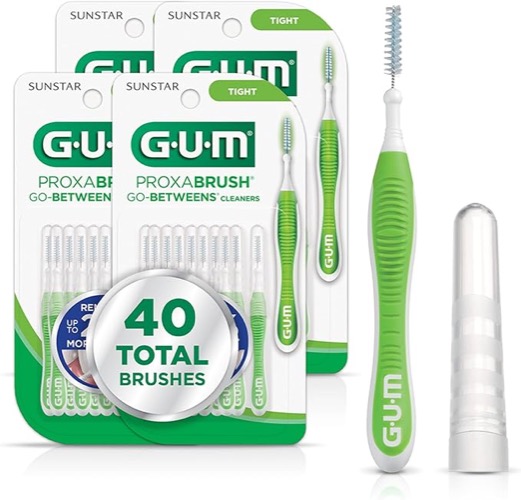
GUM Proxabrush Go-Betweens Tight (40 Count)
Best for: Most people starting out: affordable, widely available, with soft antibacterial bristles and a travel cap for on-the-go cleaning
- Soft nylon bristles with antibacterial coating (up to 7 days)
- Snap-on travel cap for portable use
- Bendable neck reaches back teeth comfortably
- 40-count value pack — 4 packs of 10
- +GUM says the bristle treatment lasts up to 7 days of use and tells you to replace each brush weekly
- +Snap-on travel cap and bendable neck make it portable and easy to reach back teeth
- +Rated 4.7 stars across more than 9,000 Amazon ratings, at roughly $0.42 per brush
- −Wire can bend if forced into a gap that's too tight; size down to Ultra Tight rather than push
- −Four retail sizes (Ultra Tight to Wide) versus TePe's nine, and GUM's size chart gives brush widths, not the gap each size fits
(Affiliate link) · Free shipping on eligible Prime items
Why We Recommend It
GUM Proxabrush Go-Betweens hold 4.7 stars across more than 9,000 Amazon ratings, and there’s a practical reason: they nail the details that daily users care about. GUM’s own site says the bristles are treated with a hygienic solution for up to 7 days of use (its Amazon listing says up to ten) and tells you to replace each brush weekly either way, so one brush covers a week of cleaning rather than a single session. The snap-on cap makes them portable, and the bendable neck helps reach posterior teeth without the awkward angles that cause wire breakage.
Tight is the second-smallest of GUM’s four retail sizes (Ultra Tight, Tight, Moderate, Wide), a sensible first try if you don’t yet know your gaps. At $16.99 for 40 brushes (about $0.42 per brush), the value is strong, and at GUM’s replace-weekly guidance one pack covers about nine months of daily use.
Key Features
- Antibacterial-coated bristles (GUM: up to 7 days of use)
- Bendable neck for posterior tooth access
- Snap-on travel cap
- Available in Ultra Tight, Tight, Moderate, and Wide sizes
- Non-slip rubber handle
Who It’s Best For
First-time interdental brush users and anyone looking for a reliable daily-use brush that travels well. If Tight won’t slide in without force, GUM’s Ultra Tight is the smaller size; if it moves loosely in the gap, step up to Moderate or Wide.
Potential Downsides
The wire can bend if it’s pushed into a space that’s too tight. If that keeps happening, you likely need the smaller Ultra Tight rather than more force on the Tight. The wire tip can occasionally jab gums if you’re not careful with insertion angle. GUM sells four sizes at retail (Ultra Tight, Tight, Moderate, Wide) against TePe’s nine, and its size chart gives brush widths rather than the gap each size fits.
(Affiliate link) · Free shipping on eligible Prime items
TePe Interdental Brush Original Mixed Pack
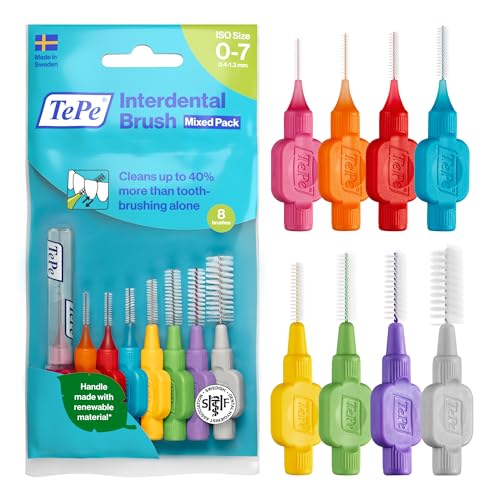
TePe Interdental Brush Original Mixed Pack (8 Count)
Best for: People who don't know what size they need: includes multiple sizes so you can find the right fit for each gap
- Multiple color-coded ISO sizes in one pack
- Plastic-coated wire for gentle cleaning, per TePe
- Slim ergonomic handle
- Used in more than 80 countries, per TePe
- +Mixed color-coded ISO sizes let you find the right fit for each gap without guessing
- +TePe says its products are used daily by consumers and dental professionals in more than 80 countries
- +Plastic-coated wire, which TePe says is there for safe, gentle cleaning around teeth and implants
- −One brush of each size (eight sizes in the 8-pack): enough to find your fit, not for daily use
- −Higher price per brush ($1.12) than GUM or DenTek
(Affiliate link) · Free shipping on eligible Prime items
Why We Recommend It
Picking a size is the first hurdle, and TePe’s mixed pack answers it directly. Instead of guessing which size you need (and likely guessing wrong), you get eight color-coded sizes to try. Each color maps to a standardized ISO size, so once you find your fit, you can reorder exactly the right single-size pack. This is how dental hygienists introduce patients to interdental brushing: try several sizes, identify what fits each gap, then commit.
TePe says its products are used daily by consumers and dental professionals in more than 80 countries, and it keeps all production in Malmö, Sweden. The brushes have a plastic-coated wire, which TePe says is there for safe, gentle cleaning around teeth and implants, and a slim handle. The Original line runs to nine sizes (ISO 0 through 8), and TePe publishes the gap each one fits. Our link goes to the Amazon listing for the mixed pack, $8.99 as of this writing, rated 4.3 stars on 13,206 ratings.
Key Features
- Color-coded ISO sizing system (9 sizes available across the range)
- Plastic-coated wire (TePe: for safe, gentle cleaning around teeth and implants)
- Slim ergonomic handle
- Mixed pack for finding your optimal size
- Used by consumers and dental professionals in more than 80 countries, per TePe
Who It’s Best For
Anyone who has never used interdental brushes before and doesn’t know their size. Also ideal for people who need multiple sizes: TePe says you are likely to need two or three, because each gap between your teeth can differ. The mixed pack lets you identify exactly which sizes you need before committing to bulk single-size purchases.
Potential Downsides
The mixed pack holds eight sizes in eight brushes, so you get one of each: enough to identify your fit but not enough for sustained daily use. You’ll need to reorder in single-size bulk packs once you know your sizes. The price per brush ($1.12 in this pack) is higher than GUM or DenTek because you’re paying for the variety. Some users also report the wires bend faster than expected, though this often indicates using too large a size for the gap.
(Affiliate link) · Free shipping on eligible Prime items
DenTek Slim Brush Advanced Clean
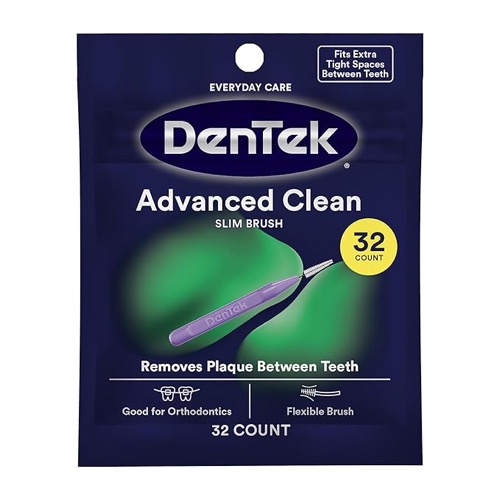
DenTek Slim Brush Advanced Clean (32 Count)
Best for: Budget-conscious buyers with tight spaces: 32 brushes for under $5, also sold at Walmart
- Slim wire design for tight interdental spaces
- Soft tapered bristles
- Mint-flavored for freshness
- 32 brushes for under $5 — lowest price per brush
- +Lowest price per brush on the list at $0.14, making daily use affordable
- +Easy to find off Amazon too: Walmart sells the same 32-count pack
- +Slim design targets tight interdental spaces where standard brushes don't fit
- −Thinner, more flexible wire bends more easily than premium brands
- −One size (extra-tight), so it's the wrong tool for moderate-to-wide gaps
(Affiliate link) · Free shipping on eligible Prime items
Why We Recommend It
At $4.40 for 32 brushes ($0.14 per brush), DenTek Slim Brush makes daily interdental cleaning affordable enough that cost stops being a barrier. They’re also easy to find off Amazon: Walmart sells the same 32-count pack, which matters when you run out and need a replacement without waiting for shipping.
DenTek describes the Slim Brush as an extra-tight fit, made for the narrow spaces where standard-width brushes won’t go. The 18,338 Amazon reviews (more than any other product on this list) reflect massive adoption. For people who’ve tried flossing and given up, these are an easy, low-commitment entry point.
Key Features
- Ultra-slim wire for tight spaces
- Soft tapered bristles
- Mint flavoring
- 32 count at the lowest price per brush on this list
- Also sold at Walmart
Who It’s Best For
People who want to try interdental brushes without a significant investment, and those with tight interdental spaces where standard-width brushes don’t fit. Also great for travel: the small, affordable pack means you won’t feel bad tossing a few in a travel bag.
Potential Downsides
The wire is thinner and more flexible than TePe or Piksters, which means it bends more easily: a trade-off of the slim design. Some users find the bristles softer and thinner than premium brands, resulting in less effective plaque removal in wider gaps. Only one size (extra-tight), so if Slim is too loose for your gaps you’ll need a different product; DenTek’s own Easy Brush Standard is made for standard spaces (its Easy Brush Tight is another extra-tight brush). A brush made for extra-tight spaces won’t reach both tooth walls in a moderate or wide gap, which is where TePe’s larger sizes or Piksters come in. DenTek also labels the Slim Brush disposable after use.
(Affiliate link) · Free shipping on eligible Prime items
Piksters Interdental Brushes
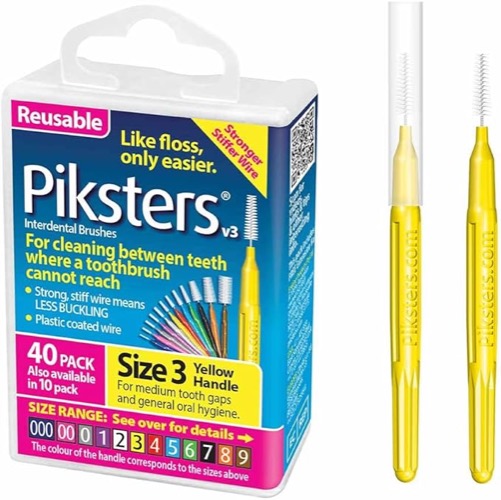
Piksters Interdental Brushes Size 3 (40 Count)
Best for: People who want a sturdier wire: Piksters says its strong wire helps prevent buckling, and its brushes are made to be reused
- Plastic-coated wire Piksters says helps prevent buckling
- Soft bristles that conform to tooth surfaces
- 40-count value pack
- 12 sizes on Piksters' own store, 000 to 9
- +Plastic-coated wire that Piksters says is built to help prevent buckling
- +Piksters says more than 90% of dental professionals recommend its brushes
- +12 sizes on Piksters' own store (000 to 9), more than TePe's nine, including larger sizes for wider gaps
- −Less brand recognition in the US, so your dentist may not know them
- −No fixed replacement interval: Piksters says to reuse them like a toothbrush until the bristles deteriorate or the wire has been bent several times
(Affiliate link) · Free shipping on eligible Prime items
Why We Recommend It
If you’ve given up on interdental brushes because the wire keeps bending, Piksters may change your mind. Piksters says its wire is made to help prevent buckling, and the plastic coating keeps bare metal off your teeth. The soft bristles wrap around tooth contours, and each brush is made to be reused rather than thrown away after one pass.
Piksters calls itself the #1 brand in Australia and says more than 90% of dental professionals recommend its brushes. Its own Australian store lists 12 sizes, 000 through 9, and also sells a variety pack for sizing. At about $10 for 40 brushes (about $0.25 per brush), Piksters sits between DenTek’s budget pricing and TePe’s higher per-brush cost.
Key Features
- Plastic-coated wire (Piksters: helps prevent buckling)
- Soft, conforming bristles
- 12 sizes on Piksters’ own store (Size 000 through Size 9)
- 40-count value pack
- Piksters says more than 90% of dental professionals recommend it
Who It’s Best For
People who’ve had wire-bending issues with other brands, and anyone looking for a good balance of durability and price. Also a strong option for people with periodontal disease or wider gaps from bone loss: Piksters’ range runs up to Size 9, so there is room to size up as gaps widen.
Potential Downsides
Less brand recognition in the US compared to TePe or GUM, so your dentist may not have heard of them. Stock can be inconsistent on Amazon (listings sometimes show “only X left”). Piksters doesn’t set a fixed replacement interval: its how-to guide says to reuse the brushes like a toothbrush until the bristles deteriorate or the wire has been bent several times. Size 3 may not fit everyone: you may need to experiment with sizes 2 or 4.
(Affiliate link) · Free shipping on eligible Prime items
Curaprox CPS Prime Interdental Brushes
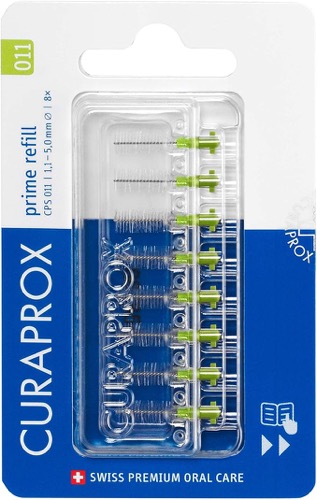
Curaprox CPS Prime Interdental Brushes (8 Count)
Best for: People who want a premium brush: Curaprox builds it on a patented surgical wire the maker calls extra thin and extra strong
- Patented surgical wire Curaprox calls CURAL
- Curaprox US lists 1.1 mm as accessibility for the CPS 011
- One in-and-out movement per gap, per Curaprox
- Reusable handle system with click-in refill heads
- +Patented surgical wire, which Curaprox describes as extra thin and extra strong
- +Curaprox says one in-and-out movement per gap is enough, and claims a long service life
- +Reusable handle system with click-in refill heads
- −Most expensive option on this list at about $3.88 per brush, roughly 28x DenTek's cost
- −Refill pack doesn't include a holder; Curaprox's US store sells a three-pack of handy holders for $10
(Affiliate link) · Free shipping on eligible Prime items
Why We Recommend It
Curaprox builds its brushes on its own wire. The maker calls its patented surgical wire extra thin and extra strong, and that is the pitch here: a fine core meant to hold its shape in tight spaces. Curaprox’s US site gives an “accessibility” figure of 1.1 mm for the CPS 011 we link; its UK site lists the same 1.1 mm as the wire diameter.
Curaprox says a single in-and-out movement per gap is enough, rather than repeated back-and-forth scrubbing, and it lists a long service life among the brush’s features. In one r/PeriodontalDisease recovery post, the writer says a hygienist helped pick the right brushes and that they now use three Curaprox sizes on different teeth.
Key Features
- Patented surgical wire, which Curaprox calls CURAL and describes as extra thin and extra strong
- One in-and-out movement per gap, per Curaprox
- From Swiss brand Curaprox
- Reusable handle system with click-in refill heads
- 5 CPS prime sizes on Curaprox’s US store (CPS 06 through CPS 011)
Who It’s Best For
People willing to pay more for a premium wire, and those who’ve had persistent wire-bending problems with other brands. The reusable handle system (sold separately) means you replace only the brush head, not a whole handle, which Curaprox says means less waste. Also worth a look if a hygienist has already fitted you with Curaprox sizes, since Curaprox says any of its brushes clicks into any of its holders.
Potential Downsides
At about $31.02 for 8 brushes (about $3.88 per brush), Curaprox costs more than the other options on this list: roughly 28x the per-brush cost of DenTek at Amazon’s price; Curaprox’s own US store lists the same 8-pack at $13. The refill pack doesn’t include a holder (Curaprox’s US store sells a three-pack of handy holders for $10), adding to initial cost. Fewer sizes than TePe (5 vs 9) or Piksters (12). The color coding doesn’t match TePe or Piksters, so switching between brands requires relearning which color fits which gap. At 738 reviews, the sample size is smaller than other products on this list.
(Affiliate link) · Free shipping on eligible Prime items
GUM Soft-Picks Wider Space
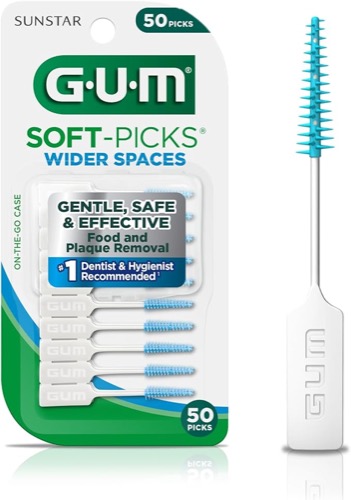
GUM Soft-Picks Wider Space (50 Count)
Best for: People who find wire brushes too harsh: rubber-tipped picks that clean between teeth without the jabbing or bleeding that wire can cause
- Flexible rubber bristles — no wire core
- Adapts to tooth contours without jabbing gums
- Convenient carry case for travel
- 50-count pack for daily use
- +Flexible rubber bristles clean without the metallic jabbing, breakage, or bleeding wire can cause
- +Comparable plaque removal to wire brushes with fewer gingival abrasions
- +Easy pick-style handle, and GUM pitches Wider Spaces for braces, bridges and other dental work
- −The evidence that they match wire brushes on plaque is rated weak
- −Single-use design increases waste and long-term cost
(Affiliate link) · Free shipping on eligible Prime items
Why We Recommend It
Not everyone can tolerate wire interdental brushes—and that’s OK. GUM Soft-Picks use flexible rubber bristles instead of a wire core, which means no metallic jabbing, no wire breakage, and no wire ends to dig into inflamed tissue. A systematic review of rubber-bristle interdental cleaners found no difference in plaque scores against interdental brushes and fewer gingival abrasions, while rating the certainty of that evidence as weak. Read that as a reasonable alternative for gums that can’t tolerate wire, not as a stronger cleaner.
For people who’ve tried wire interdental brushes and given up because of discomfort, bleeding, or the sensation of metal scraping between their teeth, Soft-Picks offer a gentler path to the same benefits. GUM pitches the Wider Spaces size for wide gaps, braces, bridges and orthodontic appliances.
Key Features
- Flexible rubber bristles (no wire)
- Adapts to varying gap widths
- Carry case included
- Single-use disposable design
- Part of a range GUM sells as Original, Advanced, Advanced Tight, Comfort Flex and Wider Spaces
Who It’s Best For
People with sensitive gums who bleed easily, those with bridges, braces or other orthodontic appliances (GUM pitches this size for all three), and anyone who tried wire brushes and found them too uncomfortable to maintain daily use.
Potential Downsides
The review that puts rubber picks level with wire brushes on plaque rates its own evidence as weak, so if your gums tolerate wire, there’s no strong reason to switch. They’re single-use (not reusable like wire brushes), which increases waste and long-term cost. The “Wider Space” size may still be too small for very wide gaps caused by periodontal bone loss. They’re also not a great fit for spaces that are narrow enough to require a traditional wire brush to access.
(Affiliate link) · Free shipping on eligible Prime items
Buyer’s Guide: How to Choose Interdental Brushes
The Size Question (and Why It Trips People Up)
The first hurdle is sizing. TePe’s sizing guide says you are likely to need two or three different sizes, because each space between your teeth can be different. Using one size everywhere means it’s either too tight in front (painful, causes bleeding) or too loose in back (doesn’t clean effectively).
The best approach: ask your dental hygienist to measure your interdental spaces at your next cleaning. They can tell you exactly which ISO sizes fit each area of your mouth. If you can’t wait for an appointment, start with a mixed pack (like TePe’s) and work from the smallest size up: the brush should slide in with slight resistance but no pain.
Why Interdental Brushes Beat Floss
This surprises most people. A Bayesian network meta-analysis of 22 randomized trials, covering 10 interdental aids used alongside toothbrushing, found interdental brushes produced the largest reduction in gingival index (0.23 points, 95% credible interval 0.09 to 0.37), with water flossers next at 0.19. Ranked by the probability of being the best aid, brushes came first at 64.7% and water flossers second at 27.4%, while toothpicks and floss ranked last. Two caveats the authors raise themselves: every aid except toothpicks still beat brushing alone, so floss ranking last is not the same as floss doing nothing, and because gingival indices measure physical signs, the patient-perceived benefit of any of these aids is not clear. Professional guidance points the same way. The European Federation of Periodontology names interdental brushes the method of choice where spaces between teeth allow a brush in without causing trauma, and gives floss a role only where the gap is too tight for one; the British Society of Periodontology publishes that prevention guidance for UK patients.
Why? Wire or rubber bristles contact more surface area than a thin thread of floss. In a 1976 study of 67 extracted teeth, an interdental brush removed plaque as far as 2 to 2.5 mm below the gum margin, and plaque is what drives gum inflammation. Floss is still necessary for very tight contacts where no brush fits, which is the split the EFP draws: brushes wherever they fit without trauma, floss where they don’t.
Bleeding Is Normal (but Only at First)
If your gums bleed the first time you use interdental brushes, don’t stop. Bleeding indicates existing inflammation: the brushes are revealing a problem, not causing one. TePe’s UK team says that with consistent daily cleaning, bleeding often eases within a few days to a week as the gums become healthier.
If bleeding continues beyond a couple of weeks of gentle daily use, becomes heavy, or comes with pain or swelling, see your dentist: persistent bleeding may indicate periodontal disease that needs professional treatment.
Wire Bending: Technique, Not Quality
Wire bending is a common complaint whatever the brand, and it usually traces back to technique rather than product quality:
- Too large a size: if you’re forcing the brush in, size down
- Bending the brush to reach back teeth: creates a weak point in the wire. Use a straight or slightly angled insertion instead, or try angled brushes (TePe makes an angled version)
- Excessive force: the brush should slide between teeth with gentle pressure, not be pushed through
Cross-Brand Size Guide
We found no ISO size or gap figure from GUM or DenTek for their US brushes, so there is no reliable way to line their sizes up against TePe’s; GUM’s size chart gives brush widths, plus one unlabelled figure per size. Piksters sells by its own size numbers and colors; its US Amazon listing calls the Size 3 we link ISO 2, a figure Piksters itself does not publish, and the listing doesn’t give the gap it fits. That’s common: a 2020 study mapping 24 manufacturers’ ranges found only a third stated the ISO size and a quarter stated the passage size, the smallest hole a brush fits through. The simplest routes are a hygienist’s sizing at your next cleaning, or a mixed pack worked from the smallest size up.
The millimetre figures brands publish often aren't the size of gap the brush fits: TePe's US product names give the wire size, and GUM's size chart gives the brush width.
What the millimetre figure measures
- TePethe gap it fits, plus the wire thickness
- The PHD size figure in TePe's catalogue: the gap it fits, labelled "PHD size" on tepe.com · TePe, checked 2026-09-24
- The wire size figure in TePe's catalogue: the wire thickness, labelled "Wire size" on tepe.com · TePe, checked 2026-09-24
- The mm figure in TePe's US product names, which matches the wire size in TePe's catalogue: the wire thickness · TePe, checked 2026-09-24
- CuraproxIts own websites disagree
- The first mm figure Curaprox gives for a CPS prime brush: the gap it fits, labelled "accessibility" on curaprox.us · Curaprox, checked 2026-09-24
- The first mm figure Curaprox gives for a CPS prime brush: the wire thickness, labelled "Wire diameter" on curaprox.co.uk · Curaprox, checked 2026-09-24
- The second mm figure Curaprox gives for a CPS prime brush: the bristle width, labelled "effectiveness" on curaprox.us · Curaprox, checked 2026-09-24
- The second mm figure Curaprox gives for a CPS prime brush: the bristle width, labelled "Brush diameter" on curaprox.co.uk · Curaprox, checked 2026-09-24
One figure, two labels: curaprox.us calls it "accessibility" (the gap it fits); curaprox.co.uk calls it "Wire diameter" (the wire thickness). The chart files it under "fits a gap of", marked with an asterisk.
Sizes, brand by brand
"Fits a gap of" is the passage-hole diameter (PHD): the smallest hole the brush passes through, and the figure to compare across brands. ISO size is the size number from the international standard for interdental brushes; each ISO number covers a small range of gap sizes, so it is coarser than the gap figure. Colours are each brand's own code, not a shared one. Each table shows only the figures that maker publishes; the line under its name lists what it leaves out. The "View on Amazon" buttons are affiliate links: if you buy through one, we may earn a commission at no extra cost to you.
| Colour | Fits a gap of | ISO size | Wire | Buy |
|---|---|---|---|---|
| Pink | 0.6 mm | 0 | 0.4 mm | View on Amazon(Affiliate link) |
| Orange | 0.7 mm | 1 | 0.45 mm | View on Amazon(Affiliate link) |
| Red | 0.9 mm | 2 | 0.5 mm | View on Amazon(Affiliate link) |
| Blue | 1.1 mm | 3 | 0.6 mm | View on Amazon(Affiliate link) |
| Yellow | 1.3 mm | 4 | 0.7 mm | View on Amazon(Affiliate link) |
| Green | 1.6 mm | 5 | 0.8 mm | View on Amazon(Affiliate link) |
| Purple | 2.0 mm | 6 | 1.1 mm | View on Amazon(Affiliate link) |
| Grey | 2.6 mm | 7 | 1.3 mm | View on Amazon(Affiliate link) |
| Black | 3.4 mm | 8 | 1.5 mm | View on Amazon(Affiliate link) |
| Size | Colour | Fits a gap of | Brush width | Buy |
|---|---|---|---|---|
| CPS 06 Prime | Blue | 0.6 mm* | 2.2 mm | View on Amazon(Affiliate link) |
| CPS 07 Prime | Red | 0.7 mm* | 2.5 mm | View on Amazon(Affiliate link) |
| CPS 08 Prime | Pink | 0.8 mm* | 3.2 mm | |
| CPS 09 Prime | Yellow | 0.9 mm* | 4.0 mm | View on Amazon(Affiliate link) |
| CPS 011 Prime | Green | 1.1 mm* | 5.0 mm |
* The maker's own websites disagree on what this figure measures (see above).
The full size guide, with GUM, DenTek and the brands that publish no size figure: interdental brush sizes, decoded.
Brand names are trademarks of their owners. Dental Roundup is not affiliated with, sponsored by, or endorsed by any manufacturer named here; we restate their published figures.
Figure · One brush, three gaps
TePe's US product name for its Original Blue says 0.6 mm. That is the wire. The gap it fits starts at 1.1 mm: the ring.
The bristles squeeze to fit a gap, but never smaller than the ring. That ring is the "fits a gap of" figure.
TePe Original Blue (ISO 3), drawn to scale from TePe's published figures; the parts TePe does not publish are drawn dashed. The ring is TePe's "PHD size" figure.
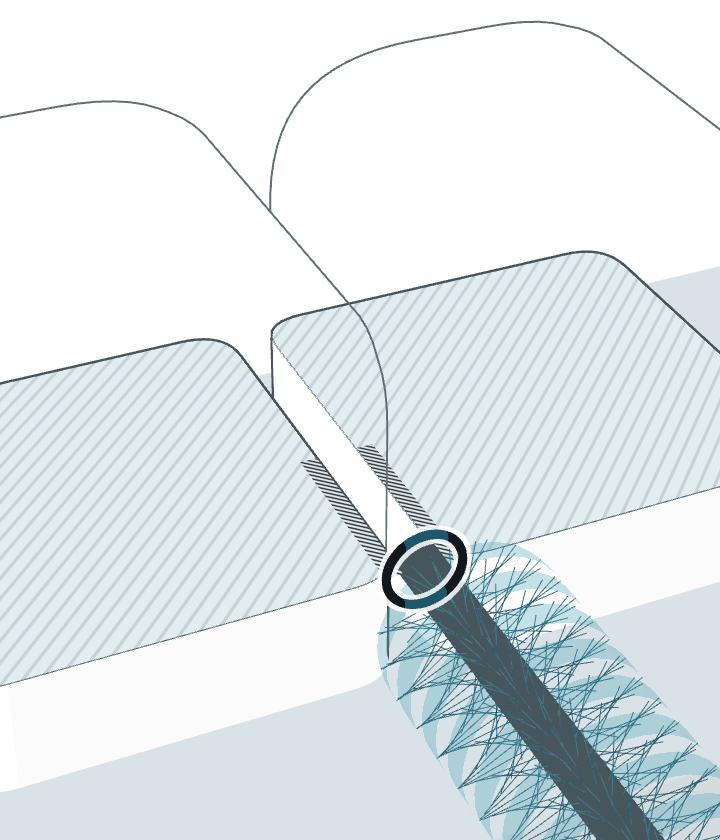
1Too tight.Gap narrower than 1.1 mm.
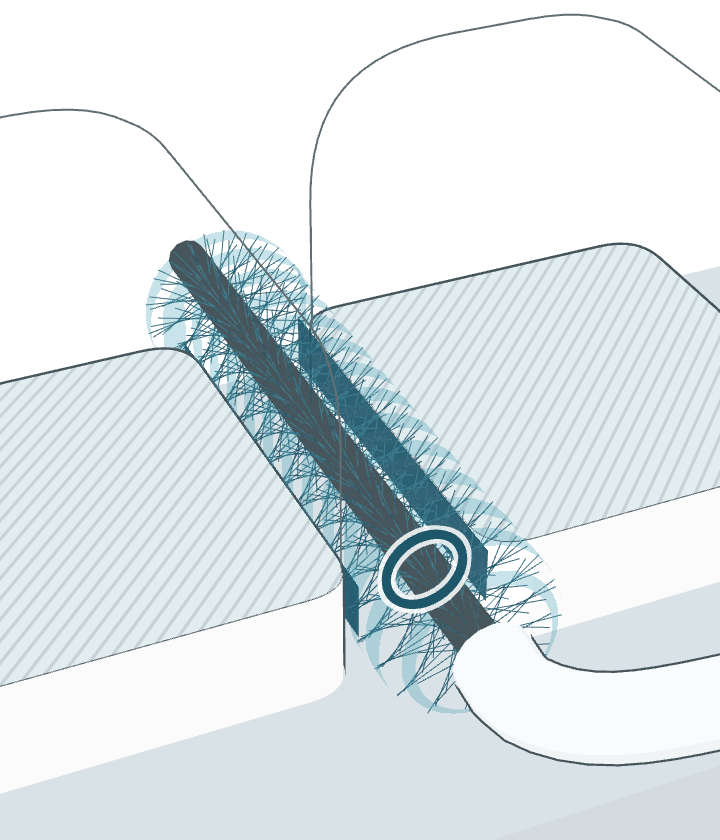
2Snug.Gap from 1.1 mm up to the bristle width.
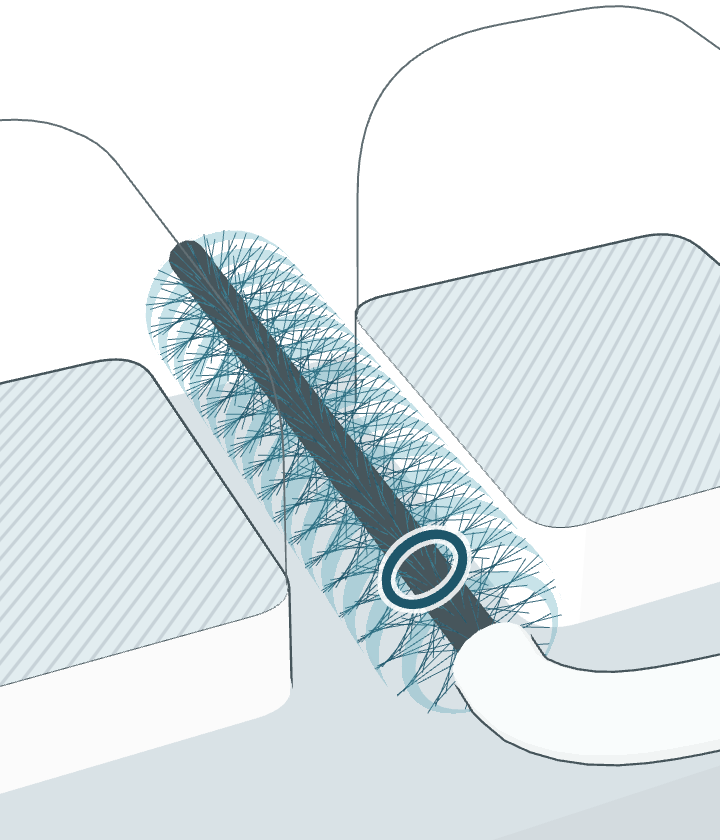
3Too loose.Gap wider than the bristles.
Each part of this figure, with its source, and the full size guide: interdental brush sizes, decoded.
Schematic, not a clinical drawing. Colour marks nothing about size.
Special Situations
Braces: Interdental brushes are a common tool for cleaning around brackets and wires, and TePe, GUM and Piksters all pitch theirs for braces. See our toothbrush for braces guide for a complete braces care routine.
Implants: Keep implants in your between-teeth routine and ask your dentist which size suits the space around each one. Use a brush with a coated wire: TePe says its plastic coating is there for safe, gentle cleaning around implants, and GUM says its nylon-coated wire cleans around implants without scratching.
Periodontal disease: If you have widened gaps from bone loss, those wider spaces are exactly where the EFP calls a brush the method of choice. In a 2024 study of 845 employees of a Japanese company, co-funded by Sunstar (the company behind GUM) and with two Sunstar staff among its authors, people whose check-up five years earlier had found a pocket of 4 mm or deeper had lower odds of tooth loss (odds ratio 0.38) if they had used interdental brushes for four to five years rather than a year or less. It was a cross-sectional study, so it shows an association, not proof that the brushes saved the teeth. Your periodontist can recommend specific sizes for your situation. For those wider, open embrasures, a rubber-tip stimulator is a tool people commonly pair with an interdental brush, see our best gum stimulators roundup.
Frequently Asked Questions
Are interdental brushes better than floss?
For most interdental spaces, yes. The Cochrane review found low-certainty evidence that interdental brushes may reduce gingivitis more than floss, though its plaque results were inconsistent. However, floss is still needed for very tight contacts where no interdental brush fits. The European Federation of Periodontology’s guidance is to use both: brushes where they fit, floss where they don’t.
How often should I replace interdental brushes?
Follow the maker, and replace any brush sooner if the bristles splay or the wire starts to bend. GUM says to replace its Go-Betweens weekly, DenTek labels its Slim Brush disposable after use, Piksters says its brushes can be reused like a toothbrush, and Curaprox lists a long service life for its CPS prime brushes. Rinse under water after each use and let dry.
How many sizes do I need?
TePe says you are likely to need two or three sizes, because each gap between your teeth can be different. A mixed pack (like TePe’s) helps you identify which sizes fit where, or your dental hygienist can measure your spaces and recommend specific sizes.
Is the bleeding normal?
Yes, at first. Bleeding when you start using interdental brushes indicates existing gum inflammation: the brushes are cleaning areas that haven’t been properly cleaned before. Continue with gentle daily use; TePe says bleeding often eases within a few days to a week. If it continues beyond a couple of weeks, becomes heavy, or comes with pain or swelling, see your dentist.
Can I use interdental brushes with braces?
Yes. TePe, GUM and Piksters all pitch their interdental brushes for cleaning around brackets and wires. Choose a size that fits comfortably between the bracket and the gum line without forcing.
Why does the wire keep bending?
Usually one of three causes: the brush is too large for the gap (size down), you’re using too much force (it should slide in gently), or you’re bending the brush to reach back teeth (insert straight or use an angled brush). If wire bending persists across multiple brands, consider Curaprox’s surgical-wire option or switching to GUM Soft-Picks.