
The Oral-B Pro 1000 is the brush people get told to buy: a dental visit ends with “get an electric toothbrush,” a search begins, and this is the name that keeps coming back. This review covers what the current version actually does (it has changed more than most buyers realize), what the first week feels like, and when the honest answer is a different brush — including our budget electric toothbrush roundup if you want the full field.
How We Evaluated
We don’t run hands-on lab tests. This review synthesizes five sources, weighted in this order:
- Cleaning evidence — what independent systematic reviews say about the oscillating-rotating category, not brand marketing.
- Manufacturer specification — Oral-B’s own published spec for the current unit, cross-checked against the live Amazon listing and a major retailer’s spec sheet, because this model was refreshed mid-life without a name change.
- Community experience — five years of Reddit threads (r/askdentists, r/Dentistry, r/oralbtoothbrush, r/BuyItForLife) covering ownership from first-week shock to year-three battery complaints.
- Independent testing data — where hands-on reviewers have published measurements (noise, battery), we attribute them rather than restate them as our own.
- Value — price checked against the step-up and cross-brand alternatives on this page, all live-read the day this published.
| What the community says | What the evidence says |
|---|---|
| “Cheap, durable, and approved by my dentist” — the default budget recommendation for years | Oscillating-rotating brushes showed a modest plaque and gingivitis reduction versus manual in the Cochrane systematic review |
| Day-one intensity owners compare to a grass cutter | Normal for the category — the ADA notes both powered and manual brushes work when used properly; the adjustment period is real but temporary |
| Battery degrades around year three | Consistent with owner reports; the motor and cleaning action are almost never the complaint |
Oral-B Pro 1000 — Editor’s Pick
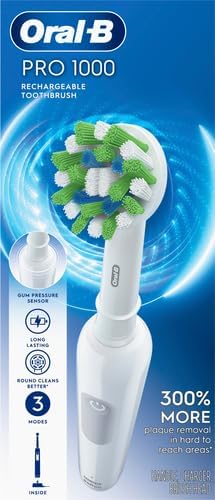
Oral-B Pro 1000
Best for: Anyone who wants Oral-B's clinically studied clean and a real pressure sensor at Oral-B's lowest price that includes one
- Gum-pressure control that stops the pulsations when you press too hard
- Daily Clean, Sensitive, and Whitening modes on current units
- CrossAction round head, 2-minute timer with 30-second quadrant pacer
- Compatible with classic Oral-B heads (not iO heads)
- +Pressure sensor stops the pulsations the moment you press too hard — a guardrail the cheaper tier drops
- +Oscillating-rotating clean backed by independent systematic reviews, with a Sensitive mode on current units
- +Cheap, durable, and the community's dentist-visit default for years
- −Noticeably louder and buzzier than sonic brushes, and the sensor gives no light or sound
- −Battery is the known failure mode — owners report degradation around year three
(Affiliate link) · Free shipping on eligible Prime items
Why We Recommend It
At around $50, the Pro 1000 is the cheapest Oral-B handle with real gum-pressure control: per Oral-B’s own spec, the sensor stops the brush’s pulsations when you press too hard. That single feature is why it keeps getting recommended to people whose dentist flagged aggressive brushing. The cleaning action itself — the round head’s oscillating-rotating-pulsating motion — is the most extensively studied powered-brush category in the Cochrane review of powered toothbrushes.
Here’s what most buyers miss: the Pro 1000 was quietly refreshed partway through its life. Earlier units shipped with a single Daily Clean mode; the current unit sold under the same name carries three modes — Daily Clean, Sensitive, and Whitening. If you’re reading an older review (or a retailer spec sheet that still says “1 mode”), it describes the previous iteration. That Sensitive mode matters for anyone whose gums are the reason they’re shopping.
Community sentiment over five years of threads is remarkably consistent: cleaning effectiveness is essentially never the complaint. What owners do report is the adjustment period — the first sessions feel intense and loud compared to a manual brush or a sonic — and, further out, batteries that fade around year three while the motor keeps going.
Who It’s Best For
First-time electric-brush buyers, over-brushers, and anyone who wants the evidence-backed clean without paying for Bluetooth. One professional’s framing from r/askdentists stuck with us: any of the major brushes works — the professional’s own lean is oscillating-rotating motion, and any model does the trick. The Pro 1000 is the cheapest reliable way to follow that advice with a pressure sensor included.
Potential Downsides
It’s the loudest brush on this page, and the pressure sensor gives no light or sound — you learn to feel the pulsations cut out, and some new owners conclude it isn’t working at all. Independent testers at Electric Teeth measured about 10 days per charge, short of the roughly two weeks typical for sonic rivals, and long-term owners report battery degradation as the reason they eventually replace it — inside the warranty window that’s a warranty conversation, beyond it a replacement handle is the realistic path, so price the brush with year-three in mind. No travel case, and one brush head in the box.
(Affiliate link) · Free shipping on eligible Prime items
Oral-B iO Series 3 Limited Deep Clean (White) — The Quiet Upgrade
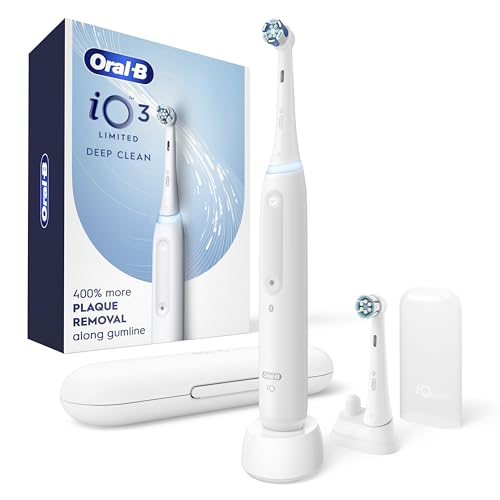
Oral-B iO Series 3 Limited Deep Clean (White)
Best for: Pro 1000 owners who love the clean but want the smoother, quieter magnetic drive and a visible pressure signal
- iO magnetic drive — smoother and quieter than the classic oscillating motor
- Visible pressure sensor plus the same 3-mode set
- iO LightRing timer and travel case included
- +Same 3-mode set as the Pro 1000 but with the iO line's quieter, smoother motion
- +Pressure sensor you can actually see, plus a travel case in the box
- −iO brush heads cost more than classic Oral-B heads and aren't cross-compatible
- −This specific listing has a far smaller review base (hundreds, not tens of thousands)
(Affiliate link) · Free shipping on eligible Prime items
Why It’s Here
The single most common Pro 1000 question in community threads is whether to upgrade to the iO line, and the honest answer from owners is: you’re paying for comfort, not cleaning. Upgraders describe the iO line’s magnetic drive as smoother and quieter, the pressure sensor is visible instead of silent, and there’s a travel case in the box. One honest caveat on tier: the community’s upgrade threads mostly discuss the Series 6-and-up models, not this one — but one iO Series 9 owner’s advice in those threads pointed firmly down-range (the app tracking disappoints and the extra modes go unused), and at around $90 the Series 3 is the cheapest ticket to the drive itself, which is the part upgraders actually praise.
Two honest caveats. iO heads cost more than classic Oral-B heads and the two systems aren’t interchangeable, so the ongoing cost is higher. And this specific Amazon listing carries several hundred ratings rather than the tens of thousands on the Pro 1000 — the iO 3 family is spread across many listings, but we flag the thinner base on this one rather than pretend otherwise. One iO Series 3 owner thread also reports gunk accumulating where the head meets the handle — rinse and dry the joint, whichever brush you land on.
(Affiliate link) · Free shipping on eligible Prime items
Philips Sonicare 4100 Series — Best Sonic Alternative
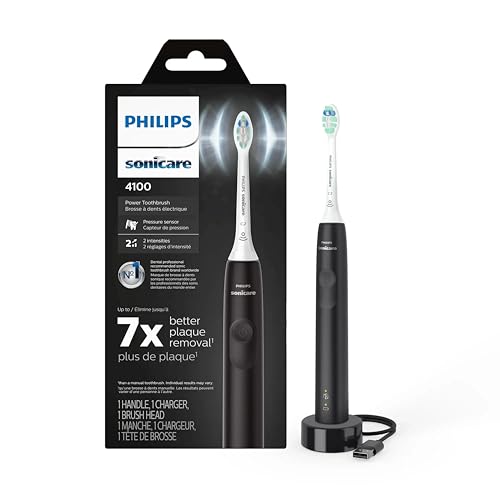
Philips Sonicare 4100 Series
Best for: People who find oscillating brushes too intense and want a gentler-feeling sonic clean with the same guardrails
- Sonic side-to-side action — quieter and gentler-feeling than oscillating
- Pressure sensor plus two intensity levels
- BrushSync head-replacement reminder, roughly 14-day battery
- +Quieter, gentler-feeling sonic action that's easier on gum-sensitive mouths
- +Pressure sensor plus two intensities and a head-replacement reminder
- −One brush head in the box, a case that holds heads rather than the handle, and brand replacement heads are a recurring cost of their own
(Affiliate link) · Free shipping on eligible Prime items
Why It’s Here
If the Pro 1000’s “grass cutter” first impression is a dealbreaker, this is the other direction: Sonicare’s entry pressure-sensor brush feels like a strong vibration rather than a scrubbing motor, runs much quieter, and adds a low/high intensity choice the Pro 1000 doesn’t have. One commenter writing as a dental professional split the two brands directly: a personal preference for Oral-B’s round heads, but a professional lean toward Sonicare for patients with periodontal disease — with the kicker that either works as long as you use it. It costs a little more than the Pro 1000, about $56 against about $50 as of September 2026, and Amazon now sells it as a bundle of the same handle with a brush head case, on a listing carrying 595 ratings where the one it replaced had gathered about 20,000. It gets a full review of its own in our Sonicare 4100 review, including the generation confusion around its “ProtectiveClean” predecessor.
(Affiliate link) · Free shipping on eligible Prime items
The rest of the budget Oral-B lineup
Oral-B Vitality FlossAction — the low-$30s step below the Pro 1000. You give up the pressure sensor and the refreshed 3-mode set, and one owner comparing it against a step-up Oral-B described the Vitality as feeling much weaker. It’s a fine timer-plus-round-head starter, but the Pro 1000’s sensor is worth the difference for most buyers, and its Amazon listing currently sells through marketplace offers rather than a standard buy box. Older Pro 3000/Smart series — discontinued tiers that still circulate; a used Pro 3000’s aging battery is not worth choosing over a new Pro 1000.
Buyer’s Guide: Is the Pro 1000 Worth It, and When Should You Buy Something Else?
The short answer on value
Around $50 buys the pressure sensor, the evidence-backed cleaning motion, three modes, and a five-year-deep record of owner satisfaction. The things it lacks — quiet operation, visible sensor feedback, travel case, long battery — are comfort features, and every one of them costs more.
The head economics
The recurring cost of any electric brush is the heads, roughly every three months. The Pro 1000 uses Oral-B’s classic head system — cheaper than iO heads and with the widest third-party supply. On third-party heads, the one owner account in our research is a caution: they “don’t seem to wield as much power as the originals,” and that owner went back to brand heads. Budget for brand heads and treat cheaper ones as an experiment your next checkup will grade.
Pro 1000 vs the iO line
Cleaning parity, comfort difference. Upgrade if the noise bothers you daily, if you want to see the pressure sensor working, or if you travel enough to want the case. Stay if your budget stops at $50 — in the threads we reviewed, upgraders describe comfort differences, not better checkups.
Which should you buy?
- Buy the Pro 1000 if you want the best evidence-per-dollar and can live with the buzz.
- Buy the iO Series 3 if you tried an oscillating brush and liked everything except how it feels and sounds.
- Buy the Sonicare 4100 if oscillating intensity is the problem itself, or your dentist suggested sonic for gum sensitivity.
- Buy neither if you brush a manual brush twice a day with good technique and clean checkups — the ADA’s guidance is that both types work when used properly.
The first week: what’s normal
The intensity surprise is the most common new-owner thread, and it fades. Let the brush do the work: rest the head against the gumline at roughly 45 degrees and glide slowly — no scrubbing strokes. The 30-second quadrant buzz will feel too fast at first; that’s the pacer working, not you failing. And the pressure sensor is silent by design: press hard on purpose once, feel the pulsations stop, and you’ll trust it afterward.
Set realistic expectations
A brush handles plaque disruption; it doesn’t whiten beyond stain removal, fix existing recession, or replace flossing. If gums bleed after the first week or two of consistent use, that’s a dentist conversation, not a settings problem.
Frequently Asked Questions
Q: Is the Oral-B Pro 1000 still good enough, or should I upgrade to an iO? A: For cleaning results, it’s good enough — the upgrade buys smoothness, quiet, and a visible sensor, not better checkups. Owners who upgraded describe the difference as comfort; one long-term owner upgraded only when the battery faded in year three.
Q: Which is better for plaque removal — the Pro 1000 or the Sonicare 4100? A: The honest evidence answer: both types beat manual brushing in the Cochrane systematic review, head-to-head differences between oscillating and sonic are small, and consistency dominates. A commenter writing as a dental professional leans toward Sonicare specifically for periodontal-disease patients while personally preferring Oral-B’s motion — and stresses that either works if you actually use it.
Q: Why does the Pro 1000 feel so rough? Will it damage my enamel? A: The first-week intensity is the most common new-owner complaint and it’s an adjustment period, not damage in progress. Used with light pressure at the gumline, powered brushes are considered safe; the pressure sensor exists to stop the pulsations at the point Oral-B set as too hard.
Q: My pressure sensor doesn’t seem to do anything — is it broken? A: Probably not: it has no light or sound. It stops the pulsation component of the motion when you press too hard, which you feel rather than see. Press firmly on purpose during one session to learn the sensation.
Q: I’ve seen old reviews say the Pro 1000 has only one mode. Which is true? A: Both, for different eras. Earlier Pro 1000s shipped with Daily Clean only; the current unit sold under the same name has Daily Clean, Sensitive, and Whitening. Oral-B’s product page and the current retail listings reflect the 3-mode version — older reviews and stale spec sheets describe the previous one. If a unit arrives behaving like the single-mode version, you likely received older stock; the mode count is the tell, and a return-and-reorder is reasonable.
Q: Is the Pro 1000 okay for braces? A: It shows up in orthodontic prep threads, and the round head plus pressure sensor is a reasonable combination for brackets. Ask your orthodontist about head choice — see also our electric toothbrush for braces roundup.