
Philips Sonicare sells a wide range of handles, and the differences between them are confusing. The naming conventions overlap (ProtectiveClean, ExpertClean, DiamondClean), the feature sets bleed into each other, and the price gaps don’t always correspond to meaningful upgrades. We read the current Sonicare listings and the owner threads behind them, and this page carries the models where the differences are real, along with what each step up in price actually buys. If you’re comparing Sonicare against other brands, see our best budget electric toothbrush and best electric toothbrush for sensitive teeth roundups. If you are still choosing between Sonicare and Oral-B, our electric toothbrush guide lays out the independent evidence on the two systems and the picks at each price.
How We Evaluated Sonicare Models
Core cleaning performance. Philips’ 62,000 bristle movements per minute is not a figure every handle shares. The 7300 and 9500 listings print it; the 4100, 1100 and 5300 listings quote no figure. Electric Teeth, an independent review site, reports that the current 4100 Series runs at half the bristle movements of the older ProtectiveClean 4100 it replaced, and its 4100 Series review concludes that “The motor is configured differently, but it doesn’t impact results”. The claim we can stand behind is narrower than any listing’s: we could find no independent study showing that a pricier model from the same brand cleans better than its entry model. Beyond the motor, what changes between models is the number of cleaning modes, what comes in the box, and how the brush tells you about pressure.
Features that matter vs. features that don’t. The features owners and self-identified dental professionals in our research agree on make one short list, repeated almost identically by both: a pressure sensor, a two-minute timer with a 30-second quadrant pacer, and a rechargeable handle. Nothing beyond it. The sensor is the one you cannot improvise, because it reports pressure you might not notice yourself. Its case is narrower than the marketing, though. The ADA recommends soft bristles and gentle pressure because both “may help reduce the risk of gingival injury”, and the 2015 Journal of Clinical Periodontology systematic review our electric toothbrush guide works through calls the evidence on brushing and recession “largely inconclusive”. BrushSync head replacement reminders save you from guessing. Bluetooth app coaching suits some people and goes unused by many.
Price-to-value ratio. The spread from about $20 to about $280 is enormous. We evaluated whether each step up in price delivers a proportional improvement in daily brushing experience, and identified the specific inflection points where spending more stops making a meaningful difference.
Long-term cost of ownership. Replacement brush head compatibility, battery longevity, and warranty coverage all factor into total cost. Nearly every modern Sonicare uses the same click-on head system, but some models include premium heads that cost more to replace. Before stocking up on heads, check which Sonicare heads fit which handles in our Fitment Registry: Philips One and the older screw-on lines are separate systems (kids heads, by Philips’ own note, fit click-on handles too, though Philips does not list the Kids handles among those that take standard click-on heads), and we keep the manufacturer-sourced compatibility map dated.
Which models this page covers. We recommend five handles here, picked where the differences between them are real rather than to cover the whole catalogue. One of them our main electric toothbrush guide leaves out: the 7300 is new enough that its review base sits below the 1,000-rating floor that guide applies. As of September 2026 the 4100 sits below that floor too, on a newer listing sold under the 4100 name that carries about 600 ratings against about 23,000 on the listing it replaced; the 7300’s card gives its count, and the 4100 section below explains the 4100’s. Two current models get a note instead of a full recommendation. The Prestige 9900 is one, and the note on it in the buyer’s guide sets out why. The other is the 6100, whose listing says its pressure sensor reduces the brush’s vibration when you press too hard; our best electric toothbrush for receding gums roundup still reviews it, though Amazon stopped stocking it in September 2026.
Evidence Receipt
- Two minutes, soft bristles, a fresh head every three to four months. The ADA’s toothbrush guidance puts the consensus at brushing “for two minutes twice a day with a toothbrush that has soft bristles” and replacing the brush “every three to four months or more often if the bristles are visibly matted or frayed”. That is why the timer makes the short list and why we count the heads in the box against a year of replacements.
- Gentle pressure is the case for the sensor, and the ADA hedges it. The same ADA page recommends a soft brush and gentle pressure, “both of which may help reduce the risk of gingival injury”, and says manual and powered brushes “can be used effectively”.
- The link between hard brushing and recession is unsettled. A 2015 systematic review in the Journal of Clinical Periodontology found the data for and against a link between traumatic toothbrushing and gum recession “largely inconclusive” (J Clin Periodontol review), so this page treats the pressure sensor as feedback worth having rather than as protection.
- Powered beats manual by a modest margin. Cochrane’s 2014 review found 11% less plaque with powered brushes than manual ones in the short term and 21% less in the long term (Cochrane review).
- Sonic against oscillating, the independent reviews split. A 2020 JADA meta-analysis put oscillating-rotating brushes ahead of other powered brushes on whole-mouth plaque and bleeding sites, while a 2021 JADA review of 24 head-to-head trials found little to no difference at four weeks. We found no independent trial comparing one Sonicare tier with another.
- Model features come from the listings we link. Modes, sensors, battery life and box contents on each card come from that product’s US Amazon listing, read in September 2026, and the 5300’s Gum Care description comes from Philips’ US product page. The 62,000-movement and plaque-multiplier figures are Philips’ own claims, not independent measurements.
Philips Sonicare 4100 (Black) — Editor’s Pick
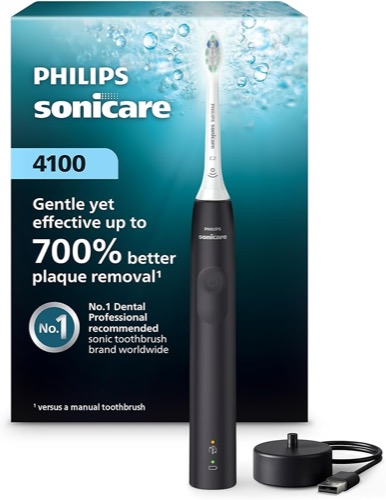
Philips Sonicare 4100 (Black)
Best for: Most people: the cheapest Sonicare on this page with a pressure sensor and a two-minute timer, and the model owners in our research name most often
- Pressure sensor: press too hard and the handle changes its vibration to tell you, per the listing
- Two-minute SmarTimer with a 30-second QuadPacer for each quadrant of the mouth
- Up to two weeks per charge, with a brush head case that holds up to three heads, per the listing
- Brush head replacement reminder tells you when the head is due, per the listing
- One cleaning mode with two intensity settings; C2 Optimal Plaque head in the box
- +The Sonicare named most often in the owner threads we read, and the cheapest one carrying the features the professionals in our research ask for
- +Pressure sensor changes the handle's vibration when you press too hard, per the listing, alongside a two-minute SmarTimer and a 30-second QuadPacer
- +Takes every Sonicare click-on head, so running cost is set by which head you buy rather than by the handle
- −One cleaning mode, and the single power button also cycles the two intensity settings, which one owner called out as annoying
- −Longevity reports are split: owners recommending it expect five years or more, while one owner reports handles dying at around 18 months
(Affiliate link) · Free shipping on eligible Prime items
Why We Recommend It
The 4100 is the cheapest Sonicare on this page with a pressure sensor (Philips’ own store also lists a 3100 Series with one, which we have not reviewed), and it is the model the owner threads keep landing on. It came up in at least five organic threads in our Sonicare research, usually stated flatly: “I bought the 4100 and it’s perfect”, and “Go with 4100 like everyone says”. The 71 Reddit threads behind our electric toothbrush guide say the same thing at greater scale, 79 mentions across 29 of them, more than any other model of either brand. Some of that record may describe the older ProtectiveClean 4100, since the name has covered two generations of handle.
The reasoning behind those mentions is about features rather than cleaning power, and it is consistent. Self-identified dental professionals on Reddit keep naming the same short list, a pressure sensor, a two-minute timer with a quadrant pacer and a rechargeable handle, and nothing beyond it. One: “I’m a hygienist and I always suggest the least expensive model of sonicare or oral-b that includes a pressure sensor.” A comment on r/DentalHygiene named this handle alongside its Oral-B counterpart: “Sonicare 4100 or Oral B io 3. They’re both great budget electric toothbrushes that have all the basic features you need.” These commenters are self-identified rather than credential-verified, which is worth holding in mind whichever way they lean.
The 4100 is exactly that brush. The handle changes its vibration when you press too hard, per the listing, and there is a two-minute SmarTimer, a 30-second QuadPacer and a head replacement reminder, at about $56. That sensor is the reason to choose it over the 1100: the ADA recommends gentle pressure because it “may help reduce the risk of gingival injury”, and a sensor tells you about pressure you might not notice. How much difference the telling makes is less settled than the marketing suggests, which is why we put the ADA’s hedged wording in the criteria above rather than promising protection.
It takes any Sonicare click-on head, so the running cost is set by which head you buy rather than by the handle: the everyday C2 Optimal Plaque head runs about $11 a head in a three-pack. For how it compares with non-Sonicare options, see our budget electric toothbrush roundup. Because the 4100 name covers more than one listing on Amazon, our Sonicare 4100 review walks through which one to buy. One note on the numbers on this card: as of September 2026 the listing Amazon serves for the 4100 is a newer bundle sold under the 4100 name, packed with a brush head case, carrying about 600 ratings where the listing it replaced had gathered about 23,000.
Key Features
- Pressure sensor that changes the handle’s vibration when you press too hard
- Two intensity settings (low and high), one cleaning mode
- Two-minute SmarTimer with a 30-second QuadPacer
- Brush head replacement reminder
- Up to two weeks per charge, with a brush head case in the box
- Compatible with all Sonicare click-on heads
Who It’s Best For
Most people buying a Sonicare, and anyone whose dentist has raised over-brushing, recession or enamel sensitivity. It is also the model to choose if you are upgrading from the 1100: the sensor and the second intensity setting are the largest step in the lineup relative to what they cost.
Potential Downsides
There is one cleaning mode, so if you want a dedicated Whitening or Gum Care setting you need the 5300 below. The single power button also cycles the intensity settings, which one owner found annoying: “I prefer the 5100 because the power button on 4100 toggles between intensity modes, which is annoying with the way I use mine.” And longevity reports split. The owners who name a lifespan put it at five to ten years, but one dissenter argued the opposite case in detail, reporting that “The latest 4100 came from Target and is noticeably weaker than the one we bought in 2024” and that handles were dying at around 18 months. We could not reconcile the two camps from the threads we read.
(Affiliate link) · Free shipping on eligible Prime items
Philips Sonicare 5300 (Black) — Best Step-Up
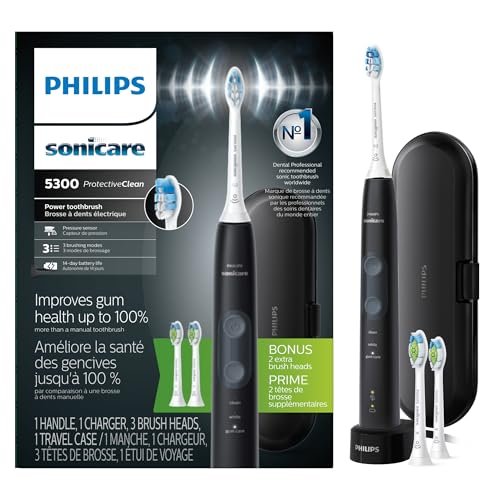
Philips Sonicare 5300 (Black)
Best for: Buyers who will use the White and Gum Care modes and want three heads and a travel case in the box on top of the 4100's basics
- Three cleaning modes: Clean, White (polish), and Gum Care
- Pressure sensor that alerts you when you are brushing too hard, per the listing
- BrushSync tracks head wear and tells you when to replace the head
- Up to two weeks per charge, per the listing; takes all standard Sonicare click-on heads
- Three brush heads and a travel case in the box, per the listing
- +Three cleaning modes (Clean, White and Gum Care) where the 4100 has one
- +Three brush heads and a travel case in the box, per the listing, covering close to a year of replacements at the ADA interval
- +4.5 stars across more than 22,000 ratings
- −The extra money over the 4100 buys modes and heads: neither the owners in our research nor any independent study we could find reports a better clean
- −One owner reported a handle failing after about a year of two people swapping heads on it daily, a single report but a plausible wear point for a shared handle
(Affiliate link) · Free shipping on eligible Prime items
Why We Recommend It
The 5300 (sold under the “ProtectiveClean 5300” name on earlier listings) is the Sonicare for people who read the section above, agreed with it, and still want the modes and the extra heads. It is the same platform underneath: the same pressure sensor, which its listing describes as alerting you when you press too hard, the same click-on heads, the same BrushSync wear reminder. What it adds is White for polishing and Gum Care, which Philips describes as an extra minute of reduced-power brushing, plus three heads and a travel case in the box.
For a lot of buyers the box matters more than the modes. The ADA advises replacing a head “every three to four months or more often if the bristles are visibly matted or frayed” (ADA), so three heads cover close to the first year. At about $110 against about $56 for the 4100, that is what the extra money buys: two more modes and two more heads. Bought separately, a 4100 and a three-pack of the everyday C2 heads come to about $88, about $22 less than the 5300, so the White and Gum Care modes, the travel case and the 5300’s own gum-care and DiamondClean heads have to earn the difference. It does not buy a better clean, and we say that because nothing in our research says otherwise, from owners, from the self-identified professionals quoted in the buyer’s guide, or from any independent trial comparing tiers inside one brand.
The 5300 carries 4.5 stars across more than 22,000 ratings. That is Amazon volume rather than community discussion, and the two point different ways here: in the 71 threads behind our electric toothbrush guide the 5300 came up eight times against 79 for the 4100. One of those eight explains the appeal plainly: “It has an extra button for extended cleaning, which I use and use the last 30 seconds for the tongue.”
Key Features
- Three cleaning modes covering daily, whitening, and gum care needs
- Pressure sensor that alerts you when you press too hard, per the listing
- BrushSync brush head replacement reminders
- Up to two weeks per charge, per the listing
- Takes Sonicare click-on heads; Philips’ 5300 page lists C1, C2, C3, G2, G3 and W among them
- Three brush heads and a travel case in the box; two-year warranty
Who It’s Best For
Buyers who will actually press White or Gum Care, and buyers who want the heads and the case without shopping for them separately. If Clean mode is all you would ever use, the 4100 above covers it for about $54 less and has a low setting: Philips’ own product page lists no intensity settings for the 5300 (its Amazon description mentions three), and the owner quoted below found no way to turn the power down. The 4100 is what most people buying a Sonicare should take.
Potential Downsides
There is no Bluetooth app, so no guided coaching; the 7300 below is the first handle on this page that adds it, and the 9500 is the only one whose listing claims zone tracking. The 5300 is also an older-generation ProtectiveClean handle, and Philips’ 5950 now sits beside it in Amazon’s sponsored placements. The 5300 itself is still stocked and sold.
The modes are also subtler than the box suggests. One owner who bought the 5300 for its three modes wrote on r/askdentists in December 2025 (read as an archive copy): “I can’t tell any real difference between them and the intensity feels very strong no matter what mode I use.” Philips’ own product page lists three modes and no intensity settings, and describes Gum Care as an extra minute of reduced-power brushing, so if a gentler setting is the reason you are shopping, the 4100’s low setting or the 7300’s Sensitive mode is the surer route.
One durability report deserves a mention because it names a cause. A couple who shared a single handle, taking the heads on and off daily, reported that “It lasted about a year or so” before it broke. That is one report rather than a pattern, but if two people are going to share a handle, two 4100s cost about what one 5300 costs.
(Affiliate link) · Free shipping on eligible Prime items
Philips Sonicare 1100 Series (White) — Best Budget
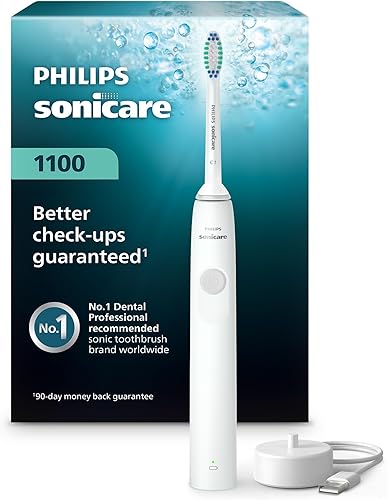
Philips Sonicare 1100 Series (White)
Best for: First-time Sonicare buyers or anyone who wants core sonic cleaning without extras
- One cleaning mode, and we could find no independent study showing a pricier Sonicare cleans better
- EasyStart gradually ramps up power over the first 14 uses for new electric toothbrush users
- SmarTimer signals the two-minute mark; QuadPacer prompts a move every 30 seconds, per the listing
- Under $20, the lowest price on this page
- +Under $20, and we could find no independent study showing a pricier Sonicare cleans better than the entry model
- +EasyStart gradually ramps power over the first 14 uses to ease the switch from a manual brush
- +SmarTimer signals the two-minute mark and QuadPacer prompts a move every 30 seconds, per the listing
- −No pressure sensor, so no warning if you brush too hard
- −Only one cleaning mode and no brush head replacement reminder
(Affiliate link) · Free shipping on eligible Prime items
Why We Recommend It
The Sonicare 1100 answers the question every Sonicare thread converges on: is the expensive one actually better? Not on any evidence we could find. We could find no independent study showing that a pricier model from the same brand cleans better than its entry model, and what you pay for at the higher tiers is modes, sensors and app features.
For someone switching from a manual toothbrush (or replacing a Sonicare that finally died) the 1100 delivers core sonic cleaning for under $20. EasyStart eases the transition by gradually increasing intensity over the first 14 uses, about a week at twice a day, which matters more than it sounds: full sonic vibration can feel strong if you’ve never used an electric brush, and one owner in our research went back to a manual brush after four nights because even the low setting felt like too much.
At 4.4 stars across more than 9,500 ratings, the 1100 does the job it is sold for. Our forum research turned up no owner reports for this model: two threads list it as the budget option, and one buyer’s question about downgrading to it went unanswered, so what we can say about it comes from the listing and the price rather than from owners. The timer is the feature that gets a new user to the ADA-recommended two minutes.
Key Features
- One cleaning mode with no intensity adjustment
- EasyStart ramps the power over the first 14 uses for new users
- 2-minute SmarTimer with 30-second QuadPacer
- Compatible with all Sonicare click-on brush heads
- Slim, lightweight handle
Who It’s Best For
The 1100 is ideal for first-time electric toothbrush users, college students, or anyone who wants sonic brushing without features they won’t use. It’s also a sensible entry point if you want to try a sonic brush before committing to a higher tier: the click-on handles share their heads, so upgrading later doesn’t waste the heads you own.
Potential Downsides
No pressure sensor means no warning if you’re brushing too hard: a meaningful gap if you have sensitive gums or a history of recession. Only one cleaning mode (Clean) with no intensity adjustment, and no brush head replacement reminder. For about $36 more, the 4100 adds the pressure sensor, a second intensity setting and the head reminder, which is the upgrade we would make.
(Affiliate link) · Free shipping on eligible Prime items
Philips Sonicare 7300 (White) — Best for Gum Health
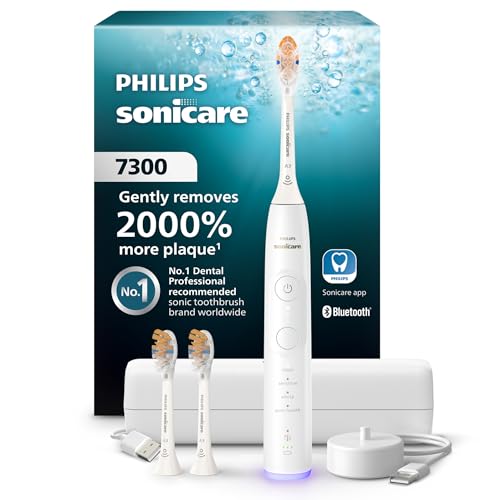
Philips Sonicare 7300 (White)
Best for: People managing gum sensitivity or recession who want a Gum Health mode, a gentler Sensitive mode and app coaching below the DiamondClean tier
- Four modes: Clean, Sensitive, Gum Health and White, each at three intensity levels (12 settings)
- Visual pressure sensor: a light ring at the base warns when you press too hard
- Sonicare app pairing for guided brushing and habit coaching; BrushSync tracks head wear, pressure and brushing time
- Up to 21 days per charge, with a charging travel case and three A3 Premium All-in-One heads in the box
- +Dedicated Gum Health mode plus a Sensitive mode, each at three intensity levels
- +App pairing adds guided brushing and habit coaching; the light-ring pressure sensor works without the app
- +Up to 21 days per charge, a charging travel case and three A3 heads in the box
- −New for December 2025, so its review base is among the smallest on this page at around 910 ratings
- −About $170, and the charging stand ships without a wall adapter
(Affiliate link) · Free shipping on eligible Prime items
Why We Recommend It
The Sonicare 7300 takes the place the ExpertClean 7500 used to hold on this page: when we checked in September 2026, Amazon no longer sold the 7500 as a single handle in the US, and the 7300 had been listed since December 2025. It sits one step below the DiamondClean tier and is the least expensive handle on this page that pairs a dedicated Gum Health mode with app coaching. For anyone with gum recession or gum disease who has been told to change technique, the app’s guided brushing gives that instruction some structure at 6 AM, and the light-ring pressure sensor works whether or not your phone is in the bathroom. For a deeper comparison of electric toothbrushes suited to sensitive gums, see our best electric toothbrush for receding gums roundup.
The four modes are Clean, Sensitive, Gum Health and White, each at three intensity levels. That is the practical gain over the 5300: someone with localized recession can run Gum Health on low, or drop to Sensitive on a sore day, instead of choosing between one Gum Care setting and full power. The listing quotes this motor at 62,000 bristle movements per minute, a company figure rather than an independent one. It is the same figure the 9500’s listing quotes, so it does not separate the two app-connected handles. Battery life is rated at up to 21 days, and the included case charges the handle on the road.
Key Features
- Four modes at three intensity levels each (12 settings)
- Visual pressure sensor light ring
- Sonicare app with guided brushing; BrushSync head-wear tracking and replacement reminders
- Up to 21-day battery, with a charging travel case and charging stand
- Three A3 Premium All-in-One brush heads in the box; two-year manufacturer warranty
Who It’s Best For
People whose dentist or hygienist has asked them to change how they brush, and who want app-guided technique to help them do it. Gum Health and Sensitive run gentler than Clean, but they are settings, not treatment: Mayo Clinic advises booking a dentist appointment as soon as possible if you notice symptoms of gingivitis, such as gums that bleed easily; that appointment comes before choosing a brush. The app coaching adds accountability while new habits form.
Potential Downsides
This is a new model, first listed on Amazon in December 2025, and its review base is one of the smallest on this page at around 910 ratings against more than 22,000 for the 5300. Its 4.5-star average matches the 4100 and the 5300, and on a base this young it is an early read. At about $170 it costs about one and a half times the 5300, and what the extra money buys is the app, the Sensitive mode, three intensity levels on every mode, the longer battery and the charging case: if you would not use the app or the extra modes, the 5300 covers the gum-care basics. The charging stand and case ship without a wall adapter, so you supply the plug. A3 replacement heads cost about $14 each in the four-pack Amazon sells alongside the 7300, against about $11 for the everyday C2 heads.
(Affiliate link) · Free shipping on eligible Prime items
Philips Sonicare DiamondClean Smart 9500 — Best Smart Features
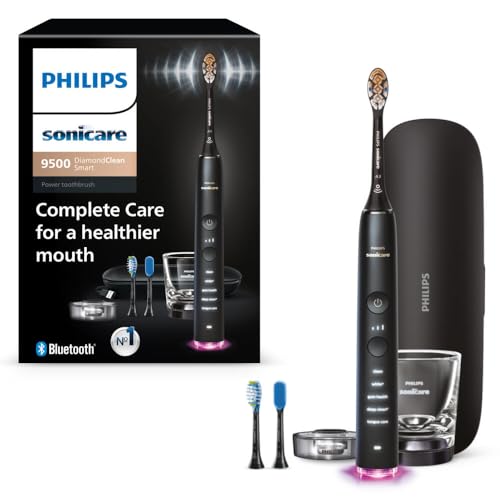
Philips Sonicare DiamondClean Smart 9500
Best for: Tech-forward users who want app coaching, the listing's zone tracking, and the signature charging glass
- Five cleaning modes: Clean, White+, Deep Clean+, Gum Health, and Tongue Care
- App pairing the listing describes as real-time zone tracking, session-by-session progress and habit coaching
- Signature charging glass, plus a USB travel case for charging on the go
- A3 Premium All-in-One and C3 Premium Plaque Control heads plus a TongueCare+ tongue brush in the box, per the listing
- +Five cleaning modes including enhanced White+, Deep Clean+, and a dedicated Tongue Care mode
- +App pairing the listing describes as real-time zone tracking and session-by-session progress
- +Signature charging glass and a USB travel case, with A3 and C3 heads and a TongueCare+ tongue brush in the box, per the listing
- −About two and a half times the 5300's price at our September read, with no independent evidence of a better clean
- −DiamondClean owners in our research report the line's weakest durability record, including handles failing at two to three years
(Affiliate link) · Free shipping on eligible Prime items
Why We Recommend It
The 9500 is where the feature set changes rather than the clean. Its listing claims the app delivers real-time zone tracking and session-by-session progress, the one app feature the 7300’s listing does not claim: the 7300’s app promises guided brushing, tips and personalized content, but nothing that tracks where in your mouth you have been. Whether that changes the outcome is a different question, and nothing we read separates the two brushes on cleaning.
The five cleaning modes include two enhanced variants (White+ and Deep Clean+) that the 7300 does not carry. Tongue Care is the one mode no other brush on this page carries, and the box includes a TongueCare+ tongue brush to go with it. The signature glass charger is both functional (it actually charges the brush) and aesthetically considered—a small detail, but one that keeps the brush charged without a visible charging cable on the counter.
The Premium A3 brush head is worth mentioning specifically: it combines plaque removal, whitening, and gum care geometry into a single head, reducing the need to switch between heads for different modes. Whether this single-head versatility is worth the premium replacement cost depends on how many modes you actively use. It is not a reason to choose the 9500 over the 7300, though: the 7300 ships with three A3 heads.
Key Features
- Five cleaning modes including enhanced White+ and Deep Clean+
- App pairing with real-time zone tracking and session progress, per the listing
- Glass charger and USB-enabled travel case
- A3 and C3 brush heads plus a TongueCare+ tongue brush in the box
- Bluetooth Sonicare app integration
- 14-day battery life
Who It’s Best For
The 9500 is for buyers who will open the app most days and want the zone tracking its listing describes, a layer of accountability the 7300’s general coaching does not claim to match. If the glass charger is the draw, that is a design choice, not a cleaning one.
Potential Downsides
At around $280 at our September 2026 read, the 9500 costs about five times the 4100 and about two and a half times the 5300, and there is no independent evidence of a better clean at either step. The smart features need consistent app use to be worth anything, and owners who bought at this tier are candid about how that goes: “I paid like $350 for a Sonicare DiamondClean top-of-the-line whatever around 2017. I never use any of the gee-whiz functions… I definitely will not be spending that kind of coin again.” Without the app you are paying a large premium for a glass charger and a fifth mode. Its review count is also low, about 1,600 against more than 22,000 for the 5300.
Durability is the reason we would think twice. The DiamondClean line carries the weakest owner reports in our Sonicare research: several owners describe recent handles dying or losing vibration at two to three years, and two owners describe the internal brush mount working loose. One long-term owner set the contrast out himself: “My first sonicare Diamondclean lasted 13 years… A $300 toothbrush should last longer than 3 years.” That thirteen-year handle is in the record too, so this is a spread rather than a verdict, but it is the widest spread in the line.
(Affiliate link) · Free shipping on eligible Prime items
Buyer’s Guide: Choosing the Right Sonicare Model
What Changes as You Move Up the Line
The 7300 and 9500 listings quote 62,000 bristle movements per minute; the 4100, 1100 and 5300 listings quote no figure, and Electric Teeth reports that the current 4100 Series runs at half the movements of the ProtectiveClean 4100 it replaced without a loss in results. What Philips calls Sonicare Fluid Action is the mechanism its listings describe, driving fluid deep between teeth and along the gumline. What changes as you move up the lineup, from the $20 1100 to the roughly $280 DiamondClean 9500, is modes, sensors, app features and what comes in the box; no independent study we found shows the clean changing with them.
This is the most important thing to understand when shopping the Sonicare range: at higher price points you are not paying for any better cleaning that an independent study has shown. You are paying for features that make cleaning more convenient, more guided, or more protective of your gums.
Where the Price Jumps Actually Matter
$20 → about $56 (1100 to 4100): Adds a pressure sensor and a second intensity setting. This is the one upgrade in the lineup that owners and self-identified professionals both back. The sensor flags pressure you might not notice; the ADA’s own wording for gentle brushing is that it “may help reduce the risk of gingival injury”, so treat it as feedback worth having rather than a guarantee.
About $56 → about $110 (4100 to 5300): Adds the White and Gum Care modes, two extra heads and a travel case. Worth it if you will use the modes or want the heads in the box; skippable if Clean mode is all you need. What it does not buy, on any evidence we found, is a better clean: everything above the 4100 buys convenience, guidance or what is in the box.
About $110 to about $170 (5300 to 7300): Adds app coaching, a Sensitive mode alongside Gum Health, three intensity levels on every mode (Philips’ own page lists none for the 5300), a 21-day battery against the 5300’s two weeks, and a charging travel case. Worth it if a dentist or hygienist has asked you to change your technique. Skippable for healthy gums.
About $170 to about $280 (7300 to 9500): The 9500 costs about $110 more than the 7300 at our September 2026 read, so this is a step up in price as well as a choice. The 9500 trades the 7300’s Sensitive mode for the app’s zone tracking, a fifth mode and the charging glass. These are luxury features either way: on cleaning, nothing independent we found separates any tier from the 1100, and the 4100’s sensor, at about $56, is the last feature the professionals in our research ask for.
Brush Head Compatibility and Cost
Nearly every current Sonicare uses the same click-on head system, so heads move freely between handles: upgrading does not waste the heads you own, and you can run premium heads (G3 Gum Care, A3 All-in-One) on a budget handle. The exceptions are the ones named in the criteria above, Philips One and the older screw-on lines, which are separate systems.
The everyday C2 Optimal Plaque head runs about $11 a head in a three-pack, and the premium C3, G3 and A3 heads cost more. The ADA’s replacement interval is “every three to four months or more often if the bristles are visibly matted or frayed” (ADA), which is three to four heads a year. Our Sonicare brush head guide covers the cheaper and specialty options.
When to Choose the App-Connected Models
Bluetooth app connectivity (Sonicare 7300 and DiamondClean 9500) is worth considering if you:
- Have been asked by a dentist or hygienist to change specific brushing technique
- Want data on brushing habits over time
- Respond well to app-based accountability (like fitness trackers)
It’s not worth the premium if you already have healthy gums and good technique, or if you historically don’t stick with health apps. The 4100 covers the sensor and the timer without asking anything of your phone.
Why We Leave Out the Sonicare Prestige 9900
Philips’ flagship is the Prestige 9900, and we do not recommend it. The owner record behind it is thinner than the price, and its star rating sits below the 4.0-star floor our electric toothbrush guide applies: 3.9 on the listing that guide checked, and 3.8 on the Prestige listing Amazon showed beside the 9500 in September 2026. That is a different bar from the rating-count floor the 4100 sits under. In the wider research for that guide, the flattering 9900 mentions were roundup-style filler or comments that arrived months after a thread had gone quiet; the one plain owner report is a complaint: “I have a high end Philips Sonicare brush, the Platinum 9900 series. It is great, and you can pair it with an app. However, twice the handle has needed to be replaced, as it started to rattle within the warranty period.” Our own Sonicare research found the same hole from the other side: every 9900 mention sat in review-style posts rather than ownership threads.
Philips sells the handle on a pressure system it calls SenseIQ, which Philips’ product page describes as sensing your pressure, motion and coverage up to 100 times per second and automatically adjusting the intensity level when you press too hard. We have no independent evidence of what that changes and no usable owner record to read it against, and the same page quotes the 62,000 bristle movements per minute that the 7300 and 9500 listings carry. If you want the top of the Sonicare line, the DiamondClean 9500 above is the one with a review base we can actually read, durability caveats included.
Sonicare vs. Oral-B: A Quick Note
This page is about choosing between Sonicare models, but the Sonicare vs. Oral-B question comes up constantly. Sonicare uses high-frequency sonic vibration, Oral-B uses oscillating-rotation, and the head-to-head evidence is unsettled: a 2020 JADA meta-analysis put oscillating-rotating brushes ahead of other powered brushes, sonic ones included, on whole-mouth plaque and bleeding sites, while a 2021 JADA systematic review of 24 head-to-head trials found little to no difference in plaque or gum inflammation at four weeks. Our electric toothbrush guide works through why that split is less even than it looks: the independent syntheses find at most a very small edge for oscillating brushes, and the largest pro-oscillating numbers come from one manufacturer’s own trial archive, which that page labels as such. What is not unsettled is powered versus manual, which Cochrane’s 2014 review puts at 11% less plaque short term and 21% long term. So the tiebreaker is not the motion, it’s which brush you keep picking up twice a day. Owners who prefer Sonicare describe the feel as gentler and quieter, and a self-identified retired dentist in our research put that case strongly: “Do you like your gums? Then stick with Sonicare style brushes. The Oral-B style certainly works, but the cleaning is harsher and over time in many people promotes recession.” Another commenter, self-identified as a dentist with ten years of running clinical trials, pushed back on exactly that: “Multiple studies and systematic reviews comparing oscillating-rotation (Oral-B) to sonic brushes (Sonicare) haven’t found a meaningful difference in gum recession outcomes between the two.” The highest-scoring professional comment in our Sonicare research picks neither: “Whichever one you will use for 2 mins each time, 30s a quadrant.” Our best electric toothbrush for sensitive teeth roundup works through the sonic-versus-oscillating evidence in full.
One more professional voice belongs in that record, because it argues against Sonicare on technique rather than on gums. A self-described practicing hygienist, answering a buyer weighing the 5300 in a June 2026 r/DentalHygiene thread (read as an archive copy), wrote “I never recommend sonicare because you have to brush meticulously in a certain way for it to work right”, describing “a certain motion of tiny slow back and forth brushing that is a huge learning curve”, and added that “My patients with sonic care brushes tend to have more tartar than my oral b patients even when they have good home care.” That is one clinician’s chairside impression rather than a trial, and the head-to-head reviews above split on the two designs, but if you switch to a Sonicare it is worth asking your own hygienist to check how you use it.
Frequently Asked Questions
What’s the best Sonicare for most people?
The Sonicare 4100, at about $56. It carries the pressure sensor and the two-minute timer with its quadrant pacer, which is the short list owners and self-identified dental professionals in our research agree on, and it is the model those threads name most often. Everything above it buys modes, app coaching, heads in the box or a nicer build: we could find no independent study showing that a pricier Sonicare cleans better, and the 4100 is where the features the professionals in our research ask for stop. If you will use the White and Gum Care modes, or you want three heads and a case in the box, the 5300 is the step up. And if your current Sonicare still charges and runs, nothing we found says a newer one will clean better; one commenter in a December 2025 r/BuyItForLife thread (read as an archive copy) put it as “Keep your current one and replace it when it breaks”.
Is the cheapest Sonicare (1100) actually good?
Yes, with one real gap. The 1100’s listing quotes no motor figure, and neither do the 4100’s or the 5300’s; the two that do, the 7300 and the 9500, print 62,000 bristle movements per minute, and Electric Teeth reports that the cheaper handles, the 1100 included, run fewer movements than the premium ones. We could find no independent study showing that a pricier model from the same brand cleans better than its entry model. What you trade away is the pressure sensor, the second intensity setting, the extra modes, the head replacement reminder and app connectivity, and of those the sensor is the one the professionals in our research actually ask for.
Do I need the Sonicare app?
Most people don’t. The app is most useful if a dentist or hygienist has asked you to change your technique, over gum recession for example, and nothing we found shows that app coaching changes gum outcomes. If your gums are healthy and you brush for two minutes twice a day, a pressure sensor (available on the 4100 and above) provides the essential feedback without needing your phone.
Can I use any Sonicare brush head on any Sonicare model?
Nearly. Philips’ brush head guide says most Sonicare handles take its standard click-on heads, and every handle on this page is a click-on handle, so a premium A3 head fits a 1100 and a basic C1 head fits the 9500, and upgrading a handle does not waste the heads you own. The exceptions Philips names are Philips One and the older screw-on lines, which take their own heads.
How often should I replace my Sonicare brush head?
The ADA says every three to four months, “or more often if the bristles are visibly matted or frayed”. Some models include a head-replacement reminder: the 4100, 5300 and 7300 listings call it BrushSync, and the 9500’s says its reminder tracks how often and how hard you brush. Either way the check the ADA describes is one you can make yourself, by looking at the bristles.
Is the Prestige 9900 worth it over the 5300?
We do not think so, and the 9900 is not one of our picks on this page. It sits below the star-rating floor our main electric toothbrush guide applies (3.8 to 3.9 stars across the listings we have read), and the only plain owner report we could find describes a handle replaced twice under warranty for rattling. Philips markets it on the SenseIQ pressure system; there is no independent evidence about what that changes, and no owner record to read it against. The note on the 9900 in the buyer’s guide above sets out what we found.
What do the “700%” and “2000%” plaque figures on Sonicare listings mean?
They are Philips’ own comparisons against a manual toothbrush (the 4100 and 9500 listings spell out the manual-brush baseline; the 7300’s prints the same footnote marker without the footnote text), and on the premium handles Philips ties them to the brush head rather than the handle. The 4100 and 5300 listings claim up to 700% more plaque removal, the same figure printed on the C2 head pack Amazon sells alongside both. The 7300 and 9500 listings claim up to 2000% and credit it to the A3 Premium All-in-One head in their boxes, and the A3 is a standard click-on head that fits every handle on this page. None of these figures comes from an independent trial. The independent yardstick is Cochrane’s 2014 review of powered against manual brushing, which found 11% less plaque in the short term and 21% in the long term. It measures plaque on a different scale, so the numbers cannot be lined up against each other, and nothing independent we found separates one Sonicare tier from another.
How long does a Sonicare handle last?
Owner reports range widely. In the threads we read, some owners describe handles still holding a charge after more than ten years, while others report recent handles failing at 18 months to three years, and one 2025 r/BuyItForLife thread (read as an archive copy) put it as “the brush body usually starts to go wonky a little after 2 years”. Battery fade is the common end: one owner in a 2022 thread, read the same way, described a seven-year-old handle whose charge “lasts about half what it used to”. On charging, the advice splits. A self-identified retired dentist in our research says “Top the brush off every few days and leave it off the base”, while Philips’ charging guidance says leaving the brush on a plugged-in charger between brushings “will not affect the battery lifespan”. Philips advertises a two-year warranty on its US site, and the 7300’s listing states the same. Over a handle’s life the heads usually cost more than the handle: at about $11 a head and three to four heads a year, a 4100 owner spends more on heads than on the handle within two years.
How do I stop mold where the head attaches?
Mold at the head mount came up in five threads in our Sonicare research, and the fix owners describe is simple: take the head off after brushing so both parts dry, and clean the connection point on the handle about once a week.