
The short answer
Brushing with fluoride toothpaste leaves a thin fluoride layer on your teeth, and the point of the next half hour is to leave it there. Rinsing with water or a non-fluoride mouthwash straight after brushing washes it off, so either use the mouthwash at a separate time of day, or make sure the one you use straight after brushing contains fluoride itself. Prescription rinses follow the dentist's instructions.
NHS, How to keep your teeth clean (reviewed June 2025); ADA Oral Health Topics, Mouthrinse; ACT and Listerine Drug Facts on DailyMed; fluoride-retention studies on PubMed
Why the Order Question Is the Wrong Question
Most of the arguing about “before or after” assumes the mouthwash is the important step and brushing is the setup. It is the other way round. Brushing with a fluoride toothpaste is the step with the strongest evidence behind it, and what the toothpaste leaves behind after you spit is what does the work over the next hour or so. The NHS puts it plainly: spit out the excess toothpaste and do not rinse, because rinsing washes away the concentrated fluoride left on your teeth.
Mouthwash enters that picture as a rinse, and a rinse does to fluoride toothpaste exactly what water does, unless the rinse carries fluoride of its own. That single mechanism settles almost every version of the question, so the useful question is not “before or after brushing” but “how far from brushing, and does my rinse contain fluoride.”
Where mouthwash goes in your day
Order matters less than spacing. Keep water and fluoride-free rinses away from the fluoride you just brushed on.
- Morning
Floss, brush two minutes with fluoride toothpaste, spit and do not rinse.
- Midday after lunch
A separate slot for a rinse. Fluoride rinse (0.05% sodium fluoride) for one minute, then nothing to eat or drink for 30 minutes.
- Night
Floss, brush, spit and do not rinse.
If you want a rinse at night too, use a non-fluoride rinse before you brush, or a fluoride rinse after; never water or a non-fluoride rinse straight after brushing.
What Happens After You Spit
The reason to protect the post-brushing layer is measurable. In a supervised study of 23 adults, brushing with a 1,450 ppm fluoride toothpaste and then rinsing with a mouthwash that contained no fluoride cut the amount of fluoride retained in saliva to roughly half of what brushing followed by a quick water rinse left behind, while rinsing with a fluoride mouthwash did not (Duckworth et al., 2009). A second series found the same “wash-out” effect from post-brushing rinses with no fluoride or only 100 ppm, and concluded that a post-brushing rinse should contain at least 226 ppm fluoride, which is the 0.05% sodium fluoride strength sold over the counter (Mystikos et al., 2011).
Fairness demands one caveat. Those are saliva-chemistry studies, not cavity counts. The one long trial that measured cavities directly followed 407 Lithuanian schoolchildren for three years and found that a thorough water rinse after supervised brushing did not significantly change the caries increment compared with spitting only, although both brushing groups did far better than the no-toothpaste control (Machiulskiene et al., 2002). So “don’t rinse” is a sound default with a clear mechanism behind it, not a rule with a large proven penalty for breaking it. The practical reading is the one the NHS lands on: keep the fluoride where it is when you can, and do not lose sleep over the mornings you forget.
Fluoride Rinse: After Brushing or Later?
Here the two most-cited authorities appear to disagree, and both are right for their own reasons. The NHS advice is not to use mouthwash, even a fluoride one, straight after brushing, and to choose a different time such as after lunch. The Drug Facts label on an ordinary 0.05% sodium fluoride rinse says to use it once a day after brushing, swish 10 mL for one minute, spit, and then not eat or drink for 30 minutes.
The reconciliation is in the numbers above, with the same caveat as before: those are saliva measurements, not cavity counts. A 0.05% rinse sits at about 226 ppm fluoride, the floor the Mystikos series identified, so using it right after brushing does not strip the toothpaste layer the way water does; it tops it up at a lower concentration. Using it at a separate time of day instead adds a second fluoride exposure when the toothpaste’s has faded. Either is defensible. The NHS route gives you two fluoride events a day rather than one longer one, which is why we lean that way in the timeline above, and it has the side benefit of never tempting you to rinse with water afterwards. Whichever slot you pick, the 30-minute no-food-or-drink rule on the label applies to the rinse just as it does to toothpaste.
What a fluoride rinse buys you is well studied in children: a Cochrane review of 37 trials involving 15,813 children and adolescents found supervised regular use reduced decayed, missing and filled tooth surfaces by a pooled 27% across the 35 trials (15,305 participants) that contributed to that analysis (Marinho et al., 2016). Adult evidence is thinner, and for people who keep getting cavities the same Mystikos paper points past the over-the-counter shelf altogether: it recommends a 5,000 ppm toothpaste or a 0.2% (900 ppm) fluoride rinse over the 0.05% strength sold on the shelf, which is a conversation to have with your dentist (Mystikos et al., 2011). The ADA’s mouthrinse topic page frames fluoride rinses as a helpful addition rather than a replacement for brushing and flossing. Our fluoride mouthwash picks cover the products; the one below is the one most people mean when they say “ACT.”
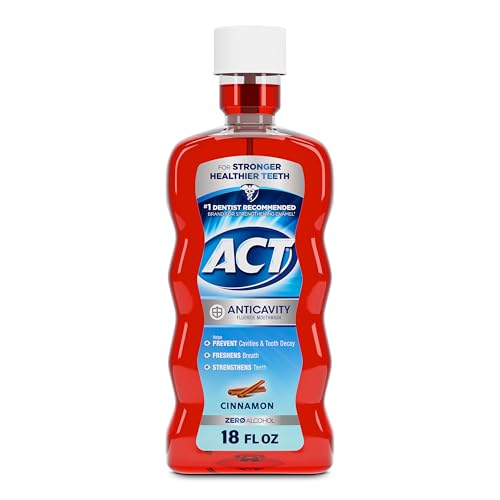
ACT Anticavity Fluoride Rinse, Cinnamon (18 oz)
Best for: The after-lunch fluoride slot; its own label also allows straight after brushing
- 0.05% sodium fluoride (0.02% w/v fluoride ion), the over-the-counter anticavity strength
- Label directions: 10 mL for one minute, once a day, then nothing to eat or drink for 30 minutes
- Alcohol-free, so no burn and no drying for people who rinse daily
- Not for children under 6; supervise under-12s so they spit rather than swallow
(Affiliate link) · Free shipping on eligible Prime items
(Affiliate link) · Free shipping on eligible Prime items
Antiseptic and Cosmetic Rinses
Essential-oil rinses (the Listerine family), cetylpyridinium chloride rinses (most alcohol-free “pro-health” products), and breath rinses built around chlorine dioxide or zinc are a different tool. The ADA’s topic page separates cosmetic rinses, which mask bad breath temporarily, from therapeutic ones with an active ingredient that reduces plaque, gingivitis, bad breath or decay, and notes that whether you rinse before or after brushing “may depend on personal preference,” with manufacturers sometimes recommending a specific order because of ingredient interactions.
Timing for these rinses is about not undoing the toothpaste. A non-fluoride antiseptic used straight after brushing is the wash-out case from the Duckworth study, so the simplest fix is to move it: before you brush, so the toothpaste is the last thing on your teeth, or to a separate time such as after lunch, before a meeting or after coffee, whenever breath or gum health is the concern. The Listerine Cool Mint label asks for 20 mL swished for 30 seconds, morning and night, and adds that the rinse is not intended to replace brushing or flossing. “Morning and night” on that label is a frequency, not an instruction to rinse the moment you put the toothbrush down. If you want an antiseptic and a fluoride top-up in one step, the fluoride-containing variant of an antiseptic line is the product the Reddit threads name as the exception to the after-brushing rule (Listerine Total, “the purple one,” in two separate threads). Read the label before treating it as a full exception, though. The alcohol-free version’s Drug Facts list sodium fluoride at 0.02%, about 100 ppm, roughly half the strength of a dedicated 0.05% rinse and below the 226 ppm floor the Mystikos series set, although the Duckworth study found a 100 ppm rinse held salivary fluoride at the level of brushing followed by a quick water rinse. The two studies disagree at exactly this strength, so treat it as fine at a separate time, borderline straight after brushing, and never a substitute for the toothpaste. Our antibacterial mouthwash roundup covers the rest of the line.
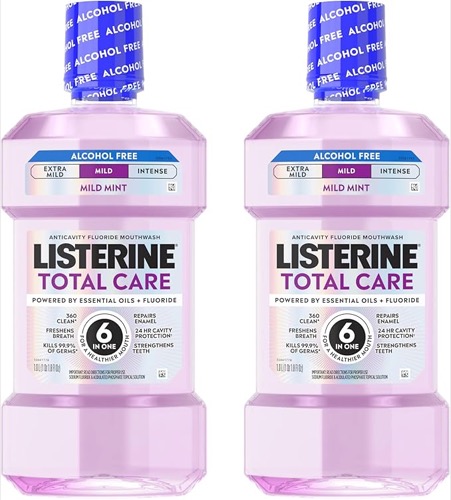
Listerine Total Care Alcohol-Free Mouthwash (Mild Mint, 2-Pack)
Best for: An antiseptic rinse that carries some fluoride, for the after-lunch or before-brushing slot
- Sodium fluoride 0.02% (about 100 ppm) with the Listerine essential oils, per its DailyMed Drug Facts: roughly half the strength of a 0.05% anticavity rinse
- Label directions: twice a day after brushing, 10 mL for one minute, ages 12 and up
- Alcohol-free, so no burn or drying for a rinse used twice a day
- Two 1-liter bottles per pack
(Affiliate link) · Free shipping on eligible Prime items
(Affiliate link) · Free shipping on eligible Prime items
For breath specifically, the timing advice flips to “when it is useful.” A breath rinse works best when the smell is the problem, which is rarely the two minutes after you have brushed. The product below is the one that dominates our bad-breath mouthwash research, and it contains no fluoride, so it belongs at a separate time from brushing, not straight after it.
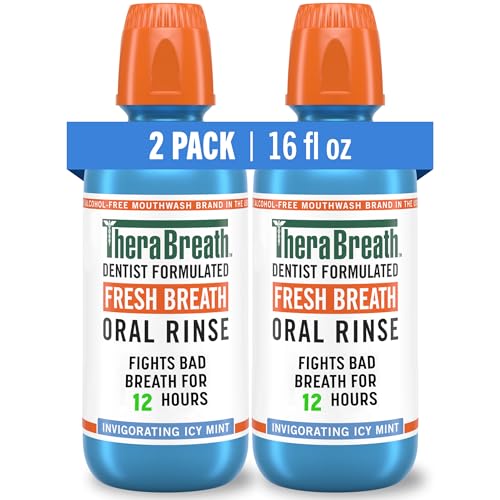
TheraBreath Fresh Breath Mouthwash, Icy Mint (2×16 oz)
Best for: A midday breath rinse at a separate time from brushing
- Alcohol-free, so no burn and no drying, which matters for a rinse used daily
- Breath-focused formula with no fluoride, which is why it belongs at a separate time from brushing
- Two 16 oz bottles per pack
- Made with xylitol; no dyes, SLS or parabens, per the listing
(Affiliate link) · Free shipping on eligible Prime items
(Affiliate link) · Free shipping on eligible Prime items
Chlorhexidine: Follow the Label
Chlorhexidine is the prescription rinse dentists hand out after gum treatment or surgery, and it has its own timing folklore: the advice to wait 30 minutes to two hours between brushing and rinsing. That came from a 2006 review of laboratory and clinical data showing that the sodium lauryl sulfate foaming agent in most toothpastes can neutralize chlorhexidine, with the effect fading after about two hours (Kolahi and Soolari, 2006). A later systematic review pooled the controlled trials and found that when toothpaste is used as a paste in the ordinary way, rather than as a diluted slurry, chlorhexidine’s plaque inhibition was not measurably reduced regardless of the order, although three of its four trials came from one research group (Elkerbout et al., 2015).
The practical position is unchanged by the disagreement. Chlorhexidine is a short-course prescription with staining and taste side effects, and the dentist who prescribed it has told you when and how long to use it. Follow that. If the instructions say to leave a gap after brushing, the gap costs nothing.
The Other Reason to Leave a Gap: Acidity
Fluoride is not the only timing argument. Many rinses are acidic, and below what dentists call the critical pH enamel begins to lose mineral, so brushing straight after an acidic rinse works on a surface that is temporarily easier to abrade. A 2018 laboratory study measured six US rinses with a calibrated meter and found a wide spread: Crest Pro-Health at pH 7.05, ACT Total Care 6.31, Scope Classic 5.18, and the three Listerine products tested between 3.43 and 3.98, with the authors concluding that some rinses sit below the critical pH of enamel and dentin and that some showed erosive potential on dentin, though enamel loss did not differ significantly between products over two weeks (Delgado et al., 2018). Those are bench measurements on extracted teeth, not mouths, where saliva buffers acid; treat them as a reason to prefer the order the studies favour, not as evidence that a mint rinse dissolves teeth.
The practical rule falls out of the erosion study above: if you use an acidic essential-oil rinse in the same session as brushing, rinse first and brush after, so the toothpaste’s fluoride is the last thing on your teeth and you are not brushing enamel that a low-pH rinse has just softened. Two of the 19 Reddit threads raised this mechanism unprompted, and one aligner wearer described the sharp end of it: “I stopped using mouthwash after the acid was creating strange sensitivity problems (ortho said the trays we’re trapping the acid against my teeth).” A near-neutral rinse such as a CPC alcohol-free product or a 0.05% fluoride rinse sidesteps the question.
If You Wear Aligners or Braces
Aligner and brace wearers ask this question separately, because they cannot keep to the usual two-brush schedule: trays come out for every meal, and whatever is on your teeth goes back under plastic for hours. We hydrated six r/Invisalign and r/braces threads on exactly this. Four of the six threads lean the same way, and it matches the evidence: rinse first, floss, brush last so the toothpaste stays on. A visible minority puts mouthwash last so it is not rinsed off. One r/Invisalign commenter lays it out: “Mouthwash first to kill bacteria and clear some food particles. Floss second to really get the rest of the food/plaque … Brush third so that the toothpaste can sit on your teeth and do its magic.” For the meal you cannot brush after, the advice is pragmatic: “mouthwash or even rinsing your mouth with water is better than nothing,” followed by putting the trays back in rather than leaving them out. One commenter’s dentist recommended a rinse “once a day-and not at the same time as brushing,” which is the after-lunch slot again.
A study that tested rinse timing in orthodontic patients supports that slot, and adds a frequency finding. Twelve volunteers wearing brackets fitted with an artificial carious enamel slab used fluoride toothpaste alone, toothpaste plus a 0.05% sodium fluoride rinse after lunch, plus the rinse at bedtime, or plus the rinse twice a day, for 21 days each; every rinse schedule remineralized more than toothpaste alone, and twice daily did best (Songsiripradubboon et al., 2014). It is a small in situ study, but it is the closest thing to a direct answer for people whose teeth spend the day under plastic: a fluoride rinse at the meal you cannot brush after is not a compromise, and a second one at bedtime is reasonable if you are prone to white spots. Products built for that job are in our braces mouthwash roundup; the acidity point above matters more under a tray, so lean neutral.
How Often, and How Much
The queries “how often should you use mouthwash” and “how to use mouthwash” have label answers, and the labels are more conservative than the marketing. The ACT rinse label says once a day, 10 mL, one minute; the Listerine label says twice a day, 20 mL, 30 seconds. Neither asks you to gargle, dilute, or rinse with water afterwards, and both say not to swallow. The ADA adds that mouthrinse is not recommended for children younger than 6 because they may swallow large amounts, and that over-the-counter products carrying the ADA Seal have submitted safety and efficacy data for the claim on the bottle.
Two things the labels do not say, because they do not need to: mouthwash is optional for a mouth that is already being brushed twice a day with fluoride toothpaste and cleaned between the teeth, and no rinse fixes a missed brushing. If you are choosing between adding a rinse and adding floss, add the floss first. Our plaque-removal guide walks through that order of priorities.
Build the Rest of the Routine
The timeline above answers the mouthwash question on its own; if you want the other slots filled around what you are dealing with, pick any conditions below and the routine updates in place.
Optional interactive tool · Routine Builder
A routine to start from
What to buy, why we’d hand you that one, and where we’re guessing. It isn’t medical advice; what your dentist told you comes first.
What we’d hand anyone
Our general picks. Tell us what’s bothering you and the shelf changes.
Every day · 3 steps
Toothpaste
Our general pick
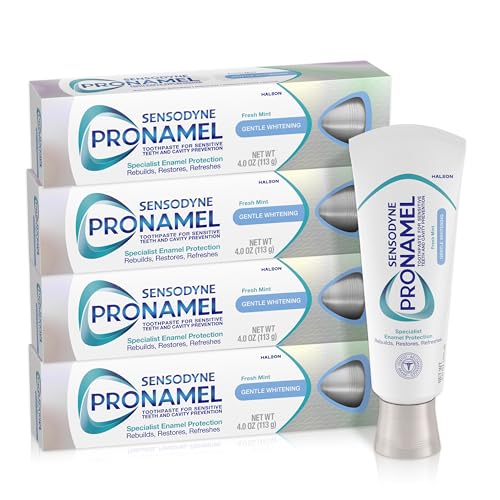
Sensodyne Pronamel Gentle Whitening
Best Overall, #1 on Best Toothpaste of 2026“Best read as Pronamel plus stain maintenance rather than a whitening-first pick; posters warn whitening formulas can run more abrasive.”
$10–$25 · from the roundup’s last price check
Forum talk is mixed
see the tally
21 mentions for, 17 against, coded by hand from the threads we read. Counts are noisy, a point or two either way, and they are not comparable between products.
Watch for
Whitening is surface-stain removal only, not a peroxide whitener.
(Affiliate link) Commission-earning; it never moves a product up the list.
Floss & interdental
Our general pick
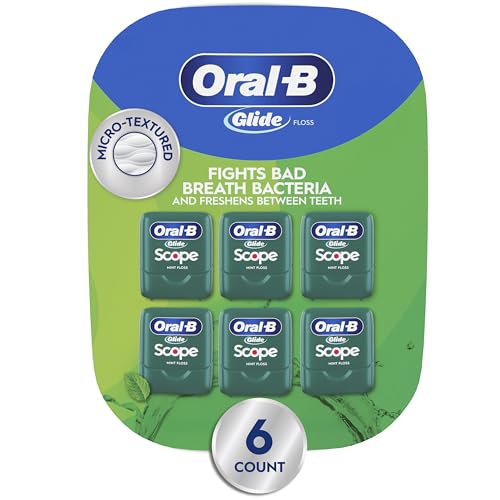
Oral-B Glide Scope Outlast Dental Floss (6-Pack)
Best Overall, #1 on Best Dental Floss of 2026No forum line for this one; the threads we read don’t name it.
$10–$25 · from the roundup’s last price check
No forum tally for this one.
Watch for
PTFE/PFAS history: in a 2019 study of 178 women, Glide users had higher blood levels of the PFAS chemical PFHxS; ingredient transparency is limited.
(Affiliate link) Commission-earning; it never moves a product up the list.
Mouthwash
Our general pick
TheraBreath Fresh Breath Mouthwash, Icy Mint (2×16 oz)
Best Overall, #1 on Best Mouthwash of 2026No summary line for this concern yet; the tally is the forum receipt.
$10–$25 · from the roundup’s last price check
Forum talk leans supportive
see the tally
53 mentions for, 15 against, coded by hand from the threads we read. Counts are noisy, a point or two either way, and they are not comparable between products.
Watch for
Targets bad breath specifically, offers no fluoride for cavity protection.
(Affiliate link) Commission-earning; it never moves a product up the list.
Two optional upgrades
The routine works without either.
A water flosser, if brushing between is a battle.
Our general pick
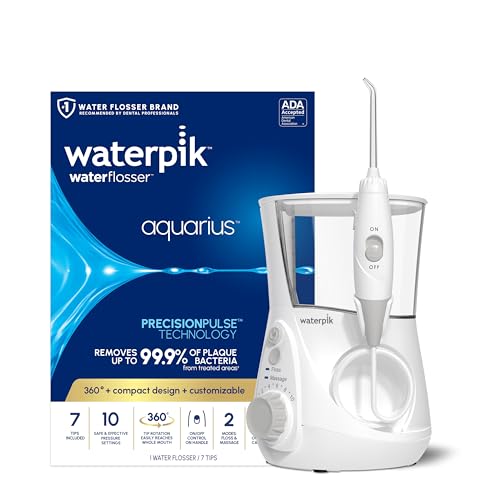
Waterpik Aquarius Water Flosser
Best Overall, #1 on Best Water Flossers of 2026No summary line for this concern yet; the tally is the forum receipt.
$75+ · from the roundup’s last price check
Forum talk leans supportive
see the tally
22 mentions for, 4 against, coded by hand from the threads we read. Counts are noisy, a point or two either way, and they are not comparable between products.
Watch for
Countertop design takes up bathroom counter space.
(Affiliate link) Commission-earning; it never moves a product up the list.
An electric brush, if you’re replacing yours anyway.
Our general pick
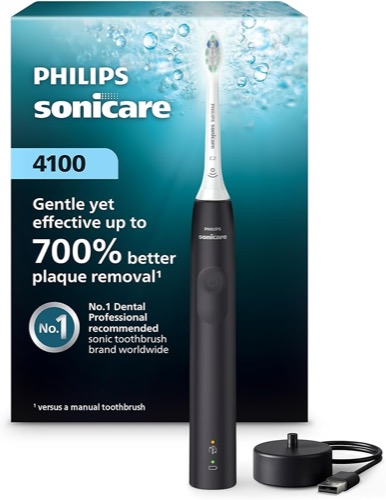
Philips Sonicare 4100 Rechargeable Electric Toothbrush
Editor's Pick, #1 on Best Electric Toothbrush of 2026“Two posters call the 4100 a solid budget pick covering the basics; one shopper notes the single head, and one owner found even low intensity too strong.”
$25–$75 · from the roundup’s last price check
Forum talk leans supportive
see the tally
7 mentions for, 2 against, coded by hand from the threads we read. Counts are noisy, a point or two either way, and they are not comparable between products.
Watch for
The one power button also cycles intensity, which several owners found awkward.
(Affiliate link) Commission-earning; it never moves a product up the list.
How a pick gets here
- 1We start from the roundup that already ranks this kind of thing, and its top pick is the default.
- 2If a roundup written for your concern places something in that step, that pick takes the slot instead.
- 3Forum talk is a receipt: it settles ties between products on the same tier and can hold a product back (ten or more coded mentions, at least two thirds against), but it never lifts one above a roundup's verdict.
- 4Prices: a same-day Amazon read with its as-of time when we have one under 24 hours old; otherwise the price band from the roundup's last check. Budget picks compare the roundups' own price receipts, not live prices.
Every pick starts from one of our roundups. For each step, and for each concern you tick, a named roundup decides which products qualify and in what order: its top pick comes first, then the products it gives a named role, then the rest of its list. Today that is38 roundups placing 163 products, of which 52 can appear as a pick across every combination of concerns and must-haves. The map of which roundup speaks for which concern was last reviewed on September 7, 2026; a roundup refresh that changes a top pick fails our build until the map is re-reviewed, so the shelf never changes by accident.
Two or more concerns: a product with a place on the roundups for all of them beats one that only appears on one; then the better tier wins. Where no roundup covers a step for your concerns, you get the general roundup's top pick, labelled as our all-round pick and not specific to the concern. Where our roundups do not yet name a pick, the card says so and links to the roundup instead of guessing.
Must-haves: "fluoride-free" and "no mint" narrow toothpaste and mouthwash using each product's own label, read from the maker's page or the listing and checked by a second reader (labels read for 95 of99 pastes and rinses as of September 7, 2026; a label we have not read never passes a must-have, and the card says how many products that removed). "Budget pick" keeps the same concerns covered and a top-two tier, prefers the roundup's own value pick, then takes the lowest price from that roundup's last check; it only swaps when the saving is at least a tenth, and the card names what it replaced.
Where the community fits: discussion from80 forum-research briefs (1,486 cited threads) appears on cards as a receipt, in coarse bands (supportive, mixed, thin, critical), and settles ties between products on the same tier. It never lifts a product over a roundup's verdict, with one exception: a product with at least ten coded mentions and at least two thirds of them against it is held back, and the card says why. 2 products are held back today. Cards sourced from our whitening-toothpaste roundup show no community line, because on that page the discussion contradicts the roundup and we would rather say nothing than blur it.
Amazon prices on the cards are same-day reads with their as-of time, shown only while that read is under 24 hours old; otherwise, and for products sold outside Amazon, you see a price band from the roundup's own last price check. The total after the everyday steps is summed only from same-day Amazon prices, rounded, excludes shipping, and is a one-time cost if you bought everything at once; we don't estimate monthly costs because we have no consumption data, and we won't invent it. Every number on a card comes from a file we publish from: the roundup itself, its price check, the label file, or the community dataset.
(Affiliate link) Commission-earning; it never moves a product up the list.
Amazon prices shown are same-day reads with their as-of time; otherwise you see a price band from the roundup's own last price check. It isn't medical advice; what your dentist told you comes first.
What Dentists on Reddit Actually Say
We read 19 Reddit threads on this exact question for this page, across r/askdentists, r/Dentistry, r/DentalHygiene, r/Teethcare and r/explainlikeimfive, including one very large thread, and the pattern is not what the bottle implies. Three findings matter for how you read the sections above.
“Spit, don’t rinse” is the one thing nearly everyone agrees on. It appears in 16 of the 19 threads, in every subreddit we sampled. A commenter flaired as a dental hygienist on r/askdentists, where only verified dental professionals may answer posts directly, puts it this way: “You should not be rinsing at all after. Toothpaste is formulated to allow swallowing that amount harmlessly after spitting. You want the residue to stay on your teeth, treating them for about a half hour after.” The same commenter, in an older thread, gives the timing answer this page settles on: “using a fluoride mouthwash at times you are not brushing, like maybe lunchtime or after a snack.”
“Before brushing” is the professionals’ answer for a rinse that has no fluoride in it. Six of the 19 threads carry that advice, and it is the most common position among the hygienists and dentists who think mouthwash is worth using at all. A commenter on r/DentalHygiene who describes herself as a hygienist states the rule with the condition attached: “If your mouthwash isn’t fluoridated but offers other benefits, then you might consider using it before you brush so you get some of those benefits while letting your fluoride toothpaste be the last thing on your teeth.” That is consistent with the fluoride studies above, and it has laboratory support of its own: a 2019 erosion study that ran fluoride rinse before brushing against rinse after brushing found that, for enamel, only the rinse-first order reduced erosive wear against a no-fluoride brushing control (Machado et al., 2019). It is also a cleaner answer than “wait 30 minutes” for anyone who only rinses at the sink. Asked why not, a flaired general dentist on r/askdentists answered: “Sure, no harm in it. Just really not doing much good.”
Nine of the 19 threads say skip it. They carry some version of “you don’t need mouthwash unless your dentist prescribed one,” from a DMD, a hygienist, and several of those professionals-only replies. That is not a fringe view, and it is why this page treats mouthwash as optional rather than as step three of a routine.
Two smaller findings are worth passing on. Six threads name a wait time between brushing and a rinse, and the numbers do not agree: 15, 20 and 30 minutes all appear, with 30 the most common. No one names a study for any of them. And the rule has a compliance problem the studies do not measure. Six threads include people who find toothpaste left in the mouth unpleasant enough to ignore the advice, including a flaired general dentist on r/Dentistry who admits it: “I can’t stand toothpaste still in my mouth before bed.” Two commenters who say they teach patients describe the workaround for exactly that: “rinse after brushing then put a little toothpaste on your brush and brush that in and then don’t rinse.” A pea-sized second pass is enough. And one r/Dentistry commenter who advises patients offers the risk-stratified version: “I usually will only go out of my way to specifically recommend not rinsing to those patients who get a lot of cavities.” If you have gone years rinsing with water and never had a filling, the evidence above is a reason to tighten the habit, not to worry about the past.
Nothing in those threads is a clinical source, and none of it overrides your own dentist’s instructions. Quotes are verbatim from the threads in our research file; the professional status of any commenter comes from their subreddit flair where one exists (“Dental Hygienist”, “General Dentist”) and otherwise from how they described themselves; on r/askdentists the subreddit’s own rule also restricts direct replies to verified dental professionals.
When to See a Dentist
Timing tweaks are for a healthy mouth. See a dentist rather than reaching for a stronger rinse if gums bleed most days when you brush, if breath odor persists after a few weeks of brushing, cleaning between the teeth and tongue cleaning (the NHS uses that few-weeks threshold), if a tooth is sensitive to cold in one spot, or if you are using a chlorhexidine rinse for longer than the course you were given. A prescription-strength fluoride rinse or varnish is a dentist’s call, and the NHS notes it can reverse early decay that an over-the-counter rinse cannot.
Evidence Receipt
- Spit, don’t rinse; no mouthwash straight after brushing; pick another time such as after lunch; nothing to eat or drink for 30 minutes after a fluoride mouthwash are all stated on the NHS “How to keep your teeth clean” page (page reviewed 30 June 2025).
- Mouthrinse is an addition, not a replacement; before-or-after “may depend on personal preference” with manufacturer-specific orders for some ingredients; not for children under 6 come from the ADA Oral Health Topics mouthrinse page.
- A non-fluoride mouthwash after fluoride toothpaste roughly halves salivary fluoride retention; a fluoride mouthwash does not: Duckworth et al., 2009, 23 adults, crossover design.
- Post-brushing rinses with 0 or 100 ppm fluoride wash out toothpaste fluoride; 226 ppm (0.05% NaF) is the recommended floor: Mystikos et al., 2011.
- A thorough water rinse after brushing did not significantly change three-year caries increment in schoolchildren: Machiulskiene et al., 2002, 407 children, 276 examined at three years.
- Supervised fluoride mouthrinse reduced caries increment by a pooled 27% in children and adolescents: Cochrane review, Marinho et al., 2016; 37 trials and 15,813 participants included, with the 27% pooled figure drawn from the 35 trials (15,305 participants) in that meta-analysis; moderate-quality evidence.
- Chlorhexidine and SLS toothpaste: the 30-minute-to-2-hour gap advice is from Kolahi and Soolari, 2006; the finding of no measurable interference when toothpaste is used as a paste, regardless of order, is from Elkerbout et al., 2015, graded moderate because three of four trials share a research group.
- A fluoride rinse before brushing reduced erosive enamel wear; rinse after brushing did not: Machado et al., 2019, in vitro 5-day erosive-abrasive cycling, enamel and dentin.
- Six US rinses ranged from pH 7.05 (Crest Pro-Health) to 3.43 (Listerine Total Care); some sit below the critical pH of enamel and dentin; dentin loss differed between products, enamel loss did not: Delgado et al., 2018, in vitro.
- In orthodontic patients, a 0.05% NaF rinse after lunch, at bedtime, or twice daily all remineralized more than toothpaste alone; twice daily did best: Songsiripradubboon et al., 2014, 12 volunteers, in situ crossover, 21-day phases.
- Label directions (ACT: once a day after brushing, 10 mL, 1 minute, no food or drink for 30 minutes; Listerine Cool Mint: 20 mL, 30 seconds, morning and night, not a replacement for brushing or flossing; Listerine Total Care Mild alcohol-free: sodium fluoride 0.02%, twice a day after brushing, 10 mL for 1 minute, ages 12+) are quoted from the FDA Drug Facts on DailyMed: ACT Anticavity, Listerine Cool Mint and Listerine Total Care Mild.
- Ratings, review counts and prices on the three product cards were read live on the day of publication from the linked Amazon listings (US delivery location confirmed) and the Amazon Creators API; the TheraBreath review count is held at the figure our other pages carry for the same listing (67 below that day’s read) so the number matches site-wide.
FAQ
Q: Should I use mouthwash before or after brushing? A: Either, as long as it is not a non-fluoride rinse straight after brushing. Brushing leaves fluoride on your teeth; rinsing it off with water or a fluoride-free mouthwash wastes it. A fluoride rinse can follow brushing, a non-fluoride rinse can go before it, and any rinse can go at a separate time of day. If in doubt, brush and spit, then use the mouthwash after lunch.
Q: Can I use mouthwash right after brushing my teeth? A: If it contains fluoride, yes; the label on a 0.05% sodium fluoride rinse actually says to use it after brushing. If it does not contain fluoride, move it to another time of day so it does not rinse the toothpaste layer away.
Q: How long should I wait after brushing to use mouthwash? A: There is no proven minute count for everyday rinses. Reddit commenters name 15, 20 and 30 minutes, with 30 the most common, and none of them names a study behind the number. The NHS suggests a different occasion altogether, such as after lunch, and rinsing before you brush avoids the question entirely. The one rinse with a studied gap is prescription chlorhexidine, where older advice was 30 minutes to two hours after brushing with an SLS toothpaste; follow whatever your dentist told you.
Q: Should I rinse with water after using mouthwash? A: No. The labels do not ask for it, and a water rinse after a fluoride mouthwash removes the fluoride you just applied. Spit, and if it was a fluoride rinse, leave food and drink for 30 minutes.
Q: Is mouthwash necessary if I brush and floss? A: No. The ADA describes mouthrinse as a helpful addition for some people, not a requirement, Listerine’s own label says it is not intended to replace brushing or flossing, and nine of the 19 Reddit threads we read carry some version of “skip it unless a dentist prescribed one.” It earns a place when there is a job for it: extra fluoride for people who get cavities, an antiseptic during a gum-health push, or a breath rinse at midday.
Q: Mouthwash before or after brushing with Invisalign or braces? A: Before. Rinse, floss, then brush last so the toothpaste is what goes back under the trays. For the meal you cannot brush after, a fluoride rinse or even water before the trays go back in beats nothing, and a timing study in orthodontic patients found a 0.05% fluoride rinse after lunch or at bedtime helped, with twice a day best. Prefer a near-neutral rinse; an acidic one trapped under a tray is the wrong combination.
Q: How often should you use mouthwash? A: Follow the bottle: once a day for a 0.05% fluoride rinse, twice a day for an essential-oil antiseptic. More often is not better, and children under 6 should not use mouthwash unless a dentist directs it.