
Fluoride mouthwash works differently from antiseptic rinses like Listerine Classic: instead of primarily targeting bacteria, fluoride rinses deposit fluoride ions directly onto tooth surfaces, where they’re incorporated into enamel to make it more resistant to acid attack and cavities. The American Dental Association points to a Cochrane systematic review that found regular use of fluoride mouthrinse reduced tooth decay in children, regardless of exposure to other sources of fluoride, and it says children younger than 6 should not use mouthrinse unless a dentist directs it. We compared five of the best options on fluoride concentration, additional benefits, alcohol content, and value. For broader cavity prevention, also see our best fluoride toothpaste and best mouthwash for cavities guides.
How We Evaluated Fluoride Mouthwashes
Fluoride concentration and type. The ADA describes over-the-counter solutions of 0.05% sodium fluoride (230 ppm fluoride) for daily rinsing, available to people older than 6. Not every rinse sold for cavity prevention sits at that level. The Drug Facts panels on these listings put ACT Anticavity and ACT Restoring at 0.05% sodium fluoride, while CloSYS Silver and Listerine Total Care Mild Mint are both 0.02%. Where a listing publishes no percentage, we say so in that product’s section rather than assume one.
ADA Seal of Acceptance. The ADA Seal means a product’s efficacy claims have been reviewed by an independent scientific panel. We read the ADA’s full Seal roster on 5 September 2026. Two rinses in this lineup are on it for cavity prevention: ClōSYS Healthy Teeth Mouth Rinse and Listerine Total Care Mild Alcohol Free Anticavity Fluoride Mouthwash. The three ACT rinses and the TheraBreath rinse do not appear on that roster.
Additional benefits. Some fluoride rinses are single-purpose (cavity prevention only); others add antibacterial action, enamel remineralization beyond basic fluoride deposition, whitening, or breath freshening. We noted which additional benefits have meaningful formulation support vs. which are primarily marketing.
Alcohol content. Alcohol-based mouthwashes can dry oral tissues and cause discomfort, particularly for people with dry mouth or sensitive gums. Most fluoride rinses are alcohol-free; we noted the exceptions.
Flavor and usability. A mouthwash you avoid using isn’t protecting your teeth. We considered mint intensity, aftertaste, burn on contact, and whether the formula is appropriate for people with oral sensitivities.
Evidence Receipt
- Two of these five rinses are on the ADA Seal roster for cavity prevention. A read of the ADA’s Seal product roster on 5 September 2026 lists ClōSYS Healthy Teeth Mouth Rinse (Rowpar Pharmaceuticals) and Listerine Total Care Mild Alcohol Free Anticavity Fluoride Mouthwash (Kenvue). Each Seal statement says the product “is safe and has shown efficacy in helping to prevent tooth decay, when used as directed.” The ACT and TheraBreath rinses in this lineup were not on the roster on that date.
- The daily over-the-counter strength is 0.05% sodium fluoride. The ADA states that “Over-the-counter solutions of 0.05% sodium fluoride (230 ppm fluoride) for daily rinsing are available for use by persons older than 6 years of age.”
- Anything stronger is prescription-only and weekly. The same ADA page says higher-strength mouthrinses, “e.g., 0.2% neutral sodium fluoride to be used once a week,” for people at high risk of tooth decay “must be prescribed by a dentist or physician,” and that 0.2% solutions (920 ppm fluoride) are also used in supervised, school-based weekly rinsing programs.
- Label concentrations differ inside this lineup. ACT Anticavity and ACT Restoring are both sodium fluoride 0.05% (0.02% w/v fluoride ion); CloSYS Silver and Listerine Total Care Mild Mint are both sodium fluoride 0.02% (0.01% w/v fluoride ion). The TheraBreath listing names sodium fluoride as the active ingredient without publishing a percentage; the product’s DailyMed label, cited on our TheraBreath lineup page, lists sodium fluoride 0.05%.
- Rinse times come from the labels, and the labels disagree. ACT Restoring directs 10 mL for 30 seconds; the ACT Anticavity label directs 10 mL for one minute, once a day; CloSYS directs 10 mL for one minute, twice daily; Listerine Total Care directs 10 mL for one minute, twice a day.
- The children’s evidence and the under-6 caution both come from the ADA. Its mouthrinse topic page says “A Cochrane systematic review found that regular use of fluoride mouthrinse reduced tooth decay in children, regardless of exposure to other sources of fluoride,” and that children younger than 6 should not use mouthrinse unless directed by a dentist, because they may swallow it.
ACT Anticavity Fluoride Mouthwash (18 fl oz, 2-Pack, Mint): Editor’s Pick
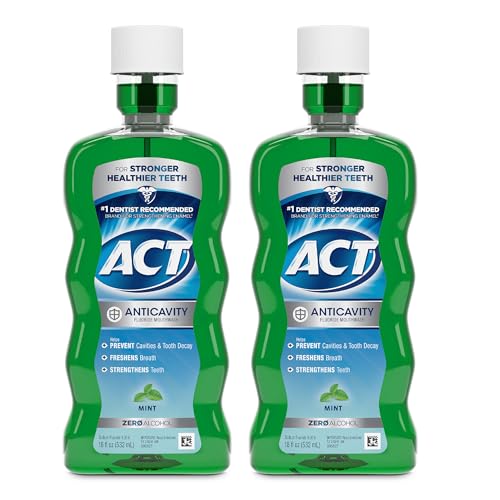
ACT Anticavity Fluoride Mouthwash (18 fl oz, 2-Pack, Mint)
Best for: Most people who want a trusted, alcohol-free fluoride rinse for daily cavity prevention
- 0.05% sodium fluoride formula, the standard-bearer for OTC daily fluoride rinses
- Zero alcohol, printed on the front panel, so no burn and no dry-mouth worry with daily use
- Includes an accurate dosing cup to ensure the correct 10 mL use volume every time
- Two 18 fl oz bottles (36 fl oz total), roughly 4 months of daily use
- +The default OTC fluoride rinse for most people, and the least expensive per bottle in this lineup at about $4 each in the 2-pack
- +Zero-alcohol formula that doesn't burn on contact or dry out oral tissues with daily use
- +Includes a dosing cup to ensure the correct 10 mL use volume every time
- −Sold as a 2-pack; the 18 fl oz single bottle has no Amazon-stocked offer as of this writing, only a third-party reseller at more than double the per-bottle price
- −Single-purpose cavity prevention only; no added breath, enamel-restoring, or antibacterial benefits
(Affiliate link) · Free shipping on eligible Prime items
ACT Anticavity is the default OTC fluoride rinse for most people, and per bottle it is the least expensive rinse in this lineup. Its Drug Facts panel reads sodium fluoride 0.05% (0.02% w/v fluoride ion), the concentration the ADA describes for daily over-the-counter rinsing, and the front panel reads zero alcohol (DailyMed label). It comes with a dosing cup for the 10 mL dose the label directs, once a day for one minute.
For most people, the case for ACT Anticavity is simple: it does the one thing fluoride rinses are supposed to do (deposit fluoride on tooth surfaces to prevent cavities), and the 2-pack runs about $8 for two 18 fl oz bottles. There’s no reason to pay more for a daily fluoride rinse unless you have a specific additional need, which the other four options below address. Use it after brushing, following the swish time on the label.
We link the 2-pack rather than the single bottle on purpose. When we checked on 6 September 2026, the single 18 fl oz bottle’s Amazon listing showed no featured offer, only a third-party seller at about $10 with a two-to-five-week delivery window, so the 2-pack is currently the way to buy this rinse at a normal price.
Potential downside: Two bottles is a commitment of about 4 months of daily use, and some people find ACT’s mint too mild. If you have never used it, the per-bottle cost is low enough that trying the 2-pack is not much of a gamble, but it is a 36 fl oz gamble.
CloSYS Silver Anti-Cavity Fluoride Oral Rinse (32 fl oz) — Best for Sensitive Mouths
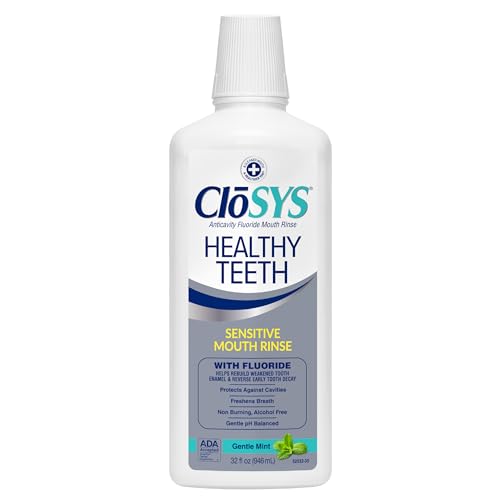
CloSYS Silver Anti-Cavity Fluoride Oral Rinse (32 fl oz)
Best for: People with sensitive oral tissues or dry mouth who need a fluoride rinse that is gentle, non-burning, and alcohol-free
- pH-balanced, alcohol-free, sulfate- and triclosan-free; the label says it works without the burn and is aimed at sensitive mouths
- On the ADA Seal roster for cavity prevention, as ClōSYS Healthy Teeth Mouth Rinse
- We recommend it for dry-mouth and older-adult users based on its non-burning formula, though the label doesn't specifically call out either group
- +pH-balanced, alcohol-free, sulfate- and triclosan-free; the label says it works without the burn and is aimed at sensitive mouths
- +Carries the ADA Seal for cavity prevention, one of two rinses here that does
- +We recommend it for dry-mouth and sensitive-tissue users based on its gentle, non-burning formula; the label itself doesn't call out either group specifically
- −Sodium fluoride 0.02%, under half the 0.05% the ACT rinses use
- −Milder antibacterial effect than Listerine-class products — prioritizes comfort over germ-killing potency
(Affiliate link) · Free shipping on eligible Prime items
CloSYS Silver is designed for people for whom every other mouthwash causes irritation: those with dry mouth, sensitive gum tissue, or oral mucosa that reacts badly to standard mouthwash ingredients. The formula is pH-balanced (closer to neutral), alcohol-free, and formulated without the sharp mint compounds that give many mouthwashes their characteristic burn. If you’ve ever rinsed with a fluoride mouthwash and felt stinging or dryness, CloSYS Silver is the product designed for you.
Two things are worth being precise about on the fluoride. First, its Drug Facts panel lists sodium fluoride 0.02% (0.01% w/v fluoride ion), which is under half the 0.05% the ACT rinses use, so this is not the strength pick. Second, the product the ADA lists is this one (identity confirmed through the ADA record’s own Buy Here link), appearing on the Seal roster as ClōSYS Healthy Teeth Mouth Rinse, with a Seal statement saying the product “is safe and has shown efficacy in helping to prevent tooth decay, when used as directed.” Lower concentration, independently listed as this exact product: both facts are true at once. At about $14 for 32 fl oz, cost per use is comparable to the other specialist rinses here. If you don’t have oral sensitivity issues, ACT gives you more fluoride for less money.
Potential downside: The very gentle formula means a milder antibacterial effect compared to Listerine-class products. For people who also want strong germ-killing action, CloSYS Silver prioritizes comfort over antibacterial potency.
Listerine Total Care Mild Mint: Best All-in-One
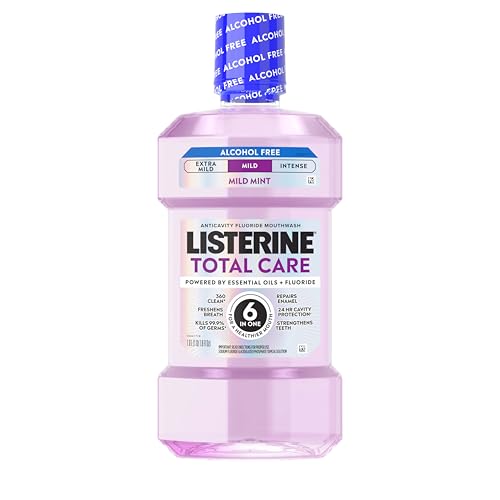
Listerine Total Care Alcohol Free Mouthwash, Mild Mint (1 Liter)
Best for: People who want one alcohol-free rinse covering cavity prevention alongside everyday cleaning and breath
- On the ADA Seal roster for cavity prevention, listed under Kenvue's name
- Alcohol-free Total Care formula in a 1-liter bottle
- Label directs 10 mL twice a day for one minute, about 50 days per bottle
- +On the ADA Seal roster for cavity prevention, under Kenvue's name
- +Alcohol-free, so it skips the burn of the classic Listerine formulas
- +A 1-liter bottle at around $9 costs less per ounce than the CloSYS or TheraBreath rinses here
- −The six-benefit list on the label is the manufacturer's own claim; the ADA Seal covers cavity prevention only
- −Inactive ingredients include sodium lauryl sulfate and added colors, which some people avoid
(Affiliate link) · Free shipping on eligible Prime items
This is the alcohol-free Mild Mint version of Listerine’s Total Care line, and it holds the all-in-one slot for one specific reason: it is on the ADA’s Seal roster for cavity prevention. The Seal record is held by Kenvue and states that the product “is safe and has shown efficacy in helping to prevent tooth decay, when used as directed.” Of the six rinses here, only this one and CloSYS Silver were on that roster when we read it on 5 September 2026.
Separate the label’s marketing from what the Seal covers. Listerine’s own listing describes six benefits in one bottle and says the rinse kills 99.9% of bad breath germs. Those are the manufacturer’s claims. The ADA’s review is narrower and is the part worth buying on: cavity prevention. The Drug Facts panel directs 10 mL twice a day for one minute, so a 1-liter bottle works out to roughly 50 days of use, which is about the same run time as the 18 fl oz ACT bottle at its once-daily dose. At around $9 that still lands below CloSYS and TheraBreath on cost per ounce, and it is the multi-benefit rinse in this lineup that carries an independent cavity-prevention review.
Potential downside: If you want fluoride and nothing else, the ACT rinses are cheaper and use a higher fluoride concentration (0.05% against this bottle’s 0.02%). This bottle’s inactive ingredients also include sodium lauryl sulfate and added colors (Red 40 and Blue 1), which people who react to SLS or avoid dyes will want to know about before switching.
TheraBreath Anticavity Fluoride Oral Rinse (16 fl oz, 2-Pack) — Best for Breath
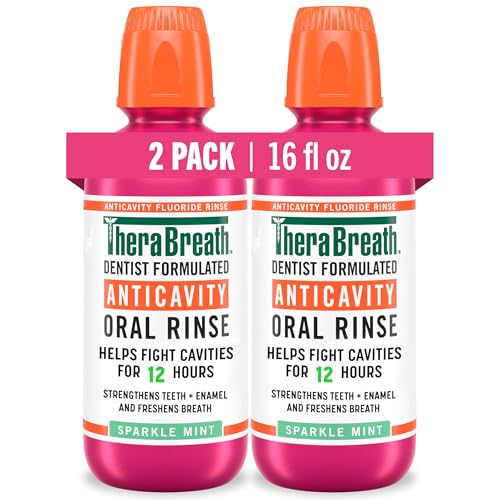
TheraBreath Anticavity Fluoride Oral Rinse (16 fl oz, 2-Pack)
Best for: People who want cavity protection and long-lasting fresh breath with no SLS, alcohol, or artificial flavors
- Dentist-formulated with fluoride for cavities and, per the brand, oxygenating agents for 24-hour fresh breath control
- SLS-free, alcohol-free, artificial flavor-free — formulated to minimize oral tissue irritation
- What TheraBreath calls its OXYD-8 technology targets volatile sulfur compounds, the bacterial byproducts responsible for bad breath
- +Dentist-formulated to combine fluoride cavity protection with the brand's oxygenating agents, which it says deliver 24-hour fresh breath
- +SLS-free, alcohol-free, and artificial-flavor-free — one of the gentlest formulas, appropriate for daily use even with oral sensitivity
- +What TheraBreath calls its OXYD-8 technology targets volatile sulfur compounds, the bacterial byproducts responsible for bad breath
- −Costs more than ACT (about $18 for two bottles against about $8 for the ACT 2-pack)
(Affiliate link) · Free shipping on eligible Prime items
TheraBreath built its reputation as a breath-focused brand, and the Anticavity Fluoride Rinse is what you get when that breath-focused formulation is combined with fluoride. Where ACT and Listerine’s fluoride products prioritize cavity prevention and treat breath freshness as secondary, TheraBreath’s formula reverses that priority: what the brand calls its OXYD-8 oxygenating agents, which it says target volatile sulfur compounds (the bacterial byproducts responsible for bad breath), are the centerpiece, with fluoride protection added to the formulation. Its Amazon listing publishes no percentage; the product’s DailyMed label, cited on our TheraBreath lineup page, lists sodium fluoride 0.05%.
For people who use mouthwash primarily for breath control and want to add fluoride protection without switching to a different product, TheraBreath is the clean solution. The SLS-free, alcohol-free, artificial-flavor-free formulation is one of the gentlest available and appropriate for daily use even with oral sensitivity. At about $18 for two 16 fl oz bottles, the cost is higher than ACT, but you’re paying for the dual-purpose formulation and a notably clean ingredient profile.
Potential downside: Pure cavity prevention users will find ACT Anticavity a better value. TheraBreath’s premium is for the breath-control benefit; if that’s not a priority, there’s no reason to pay more than the ACT 2-pack above. And if you’re already a TheraBreath user deciding between its bottles, our TheraBreath lineup comparison shows where the Anticavity formula fits among all six.
ACT Restoring Zero Alcohol Fluoride Mouthwash (33.8 fl oz, Mint Burst) — Best for Enamel
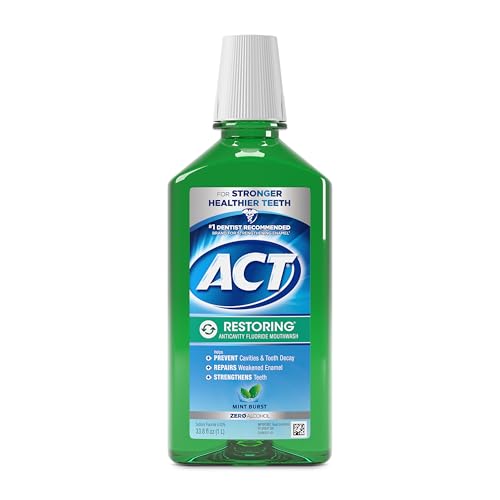
ACT Restoring Zero Alcohol Fluoride Mouthwash (33.8 fl oz, Mint Burst)
Best for: People with early enamel erosion or acid exposure who want a fluoride rinse focused on enamel remineralization
- Specifically formulated to strengthen and restore weakened enamel — goes beyond cavity prevention
- Larger 33.8 fl oz size provides about 100 uses at the standard 10 mL dosage
- Alcohol-free with a mild mint flavor — appropriate for daily use without oral tissue drying
- +The listing positions this as reformulated for enamel remineralization, going beyond basic cavity prevention
- +Large 33.8 fl oz bottle provides about 100 uses: one of the better per-ounce values in the category
- +Alcohol-free with a mild mint flavor, suitable for daily use without drying oral tissues
- −Cannot reverse significant enamel loss — it strengthens remaining enamel and slows erosion but cannot regenerate enamel that's already gone
- −For people without specific enamel concerns, the difference from the standard Anticavity formula is modest
(Affiliate link) · Free shipping on eligible Prime items
The ACT Restoring formula takes the same 0.05% sodium fluoride foundation as the Anticavity (its Drug Facts panel reads sodium fluoride 0.05%, 0.02% w/v fluoride ion) but is marketed around a specific claim: enamel remineralization rather than just cavity prevention. The distinction matters if you have early-stage enamel erosion from acid exposure (carbonated drinks, citrus, acid reflux) or if your dentist has mentioned thinning enamel. The listing positions it for enamel strengthening; its Drug Facts panel shows the same 0.05% sodium fluoride as the Anticavity and no added minerals, so treat the enamel-rebuilding claim as the manufacturer’s.
For people without specific enamel concerns, the difference between the Anticavity and Restoring formulas is modest: both deposit fluoride and both prevent cavities. But for the subgroup that experiences acid erosion, the Restoring formula is the more appropriate choice. The 33.8 oz bottle is significantly larger than most competitors (equivalent to nearly two 18 oz bottles), making it one of the better values per ounce in the category at around $6.50. Note that its label directs a 30-second swish, not the one minute the other rinses here call for.
Potential downside: “Restoring” doesn’t mean clinically reversing significant enamel loss: that damage is largely permanent. This product can strengthen remaining enamel and help slow erosion; it cannot regenerate enamel that’s already gone. For significant enamel erosion, discuss fluoride varnish or prescription fluoride rinses with your dentist.
Buyer’s Guide: Getting the Most from Fluoride Mouthwash
When to Use Fluoride Rinse (and When Not To)
Fluoride rinse is most effective when used after brushing, not before. Brushing first removes plaque and food debris; rinsing afterward deposits fluoride on clean enamel where it can be incorporated most efficiently. Wait at least 30 minutes after rinsing before eating or drinking to allow fluoride absorption.
Children under 6 should not use fluoride rinse at all unless a dentist directs it, because they may swallow it. The ADA cautions that children younger than 6 should not use mouthrinse of any kind unless a dentist directs it, due to the risk of swallowing. For children old enough to rinse and spit, our kids’ mouthwash guide covers the age rules, fluoride strengths, and label-checked picks in depth. If cavity prevention isn’t your main goal, our full mouthwash guide covers the other rinse categories, from antibacterial to whitening.
Who Benefits Most from Fluoride Mouthwash
Fluoride rinse is particularly beneficial for: people with a history of cavities, people undergoing orthodontic treatment (braces create areas that are harder to clean), people with dry mouth (saliva naturally contains fluoride and buffers acids, dry mouth patients lose this protection), people with exposed root surfaces, and people with high sugar or acid intake in their diet. Readers for whom dry mouth is a bigger issue than cavity risk may get more day-to-day relief from something built to keep saliva flowing between rinses, which is what our best lozenges for dry mouth roundup covers.
If you have no cavity history and good oral hygiene, fluoride toothpaste alone may be sufficient. Fluoride rinse adds an additional daily fluoride exposure that’s meaningful for elevated-risk individuals.
How Much Fluoride Do You Already Get?
A daily rinse at 0.05% sodium fluoride (230 ppm fluoride, the concentration the ADA describes for over-the-counter daily use) adds to the fluoride you already get from fluoride toothpaste (typically 1,000–1,500 ppm) and, in most of the US, from fluoridated municipal water. The total fluoride exposure from toothpaste + rinse + water is well within safe and effective ranges. Following each product’s label directions is what keeps total fluoride intake within that range.
Prescription vs. OTC Fluoride Rinses
The ADA describes higher-strength mouthrinses, such as 0.2% neutral sodium fluoride used once a week, as products that “must be prescribed by a dentist or physician” for people at high risk of tooth decay. It notes that 0.2% solutions (920 ppm fluoride) are also used in supervised, school-based weekly rinsing programs. If you have active cavities, significant enamel erosion, or post-radiation dry mouth, that is a conversation to have with your dentist. For everyone else, the daily 0.05% rinse is what’s available without a prescription.
FAQ
Can fluoride mouthwash replace fluoride toothpaste? No, they work together, not interchangeably. Toothpaste provides a higher fluoride concentration and the mechanical action of brushing; mouthwash provides a lower-concentration fluoride rinse that covers more of the mouth and reaches areas that brushing misses. Both contribute to daily fluoride protection.
How long should I rinse with fluoride mouthwash? Follow the bottle, because the labels in this lineup do not agree. ACT Restoring directs a 30-second swish; ACT Anticavity, CloSYS Silver, and Listerine Total Care each direct one minute. Whatever your bottle says, swish vigorously so the rinse reaches between teeth and along the gum line, then spit completely. Don’t swallow.
Should I use fluoride mouthwash if I live in a fluoridated water area? Yes, for elevated-risk individuals. Fluoridated water provides systemic fluoride exposure during tooth development in children, but topical fluoride from rinses and toothpaste provides direct enamel protection regardless of water fluoride levels. The two mechanisms are complementary.
Can I use fluoride mouthwash if I have a sensitivity to fluoride? Fluoride sensitivity is rare but possible. If you experience irritation or reactions from fluoride products, discuss alternatives with your dentist. Hydroxyapatite-based toothpastes are an emerging fluoride-free remineralization option; see our best hydroxyapatite toothpaste guide for more.
Why is alcohol-free fluoride rinse preferred? Alcohol-based rinses can temporarily dry oral tissues and cause discomfort, particularly with daily use. For fluoride-specific rinses, there’s no functional need for alcohol: the cavity prevention mechanism is the fluoride, not the alcohol. Alcohol-free formulas provide equivalent protection without the drying and irritation side effects.