

Braces do a remarkable job straightening teeth; but they also create dozens of tiny hiding spots where plaque, food debris, and bacteria love to accumulate. That’s why adding the right mouthwash to your daily routine matters more during orthodontic treatment than at almost any other time in your dental life. For a complete orthodontic oral care setup, also see our picks for the best toothpaste for braces and the best electric toothbrush for braces.
The best mouthwash for braces isn’t just about fresh breath. It should deliver fluoride to protect enamel around brackets, fight bacteria that cause gum inflammation, and (crucially) skip the alcohol that can irritate already-sensitive gum tissue. According to the ADA, fluoride rinses may help with cavity prevention by remineralizing weakened enamel, which is especially valuable when brackets make thorough brushing a challenge. NHS guidance on braces stresses keeping teeth and braces clean: brush with fluoride toothpaste in the morning, at night and after meals, use an interdental brush every day, and get advice if your gums become very red, swollen or painful.
We’ve reviewed the research, read an orthodontic practice’s mouthwash recommendations, and evaluated the most-recommended products to bring you this guide.
How We Evaluated
Before diving into our picks, here’s how we approached this roundup:
- Fluoride content: We prioritized rinses containing sodium fluoride or stannous fluoride, which according to the ADA may help with enamel remineralization and cavity prevention.
- Alcohol-free formulas: Just for Grins Orthodontics says it’s best to avoid alcohol mouthwash, calling alcohol “rather harsh on the skin and gums,” and the ADA notes that alcohol can be drying, so we prioritized alcohol-free formulas for braces wearers.
- Antibacterial activity: Products with an antimicrobial that the American Dental Association’s mouthrinse overview says has been shown to help reduce plaque and gingivitis, such as cetylpyridinium chloride (CPC), received higher marks.
- Ease of use and flavor: A mouthwash you’ll actually use is the best mouthwash. We considered flavor profiles, burn level, and kid-friendliness where applicable.
- Orthodontist endorsement: We gave additional weight to products named by the orthodontic practice (Just for Grins Orthodontics) and the publication (NBC Select) in our research.
We do not accept payment for product placement. Some links in this article are affiliate links, meaning we may earn a commission at no extra cost to you.
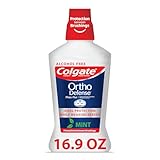
Colgate Phos-Flur Ortho Defense Oral Rinse
Colgate Phos-Flur Ortho Defense Oral Rinse
Best for: Anyone in active orthodontic treatment, especially patients with early white spot lesions forming around brackets
- 0.04% sodium fluoride (0.02% fluoride ion), acidulated phosphate formula
- Alcohol-free formula
- Mint flavor, for adults and children 6 and older
- ADA Seal of Acceptance
- +0.04% sodium fluoride (0.02% fluoride ion) in an acidulated phosphate formula to help remineralize enamel around brackets
- +Alcohol-free mint rinse labeled for adults and children 6 and older
- +Carries the ADA Seal of Acceptance and is NBC Select's pick for braces
- −Fluoride concentration is lower than prescription-strength rinses
- −Once-a-day product: the Drug Facts label says rinse for one minute after brushing, then nothing to eat or drink for 30 minutes
(Affiliate link) · Free shipping on eligible Prime items
Why We Recommend It
Colgate sells Phos-Flur as a fluoride mouthwash for braces. It is NBC Select’s pick for braces, and Just for Grins Orthodontics puts Colgate’s Ortho Defense rinse first on its list of braces mouthwashes, calling it “specially formulated for people undergoing orthodontic treatment.” Its formula is a sodium fluoride acidulated phosphate solution, which Colgate says offers ideal protection while wearing braces, aimed at the enamel around brackets that is hard to brush.
Key Features
- 0.04% sodium fluoride (0.02% fluoride ion) in an acidulated phosphate formula, per the Drug Facts label
- Alcohol-free formula
- Mint flavor, for adults and children 6 and older
- Labeled for once-daily use, per the listing
- ADA Seal of Acceptance for helping to prevent tooth decay
Best For
Anyone in active orthodontic treatment who wants a purpose-built rinse. It’s particularly well-suited for patients who have already noticed early white spot lesions forming around brackets, as fluoride rinses may help with remineralization of those areas, according to the ADA.
Potential Downsides
The fluoride concentration is on the lower end compared to prescription-strength rinses. Patients with very high cavity risk may want to ask their orthodontist about a higher-fluoride prescription option. It is also a once-a-day product by label: the Drug Facts directions say to swish 10 mL for one minute after brushing, spit, and then not eat or drink for 30 minutes, so it fits the end of the evening routine rather than a quick swish after lunch. The single 16.9 oz bottle runs about $12, roughly three times the price of an everyday drugstore rinse like ACT; if you expect to be in treatment for a year or more, Colgate also sells a four-pack of 16 oz bottles at around $47, which works out cheaper per bottle. (Affiliate link)
(Affiliate link) · Free shipping on eligible Prime items
ACT Anticavity Fluoride Mouthwash
ACT Anticavity Fluoride Mouthwash (Cinnamon, 18 fl oz)
Best for: Budget-conscious patients, teenagers, and families looking for a reliable everyday rinse without a specialty price tag
- 0.05% sodium fluoride (over-the-counter maximum strength)
- Alcohol-free formula
- Cinnamon flavor on this bottle; ACT also makes mint and kids' versions
- 0.05% sodium fluoride, alcohol-free
- +0.05% sodium fluoride, the over-the-counter maximum strength, for reliable cavity protection
- +Alcohol-free cinnamon rinse; ACT also sells mint and kids' versions
- +Accessible price point, around $4, and widely available at drugstores
- −Its only labeled active is fluoride, with no plaque or gingivitis claim, so it may not be enough for significant gum inflammation
(Affiliate link) · Free shipping on eligible Prime items
Why We Recommend It
ACT has been a trusted name in fluoride rinses for decades, and it earns its spot on this list for braces wearers by delivering straightforward, effective fluoride protection at an accessible price point: around $4. Just for Grins Orthodontics calls ACT Anticavity “another highly-effective mouthwash for patients with braces” and says it “supports the teeth in re-mineralizing the softer spots on the teeth that are more susceptible to damage.”
Key Features
- 0.05% sodium fluoride (over-the-counter maximum strength)
- Alcohol-free formula
- Cinnamon flavor on this bottle; ACT also makes mint and kids’ versions
- 0.05% sodium fluoride, alcohol-free
- Over-the-counter, no prescription required
Best For
Budget-conscious patients, teenagers, and families looking for a reliable everyday rinse without a specialty price tag. ACT’s kids’ line makes it a natural fit for younger orthodontic patients.
Potential Downsides
ACT’s anticavity formula lists fluoride as its only active, with cetylpyridinium chloride only among the inactive ingredients and no plaque or gingivitis claim, so patients dealing with significant gum inflammation or gingivitis may want to consider a formula with added antibacterial properties.
(Affiliate link) · Free shipping on eligible Prime items
Crest Pro-Health Complete Clean Mouthwash
Crest Pro-Health Complete Clean Mouthwash
Best for: Braces wearers prone to gum inflammation who want an alcohol-free CPC rinse labeled antigingivitis and antiplaque
- Cetylpyridinium chloride (CPC) as active antibacterial agent
- Alcohol-free
- Targets plaque, gingivitis, and bad breath simultaneously
- Alcohol-free cetylpyridinium chloride (CPC) formula
- +Cetylpyridinium chloride (CPC) targets plaque, gingivitis, and bad breath in a single rinse
- +Alcohol-free and doesn't require a prescription, priced around $5
- +CPC is one of the antimicrobial rinse ingredients covered in the ADA's mouthrinse overview
- −CPC rinses can stain teeth with regular use, per the ADA
- −Contains no fluoride, so higher cavity-risk users should pair it with a fluoride rinse or toothpaste
(Affiliate link) · Free shipping on eligible Prime items
Why We Recommend It
Crest Pro-Health delivers a well-rounded formula that tackles multiple concerns at once—a valuable trait when braces are involved. Its active ingredient, cetylpyridinium chloride (CPC), is an antibacterial agent that may help with reducing the bacteria that cause gingivitis and bad breath, according to the ADA. It’s alcohol-free, doesn’t require a prescription, and at around $5, it’s easy to incorporate into a daily routine without straining the budget.
Key Features
- Cetylpyridinium chloride (CPC) as active antibacterial agent
- Alcohol-free
- Targets plaque, gingivitis, and bad breath simultaneously
- Clean Mint flavor
- Alcohol-free cetylpyridinium chloride (CPC) formula
Best For
Braces wearers who are prone to gum inflammation and want an alcohol-free rinse whose label targets plaque and gingivitis. It has no fluoride, so cavity protection still comes from your toothpaste or a separate fluoride rinse.
Potential Downsides
CPC rinses can stain teeth with regular use: the ADA lists brown staining of teeth, tongue and restorations as a possible side effect, so mention any staining at your next cleaning. It also does not contain fluoride, so patients with higher cavity risk should pair it with a fluoride rinse or use a fluoride toothpaste consistently.
(Affiliate link) · Free shipping on eligible Prime items
Listerine Smart Rinse Kids Anticavity
Listerine Smart Rinse Kids Anticavity
Best for: Children and younger teenagers in orthodontic treatment still developing brushing and rinsing habits
- 0.02% sodium fluoride
- Tints rinsed-out food particles and debris so kids can see them
- Alcohol-free, Mint Shield flavor
- ADA Accepted for cavity prevention
- +0.02% sodium fluoride with acidulated phosphate in a kids' anticavity rinse, ADA Accepted to help prevent cavities
- +Tints the food particles and debris it rinses out, so kids can see the result in the sink
- +Alcohol-free, in the Mint Shield flavor on this six-pack
- −Fluoride concentration is lower than adult formulas like ACT or Phos-Flur
- −The linked listing is a six-pack at around $26, a bigger upfront cost than a single bottle of adult ACT
(Affiliate link) · Free shipping on eligible Prime items
Why We Recommend It
Children and tweens with braces present a unique challenge: they need strong protection, but they also need a rinse that isn’t so intense that they refuse to use it. Listerine Smart Rinse Kids threads that needle nicely. It contains sodium fluoride for cavity protection, and Listerine says it cleans by removing and tinting food particles and debris so a child can see the evidence in the sink: useful feedback for young patients still mastering oral hygiene around hardware.
Key Features
- 0.02% sodium fluoride
- Tints rinsed-out food particles and debris so kids can see them
- Alcohol-free, Mint Shield flavor
- Directions: twice a day after brushing, 10 mL for one minute, ages 6 and up
- ADA Accepted for cavity prevention, listed on the ADA roster under its current name, Listerine Total Care Kids
Best For
Children and younger teenagers in orthodontic treatment, especially those who are still developing their brushing and rinsing habits. The tinted rinse gives parents and kids visible feedback that food came loose, which can prompt a closer look around the brackets.
Potential Downsides
The fluoride concentration is lower than adult ACT or Phos-Flur formulas. For kids with a higher cavity risk, parents should discuss with their orthodontist or pediatric dentist whether a stronger rinse is appropriate. The linked listing is a six-pack of 500 mL bottles at around $26, so the upfront cost is noticeably more than a single bottle of adult ACT.
(Affiliate link) · Free shipping on eligible Prime items
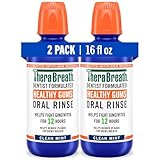
TheraBreath Healthy Gums Oral Rinse
TheraBreath Healthy Gums Oral Rinse
Best for: Braces wearers with frequent gum soreness, bleeding gums, or bad breath from bacterial buildup around brackets
- Cetylpyridinium chloride (CPC) 0.05%, an antigingivitis and antiplaque active, per its drug label
- Alcohol-free, dye-free, SLS-free
- Non-burning Clean Mint flavor, per the listing
- Does not contain fluoride
- +CPC formula that, per the listing, kills bacteria linked to gum disease to help fight gingivitis
- +Alcohol-free, dye-free, and SLS-free, and sold as a non-burning rinse
- +Dentist-formulated by Dr. Harold Katz
- −Does not contain fluoride, so it should be paired with a fluoride toothpaste or separate rinse
- −CPC rinses can stain teeth with regular use, per the ADA
(Affiliate link) · Free shipping on eligible Prime items
Why We Recommend It
Gum health often takes a hit during orthodontic treatment, as brackets and wires make it easier for bacteria to accumulate along the gumline. Braces wearers are particularly prone to gingivitis: our guide on how to fix gingivitis covers the steps you can take at home and when to see a dentist. TheraBreath Healthy Gums targets gum-related bacterial buildup with cetylpyridinium chloride (CPC) at 0.05%, which its DailyMed drug label lists as an antigingivitis and antiplaque active. TheraBreath sells it as a non-burning rinse, which suits patients with tender gum tissue. At around $17, it sits in the middle of our picks on price.
Key Features
- Cetylpyridinium chloride (CPC) 0.05%, an antigingivitis and antiplaque active, per its drug label
- Alcohol-free, dye-free, SLS-free
- Non-burning Clean Mint flavor, per the listing
- Dentist-formulated by Dr. Harold Katz
- Does not contain fluoride
Best For
Braces wearers who experience frequent gum soreness, bleeding gums, or bad breath related to bacterial buildup around brackets. It’s also well-suited for patients who react poorly to more chemically intense rinses.
Potential Downsides
TheraBreath Healthy Gums does not contain fluoride, so it should be used alongside a fluoride toothpaste or a separate fluoride rinse rather than as a standalone cavity-prevention tool. Its active is the same CPC as the Crest rinse above, so the same staining caveat applies with regular use.
(Affiliate link) · Free shipping on eligible Prime items
Buyer’s Guide: What to Look For
Choosing a mouthwash when you have braces doesn’t have to be complicated. Keep these key criteria in mind:
Fluoride: Your Enamel’s Best Friend
According to the ADA, fluoride may help with preventing cavities by strengthening enamel and reversing early signs of tooth decay. For braces wearers, fluoride is especially important because brackets create areas that are difficult to brush and are prone to demineralization. On US labels, over-the-counter sodium fluoride rinses come in 0.05% (once a day) and 0.02% (twice a day) strengths, and Phos-Flur’s acidulated phosphate formula lists 0.04% sodium fluoride (0.02% fluoride ion); all three appear in this roundup.
Skip the Alcohol
Alcohol-based rinses can cause stinging, dryness, and irritation: problems that are amplified when your gum tissue is already working hard to stay healthy around metal brackets. Just for Grins Orthodontics puts it plainly: “It’s best to avoid alcohol mouthwash.” Dr. Matt Messina, an associate professor at The Ohio State University College of Dentistry, tells NBC Select that people prone to dry mouth or with sensitive gums and cheek tissues should avoid mouthwashes made with alcohol.
Antibacterial Ingredients Help
The ADA lists cetylpyridinium chloride (CPC), chlorine dioxide and essential oils among the antimicrobials used in mouthrinses, and says CPC and essential oils have been shown to help reduce plaque and gingivitis alongside brushing and flossing. This can translate to less plaque buildup around brackets and healthier gum tissue over the course of your treatment.
Flavor Matters More Than You Think
The best mouthwash is one you’ll actually use twice a day. Harsh burn can lead to shorter rinse times or skipping altogether. If you or your child is sensitive to strong flavors, lean toward mild mint, bubblegum, or berry options.
ADA Seal of Acceptance
When in doubt, look for the ADA Seal. According to the ADA, products carrying this seal have been independently evaluated for safety and effectiveness claims.
FAQ
Q: How often should I use mouthwash with braces?
Follow each product’s own label rather than a general rule: Colgate Phos-Flur’s Drug Facts directions say to use it once a day after brushing, swishing 10 mL for one minute, then not eating or drinking for 30 minutes, while Listerine Smart Rinse’s directions say twice a day after brushing. For most patients, a consistent once-daily rinse after the last brushing of the day is a practical and effective approach.
Q: Can mouthwash replace flossing when you have braces?
No—mouthwash is a complement to, not a replacement for, flossing. The ADA says mouthrinse is not a replacement for daily brushing and flossing, and the NHS’s braces guidance asks for an interdental brush every day to clean between the teeth and underneath the braces. A water flosser is another option for flushing debris from around brackets and under the archwire.
Q: Is it safe for kids with braces to use adult mouthwashes?
Generally, mouthwashes with fluoride are not recommended for children under 6, as they may swallow the rinse. For children 6 and older with braces, a children’s fluoride rinse like Listerine Smart Rinse Kids is typically a better fit. Always check with your orthodontist or pediatric dentist before introducing a new oral care product.
Q: Why is alcohol in mouthwash a problem for braces wearers?
Alcohol can cause dry mouth, irritate inflamed gum tissue, and create a burning sensation that’s intensified when gums are tender from recent orthodontic adjustments. Multiple orthodontic sources in our research consistently recommend alcohol-free formulas for this reason.
Q: Will mouthwash stain my teeth or my braces?
Staining is tied to specific actives: mouthwashes containing cetylpyridinium chloride (CPC), like Crest Pro-Health and TheraBreath Healthy Gums, can cause brown staining of teeth and tongue with regular use, per the ADA, which gives the same caution for chlorhexidine. The brackets themselves should not be affected by mouthwash, but consistent oral hygiene will help prevent staining of the enamel around brackets that only becomes visible after braces are removed.
Q: Can I use mouthwash right after getting braces tightened?
Yes, unless your orthodontist says otherwise. An alcohol-free rinse avoids the drying the ADA links to alcohol, and a fluoride rinse keeps up the remineralizing protection the ADA describes. Avoid vigorous swishing if your gums are particularly tender following an adjustment appointment.
Our Methodology
We research each product roundup using a combination of published dental guidance, orthodontic practice recommendations, consumer review data, and manufacturer-provided information. For this article, we consulted sources including the American Dental Association (ADA), the NHS, NBC Select’s mouthwash guide, and orthodontic practice guidance including Just for Grins Orthodontics. If you’re still deciding on your treatment path, see our comparison of Invisalign vs braces and clear braces vs metal braces.
We do not accept payment for product placement or rankings. Our affiliate links generate a small commission that helps support the site, at no additional cost to you. All health claims in this article are attributed to the ADA or other cited sources. We do not claim that any product cures or treats any dental condition; we describe only what products “may help with” based on available evidence and professional guidance.
Product availability, pricing, and formulations may change over time. We aim to update our roundups regularly to reflect current market conditions; the updated date at the top of this page shows the latest review.