
Tooth powder sits in a gap between conventional toothpaste and the growing demand for simpler, fluoride-free oral care. The format has attracted a wave of new brands—some built on researched ingredients like hydroxyapatite, others on marketing claims that dental professionals openly question. We compared six tooth powders across ingredient quality, abrasiveness, remineralization support, and value to help you find one worth using. If what you actually want is a brighter smile rather than enamel support, that is a different job—our teeth whitening powder roundup ranks the powders sold for stain removal and color correction.
How We Evaluated
We started from the tooth powder brands we could verify on Amazon and narrowed the field to six using these criteria. A few popular brands—notably Just Ingredients and Akamai—are not included because they sell primarily through their own websites and have inconsistent Amazon availability, which makes them harder to verify and purchase through a standard retailer.
- Ingredient quality: Does the formula include ingredients with published research support (hydroxyapatite, xylitol, calcium carbonate), or does it rely entirely on unsubstantiated “detox” claims?
- Abrasiveness profile: Tooth powders face persistent concerns about being too abrasive. Where a formula uses baking soda, a 2017 review calls that base intrinsically low-abrasive; for the calcium carbonate, salt and clay bases here, only OraWellness publishes a figure (an independent lab RDA of 33 for Shine, reported in a 2018 article); we found none for the other five, and we say so.
- Consumer track record: Review counts, star ratings, and the specific complaints buyers report. Four of our six picks have over 1,000 Amazon reviews.
- Value: Per-use cost matters more than sticker price. A $26 jar lasting 200+ brushings costs less per use than a $10 jar lasting 60.
- Packaging and sustainability: Glass jars reduce plastic waste and keep moisture out of the powder. Five of our six picks ship in a glass jar; we could not confirm what Dr. Michelle’s jar is made of.
Evidence Receipt
- Hydroxyapatite has been tested in laboratory work as an approach to enamel remineralization, depositing mineral onto the tooth surface—the basis for the HAp picks in this lineup.
- Baking soda is intrinsically low-abrasive: a 2017 Journal of the American Dental Association review confirmed its hardness falls below that of enamel and dentin.
- Europe’s Scientific Committee on Consumer Safety found nano-hydroxyapatite safe in June 2025 at up to 29.5% in toothpaste, for rod-shaped particles.
- The American Dental Association calls fluoride safe and effective for preventing tooth decay and recommends brushing with a fluoride toothpaste—the trade-off every fluoride-free powder here carries.
Uncle Harry’s Natural Tooth Powder — Editor’s Pick
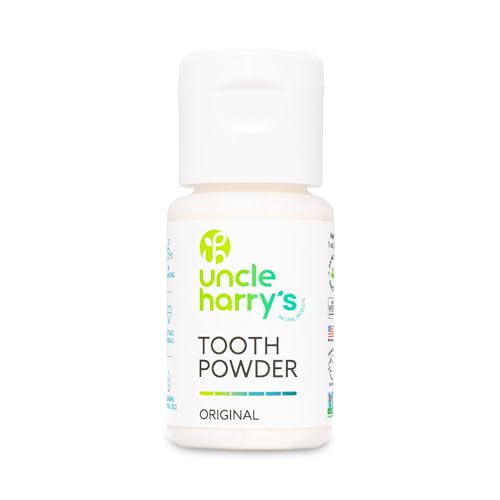
Uncle Harry's Natural Tooth Powder (1 oz)
Best for: People who want a classic, well-reviewed natural tooth powder at an affordable price
- Alkalizing formula with calcium carbonate, sea salt, and essential oils
- Over 25 years in the natural oral care market
- 100% natural — no synthetic additives, foaming agents, or preservatives
- Fluoride-free, glycerin-free, vegan
- Essential oil blend: peppermint, eucalyptus, clove, wintergreen, oregano
- +Longest track record of any tooth powder in this lineup, with over 2,400 reviews at 4.6 stars
- +Clean ingredient list with no synthetic additives, foaming agents, or preservatives
- +Alkalizing formula designed to maintain a neutral-to-basic oral pH
- −Does not contain hydroxyapatite — relies on mineral support rather than direct enamel deposition
- −Essential oil blend (clove, oregano, eucalyptus) produces a strong herbal flavor some find intense
(Affiliate link) · Free shipping on eligible Prime items
Uncle Harry’s has been making natural oral care products for over 25 years, and their tooth powder carries over 2,400 Amazon reviews—the second-largest review base in this lineup. The formula uses calcium carbonate and sea salt, which Uncle Harry’s says alkalize the mouth and provide a gentle polish, plus mustard seed powder, natural menthol, and a blend of five essential oils—peppermint, eucalyptus, clove, wintergreen, and oregano. The Amazon listing calls the powder pH balancing and says it freshens breath and whitens gently.
Why we recommend it: This is the most dependable choice in a category full of newcomers. Over 2,400 buyers have reviewed it at 4.6 stars, and the ingredient list is short enough to read in one breath. The alkalizing formula is designed to maintain a neutral-to-basic oral pH, which may help create an environment less favorable to acid-producing bacteria. At around $10 for 1 oz, it sits at the affordable end without cutting corners on ingredient sourcing.
Potential downsides: Uncle Harry’s does not contain hydroxyapatite, so if direct enamel mineral deposition is your priority, OraWellness Shine or EcoFam are better fits. The essential oil blend—particularly the clove and oregano—produces a distinctly herbal flavor that reads as medicinal rather than minty. Some reviewers love it; others find it overpowering.
(Affiliate link) · Free shipping on eligible Prime items
OraWellness Shine — Best for Remineralization
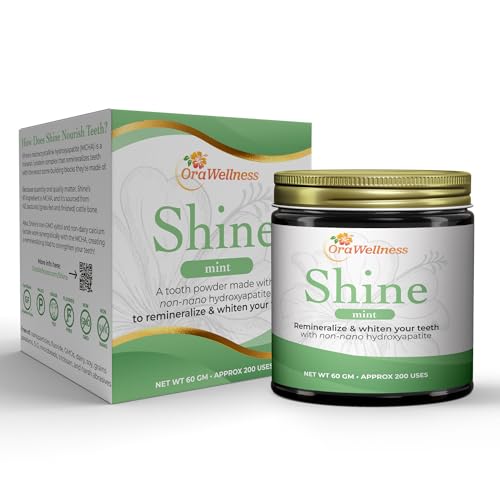
OraWellness Shine Remineralizing Tooth Powder (Mint, 60g)
Best for: Anyone prioritizing hydroxyapatite-based enamel support and whitening
- Microcrystalline hydroxyapatite for enamel mineral support
- White kaolin clay, which OraWellness says polishes gently, plus xylitol
- Approximately 200 uses per 60g glass jar
- Fluoride-free, made in the USA
- Mint flavor with baking soda for pH balance
- +Contains microcrystalline hydroxyapatite — a non-nano form of the mineral tooth enamel is built from
- +Approximately 200 uses per jar, bringing the per-use cost closer to mid-range despite the higher sticker price
- +Glass jar packaging with a ~3-month supply
- −Most expensive option in this lineup at around $30
- −Does not disclose exact HAp concentration
(Affiliate link) · Free shipping on eligible Prime items
OraWellness Shine is built around microcrystalline hydroxyapatite, a non-nano form of the mineral that makes up most of tooth enamel. The formula pairs HAp with white kaolin clay, xylitol, baking soda, and peppermint oil, and the brand claims approximately 200 uses per 60g jar. OraWellness describes the whitening as gentle and reports in a 2018 article that an independent lab it hired scored Shine at an RDA of 33, which it places at the upper end of the “very low abrasive” band.
Why we recommend it: If remineralization is the reason you’re considering tooth powder, this is the most focused option. Laboratory work has tested hydroxyapatite as an approach to enamel remineralization, and OraWellness uses the microcrystalline form rather than nano-particles. Europe’s Scientific Committee on Consumer Safety reviewed nano-hydroxyapatite again in June 2025 and found the rod-shaped form safe in toothpaste at up to 29.5%, so the non-nano choice here is a preference rather than a safety requirement. The 200-use claim brings the per-use cost to roughly $0.15, which is competitive with mid-range toothpaste.
Potential downsides: At around $30, this is the most expensive option in our lineup by a significant margin. OraWellness does not disclose the exact concentration of HAp in the formula, so you’re trusting the brand’s formulation choices without being able to compare concentrations directly. The 4.4-star rating, while solid, is tied with Dirty Mouth and Viva Doria for the lowest here.
(Affiliate link) · Free shipping on eligible Prime items
Primal Life Organics Dirty Mouth — Best Clay-Based
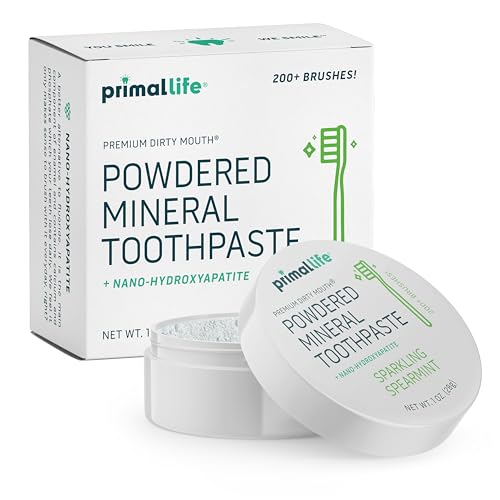
Primal Life Organics Dirty Mouth Toothpowder (Spearmint, 1 oz)
Best for: People drawn to a clay-forward formula for deep cleaning and polishing
- Triple-clay blend: bentonite, kaolin, and French green clay, with nano-hydroxyapatite
- Baking soda and spearmint essential oils
- Over 200 brushings per 1 oz jar
- Organic, vegan, gluten-free, fluoride-free
- Multiple flavors available (spearmint, peppermint; the black peppermint version adds charcoal)
- +Three mineral-rich clays do the polishing, with no synthetic abrasives in the formula
- +Well-established brand with about 3,700 reviews and a full oral care line
- +Over 200 brushings per jar for a reasonable per-use cost
- −Tied for the lowest rating in this lineup, at 4.4 stars; one reviewer called it 'gritty'
- −Lists nano-hydroxyapatite but does not disclose the amount
(Affiliate link) · Free shipping on eligible Prime items
Dirty Mouth has built a following around its triple-clay formula: bentonite, kaolin, and French green clay, blended with baking soda, nano-hydroxyapatite and spearmint essential oil. The brand is one of the most visible in the natural tooth powder space, ranking near the top of search results and carrying about 3,700 Amazon reviews. The Amazon listing calls it a non-abrasive powder that polishes gently, though we found no published abrasivity figure for it.
Why we recommend it: If you’re specifically drawn to clay-based oral care, this is the most established option. The three clays do the polishing, and baking soda—which is intrinsically low-abrasive because it is softer than enamel and dentin—balances the formula. The 1 oz jar lasts 200+ brushings, and Primal Life offers multiple flavors (spearmint, peppermint, and a black peppermint with charcoal we would skip, for the reason below) if the standard doesn’t suit your taste.
Potential downsides: Dirty Mouth’s 4.4-star average is tied with OraWellness and Viva Doria for the lowest in this lineup. On texture, Amazon’s review summary says buyers give positive feedback for its gritty clay feel, though one reviewer wrote that it was “Gritty, tastes terrible”. The listing includes nano-hydroxyapatite in the base formula, but Primal Life does not say how much, so we do not count it among the HAp-focused picks here. At around $26 for 1 oz, the price sits at the premium end alongside OraWellness.
(Affiliate link) · Free shipping on eligible Prime items
EcoFam — Best Eco-Friendly
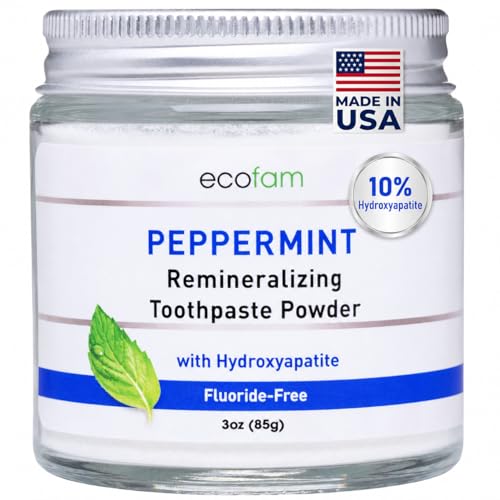
EcoFam Remineralizing Tooth Powder (Peppermint)
Best for: Eco-conscious buyers who want HAp and xylitol in zero-waste packaging
- Hydroxyapatite and xylitol for enamel and bacterial balance support
- Zero-waste reusable glass jar, made in the USA
- Fluoride-free, SLS-free, no artificial preservatives
- Peppermint flavor
- Refillable packaging to reduce single-use plastic
- +Combines hydroxyapatite and xylitol — two ingredients studied individually for enamel support and bacterial balance
- +Zero-waste glass jar packaging, refillable, made in the USA
- −Smallest review base in this lineup (160 reviews), a newer brand with less track record
- −Available in limited flavors compared to more established brands
(Affiliate link) · Free shipping on eligible Prime items
EcoFam combines hydroxyapatite and xylitol—two ingredients with independent research support—in a zero-waste glass jar made in the USA. The formula is fluoride-free, SLS-free, and free of artificial preservatives.
Why we recommend it: EcoFam pairs HAp with xylitol—an ingredient that research has linked to reduced growth of cavity-causing bacteria—and packages both in a zero-waste glass jar. The glass jar is refillable and recyclable, which matters if reducing plastic waste is part of your motivation for switching from tube toothpaste. At around $15, it is the least expensive hydroxyapatite powder in this lineup—roughly half what OraWellness Shine costs—and the formula still covers both HAp and xylitol.
Potential downsides: EcoFam is a newer brand with 160 Amazon reviews at the time of this writing—the smallest review base in our lineup by a wide margin. That 4.6-star rating is strong, but it’s built on a sample that could shift meaningfully as more buyers weigh in. If a long track record matters to you, Uncle Harry’s or Viva Doria are safer bets.
(Affiliate link) · Free shipping on eligible Prime items
Viva Doria — Best Budget
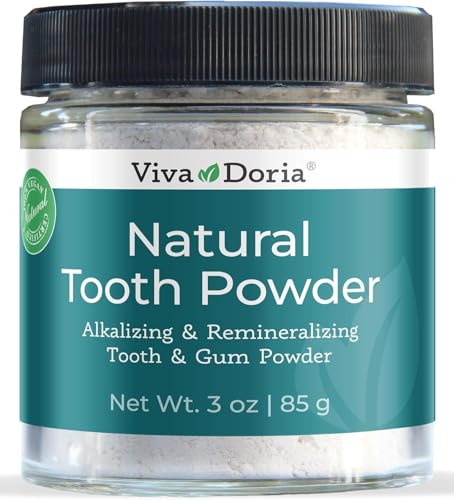
Viva Doria Natural Tooth Powder (Mint, 3 oz)
Best for: Budget-conscious buyers who want a large jar of natural tooth powder at the lowest per-ounce cost
- 3 oz glass jar — largest volume in this lineup
- Calcium carbonate and Himalayan pink salt
- Refreshing mint flavor with essential oils
- No synthetic additives, made in the USA
- Remineralizing and whitening formula
- +Largest review base of any tooth powder in this lineup with over 4,500 reviews
- +3 oz glass jar provides the best per-ounce value in this lineup
- +Simple, recognizable ingredient list with no synthetic additives
- −Strong mint flavor that some reviewers find overly intense
- −Does not contain hydroxyapatite — a mineral-support formula rather than a direct remineralizer
(Affiliate link) · Free shipping on eligible Prime items
Viva Doria’s 3 oz glass jar at around $10 delivers the best per-ounce value in this lineup. The formula uses calcium carbonate, Himalayan pink salt, and essential oils in a mint flavor that reviewers describe as strong and refreshing.
Why we recommend it: With over 4,500 reviews, this is the most-reviewed tooth powder in this lineup—and that review volume provides something the smaller brands cannot: a large, diverse sample of real-world experiences. The 3 oz jar at around $10 means you’re paying roughly a quarter of what OraWellness costs per ounce. If you’re new to tooth powder and want to try the format without a significant financial commitment, this is the lowest-risk entry point.
Potential downsides: The mint flavor draws the most complaints—multiple reviewers describe it as significantly stronger than expected. Viva Doria does not contain hydroxyapatite, so the remineralization mechanism is limited to mineral support from calcium carbonate and salt rather than direct enamel deposition. The formula is straightforward and effective for cleaning, but it’s not the choice if HAp-based remineralization is your primary goal.
(Affiliate link) · Free shipping on eligible Prime items
Living Well with Dr. Michelle — Dentist-Developed
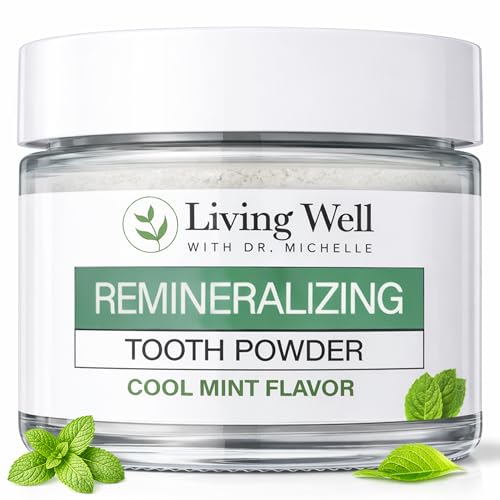
Living Well with Dr. Michelle Remineralizing Tooth Powder (Cool Mint)
Best for: People who value a formula developed by a practicing dentist with hydroxyapatite and xylitol
- Formulated by Dr. Michelle Jorgensen, a licensed dentist
- Hydroxyapatite and xylitol for enamel and bacterial balance support
- Calcium carbonate and essential oils (spearmint, wintergreen)
- Fluoride-free, clean ingredient formula
- Several variants available, including sensitive and citrus
- +Developed by a licensed dentist with expertise in both conventional and holistic dentistry
- +Contains hydroxyapatite and xylitol alongside calcium carbonate and essential oils
- +4.6-star average, tied for the highest rating in this lineup
- −Moderate review base (563 reviews), less consumer track record than the established brands
- −Sold in several variants, including sensitive and citrus, which can make it hard to tell which version you are ordering
(Affiliate link) · Free shipping on eligible Prime items
This tooth powder was formulated by Dr. Michelle Jorgensen, a dentist who practices both conventional and holistic dentistry. The formula includes hydroxyapatite, calcium carbonate, xylitol, and essential oils—covering several of the ingredient categories that research supports.
Why we recommend it: Dr. Michelle’s professional background gives this formula a credibility edge that most tooth powders lack. The ingredient list reads like a curated version of the research: HAp for enamel mineral deposition, xylitol for bacterial balance, calcium carbonate as the cleaning base (the brand calls it a mild mineral cleanser that polishes without excessive abrasion), and essential oils for flavor. At around $25 it sits at the premium end of this lineup—cheaper than OraWellness Shine, but well above EcoFam, the least expensive hydroxyapatite powder here. The brand also offers a sensitive variant with arginine bicarbonate and a citrus-flavored version for people who find mint uncomfortable.
Potential downsides: With 563 reviews, Dr. Michelle’s tooth powder has a moderate consumer track record—more established than EcoFam but well below Uncle Harry’s or Viva Doria. The brand sells the powder in several variants, including sensitive and citrus, and the similar packaging across them makes it easy to order the wrong one. Some of these variants are new Amazon listings with separate review pools, which fragments the social proof.
(Affiliate link) · Free shipping on eligible Prime items
Also Worth a Look: MySmile’s Nano-HAp Powders
MySmile, a brand best known for its whitening line, sells two nano-hydroxyapatite powders that sit just outside this lineup. The glass-jar Nano Hydroxyapatite Tooth Powder is the closest fit to this page: nano-HAp in a dip-and-brush powder at around $16, close to EcoFam’s price. We list it as a link rather than a ranked card for one reason—its review base is 74 ratings at the time of this writing, below every ranked pick here, so there is not yet enough consumer track record to rank it against them. Both of MySmile’s powders are sold as whitening polishes first; neither is a dedicated remineralization formula, so treat them as a way to try the nano form of HAp, not as a substitute for the remineralization-focused picks above.
(Affiliate link) · Free shipping on eligible Prime items
The second version, the nHAP Brightening Powder at around $20, leans further toward stain polishing. If surface stains are the job you are actually hiring a powder for, our teeth whitening powder roundup compares it against the PAP and charcoal alternatives in that category.
(Affiliate link) · Free shipping on eligible Prime items
What dental professionals say about tooth powder: The American Dental Association calls fluoride safe and effective for preventing tooth decay and recommends brushing with a fluoride toothpaste, which no powder in this lineup contains. However, some professionals acknowledge hydroxyapatite as a credible fluoride alternative—one dentist noted that when evaluating a new oral care product, “the first thing I’m looking for is whether or not it has Fluoride or Hydroxyapatite. If it has neither then I don’t need to read any further.” The strongest professional endorsement goes to tooth powders that include researched active ingredients (HAp, xylitol) rather than those relying solely on clay or salt.
Buyer’s Guide
What Makes Tooth Powder Different from Toothpaste
Tooth powder is a dry, loose-powder alternative to conventional toothpaste. You dip a wet toothbrush into the jar (or sprinkle the powder onto the brush) and brush as usual. The main practical differences: no water in the formula means no need for preservatives or binding agents, and the dry format tends to last longer per ounce than paste. Most tooth powders ship in glass jars rather than plastic tubes, which appeals to buyers motivated by sustainability.
The trade-off is convenience. Dipping into a jar is messier than squeezing a tube, and sharing a jar raises hygiene questions that a personal tube doesn’t. Some brands address this with a scoop or sprinkle cap, but the format fundamentally favors individual use.
HAp, Clay, and Baking Soda: Active Ingredients That Matter
Not all tooth powders work the same way. The active ingredients determine what the powder actually does beyond basic cleaning:
Hydroxyapatite (HAp) is the primary mineral component of tooth enamel, which is roughly 96–97% mineral by weight. Research has explored its potential to support enamel remineralization by depositing mineral directly onto the tooth surface. In our lineup, OraWellness Shine, EcoFam, and Dr. Michelle are built around HAp, and Primal Life’s Dirty Mouth also lists nano-HAp in its clay formula without saying how much. If enamel support is your primary goal, look for products that list hydroxyapatite as an ingredient—and be aware that not all formulas disclose concentrations.
Bentonite and kaolin clays act as the polishing abrasive in clay-based powders. OraWellness says its kaolin clay and baking soda help remove surface stains and plaque buildup, and it reports an independent lab RDA of 33 for the finished Shine powder; we found no published figure for Primal Life’s triple-clay blend. The clays themselves do not deposit minerals onto enamel the way HAp does. Dirty Mouth’s triple-clay formula is the most clay-forward option in this lineup.
Baking soda (sodium bicarbonate) is intrinsically low-abrasive because it is softer than both enamel and dentin. Baking soda also raises oral pH, which may help neutralize acid after eating.
Xylitol is a sugar alcohol that research has linked to reduced growth of Streptococcus mutans, the primary cavity-causing bacterium. OraWellness Shine, EcoFam, and Dr. Michelle include xylitol alongside HAp.
Is Tooth Powder Too Abrasive?
This is the most common safety concern, and it’s worth addressing directly. Tooth powders use physical particles for cleaning rather than the chemical foaming agents in conventional toothpaste, which raises questions about enamel wear.
The answer depends on the specific formula. Baking soda, one of the most common tooth powder bases, has an intrinsically low abrasivity—a 2017 review in the Journal of the American Dental Association confirmed that its hardness falls below that of enamel and dentin, making it safe for daily use. The same review cautions that a finished baking soda product can carry other ingredients that push its abrasivity back up, so the base being gentle does not settle the question for a whole formula. Clays (kaolin, bentonite) are a different matter. Only one clay-based powder here comes with a number: OraWellness reports an independent lab RDA of 33 for Shine, which it places at the upper end of the “very low abrasive” band. Primal Life’s listing calls Dirty Mouth non-abrasive, but we found no published figure for it, so for that powder how the clays compare with baking soda is unknown rather than low.
Two things we would avoid: any powder that feels gritty against your teeth, and charcoal formulas, which a 2024 Journal of Dentistry lab study (da Silva et al.) linked to enamel roughness and wear; our teeth whitening powder roundup walks through that study. If a powder feels scratchy during brushing, that’s a signal to stop.
Only one of the six products in this lineup comes with a published RDA (Relative Dentin Abrasivity) value: OraWellness reports that an independent lab scored Shine at 33. We found no published figure for the other five. The FDA’s rules for fluoride toothpaste set no requirement to publish an RDA; what the ADA requires is an RDA of 250 or less for any toothpaste carrying its Seal of Acceptance, and it says figures under 250 should not be used to rank one toothpaste as safer than another. If abrasivity is a primary concern, our enamel repair toothpaste roundup explains how the score works.
The Fluoride-Free Question
Nearly all tooth powders—including every product in this lineup—are fluoride-free. This is the category’s most significant trade-off, and we want to be direct about it.
The American Dental Association calls fluoride safe and effective for preventing tooth decay in children and adults, and recommends a fluoride toothpaste that displays its Seal of Acceptance. Decades of research support fluoride’s ability to strengthen enamel and reduce decay. No tooth powder in this lineup carries the ADA Seal of Acceptance.
Hydroxyapatite is the fluoride alternative with a clinical research base of its own. Clinical studies, primarily conducted in Japan and Europe, suggest HAp may support enamel remineralization through a different mechanism—depositing mineral directly onto the tooth surface rather than incorporating into the crystal structure the way fluoride does. However, the body of evidence for HAp is smaller and more recent than the fluoride evidence base.
If you choose a fluoride-free tooth powder, consider pairing it with a fluoride mouthwash or using fluoride toothpaste for one of your daily brushings. This “both/and” approach is increasingly common among dental professionals who acknowledge HAp’s potential while maintaining fluoride as a safety net.
Sensory Sensitivity and Accessibility
Some people arrive at tooth powder not from a sustainability or natural-health motivation but because conventional toothpaste is physically intolerable. Foaming agents (SLS), strong flavors, and paste textures can trigger sensory discomfort—particularly for people with autism or other sensory processing differences. Tooth powders without foaming agents, artificial flavors, or sweeteners may offer a tolerable brushing experience where paste cannot. If this describes your situation, look for powders with minimal flavoring (Uncle Harry’s essential-oil blend is intense; Dr. Michelle’s citrus variant or an unflavored option may be gentler) and test a small amount before committing to a full jar.
When to Stick with Fluoride Toothpaste
Tooth powder is not the right choice for everyone. If your dentist has identified active cavities, significant enamel erosion, or a high caries risk, switching away from fluoride toothpaste removes a protective tool your teeth currently need. People with dry mouth (xerostomia) should also consult their dentist before switching, since reduced saliva already limits the mouth’s natural remineralization capacity. Tooth powder works best as part of an otherwise healthy oral care routine—not as a rescue tool for teeth already in trouble. If your dentist has pointed you toward a dedicated remineralizing product instead, our MI Paste guide covers the CPP-ACP option and what the evidence behind it actually shows.
How to Use Tooth Powder
- Wet your toothbrush under running water
- Dip the bristles lightly into the powder, or use the jar’s scoop to sprinkle powder onto the brush
- Brush for two minutes using gentle, circular motions
- Spit and rinse thoroughly
Hygiene tip: If you’re sharing a jar, use a small spoon to transfer powder onto each person’s brush rather than dipping multiple brushes into the same jar. Some brands include a scoop for this purpose.
Frequently Asked Questions
Is tooth powder better than toothpaste?
Neither format is inherently superior—the active ingredients matter more than the delivery method. A tooth powder with hydroxyapatite and xylitol may support enamel health as effectively as a comparable paste, while a powder with only salt and clay offers less protection than a fluoride toothpaste. The format you’re more likely to use consistently is the one that will benefit your teeth the most.
Can tooth powder remineralize teeth?
Tooth powders containing hydroxyapatite may support the remineralization process by depositing mineral onto the tooth surface. Hydroxyapatite has been tested in the laboratory as a remineralizing agent, though that testing used a gel rather than a powder. Powders without HAp—those relying on clay or baking soda alone—clean the teeth but do not directly contribute to mineral deposition. Our guide to how to remineralize teeth covers what the process can and cannot do.
Is nano-hydroxyapatite in tooth powder safe?
Europe’s Scientific Committee on Consumer Safety has assessed it twice. Its June 2025 opinion found nano-hydroxyapatite safe in toothpaste at concentrations up to 29.5% and in mouthwash up to 10%, and stated that the material does not pose a mutagenic hazard. That assessment covers rod-shaped particles and does not extend to needle-shaped ones. Some brands (like OraWellness) use microcrystalline HAp instead of nano-particles, which is a formulation preference rather than a fix for a safety problem.
Why do dentists often recommend against tooth powder?
The American Dental Association calls fluoride safe and effective for preventing tooth decay and recommends brushing with a fluoride toothpaste, and the evidence behind fluoride is broader and deeper than the evidence behind any powder ingredient here. Only OraWellness publishes an RDA value (a lab abrasiveness score) for its powder, 33 for Shine from an independent lab it hired; we found none for the other five, and none of the six carries the ADA Seal of Acceptance, which requires an RDA of 250 or less. That makes them harder for professionals to evaluate. This doesn’t mean every tooth powder is harmful—it means the category has less institutional validation than conventional toothpaste.
How long does a jar of tooth powder last?
Most 1 oz jars provide 60-200+ brushings depending on how much powder you use per session. OraWellness Shine (60g) and Primal Life Dirty Mouth (1 oz) both claim 200+ brushings. Viva Doria’s 3 oz jar should last significantly longer. A light dip of a wet brush is all you need—using too much creates a gritty paste that’s harder to brush with and wastes product.
Can I use tooth powder and toothpaste together?
Yes. Some people brush with tooth powder in the morning and fluoride toothpaste at night, or use tooth powder as a supplement to their regular toothpaste routine. This approach lets you get the polishing and mineral benefits of powder while maintaining fluoride exposure from conventional paste. If your dentist has recommended fluoride specifically, this combination approach keeps that covered.