
This page is about chewing gum you buy in a pack, not about gum tissue. If you came looking for how to treat receding or inflamed gums, our gum recession guide is the page you want. Everyone else: remineralizing gum is a young category selling a big promise, and the honest answer to “does it work” has three separate parts. We researched the published evidence and the community discussion behind it before ranking anything.
Does Remineralizing Gum Actually Work?
The chewing part is real. The American Dental Association states that chewing an unsweetened gum base stimulates the salivary flow rate to 10 to 12 times the unstimulated rate, and that saliva carries calcium and phosphate ions “which can contribute to remineralization of tooth enamel.” That effect is not brand-specific. Any sugar-free gum produces it, and a 2023 review in Frontiers in Oral Health puts the window of stimulated flow at roughly nine minutes per piece (Yeung, 2023).
The hydroxyapatite part is borrowed. Hydroxyapatite is the mineral enamel is mostly made of, and the research behind it is encouraging, but it was done on other products. The 2024 systematic review in the Journal of Dentistry that concluded hydroxyapatite is an effective anti-caries agent defined its scope as “toothpastes, mouthwashes or gels containing hydroxyapatite” (Pawinska et al., 2024; two authors are employed by ingredient manufacturer Dr. Kurt Wolff GmbH). No gum was included. A 2025 narrative review notes hydroxyapatite gums exist but the only gum study it reviews measured mineral uptake in enamel samples rather than any cavity outcome (Naim & Sen, 2025). Our own searches of PubMed returned no systematic review of hydroxyapatite gum and no randomized trial of a nano-hydroxyapatite gum. Brand pages that reference multiple published trials of nano-hydroxyapatite gum do not name locatable records. For how the ingredient compares with fluoride where the research does exist, see our fluoride vs hydroxyapatite comparison.
The xylitol part is indirect. Xylitol does not deposit mineral onto a tooth. Its contribution runs through the same saliva pathway as the chewing itself, and the evidence for xylitol products other than toothpaste is unsettled: the 2015 Cochrane review found the available evidence “insufficient to determine whether any other xylitol-containing products can prevent caries” (Riley et al., 2015). A 2020 meta-analysis put the preventive fraction for sugar-free gum at 28 percent, calling it tentative evidence from moderate-quality trials (Newton et al., 2020; the authors report an association with an industry-funded oral healthcare program).
One gum did have real remineralization data, and it left. CPP-ACP gum, sold in the US as Recaldent-containing Trident, produced dose-dependent remineralization in a crossover trial, up to 152 percent more than a control gum (Shen et al., 2001; a laboratory-style in-situ model rather than a cavity-outcome study, and an author of the paper invented the Recaldent technology). That gum is no longer sold in the US, which is a market observation rather than a documented finding. The hydroxyapatite brands are moving into a gap the best-evidenced gum left behind. The paste form of the same technology is still available and covered in our MI Paste guide.
So the verdict: chewing one of these gums after meals is likely better for your teeth than chewing nothing, and that benefit comes mostly from saliva. Whether the hydroxyapatite in it adds anything on top is, at the time of writing, an open question rather than a settled one.
What Remineralizing Gum Cannot Do
Remineralization has a boundary, and it is the single most important thing to understand before spending $45 on gum. The ADA’s caries classification describes tooth surfaces as sound, noncavitated, or cavitated, and frames decay as an imbalance between demineralization and remineralization (Young et al., 2015). The ADA likewise describes progression as depending on a balance between protective and pathogenic factors. Mineral can move back into an early lesion where the surface is still intact. Once the surface has broken and there is a physical hole, no gum closes it.
That boundary is exactly where the category’s marketing overreaches. A practicing dentist in the discussions we researched drew the line the same way, praising the ingredients while objecting that the creator “claims that the gum entirely reverses cavities and that dentists have been lying.” For lesions that need intervention, the ADA’s clinical guideline points to professional treatments such as silver diamine fluoride, sealants and fluoride varnish rather than consumer products (Slayton et al., 2018). If you have a spot your dentist is watching, gum can sit alongside that plan. If you have a cavity, it cannot replace the filling. Our remineralization guide covers where that line sits in more detail.
How We Evaluated
- Ingredient honesty. We read each listing’s own ingredient panel and dosing statements, and we flag claims the listing makes that we could not trace to a published source. Only one brand here states how much hydroxyapatite a piece contains: crait states 70 mg per piece on its listing. The other listings leave you comparing products on an ingredient none of them quantifies.
- Rating and review base. We show live ratings as read, including the one that is unflattering. A product with a 3.8 earns its slot on relevance, not on its score.
- Cost per piece. This category asks you to chew several pieces a day, forever, so per-piece cost is the number that matters. Our picks run from roughly 13 cents to about 62 cents.
- Dosing clarity. Almost no brand tells you how many pieces a day is enough. The ones that do get credit for it.
- The cheap alternative stays on the page. Every hydroxyapatite gum here is measured against a plain xylitol gum, because that is the comparison the professional discussion keeps making.
Dentagum Remineralizing Gum
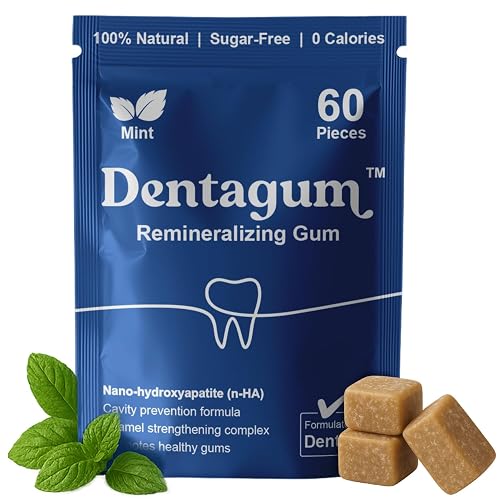
Dentagum Remineralizing Gum (Mint, 60 Pieces)
Best for: The best-reviewed purpose-built nano-hydroxyapatite gum, on a natural chicle base
- Nano-hydroxyapatite as the headline active, per the listing
- Sweetened with xylitol and erythritol
- Chicle, mastic and spruce natural gum base
- No aspartame, per the listing
- 60 pieces per pack
- +Strongest rating-and-review combination among the purpose-built nano-hydroxyapatite gums here, at 4.3 stars across 798 ratings
- +Natural chicle, mastic and spruce gum base rather than a synthetic base, per the listing
- +Sweetened with xylitol and erythritol, with no aspartame per the listing
- −About 55 cents per piece, several times the cost of a standard sugar-free gum
- −We found no published cavity-outcome trial of nano-hydroxyapatite in a gum format, so the ingredient's evidence comes from toothpaste and mouthwash research
(Affiliate link) · Free shipping on eligible Prime items
Why We Recommend It
If you have decided to try the category, this is the listing we would start with. At 4.3 stars across 798 ratings it has the strongest score-and-volume combination of the purpose-built hydroxyapatite gums here, and its formula reads as the most conventional of the group: nano-hydroxyapatite with xylitol and erythritol, on a chicle, mastic and spruce base, with no aspartame. There is no clay, no eggshell powder and no propolis to complicate an allergy check.
Potential Downsides
At around $33 for 60 pieces this works out to about 55 cents per piece, the second-highest per-piece cost on this page behind Underbrush. And the caveat from the evidence section above applies to it as much as to any brand here: the hydroxyapatite evidence base is toothpaste and mouthwash research (Pawinska et al., 2024; two authors are employed by an ingredient manufacturer), not gum research. We found no discussion of this brand in the dental communities we searched, so there is no user experience beyond the Amazon reviews to weigh.
(Affiliate link) · Free shipping on eligible Prime items
Underbrush Mastic Mint Gum
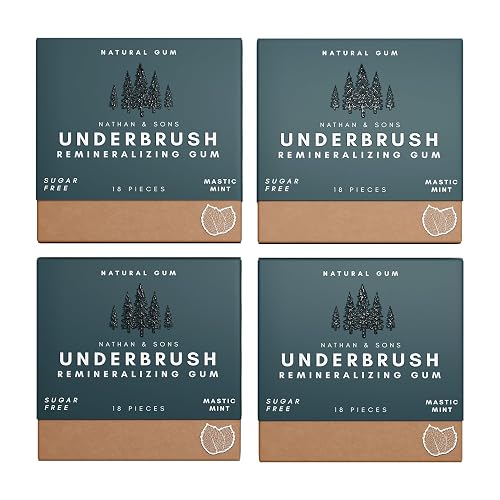
Underbrush Mastic Mint Remineralizing Gum (Nathan & Sons, 4-Pack)
Best for: Readers who arrived from the viral videos and want the actual product rather than a knockoff
- Nano-hydroxyapatite with xylitol and erythritol, per the listing
- Tree-sap gum base with calcium bentonite clay
- Sold as a 4-pack
- Mastic mint flavor
- The brand behind the category's social-media traction
- +The listing the category's viral interest points at, with the largest review base of the hydroxyapatite gums here at 1,735 ratings
- +Tree-sap base with calcium bentonite clay, plus nano-hydroxyapatite and xylitol and erythritol, per the listing
- +Buying the brand's own listing avoids the copycat listing that has appeared alongside it
- −Lowest rating in this lineup at 3.8 stars, and the most expensive at around $45
- −Carries no ADA Seal of Acceptance, and the price drew a blunt professional dismissal in the threads we researched
(Affiliate link) · Free shipping on eligible Prime items
Why We Recommend It
Underbrush is on this page because it is the product people are actually asking about. Three of the four category threads we read in full name it, its social-media traction is real, and the demand is organic enough that at least one copycat listing has appeared alongside it. If the videos are what brought you here, this is the brand’s own listing, and buying it rather than a lookalike is the practical point of including it.
Potential Downsides
This is the pick where the honest reading is least comfortable. The rating is 3.8, the lowest in this lineup, across the largest review base here. At around $45 for a 4-pack totaling 72 pieces—about 62 cents a piece—it is also the most expensive here, per pack and per piece. The most upvoted professional reply in the whole set of threads we researched addressed exactly that price: “They would advertise it as ADA approved if it was. At that price, it’s not worth it. I’d stick with regular sugar free gum.” The ADA states that the only chewing gums carrying the ADA Seal are sugar-free ones, and the Seal requires safety and efficacy data evaluated by an independent ADA scientific body, so its absence is worth weighing rather than shrugging off. A September 2025 r/Teethcare thread asking whether the gum is worth it reached the same place from the buyer side: the poster had read reviews saying the flavor fades within a minute or two and one that reported three cavities despite daily use, and the replies settled on any sugar-free xylitol gum doing the mechanical part of the job, with one reader “not convinced it’s worth the price”. Not everyone objects on price either: one consumer in a separate thread rejected the gum on ingredient grounds, writing that “it unfortunately contains hydroxyapitite. This is a so far controversial ingredient.” We also found one account pushing this brand across two subreddits in a pattern that did not look like ordinary participation, so treat brand-favorable posts about it with more caution than the questions and criticisms.
(Affiliate link) · Free shipping on eligible Prime items
crait Remineralizing Gum
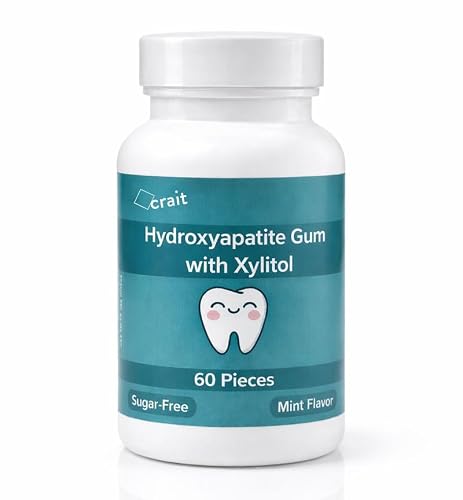
crait Remineralizing Gum (Mint, 60 Pieces)
Best for: Buyers who want a labelled amount of hydroxyapatite per piece rather than an unquantified claim
- Non-nano hydroxyapatite at 70 mg per piece, per the listing
- Ingredient panel reads gum base, sorbitol, maltitol, xylitol, isomalt, hydroxyapatite
- 60 pieces per bottle
- Sugar-free mint, gluten free per the listing
- About 25 cents per piece
- +The only listing here that states a hydroxyapatite dose, at 70 mg a piece, named in the listing's own subtitle and first bullet
- +The cheapest hydroxyapatite gum on this page at $15 for 60 pieces, about 25 cents a piece
- +Review dates on the listing run from May 2025 through September 2026 rather than clustering in one burst
- −Only 403 ratings, a fraction of the review base behind the other gums here, and we found no mention of the brand in any community we searched
- −Its hydroxyapatite is the non-nano form where the other two hydroxyapatite gums here are nano, and we found no study comparing the two forms in a gum
(Affiliate link) · Free shipping on eligible Prime items
Why We Recommend It
crait is here for the one thing the other listings on this page will not do: it tells you how much hydroxyapatite you are chewing. The listing’s subtitle and its first bullet both state 70 mg a piece, in the non-nano form, and neither of the other two hydroxyapatite gums here puts a number on the ingredient it is sold on. It is also the cheapest way into the category here, at $15 for 60 pieces, which works out at about 25 cents a piece, under half what the other two hydroxyapatite gums cost per chew.
The caveat belongs in the same breath as the recommendation. crait has 403 ratings, against 798 for Dentagum and 1,735 for Underbrush, and we found no discussion of the brand in any of the dental communities we searched, so its Amazon reviews are the only record that exists. What could be checked, we checked: the individual review dates run from May 2025 through September 2026 rather than piling into a single week, the pattern a purchased review pool usually shows. A few hundred ratings is still a thinner base than the two larger gums above it, and that is why this sits below them rather than at the top of the page.
Potential Downsides
A stated dose is a labelling win, not an evidence win. No trial has tested 70 mg of hydroxyapatite in a chewing gum, in either particle form, so the number tells you what you are buying rather than what it will do for you. The non-nano form also sits outside the one official safety review of the ingredient, which covered the nano form in toothpaste and mouthwash and is discussed below. And read the sweetener line before assuming this is a xylitol gum: the panel runs gum base, sorbitol, maltitol, xylitol, isomalt, so xylitol is the third sweetener listed rather than the whole formula, and sorbitol carries the same digestive ceiling as the rest of the sugar alcohols.
(Affiliate link) · Free shipping on eligible Prime items
PUR Xylitol Gum
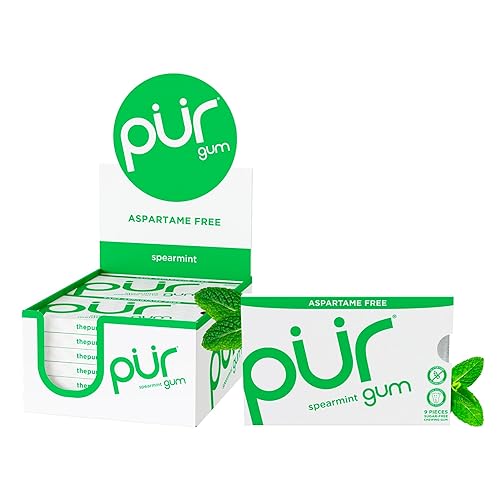
PUR Aspartame-Free Xylitol Gum (Spearmint, 108 Count)
Best for: The cheap established alternative most dental professionals point at instead
- 100 percent xylitol-sweetened, no aspartame
- Free of gluten, soy, dairy and nuts, per the listing
- 108 pieces across twelve 9-piece packs
- Swiss made, per the listing
- Roughly 13 cents per piece
- +Highest rating in this lineup at 4.6 stars, and the cheapest per piece by a wide margin at roughly 13 cents
- +100 percent xylitol with no aspartame, free of the major allergens, and Swiss made per the listing
- +Individually wrapped nine-piece packs suit the after-every-meal habit the evidence actually supports
- −Contains no hydroxyapatite, so it works only through saliva stimulation
- −Spearmint is the only flavor in this listing
(Affiliate link) · Free shipping on eligible Prime items
Why We Recommend It
PUR is here as the control condition. It contains no hydroxyapatite and makes no remineralization claim, which means everything it does for your teeth comes through the saliva mechanism the ADA describes, and that mechanism is the best-evidenced part of this entire page. It is 100 percent xylitol-sweetened, aspartame-free, free of the major allergens, and at around $14 for 108 pieces it costs roughly 13 cents a piece, about a quarter of what the priciest picks here cost. One person managing Invisalign treatment described the habit plainly: “I chew PUR gum (xylitol) after every meal for at least 15 mins,” adding that “it’s not too expensive in the grand scheme.”
Potential Downsides
It is the cheapest option here precisely because it is not trying to be a remineralizing gum. If the hydroxyapatite research eventually delivers a gum trial with real cavity outcomes, PUR will not be the product that benefits. Spearmint is also the only flavor in this listing. We rank xylitol gums properly on a separate page, and PUR appears here only as the representative alternative.
(Affiliate link) · Free shipping on eligible Prime items
Is Plain Sugar-Free Gum Enough?
For most people, probably yes, and this is the section the category’s marketing would prefer you skipped.
The strongest professional verdict in everything we researched was not about ingredients at all. It was about price: “They would advertise it as ADA approved if it was. At that price, it’s not worth it. I’d stick with regular sugar free gum.” Set that against the evidence. Saliva stimulation from chewing is documented by the ADA and available from any sugar-free gum. Sugar-free gum as a category carries a tentative 28 percent preventive fraction (Newton et al., 2020, industry-associated authors). Hydroxyapatite adds a second mechanism that has not yet been tested in a gum. You are paying roughly twice to nearly five times as much for the untested half.
That is not an argument against trying one. It is an argument for knowing what you are buying: a plausible add-on, not an upgrade. If a plain xylitol gum is where you land, our best xylitol gum roundup ranks that category properly, comparing xylitol per piece across Spry, PUR and Epic. This page deliberately does not re-rank those gums, because that page owns them.
How Many Pieces a Day?
This question was asked repeatedly and never answered in the discussions we researched, and it matters more than usual here because sugar alcohols have a dose ceiling.
The upper bound is digestive, not dental. Sugar alcohols like xylitol are poorly digested by design, which is what makes them tooth-friendly and also what makes them a problem in quantity. A tolerance study puts the no-diarrhea threshold for xylitol at 0.37 g per kg of body weight in men and 0.42 g per kg in women, roughly 26 to 29 g for a 70 kg adult (Oku & Nakamura, 2007). The 2023 Frontiers in Oral Health review makes the same point in practical terms: the doses in ordinary gum use are fine for most people, and digestive upset is dose-dependent overconsumption (Yeung, 2023). A review written for dentists adds that xylitol is better tolerated than other polyols and that tolerance improves with sustained use (Mäkinen, 2016).
Community experience matches the arithmetic rather than contradicting it. One heavy chewer in a quit-smoking thread put it bluntly: sugar alcohols “are basically not-digestible. So they cause intense gas and other even less pleasant digestive consequences,” and a second chewer in the same thread agreed. That is the failure mode of the multi-piece-a-day pattern these products encourage, not of an occasional piece.
A workable pattern. Chew one piece after each meal, for 10 to 20 minutes, which covers the roughly nine minutes of stimulated saliva flow the research describes plus a margin. That lands at three to four pieces a day, which is also the ceiling the WGKLLY listing states. If you go higher, add pieces gradually rather than all at once, and back off if your stomach objects. And if you have a dog in the house, store xylitol gum out of reach: the FDA warns that while xylitol is safe for humans, it “can be deadly to dogs.”
Is Swallowing Nano-Hydroxyapatite Safe?
A gum habit means swallowing hydroxyapatite-loaded saliva several times a day, and no regulator has assessed that exposure. The closest official review is the EU Scientific Committee on Consumer Safety’s 2023 opinion on nano-hydroxyapatite (SCCS/1648/22), which found the ingredient safe at up to 10 percent in toothpaste and up to 0.465 percent in mouthwash. That clearance is narrow. It applies only to rod-shaped particles that are not coated or surface-modified, it explicitly does not cover needle-shaped particles, and it excludes sprayable products because no inhalation data were submitted. Chewing gum is not mentioned anywhere in the document—the exposure it modelled is toothpaste and mouthwash use, not a multi-piece daily chew. The same review did note that swallowed nano-hydroxyapatite dissolves in stomach acid, which is reassuring as far as it goes, but that finding covers incidental swallowing of toothpaste and mouthwash residue rather than gum doses. One more wrinkle: crait states that its hydroxyapatite is the non-nano form, which puts it outside this assessment entirely, because the opinion covers nano-hydroxyapatite only.
Community Claims vs the Evidence
One table, because this category generates more assertion than evidence. Each row pairs something circulating in the discussions and marketing with what the published record supports.
| The claim | What the record supports |
|---|---|
| “It reverses cavities” | An early lesion with an intact surface and a cavitated hole are different categories in the ADA’s classification (Young et al., 2015). Mineral can return to the former; no gum closes the latter. |
| “Hydroxyapatite gum is proven” | The systematic review evidence covers toothpastes, mouthwashes and gels (Pawinska et al., 2024, manufacturer-employed co-authors). We found no randomized trial of a hydroxyapatite gum. |
| “Chewing gum helps your teeth” | Supported. Chewing raises saliva flow 10 to 12 times, and saliva carries the calcium and phosphate involved in remineralization (ADA). |
| “Xylitol remineralizes enamel” | Xylitol’s route is indirect, via saliva. Cochrane found the evidence insufficient to decide for xylitol products other than toothpaste (Riley et al., 2015). |
| “There was once a gum that worked” | Closest thing: CPP-ACP gum showed dose-dependent remineralization in an in-situ model (Shen et al., 2001, Recaldent inventor among the authors). It is no longer sold in the US. |
| “Nano is the important part” | The word appears in marketing far more than in trial results. Clinicians in the threads we researched read it as a hype signal, and the gum-specific research to test it does not exist yet. |
How to Choose a Remineralizing Gum
Read the panel before the promise
Every product here is sugar-free and every product here stimulates saliva. What separates them is the rest of the panel: a chicle, mastic and spruce base, a tree-sap base with calcium bentonite clay, or a plain gum base with sorbitol and maltitol ahead of the xylitol. Allergy considerations are the practical differentiator, and at least one listing in this category tells buyers to check the ingredients themselves.
Treat it as an addition, never a replacement
Gum is a between-brushings tool. It does not replace brushing, flossing or fluoride, and the ADA’s caries guidance frames decay as a running balance between protective and damaging factors rather than a single product’s job. If you are building the rest of that routine, our remineralizing mouthwash picks and hydroxyapatite toothpaste roundup cover the surfaces where the ingredient does have research behind it. If hydroxyapatite itself is why you are here, a toothpaste is the purchase the evidence currently supports; a gum is the bet that the evidence will follow.
Hydroxyapatite is not universally comfortable
Most people report nothing unusual, but one person in the threads we researched described switching to a hydroxyapatite toothpaste, finding their teeth became more sensitive, and going back. That is a single account, not a pattern, and we found no equivalent report for gum. It is still worth knowing that “natural mineral” does not mean “cannot disagree with you.”
Braces, crowns and TMJ
If you wear braces, ask your orthodontist before adding a gum habit. Two randomized trials found sugar-free gum did not increase bracket breakages or bond failures, and both found it eased post-adjustment soreness (Benson et al., 2012; Ireland et al., 2016). But the ADA’s patient guidance still lists chewing gum among the sticky foods to avoid during treatment, and neither trial tested the dense tree-sap bases the remineralizing brands use. The standing advice outranks the trial evidence until your own orthodontist says otherwise. Separately, the ADA advises avoiding gum entirely with a TMJ disorder—chewing adds stress a painful jaw does not need. We found no professional-body guidance on chewy gum bases against crowns or fillings; if a restoration is loose enough for gum to threaten it, that is a dentist visit, not a product choice.
Not for young children
The American Academy of Pediatrics lists chewing gum among the high-risk choking foods to keep away from children until at least age four, and even then it depends on the individual child’s development. The cavity-prevention case in kids is also weaker than the marketing suggests: the Cochrane review found the evidence insufficient for xylitol products beyond toothpaste in any age group (Riley et al., 2015). For a child’s remineralization routine the researched surface is toothpaste—our kids hydroxyapatite toothpaste roundup covers it.
Match the spend to the reason
If the reason is a spot your dentist is watching, the money is better spent on the treatment they recommend, with gum as a habit alongside it. If the reason is that you want something useful to chew after lunch, a 13-cent xylitol piece delivers the mechanism the evidence actually supports.
Frequently Asked Questions
Is remineralizing gum legit?
Partly. The chewing mechanism is well documented: saliva flow rises 10 to 12 times and saliva carries calcium and phosphate that contribute to remineralization (ADA). The hydroxyapatite added on top has research behind it in toothpaste and mouthwash (Pawinska et al., 2024; manufacturer-employed co-authors) but not in gum, and we found no randomized trial testing a nano-hydroxyapatite gum. So the products are not fake, and they are not proven either.
Is any remineralizing gum ADA approved?
None of the products on this page claims the ADA Seal of Acceptance. The ADA states that the only chewing gums with its Seal are sugar-free ones, and the Seal requires safety and efficacy data evaluated by an independent ADA scientific body, which is a meaningful bar for a young category to clear. The community’s instinct here was sound: a brand that had it would be advertising it.
How many pieces a day should you chew?
Three to four, one after each meal, chewed 10 to 20 minutes, is a reasonable pattern and matches the daily ceiling stated by the clearest listing we read in this category, WGKLLY’s. The limit is digestive rather than dental: a xylitol tolerance study puts the no-diarrhea threshold near 26 to 29 g a day for a 70 kg adult (Oku & Nakamura, 2007), and tolerance improves with sustained use (Mäkinen, 2016).
Can gum reverse a cavity?
No. Early lesions with an intact surface can regain mineral; once the surface is broken, the classification changes and so does the treatment (Young et al., 2015). The ADA’s clinical guideline directs those lesions to professional interventions such as silver diamine fluoride, sealants and fluoride varnish (Slayton et al., 2018). A dentist in the discussions we researched objected specifically to the cavity-reversal marketing while having no problem with the ingredients themselves.
Does citric acid in gum cancel out the benefit?
This question comes up in the communities and goes unanswered, and we cannot resolve it either. Food acids are added to many sugar-free gums for tartness, and acid is what demineralizes enamel in the first place. What we can say is that chewing raises saliva flow sharply and saliva buffers acid (ADA), so the same act delivers both the acid and the defense against it. We found no study measuring the net effect in acidulated gum. If you are managing enamel erosion, reading the panel and choosing a gum without added citric or malic acid costs nothing.
Is it worth the price over regular sugar-free gum?
On current evidence, the honest answer is that you are paying a premium for an untested addition to a mechanism you can get for 13 cents a piece. The most upvoted professional comment we found said so directly: “At that price, it’s not worth it. I’d stick with regular sugar free gum.” If you want to try the category anyway, do it knowing that is what you are buying, and see our xylitol gum roundup for the alternative.