
Search for the Sonicare 4100 and you’ll find two different brushes wearing the name — the current “4100 Series” and the discontinued “ProtectiveClean 4100” — and retailers routinely mislabel one as the other. This review covers the current generation (the 4100 Series; the listing our link points at is the BD5003AZ bundle, the same handle packed with a brush head case), how it differs from its predecessor, what five years of owner threads actually say, and when a cheaper or different brush is the better call. For the whole Sonicare range, see our Sonicare lineup roundup.
Which 4100 is this? The generation decoder
“Is there a difference between these two?” is a literal, unanswered community question — one buyer found both listings side by side and couldn’t tell. The short version:
| 4100 Series (this review) | ProtectiveClean 4100 (discontinued) | |
|---|---|---|
| Model numbers | HX3681/xx | HX681x/xx |
| Status | Current | Being phased out |
| Intensities | 2 (low/high) | None (single) |
| Handle | Slimmer, lighter | Heavier |
| Charging | USB-cable stand | 2-pin plug |
| Motion rate | About half the old generation’s movements/min | About double (per Electric Teeth’s testing) |
The motion-rate drop sounds alarming; Electric Teeth’s testing verdict is that the current 4100 Series still cleans at the level that matters at this price, and it’s the generation Philips actually sells. If a listing says “ProtectiveClean,” check the model number before assuming it’s the newer brush — the mislabeling is common enough that it confuses careful buyers. And if you find a genuine ProtectiveClean discounted as stock drains: it will still clean well, but you’d be buying into a discontinued platform with a heavier handle, no intensity choice, and a legacy charger. Electric Teeth’s head-to-head lands on the current generation for exactly that reason, and on the evidence we agree — take a clearance unit only if the discount is steep and none of those trade-offs bother you.
How We Evaluated
We don’t run hands-on lab tests. This review synthesizes, in order of weight:
- Manufacturer specification — Philips’ published spec for the 4100 Series (HX3681/23), cross-checked against the live Amazon listing the day this published.
- Generation verification — the exact model our link resolves to, because the naming confusion above is the biggest buying mistake in this category.
- Community experience — five years of Reddit threads (r/askdentists, r/Dentistry, r/BuyItForLife, r/DentalHygiene), where the 4100 is the most-endorsed specific Sonicare model.
- Independent testing data — attributed where hands-on reviewers have published measurements rather than restated as our own.
- Value — judged on total cost including replacement heads, because that’s where the real objection lives.
Philips Sonicare 4100 Series — Editor’s Pick
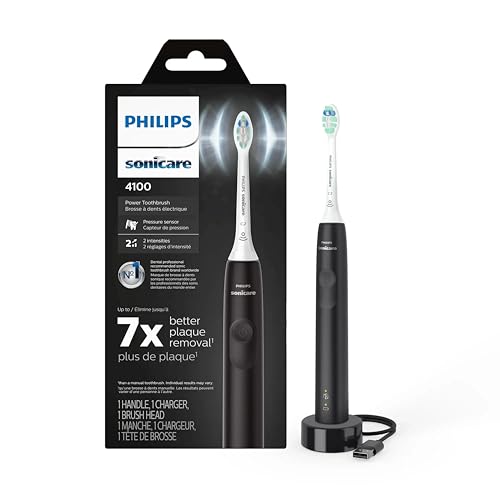
Philips Sonicare 4100 Series
Best for: Anyone who wants Sonicare's gentle sonic clean with a pressure sensor at the entry price
- Pressure sensor that warns and automatically softens the vibration
- Two intensity levels (low is the default each power-on)
- BrushSync reminder tracks head wear via a chip in the included C2 head
- SmarTimer + QuadPacer; roughly 14-day battery claim, USB charging stand
- +The community's default answer to "which Sonicare" — praised as doing what the expensive models do for cleaning
- +Pressure sensor that warns and softens the vibration, plus low/high intensities
- +BrushSync head-replacement reminder and a roughly 14-day battery claim independent testing comfortably beat
- −One brush head in the box, and the case it ships with holds heads rather than the handle; the per-head economics are the real cost
- −Even the low intensity feels strong at first; some pressure-sensitive users never adjust
(Affiliate link) · Free shipping on eligible Prime items
Why We Recommend It
The 4100’s community record is unusual: across the five years of threads we read it’s the most-endorsed specific Sonicare model, and we found essentially no complaints about this exact model’s cleaning. “I bought the 4100 and it’s perfect” is the register the praise arrives in, and the May consensus from our broader Sonicare research was blunt — it does what the expensive models do for cleaning. That squares with the evidence picture for powered brushes generally: the Cochrane review found powered brushes modestly outperform manual, and the ADA’s guidance is that any proper brush used well does the job — so paying more buys features, not checkup results.
What about $56 buys here, per Philips’ spec for the 4100 Series: a pressure sensor that both warns you (the vibration pattern changes) and automatically softens the motion; two intensities; a BrushSync chip in the included C2 head that flashes amber when the head is genuinely worn; and a 14-day battery claim that independent testers at Electric Teeth beat comfortably in their measurements — 17 days at high intensity, 41 at low. EasyStart, which ramps the power up gradually over the first 14 sessions, was described on this handle’s earlier Amazon listing; the listing Amazon serves as of September 2026 does not mention it, so treat it as likely rather than promised.
The honest negatives: one head in the box, a case that holds heads rather than the handle, and the intensity itself. One owner who bought it specifically because they brush too hard found even the low setting “just too much” and went back to manual after four nights. That’s the minority report — but if vibration sensitivity is your situation, sonic isn’t automatically gentle, and the low-is-default-every-power-on behavior (annoying to owners who prefer high) is at least the right default for adjustment.
Who It’s Best For
Buyers whose dentist said “get a Sonicare,” over-brushers who want the sensor guardrail, and anyone stepping up from the DailyClean tier for the pressure sensor. Electric Teeth points case-shoppers at the 4300 tier, which adds the travel case and a second head for more money; if the case is the only reason, a cheap generic case closes the gap.
Potential Downsides
The per-head economics are the real objection — one buyer put it plainly: a budget brand offers six heads for less than the 4100’s price with one. (We haven’t verified those multi-head budget brands, so we can’t grade that trade — what we can price is this one.) Genuine C2 heads live-read at about $7.50 to $12.50 per head depending on pack size, so the standard three-month replacement cadence runs roughly $30-50 a year — comparable to the handle itself every 12 to 18 months. One long-time owner who tried cheaper third-party heads found they “don’t seem to wield as much power as the originals” and switched back. Budget accordingly: the handle price is the entry fee, the heads are the subscription.
(Affiliate link) · Free shipping on eligible Prime items
Philips Sonicare 1100 — Bare-Bones Budget
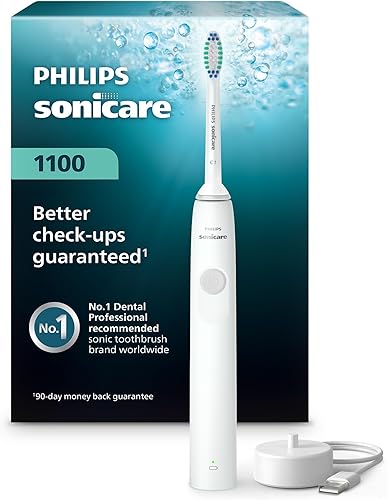
Philips Sonicare 1100
Best for: First-timers who want the sonic feel and a timer for about $36 less, and can live without a pressure sensor
- Sonic action with the 2-minute QuadPacer timer
- EasyStart gradual power ramp over the first 14 uses, per the listing
- About 14-day battery; extra-soft SimplyClean head included
- +The cheapest way into Sonicare's sonic feel, with the 2-minute quadrant-paced timer intact
- +EasyStart ramps power up gradually over the first 14 uses, per the listing
- −No pressure sensor — the guardrail most 4100 buyers are shopping for
- −Single intensity and a basic head in the box
(Affiliate link) · Free shipping on eligible Prime items
Why It’s Here
At about $20 it answers the “do I really need the 4100?” question honestly. In the one community comparison that lists it directly, the 1100 is the ultra-budget pick — simple sonic cleaning, gentle on gums, “not very powerful and no pressure sensor.” That’s the whole trade: same sonic category and timer, none of the guardrails. If you brush with reasonable pressure and want the sonic feel cheaply, it’s a fine starter; if a dentist has ever told you to ease up, spend the extra $36 on the 4100’s sensor — that sensor is the reason the 4100 exists.
(Affiliate link) · Free shipping on eligible Prime items
Oral-B Pro 1000 — Best Oscillating Alternative
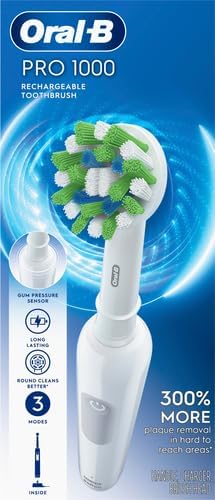
Oral-B Pro 1000
Best for: People who want the other heavily studied cleaning motion — round-head oscillating — with its own pressure sensor
- Oscillating-rotating round head — the category with the strongest independent evidence
- Gum-pressure control that stops the pulsations
- Daily Clean, Sensitive, and Whitening modes on current units
- +The most extensively studied powered-brush category in independent reviews
- +Pressure sensor that stops the pulsations, three modes on current units
- −Louder and buzzier than the 4100; the sensor gives no visible or audible signal
(Affiliate link) · Free shipping on eligible Prime items
Why It’s Here
The other half of the eternal question — and worth noting the community’s own budget pairing names Oral-B’s iO Series 3 alongside the 4100 too; we cover that model in the Pro 1000 review’s upgrade section. Close in price (about $6 apart at our last check), opposite feel: the Pro 1000’s round head physically oscillates against each tooth — a deeper trial record behind the category, more noise and vibration in the hand. One commenter writing as a dental professional split it usefully: a personal preference for Oral-B’s round heads, but a professional lean toward Sonicare for patients with periodontal disease — and either works as long as you use it. If you’ve never tried oscillating, our full Oral-B Pro 1000 review covers its own quirks, including the mid-life 3-mode refresh most old reviews miss.
(Affiliate link) · Free shipping on eligible Prime items
The rest of the Sonicare range
The 4300 tier — per Electric Teeth’s range guide, the 4100 plus a travel case and second head; worth it only if you’d buy those anyway. The tiers below — the community’s shorthand for sub-4100 Sonicares is the same clean with fewer guardrails; the 1100 above is the version of that trade we can vouch for from a live spec read. 5000-series and up — more modes and accessories, same fundamental clean; the community’s premium-tier verdict in our research was consistently that basic models clean just as well, with durability complaints concentrating in the premium DiamondClean tier rather than the basic handles.
Buyer’s Guide: Is the 4100 Worth It, and Which Sonicare Should You Actually Buy?
The short answer on value
The 4100 is the pressure-sensor step up from the sensorless 1100 tier, and the community treats it as the sensible default. One thing to know about the star rating on its card: as of September 2026 Amazon sells the 4100 through a newer bundle listing of the same handle, and that listing carries 4.5 stars on 595 ratings, where the listing it replaced had gathered about 20,000 at 4.2 stars. The newer pool is young, so read the average as an early signal rather than a settled verdict. In the threads we reviewed, the complaints are expectation mismatch around intensity and box contents rather than cleaning failures.
4100 vs the cheaper tiers
Buy down to the 1100 only if the pressure sensor genuinely doesn’t matter for you. The sensor is the feature that changes brushing behavior; timers just measure it.
4100 vs the premium tiers
Community consensus from our broader Sonicare research is blunt: basic models clean just as well, and the longest-lived handles in owner threads are the cheap ones. Premium buys modes, screens, and cases.
First week: what’s normal
Strong vibration — even on low — is a recurring first impression in owner accounts, and if your handle has EasyStart, as its earlier listing described, it is already softening the power over the first 14 sessions. Give it the two weeks before judging. The brush restarts on low intensity every power-on; press the button again within a couple of seconds to get high.
Set realistic expectations
A brush disrupts plaque; it doesn’t remove established stains beyond surface polish, fix recession, or replace flossing. Bleeding or receding gums is a dentist conversation, not a brush choice. Owners with excellent routines still get cavities in hard-to-reach wisdom teeth — a brush is one tool, and twice-yearly cleanings stay on the menu.
Frequently Asked Questions
Q: Is the “ProtectiveClean 4100” the same as the “4100 Series”? A: No — the ProtectiveClean (HX681x models) is the older, discontinued generation; the 4100 Series (HX3681 models) is the current one with two intensities, a lighter handle, and USB charging. Retail listings mislabel them often enough that the model number is the only reliable check.
Q: Sonicare 4100 or Oral-B Pro 1000? A: Sonic vs oscillating at the same price, both with pressure sensors. The 4100 is quieter and gentler-feeling; the Pro 1000’s category has the stronger independent evidence and the louder, buzzier feel. A commenter writing as a dental professional leaned toward Sonicare for periodontal patients while personally preferring Oral-B — and emphasized that consistency beats the choice.
Q: What’s the difference between the 4100 and the 3100 or 2100? A: Descending the range strips guardrails while the cleaning motion stays in the same family — the community’s shorthand is the same clean with fewer of the extras. The spec trade we can vouch for from a live read is the 1100’s: no pressure sensor, single intensity. That’s why it’s on this page as the honest budget answer.
Q: Is it supposed to feel this intense, even on low? A: A strong first-week vibration is normal, and the handle’s earlier listing described an EasyStart ramp over the first sessions. Most owners adjust within the two-week window; a small minority with real vibration sensitivity don’t, and an oscillating brush or a manual with good technique is a legitimate answer.
Q: Why does it always start on the low intensity? A: That’s the design default every power-on. Press the power button a second time within about two seconds of starting to switch to high — a repeated small annoyance among owners, but deliberate on Philips’ part.
Q: Do third-party replacement heads work? A: They fit, and they’re cheaper. The one owner account in our research found they feel weaker than brand heads and went back to the originals. If you try them, judge by whether your checkups stay clean, and let the BrushSync reminder pace replacements for brand heads.