


Best Teeth Whitening Products of 2026: Every Format Compared
A brighter smile is a popular cosmetic goal (the ADA notes consistent consumer demand for whiter, brighter teeth), and the market is packed with options ranging from drugstore strips to LED-powered kits. This guide is the format-level map: one best pick for strips, trays, toothpaste, overnight serums and LED devices, so you can work out which route suits you before you shop a shortlist. But which products are worth your money, and which are more hype than help? We dug into the research, consulted dentist-published guidance, and narrowed the field to seven picks across those five formats to bring you this straightforward guide to the best teeth whitening options available right now. According to Cleveland Clinic, over-the-counter whitening products can deliver noticeable results when used consistently, though professional treatments typically offer faster outcomes. Where a format has a deeper comparison of its own, the section below links onward to it.
How We Evaluated
We assessed each product across five criteria:
- Active ingredients and concentrations: Does the formula align with evidence-based whitening science?
- Ease of use: How practical is the application process for everyday routines?
- Sensitivity risk: Does the product account for users with sensitive teeth or enamel concerns?
- Value for money: Is the price proportionate to the results and quantity provided?
- User feedback: For every pick sold on Amazon we read the listing and, where Amazon shows one, its review summary for recurring patterns in what buyers report, such as sensitivity, gum soreness, adhesion and how easy the gel is to apply. The dentist-dispensed Philips Zoom pick has no retail listing, so we judged it on Philips’ own published claims.
We also rely on guidance from the American Dental Association (ADA), including the systematic reviews its whitening overview summarizes, plus Cleveland Clinic and Mayo Clinic guidance when evaluating safety claims.
Opalescence Go — Best Pre-Filled Tray Pick
Opalescence Go
Best for: Near-professional whitening at home
- 15% hydrogen peroxide in the box we link
- Pre-loaded UltraFit trays
- Potassium nitrate + fluoride for sensitivity
- 15–20 minutes a day for the 15% formula
- +Uses the same hydrogen peroxide chemistry as in-office treatments, at a home-safe concentration
- +Pre-loaded UltraFit trays adapt to most tooth shapes, a fix for ill-fitting strips
- +Includes potassium nitrate and fluoride to help minimize sensitivity
- −Priced higher than drugstore strips
- −Single-use trays add up over longer whitening courses
(Affiliate link) · Free shipping on eligible Prime items
Why We Recommend It
Opalescence Go comes from Ultradent, a company with deep roots in professional dental care, which says Opalescence is trusted by more than 25,000 dentists. These pre-filled, disposable trays use hydrogen peroxide, the same agent in-office treatments use, at the lower concentration the ADA describes for over-the-counter products.
Key Features
- The box we link is the 15% hydrogen peroxide formula, 10 treatments; Ultradent also sells a 10% version
- Pre-loaded UltraFit trays that adapt to most tooth shapes
- Wear time of 15–20 minutes a day for the 15% formula, or 30–60 minutes for Ultradent’s 10%
- Includes potassium nitrate and fluoride to help minimize sensitivity
Who It’s Best For
People who want a near-professional experience without the dental office price tag. It’s also a strong choice for those who’ve struggled with ill-fitting strip applications.
Potential Downsides
It’s priced higher than drugstore strips. The trays are single-use, which adds up over longer whitening courses. If you have crowns, veneers or fillings, Ultradent’s listing warns they may not whiten like natural teeth.
Pre-filled trays are one route into a full at-home course; boxed tray and LED systems are another. If that is the direction you want, our best at-home teeth whitening kits roundup ranks complete systems on peroxide strength and cost per treatment.
(Affiliate link) · Free shipping on eligible Prime items
Crest 3D Whitestrips Professional Effects — Best Strip-Format Pick
Crest 3D Whitestrips Professional Effects
Best for: A mainstream strip with the largest review base on this page
- Hydrogen peroxide strips, 45 minutes a day
- 22 treatments (44 strips) per box
- No-slip grip technology
- 19 levels whiter in 22 days, per Crest
- +Part of the Crest 3D Whitestrips line, which holds the ADA Seal of Acceptance
- +More than 100,000 ratings, the largest review base on this page
- +Crest's own figure is 19 levels whiter in 22 days
- −Amazon's review summary reports some buyers had painful sensitivity or gum soreness
- −The same summary is split on adhesion, with some buyers saying the strips don't stick properly
(Affiliate link) · Free shipping on eligible Prime items
Why We Recommend It
The Crest 3D Whitestrips line holds the ADA Seal of Acceptance, which the ADA bases on its finding that the product “is safe and has shown efficacy in whitening natural teeth” when used as directed. The ADA’s Seal listing pictures other Whitestrips variants rather than Professional Effects, so read the Seal as a mark on the line. Crest’s own claim for Professional Effects is 19 levels whiter in 22 days, and with more than 100,000 ratings it has the largest review base on this page.
Key Features
- From the Crest 3D Whitestrips line, which holds the ADA Seal
- 22 treatments (44 strips) per box
- Hydrogen peroxide formula; no-slip grip technology
- Wear time: 45 minutes once a day, per Crest
- 19 levels whiter in 22 days, per Crest
Who It’s Best For
First-time whiteners looking for a reliable, well-documented product. Also well-suited for those who want a strips format that’s easy to use during low-key activities at home.
Potential Downsides
Amazon’s review summary reports some buyers had painful sensitivity or gum soreness, and it is split on adhesion, with some buyers saying the strips don’t stick properly. The ADA notes that a risk of temporary sensitivity comes with all forms of bleaching.
Crest is the strip we put forward for the format as a whole. If strips are the route you have already settled on, our best whitening strips comparison weighs the field on peroxide strength, sensitivity and cost per treatment.
(Affiliate link) · Free shipping on eligible Prime items
Philips Zoom Take-Home Whitening: Dentist-Fitted Custom Trays
Philips Zoom Take-Home Whitening (DayWhite or NiteWhite)
Best for: A dentist-prescribed course in trays made to fit your teeth
- Custom trays made by your dentist
- DayWhite: hydrogen peroxide gel, 30 to 90 minutes a day
- NiteWhite: carbamide peroxide gel, 2 to 4 hours a day or overnight
- Up to 9 shades whiter after 14 days, per Philips
- +Your dentist makes trays that fit your teeth and gum line, per Philips
- +Choice of wear time: DayWhite 30 to 90 minutes a day, NiteWhite 2 to 4 hours a day or overnight
- +Philips says its take-home gels whiten teeth up to 9 shades after 14 days of use
- −Starts with a dental visit: it is prescribed and dispensed by your dentist, not sold as a retail box
- −Philips says some people may experience temporary tooth sensitivity during treatment
Dispensed through dental offices: ask your dentist about take-home Zoom
Why We Recommend It
Philips’ in-office Zoom treatment, WhiteSpeed, pairs hydrogen peroxide with a blue LED lamp, and Philips says it whitens up to 8 shades in one visit. The take-home side of the range is a different product: your dentist makes custom trays that fit your teeth and gum line, then prescribes a gel for you to wear at home. For custom trays, Philips describes two gel styles. DayWhite uses hydrogen peroxide and is worn 30 to 90 minutes a day; NiteWhite uses carbamide peroxide, which Philips says acts more slowly, and is worn 2 to 4 hours a day or overnight. Philips says its take-home gels whiten teeth up to 9 shades after 14 days of use, which is the maker’s figure rather than an independent one. Because every Zoom treatment starts with a consultation with your dentist, the path to buying one runs through the practice rather than a retail box.
Key Features
- Custom trays your dentist makes to fit your teeth and gum line
- DayWhite: hydrogen peroxide, worn 30 to 90 minutes a day
- NiteWhite: carbamide peroxide, worn 2 to 4 hours a day or overnight
- Philips says every take-home formula includes ingredients that help protect enamel and reduce sensitivity
Who It’s Best For
People who want a dentist to choose the strength and fit the trays, and who are happy to book a consultation first. Also appealing for anyone who has already tried strip-based products without satisfaction.
Potential Downsides
You need a dental visit before you start, and because it’s dispensed through dental offices, you can’t simply add it to a cart; the cost comes from your practice. NiteWhite asks for 2 to 4 hours of wear a day or overnight, far longer than a strip. Philips says some people may experience temporary tooth sensitivity during treatment, and the ADA notes sensitivity is a risk with all forms of bleaching.
Sensodyne Extra Whitening Toothpaste — Best for Sensitive Teeth
Sensodyne Extra Whitening Toothpaste
Best for: Sensitive teeth wanting gradual whitening
- Potassium nitrate for sensitivity relief
- Silica paste Haleon says gently polishes away surface stains
- Fluoride for enamel support
- Daily-use toothpaste format
- +5% potassium nitrate for sensitivity, in a silica paste Haleon says gently polishes away surface stains
- +Fluoride supports enamel and it fits daily brushing with no special application
- +Its drug-facts label says it builds increasing protection against painful sensitivity
- −Whitening is gradual compared with peroxide strips or trays
- −Surface-stain focused, not a deep bleaching system
(Affiliate link) · Free shipping on eligible Prime items
Why We Recommend It
For many people, whitening and sensitivity are in direct tension: the ADA lists temporary tooth sensitivity as one of the two most common side effects of whitening. Sensodyne Extra Whitening is designed to thread that needle: its hydrated silica is what Haleon says gently polishes away surface stains, while 5% potassium nitrate is the active its drug-facts label lists for building protection against painful sensitivity. A Mayo Clinic dentist notes that whitening makers add potassium nitrate and fluoride to help minimize tooth sensitivity.
Key Features
- Potassium nitrate for sensitivity relief
- Hydrated silica for surface-stain polishing, per Haleon
- Fluoride included for enamel support
- Daily-use toothpaste format: no special application required
Who It’s Best For
Anyone who has experienced discomfort with traditional whitening products, or those looking for a surface-stain whitening boost to use between more intensive treatments. It’s also a sensible everyday option for people with naturally sensitive teeth. For a full comparison of toothpastes designed for this concern, see our roundup of the best whitening toothpaste for sensitive teeth.
Potential Downsides
Whitening results will be more gradual compared to peroxide-based strip or tray products. This is a surface-stain-focused product, not a deep bleaching system. Managing expectations here is important.
(Affiliate link) · Free shipping on eligible Prime items
GLO Science So Brilliant Teeth Whitening Kit (Sensitivity Free) — Best LED Device Pick
GLO Science So Brilliant Teeth Whitening Kit (Sensitivity Free)
Best for: Tech-forward users wanting a device-led approach, and who can accept a thin review base
- Warming illuminating mouthpiece that activates the gel, per the listing
- Three daily 8-minute sessions, per the listing
- Up to 10 shades in five days, the maker's claim
- Safe for veneers, crowns, and bridges, per the listing
- +Illuminating mouthpiece designed by dentists that warms to activate the gel, per the listing
- +Three daily 8-minute sessions, with up to 10 shades in five days claimed by the maker
- +The maker says it is safe for veneers, crowns, and bridges
- −At about $300 it is the most expensive option on this list
- −Proprietary gel refills tie ongoing costs to the GLO ecosystem
- −Thin review base at our last read, so we do not link it for purchase
Under our review-count floor at our last read, so no buy link until it clears.
Why We Recommend It
The So Brilliant kit is GLO’s current version of its device-led system. The listing describes an illuminating mouthpiece that reaches a gentle warmth to activate the gel, three 8-minute sessions a day, and a whitening claim of up to 10 shades in five days, which is the maker’s number rather than a tested one. We keep it on the page as the reference point for heat-plus-light devices, but without a buy link: at our last read the listing carried far fewer reviews than we require before we send readers to a product.
Key Features
- Illuminating mouthpiece that warms to activate the gel, per the listing
- Three daily 8-minute sessions, per the listing
- Up to 10 shades in five days, the maker’s claim
- Marketed as sensitivity free and safe for veneers, crowns, and bridges, per the listing
Who It’s Best For
Tech-forward users who prefer a gadget-integrated approach to whitening. Also appeals to those who’ve had gum sensitivity with open-tray or strip products.
Potential Downsides
At about $300 it is the most expensive option on this list. The gel refills are proprietary, meaning ongoing costs are tied to the GLO ecosystem: 10-vial refills of the standard 6% gel run about $65 at our read, and GLO also sells a gingermint pod version that it labels “Sensitivity Free,” at the same price and the same 6% peroxide strength. (Affiliate link) The device needs charging, and the review base was thin at our last read, which is why there is no buy button on this card.
Colgate Optic White Overnight Whitening Pen: Best Overnight Treatment
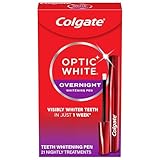
Colgate Optic White Overnight Teeth Whitening Pen
Best for: Busy people wanting passive overnight whitening
- Click-to-dispense pen, applied to clean, dry teeth
- Hydrogen peroxide formula
- No trays, strips, or devices required
- Enamel safe for daily use, per Colgate
- +Passive overnight whitening: click the pen, apply before bed, no trays or strips
- +Backed by Colgate with a 60,000-plus rating history
- +Hydrogen peroxide formula that Colgate calls enamel safe for daily use
- −In a 2020 review the ADA cites, paint-on gels whitened about as well as whitening toothpaste, which fell short of strips
- −Amazon's review summary reports the gel can harden on the brush and be hard to apply evenly
- −Expect a toothpaste-level result, not a strip-level one: the low ratings come from buyers who report it did not whiten at all
(Affiliate link) · Free shipping on eligible Prime items
Why We Recommend It
Colgate’s Optic White Overnight Pen has carved out a distinct niche: you click the pen to dispense the gel onto clean, dry teeth before bed, let it work while you sleep, and brush it off when you wake up. The formula is powered by hydrogen peroxide. It’s a passive approach to whitening that fits naturally into an existing routine.
Key Features
- Click-to-dispense pen, applied to clean, dry teeth
- Hydrogen peroxide formula
- No trays, strips, or devices required
- Enamel safe for daily use, per Colgate
- Colgate claims it removes 15 years of stains in 1 week when used as directed
Who It’s Best For
Busy people who don’t want to carve out dedicated whitening time during the day. Also useful as a maintenance product following a more intensive whitening course.
Potential Downsides
Apply at bedtime, leave it on overnight and brush it off in the morning. Amazon’s review summary says the gel can harden on the brush and that some buyers find it hard to apply evenly or to remove from their teeth. A 2020 review cited in the ADA’s whitening overview found paint-on gels whitened about as well as whitening toothpaste, which in turn fell short of strips, and the ADA notes that the type of stain can change how many treatments you need. This listing is a single 0.08 oz pen.
(Affiliate link) · Free shipping on eligible Prime items
Lumineux Whitening Strips — Best Peroxide-Free Option

Lumineux Whitening Strips
Best for: Those wanting peroxide-free natural whitening
- Peroxide-free and bleach-free formula
- Dead Sea salt, coconut, sage, and lemon peel oil blend
- Worn 30 minutes per session
- Marketed as safe for sensitive teeth
- +Peroxide-free natural blend (Dead Sea salt with coconut, sage and lemon peel oils) suits those avoiding bleach
- +Dentist-formulated per the brand; in its own published 14-day trial, a peroxide strip caused significantly more sensitivity
- +Peroxide-free strips worn 30 minutes per session, per Lumineux
- −Works on surface stains; the ADA says changing a tooth's own color takes a peroxide bleaching reaction
- −Lumineux's routine is seven days in a row, then once or twice a week to maintain, and the box's 21 treatments are sold as a three-month supply
(Affiliate link) · Free shipping on eligible Prime items
Why We Recommend It
Not everyone is comfortable with peroxide-based products, whether due to sensitivity, personal preference, or medical considerations. Lumineux Whitening Strips use a natural ingredient blend (including Dead Sea salt, coconut oil, sage oil, and lemon peel oil) rather than hydrogen peroxide. The brand markets the formula as dentist-formulated, and in a 14-day trial it publishes, a peroxide strip caused significantly more sensitivity than its non-peroxide strip, with no significant difference in whitening: treat both as company claims rather than independent evidence.
Key Features
- Peroxide-free and free from bleach
- Marketed as enamel safe and “clinically tested & proven,” per the brand
- Worn 30 minutes per session, then removed
- Marketed as safe for sensitive teeth
Who It’s Best For
Those who want to avoid peroxide entirely, including people with a history of significant sensitivity or those who prefer natural formulations. Lumineux labels the strips for adults, so they suit adults cleared for over-the-counter whitening but cautious about stronger chemistry.
Potential Downsides
Without peroxide it works on surface stains: the ADA describes changing a tooth’s own color as a chemical bleaching reaction, most commonly with carbamide or hydrogen peroxide, and Amazon’s review summary is mixed on how much these strips whiten. Best understood as a stain-maintenance or mild whitening product rather than a dramatic transformation solution. Lumineux’s routine is seven days in a row, then once or twice a week to maintain.
(Affiliate link) · Free shipping on eligible Prime items
Buyer’s Guide: What to Look For
Understand the Active Ingredient
Most whitening products that bleach rely on hydrogen peroxide or carbamide peroxide (which releases about a third of its content as hydrogen peroxide). According to the ADA’s whitening overview, these are the most common bleaching ingredients, and reducing stains inside the tooth takes that chemical reaction. Peroxide-free alternatives work on surface stains instead, the way the ADA says whitening toothpastes mainly rely on abrasives.
Check the Concentration
The ADA notes that sensitivity can be more common with higher concentrations of the active agent. Over-the-counter products carry carbamide or hydrogen peroxide at lower concentrations than dentist-supplied gels, which the ADA says typically run 10% to 38% carbamide peroxide for home trays; in-office “power bleaching” uses concentrated hydrogen peroxide under dental supervision.
Match the Format to Your Lifestyle
- Strips are convenient and widely accessible
- Trays conform to the teeth, and Cleveland Clinic says gel-filled trays work fastest
- Serums and toothpastes integrate easily into daily habits
- LED kits add a light step; the ADA describes lights in in-office systems as “intended to accelerate and enhance” bleaching, a design aim rather than a settled result
Look for the ADA Seal
The ADA Seal of Acceptance is a meaningful marker. Per the ADA’s whitening overview, a seal means the company has demonstrated that the product meets ADA Seal Program requirements for safety and effectiveness when used as directed.
Consider Sensitivity Before You Start
If you already have sensitive teeth, look for formulas containing potassium nitrate or fluoride, which may help with reducing discomfort during treatment. Starting with lower concentrations and shorter sessions is also a sensible approach. Our guide to the best toothpaste for whitening includes sensitivity-aware picks that work well alongside active whitening treatments.
Manage Expectations Around Dental Work
Whitening products do not change the color of crowns, veneers, bonding, or fillings. If you have significant dental restorations in visible areas, consult your dentist before starting any whitening regimen. If you’re weighing cosmetic options like veneers against other treatments, our veneers vs. crowns comparison may help clarify your choices. If you’d rather try a non-peroxide, purely cosmetic route to a brighter look, our best purple toothpaste picks work by optics rather than bleaching.
FAQ
Q: Should I start with strips or a tray system? A: Strips are the cheaper, lower-commitment route and a sensible default for a first whitening course. Trays conform to the teeth (Ultradent says its prefilled trays work even when teeth aren’t straight), and Cleveland Clinic notes gel-filled trays work fastest, sometimes within a few days, while strips and gels typically lighten teeth within two weeks. This page exists to settle that format question first: it names one pick per format, and the tray and strip sections above each link onward to a deeper comparison, so you only shop a shortlist once you know which route you want.
Q: Are at-home whitening products safe to use? A: When used as directed, most ADA-accepted whitening products are considered safe for healthy adults. According to the ADA, the most common side effects are temporary tooth sensitivity and gum inflammation. We recommend consulting your dentist before beginning any whitening program, especially if you have crowns, veneers, or existing sensitivity.
Q: How long does teeth whitening last? A: Results vary based on diet, habits, and the product used. A Mayo Clinic dentist says no whitening option is permanent, and puts dentist-supplied tray results at about two years. Foods and drinks like coffee, tea, wine, and tobacco can accelerate re-staining.
Q: Can whitening damage tooth enamel? A: Cleveland Clinic’s dentist says teeth whitening is considered safe and that dentists haven’t seen an increase in problems like cavity risk or tooth fractures after whitening, though lab research points to possible erosion and changes in tooth microstructure with aggressive bleaching. The ADA’s Seal findings apply when a product is used as directed, so follow the instructions and don’t overdo it.
Q: What’s the difference between whitening and bleaching? A: The ADA uses “bleaching” for the chemical process: reducing stains inside the tooth involves a chemical reaction that changes the tooth’s color, most commonly with carbamide or hydrogen peroxide. “Whitening” is the broader term and also covers whitening toothpastes, which the ADA says rely mainly on abrasives to remove surface stains.
Q: Will whitening strips work on veneers or crowns? A: No. Whitening products work on natural tooth enamel only and will not change the shade of dental restorations. If you have visible crowns or veneers, speak with your dentist about your options before using whitening products.
Q: How often should I whiten my teeth? A: This depends on the product and your sensitivity level. Cleveland Clinic notes that some products are used once a day and others twice, for a week, two weeks or longer, and its advice is to read and follow the instructions. Daily-use products like whitening toothpastes and overnight serums are formulated for ongoing use. Always follow the manufacturer’s guidelines and consult your dentist if you’re unsure. For maintenance between treatment courses, a daily whitening toothpaste can help keep results fresh.
Our Methodology
We at Dental Roundup approach every product roundup as a research and synthesis exercise rather than a first-hand clinical trial. Our process for this guide included:
- Review of clinical and maker sources: the ADA’s whitening overview, Cleveland Clinic and Mayo Clinic guidance, and each maker’s own directions and published claims where the maker publishes them
- Ingredient analysis cross-referenced against ADA guidance and the systematic reviews it summarizes on the safety and efficacy of common whitening agents
- Amazon and retail data review to assess real-world user satisfaction and identify consistent patterns in reported experiences
- Format and use-case mapping to ensure our recommendations reflect diverse user needs, from sensitive teeth to fast-result priorities
- No payments from brands influenced inclusion in this guide. Affiliate links are present but do not affect editorial decisions
We update our roundups when new products launch, formulas change, or new guidance from dental organizations becomes available. This article reflects the best available information as of our September 2026 update.