If you’re searching for dental probiotics, chances are you’ve already tried the standard playbook (brushing, flossing, mouthwash) and still can’t shake bad breath, bleeding gums, or recurring cavities. You’re not alone. Dental professionals on Reddit and oral health forums increasingly point to the oral microbiome as the missing piece: your mouth hosts over 700 bacterial species, and killing everything with antiseptic mouthwash doesn’t distinguish the harmful from the protective. Oral probiotics take the opposite approach, introducing beneficial strains that compete with the bacteria causing problems. The catch? Not all strains do the same thing, most general gut probiotics don’t colonize the mouth at all, and the category is still emerging: making it easy to waste money on products that sound scientific but lack real evidence. We compared the strains, delivery methods, and clinical backing behind available dental probiotics to find the options worth trying.
How We Evaluated Dental Probiotics
We focused on four criteria specific to oral probiotics:
- Strain specificity: Does the product use strains actually studied for oral health? BLIS K12 and BLIS M18 (both Streptococcus salivarius) and Lactobacillus reuteri have the most published clinical evidence for dental outcomes. General gut strains like L. acidophilus have weaker oral-specific data.
- Delivery method: Lozenges and chewables that dissolve in the mouth give probiotic bacteria direct access to oral surfaces. Swallowed capsules bypass the mouth entirely, which limits colonization where it matters.
- CFU count and viability: Colony-forming units matter, but only if the bacteria are alive when you take them. We prioritized products with shelf-stable formulations or documented viability testing.
- Real-world feedback: We researched what people in oral health communities, dental professional forums, and halitosis support groups actually report about each product’s effectiveness.
NOW OralBiotic
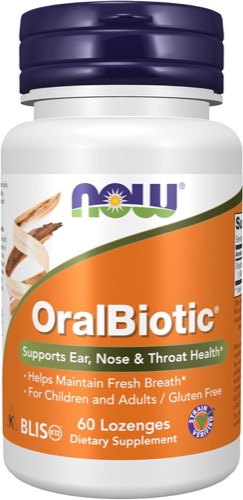
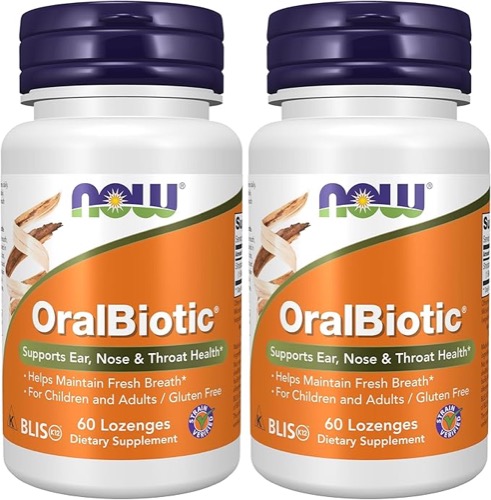
NOW OralBiotic (BLIS K12, 60 Lozenges)
Best for: Bad breath prevention: the most established oral probiotic with the clinically studied BLIS K12 strain in a dissolving lozenge format
- BLIS K12 strain — the most researched oral probiotic for halitosis
- 1 billion CFU per lozenge in a slow-dissolve format
- Strain-verified by the manufacturer for identity and potency
- Room-temperature stable — no refrigeration required
- 60-day supply at one lozenge per day
- +BLIS K12 is the oral probiotic strain with the most clinical evidence for reducing bad breath
- +Dissolving lozenge delivers bacteria directly to oral surfaces rather than the gut
- +Room-temperature stable, no refrigeration required
- −At 1 billion CFU per lozenge, the dosage is lower than some competitors
- −Effects are gradual: 2-4 weeks before most users notice a difference
(Affiliate link) · Free shipping on eligible Prime items
Why We Recommend It
BLIS K12 is the oral probiotic strain with the most clinical evidence behind it. Isolated from the mouths of children who naturally resisted strep throat and ear infections, Streptococcus salivarius K12 has been studied specifically for its ability to reduce halitosis by competing with the sulfur-producing bacteria that cause bad breath. NOW Foods, a well-established supplement manufacturer, delivers it in a dissolving lozenge: the format that actually matters for oral colonization, since the bacteria need to coat oral surfaces rather than pass through to the gut.
The lozenge dissolves slowly in the mouth, giving K12 time to adhere to the tongue and throat where odor-causing bacteria concentrate. For people whose bad breath persists despite good hygiene (a pattern that comes up constantly in halitosis forums), this is one of the few products that addresses the microbial root cause rather than just masking the smell. At around $15 as of this writing for the 60-day supply (roughly 25 cents a day), it’s also an inexpensive way to test a strain-specific approach.
Key Features
- BLIS K12 (Streptococcus salivarius): clinically studied oral probiotic strain
- 1 billion CFU per lozenge, strain-verified
- Dissolving lozenge format for direct oral colonization
- Shelf-stable: no cold chain required
- Non-GMO, manufactured under GMP standards
Who It’s Best For
People dealing with persistent bad breath that doesn’t respond to brushing, flossing, and mouthwash alone. Particularly relevant if a dentist has ruled out dental causes (cavities, gum disease) and the problem seems to originate from the tongue or throat.
Potential Downsides
At 1 billion CFU per lozenge, the dosage is lower than some competitors, though the clinical studies supporting BLIS K12 used similar concentrations. Some users report the effects are gradual (2-4 weeks before noticing a difference) rather than immediate. The flavor is mild, which most people appreciate, but a few reviewers find the lozenges slightly chalky. If you’re looking for gum-specific benefits rather than bad breath, L. reuteri may be a better strain choice.
(Affiliate link) · Free shipping on eligible Prime items
NatureWise Oral Probiotics
NatureWise Oral Probiotics (L. reuteri, 60-ct 2-Pack)
Best for: Gum health and overall oral wellness: L. reuteri chewable tablets in a 120-day supply, at about $0.37 a day
- Lactobacillus reuteri — the strain most studied for gum inflammation
- Sugar-free mint chewable tablets
- 120 tablets total (2-pack) for a 4-month supply
- Suitable for both adults and children
- Non-GMO, manufactured in the USA
- +Pooled randomized trials show less gum bleeding when L. reuteri is added to a professional deep cleaning
- +Chewable tablet dissolves in the mouth for direct oral colonization
- +2-pack delivers a competitive per-day cost for sustained use
- −Only the 2-pack is readily available, raising the upfront cost
- −Better studied for gum health than for bad breath specifically
(Affiliate link) · Free shipping on eligible Prime items
Why We Recommend It
Lactobacillus reuteri is the strain the gum-health trials have tested, and the gains they measured are real but short-term. A systematic review and meta-analysis in the Journal of Clinical Periodontology pooled trials of L. reuteri added to scaling and root planing for chronic periodontitis: bleeding on probing fell (-14.66%, p = 0.003) and clinical attachment level gained 0.42 mm at short-term follow-up, with pocket-depth reduction reaching significance in moderate and deep pockets. A gingivitis-specific meta-analysis found the evidence thinner there, with no significant difference in gingival or plaque index against placebo. NatureWise delivers it in a chewable tablet format that dissolves in the mouth, and the 2-pack pricing makes it a competitively priced option for sustained use.
The reason this strain matters: L. reuteri secretes antimicrobial molecules including reuterin, and a review of the species credits that activity with inhibiting colonization by pathogenic microbes and remodeling the commensal microbiota. For people whose dentist keeps flagging inflammation despite good brushing habits, adding L. reuteri as an adjunct may help shift the microbial balance.
Key Features
- Lactobacillus reuteri: clinically studied for gingivitis and periodontitis
- Sugar-free mint flavor, chewable format
- 120 tablets total (60 per bottle, 2-pack)
- One tablet daily: 4-month supply
- USA-manufactured under cGMP standards
Who It’s Best For
People whose primary concern is gum health: bleeding when brushing, or early periodontitis being managed alongside professional cleaning. Also a strong choice for anyone who wants a general oral probiotic in a four-month supply; per day it costs a little more than the NOW lozenges above.
Potential Downsides
The 2-pack is the only size readily available on Amazon, which means a higher upfront cost (around $45) even though the per-tablet price is competitive. Some users report the chewable texture takes getting used to compared to traditional lozenges. The L. reuteri strain is better studied for gum health than for bad breath specifically: if halitosis is your main concern, BLIS K12 may be a better match.
(Affiliate link) · Free shipping on eligible Prime items
Luv Biotics Oral Probiotic Mint Lozenges
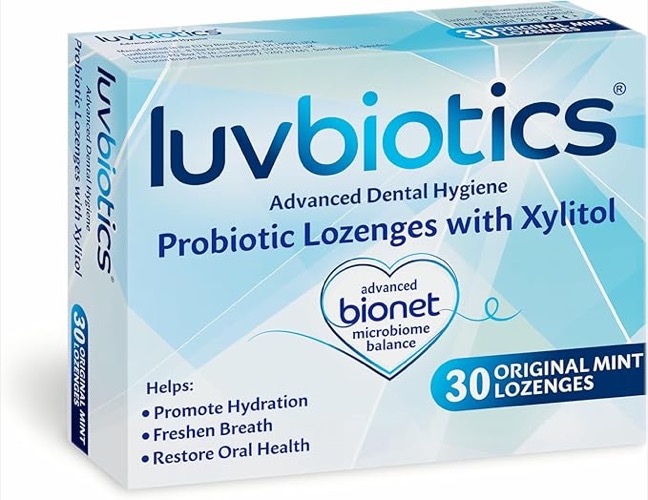
Luv Biotics Oral Probiotic Mint Lozenges (30 ct)
Best for: People with dry mouth who want cavity protection alongside relief: xylitol works against the bacteria that drive decay once saliva stops buffering acid, and aloe vera soothes irritated tissue
- Combines oral probiotics with xylitol and aloe vera
- Xylitol lowers cavity-causing bacteria with habitual use
- Sugar-free mint flavor with no artificial colors or preservatives
- Dissolving lozenge format for direct oral colonization
- 30-day supply at one lozenge per day
- +Combines xylitol, aloe vera and probiotics, so one lozenge covers cavity risk and tissue comfort
- +Xylitol has randomized-trial support: habitual use lowers cavity-causing S. mutans
- +Dissolving lozenge keeps ingredients in contact with oral surfaces for several minutes
- −Probiotic strains aren't clearly specified, making the clinical evidence harder to evaluate
- −30-count bottle is a smaller supply, so the per-day cost is less competitive than it appears
(Affiliate link) · Free shipping on eligible Prime items
Why We Recommend It
Luv Biotics earns its slot on xylitol and aloe rather than on its probiotic blend. Xylitol carries the clearest clinical record of anything in the lozenge: a systematic review of randomized trials found habitual xylitol use lowers levels of cavity-causing Streptococcus mutans, though it left the wider oral microbiome unchanged. That is the leg worth buying for, because faster decay is what a dry mouth does to teeth. Aloe vera (an anti-inflammatory that soothes irritated oral tissue) covers comfort.
For people on medications that reduce saliva flow (antidepressants, antihistamines, blood pressure drugs), the honest pitch is protecting teeth that have lost their main defense, not restoring the flow itself. The format still matters: dissolving a lozenge holds xylitol against oral surfaces for several minutes, closer to how the trials delivered it (gum and candies kept in the mouth) than a rinse would be.
Key Features
- Xylitol: clinical trials show lower S. mutans counts
- Aloe vera: soothes dry, irritated oral tissue
- Oral probiotic blend
- Sugar-free, no artificial colors or preservatives
- Dissolving lozenge for sustained oral contact
Who It’s Best For
People dealing with dry mouth (xerostomia) who want more than just moisture relief: this addresses the downstream effects of reduced saliva too. Also a good match for anyone who wants a multi-ingredient approach rather than a single-strain probiotic. Pairs well with a dedicated dry mouth toothpaste.
Potential Downsides
The probiotic strains aren’t as clearly specified as NOW’s BLIS K12 or NatureWise’s L. reuteri, which makes it harder to evaluate the clinical evidence behind them specifically. The one trial that tested whether adding probiotics to xylitol changes anything measurable in a dry mouth found that it did not: in a 12-week study of adults with low salivary flow, all three groups chewed xylitol gum, flow rate and saliva pH improved across the board, and the probiotic arms were no different from placebo. At 30 lozenges per bottle (around $12 as of this writing, which works out to about 40 cents per lozenge), it’s a smaller supply than the 60-count competitors, so the per-day cost isn’t as competitive as it first appears. If bad breath or gum disease is your primary concern, a strain-specific product may be more targeted.
(Affiliate link) · Free shipping on eligible Prime items
MouthFlora Probiotic & Prebiotic Mouthwash
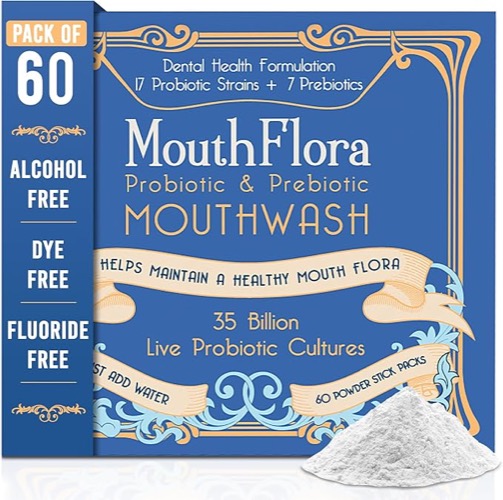
MouthFlora Probiotic & Prebiotic Mouthwash (60 Packets)
Best for: People who prefer a rinse over lozenges: a probiotic mouthwash with 17 strains and prebiotics that aims to support rather than strip the oral microbiome
- 17 probiotic strains plus 7 prebiotics per serving
- 35 billion CFU per packet — highest potency on this list
- Individual packets for freshness and portability
- Rinse format coats the entire mouth including hard-to-reach areas
- 60 packets for a 2-month supply
- +Rinse coats the entire mouth, including the gumline and back of the tongue
- +Designed to support the oral microbiome rather than strip it like conventional mouthwash
- +Individual sealed packets maintain probiotic viability until use
- −One of the pricier options on the list, for a category with limited long-term clinical data
- −Specific strains aren't individually studied for oral health the way BLIS K12 or L. reuteri are
(Affiliate link) · Free shipping on eligible Prime items
Why We Recommend It
Most conventional mouthwashes (even “alcohol-free” ones) are designed to kill bacteria indiscriminately. MouthFlora takes the opposite philosophy: instead of sterilizing your mouth, it delivers 17 probiotic strains plus prebiotics (food for the probiotics) in a rinse format. The idea is to support beneficial bacteria rather than carpet-bombing everything.
The rinse format has a genuine advantage over lozenges: it coats the entire mouth including the gumline, between teeth, and the back of the tongue where odor-causing bacteria concentrate. For people who’ve been using alcohol-free mouthwash and want to take the next step toward microbiome-friendly oral care, this is a logical upgrade. The individual packet format also keeps the probiotics sealed until use, which helps viability.
Key Features
- 17 probiotic strains for broad-spectrum oral microbiome support
- 7 prebiotics to feed and sustain beneficial bacteria
- 35 billion CFU per serving: highest count on this list
- Individual sealed packets maintain viability until use
- 60 packets: 2-month supply at one per day
Who It’s Best For
People who prefer a rinse format over lozenges or chewables, and anyone who wants to replace their conventional mouthwash with something designed to support rather than destroy the oral microbiome. Also convenient for travel thanks to the individual packets.
Potential Downsides
At around $40 for the two-month supply, it’s a significant investment for a category with limited long-term clinical data. The multi-strain approach sounds impressive, but the specific strains aren’t individually studied for oral health the way BLIS K12 or L. reuteri are—more isn’t necessarily better when the evidence base is thin. With 437 reviews, it has less real-world feedback than the other products on this list. The packets can also feel wasteful compared to a standard bottle.
(Affiliate link) · Free shipping on eligible Prime items
Buyer’s Guide: How to Choose a Dental Probiotic
Know Your Strains
The single most important factor in choosing a dental probiotic is which bacterial strain it contains. Not all probiotics are created equal for oral health:
| Strain | Primary benefit | Evidence level | Best for |
|---|---|---|---|
| BLIS K12 (S. salivarius) | Reduces halitosis-causing bacteria | Strong — multiple RCTs | Bad breath, throat health |
| BLIS M18 (S. salivarius) | Reduces plaque and cavity-causing bacteria | Moderate — fewer studies | Cavity prevention |
| L. reuteri | Reduces bleeding as an adjunct to deep cleaning | Moderate — pooled RCTs, short-term | Periodontitis, alongside professional treatment |
| L. acidophilus | General gut health | Weak for oral-specific outcomes | Gut-related breath issues |
If the product label doesn’t name a specific strain (just “probiotic blend” or “oral microbiome support”), be skeptical. The research is strain-specific, not genus-level.
Delivery Method Matters More Than You Think
This is the detail most buyers miss. For an oral probiotic to colonize your mouth, it needs to dissolve there: lozenges, chewables, and rinses all work. Capsules you swallow bypass the oral cavity entirely and deliver bacteria to your gut instead. A gut probiotic might still help breath issues that originate from digestive problems, but it won’t change your oral microbiome directly.
Timing: When to Take Dental Probiotics
The most common question in oral health forums: should you use mouthwash and a dental probiotic together? The answer depends on your mouthwash type:
- Antiseptic mouthwash (Listerine, chlorhexidine): Use the mouthwash first, wait 30 minutes, then use the probiotic. The mouthwash kills bacteria: including the beneficial ones you’re about to introduce.
- Alcohol-free mouthwash: Same principle: rinse first, probiotic second.
- Probiotic mouthwash (like MouthFlora): No timing issue: the rinse IS the probiotic.
Most products recommend using the probiotic after brushing and flossing, ideally before bed, so the bacteria have hours of undisturbed time to colonize.
Set Realistic Expectations
Dental probiotics are supplements, not medications. The clinical evidence is promising but still developing. Expect:
- 2-4 weeks before noticing changes in breath or gum health
- Ongoing use: benefits typically reverse when you stop
- Complementary, not replacement: probiotics don’t substitute for brushing, flossing, or professional cleanings
- Variable results: individual oral microbiomes differ, and what works for one person may not work for another
If you’re dealing with active gum disease, cavities, or severe halitosis, see a dentist first. Probiotics work best as an adjunct to good dental care, not as a substitute for it.
Frequently Asked Questions
Do dental probiotics actually work for bad breath?
The clinical evidence for BLIS K12 specifically is encouraging. Multiple studies show it reduces volatile sulfur compounds (the chemicals that cause halitosis) in people with chronic bad breath. Results aren’t universal, and the research is still relatively young, but K12 has more evidence behind it than most over-the-counter breath products. The key is using a dissolving lozenge, not a swallowed capsule, so the bacteria actually reach the oral cavity.
Can I take a dental probiotic with mouthwash?
Yes, but timing matters. Antiseptic mouthwash kills bacteria indiscriminately: including the probiotic bacteria you’re trying to introduce. Use mouthwash first, wait at least 30 minutes, then use your oral probiotic. Some people switch to a probiotic mouthwash instead of using both separately.
How long do dental probiotics take to work?
Most people report 2-4 weeks before noticing improvements in breath or gum health. The bacteria need time to establish colonies in the oral cavity. Consistency matters—skipping days resets the colonization process. If you haven’t noticed any change after 4-6 weeks of daily use, the product may not be the right strain for your specific microbiome.
What’s the difference between dental probiotics and gut probiotics?
Dental probiotics use strains that colonize the mouth: typically Streptococcus salivarius (BLIS K12, BLIS M18) or Lactobacillus reuteri. They come in lozenges or chewables that dissolve in the mouth. Gut probiotics use strains that survive stomach acid and colonize the intestines. A gut probiotic swallowed as a capsule won’t change your oral microbiome, though it may help breath issues that originate from digestive problems.
Are dental probiotics safe?
The strains used in dental probiotics (BLIS K12, L. reuteri, L. acidophilus) have strong safety profiles and are generally recognized as safe. Side effects are rare and typically mild: occasional bloating during the first few days as your microbiome adjusts. As with any supplement, check with your dentist or doctor if you’re immunocompromised or taking medications that affect your immune system.
Should I refrigerate my dental probiotics?
Check the product label. Most modern dental probiotics (including all products on this list) are formulated to be shelf-stable at room temperature. Refrigeration won’t hurt them and may extend viability, but it’s not required. Avoid storing them in hot, humid environments like a bathroom cabinet directly above a shower.