
Oil pulling is an ancient Ayurvedic practice where you swish oil in your mouth for 10-20 minutes to reduce oral bacteria and support gum health. A 2022 meta-analysis of nine randomized controlled trials found that oil pulling significantly reduced salivary bacterial counts compared to control groups, though the researchers noted that more high-quality studies are needed to establish definitive benefits.
The practice has seen a surge of interest: partly through social media, partly through growing demand for natural oral care. But the product landscape is confusing: should you use plain coconut oil, traditional sesame oil, or a modern flavored oil pulling mouthwash? We compared all three formats to find the six products that balance quality, convenience, and value for daily oil pulling.
What oil pulling is not: It is not a replacement for brushing, flossing, or professional dental care. The American Dental Association does not recommend oil pulling as a dental hygiene practice, citing the lack of reliable scientific studies showing it reduces cavities, whitens teeth, or improves oral health. There is likewise no evidence it can reverse cavities, regrow enamel, or cure gum disease. If you have active dental problems, see a dentist first.
How We Evaluated
We researched oil pulling products across five criteria, drawing on clinical literature, Ayurvedic tradition, and real user experiences from dental and wellness communities:
- Oil quality and sourcing: Is the oil organic, cold-pressed, and unrefined? For dedicated oil pulling products, what additional ingredients are included and why?
- Ease of use: Oil pulling requires 10-20 minutes of swishing. Products that reduce friction (better taste, pre-portioned amounts, pleasant texture) make it easier to maintain the habit.
- User-reported results: We cross-referenced thousands of Amazon reviews and community discussions for consistent feedback on taste, texture, gum health improvements, and any reported issues.
- Ingredient transparency: We checked for unnecessary additives, artificial sweeteners, or ingredients that undermine the “natural” premise of oil pulling.
- Value: Price per use varies dramatically between a $16 jar of coconut oil (months of use) and pre-portioned sachets. We evaluated each product in context of its format.
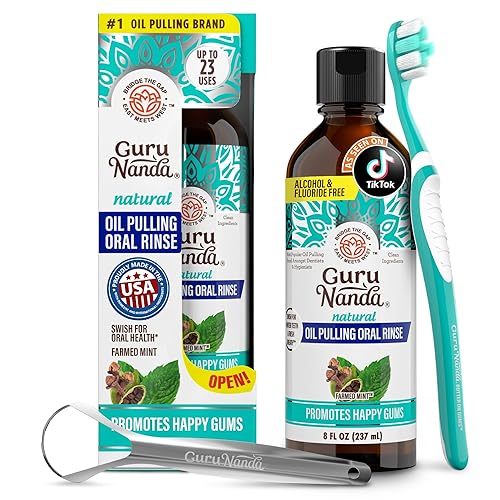
GuruNanda CocoMint Oil Pulling Mouthwash
GuruNanda CocoMint Oil Pulling Mouthwash
Best for: Most people who want a convenient, ready-to-use oil pulling product
- Coconut oil base with 7 essential oils and vitamins D3, E, and K2
- Alcohol-free, peroxide-free, no artificial colors
- Includes toothbrush and tongue scraper
- Peppermint flavor for a more pleasant swishing experience
- +Over 41,000 reviews provide unusually deep real-world feedback for an oil pulling product
- +Peppermint flavoring and liquid format remove the biggest friction points from daily oil pulling
- +Stays liquid at room temperature: no melting step needed
- −Social media driven popularity raises fair questions about review authenticity
- −Higher cost per use than plain coconut oil from a jar
(Affiliate link) · Free shipping on eligible Prime items
Why We Recommend It
GuruNanda CocoMint is the most popular oil pulling product on Amazon by a wide margin—over 41,000 reviews at 4.5 stars. That review volume matters in a category where most products have a few hundred reviews at best. It gives us an unusually deep pool of real-world feedback.
The formula is a coconut oil base blended with peppermint, tea tree, clove, oregano, and other essential oils, plus vitamins D3, E, and K2. The peppermint flavoring makes a meaningful practical difference: traditional oil pulling with plain coconut oil can feel oily and bland, and the 10-20 minute swishing time amplifies any unpleasant texture. GuruNanda’s minty flavor makes the experience closer to using a conventional mouthwash.
The liquid format (it stays liquid at room temperature, unlike plain coconut oil) also eliminates the step of waiting for a solid coconut oil spoonful to melt in your mouth. For people whose biggest barrier to oil pulling is the routine’s inconvenience, these quality-of-life improvements matter.
Key Features
- Coconut oil base with peppermint, tea tree, clove, oregano, sage, lemon, and frankincense oils
- Added vitamins D3, E, and K2
- 8 oz liquid bottle: stays liquid at room temperature
- Comes with toothbrush and tongue scraper
- Alcohol-free, peroxide-free, no fluoride
Who It’s Best For
This is our top recommendation for anyone new to oil pulling or anyone who tried plain coconut oil and couldn’t stick with it. The flavored, liquid format removes most of the friction from the practice. If you already practice oil pulling with plain oil and prefer the traditional approach, one of our pure oil picks below may be a better fit.
Potential Downsides
GuruNanda’s popularity has been driven significantly by social media marketing, which makes some buyers skeptical of the reviews. The formula contains many ingredients beyond coconut oil, which purists may view as unnecessary additions to a traditional practice. At $14.99 for 8 oz, the cost per use is substantially higher than buying a jar of plain coconut oil: you’re paying for convenience and flavor. One community member who tried both GuruNanda and plain oils reported that nanohydroxyapatite toothpaste ultimately helped their oral health more.
(Affiliate link) · Free shipping on eligible Prime items
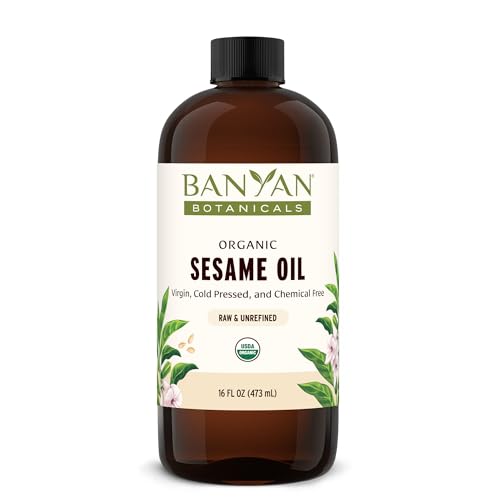
Banyan Botanicals Organic Unrefined Sesame Oil
Banyan Botanicals Organic Unrefined Sesame Oil
Best for: People who want the traditional Ayurvedic oil for oil pulling
- USDA certified organic, cold-pressed, unrefined
- Traditional Ayurvedic oil — sesame was the original oil for oil pulling
- Multi-use: oil pulling, abhyanga massage, cooking
- Established Ayurvedic brand with 3,400+ reviews
- +Sesame oil is the historically authentic Ayurvedic choice for oil pulling
- +USDA organic, cold-pressed, and unrefined: the three qualities that matter for oral use
- +Naturally liquid at room temperature, eliminating the melting step coconut oil requires
- −Distinct sesame taste that not everyone enjoys for 15-20 minutes of swishing
- −Not marketed specifically for oral use: you won't find oil pulling instructions on the label
(Affiliate link) · Free shipping on eligible Prime items
Why We Recommend It
If you want to practice oil pulling the way it was traditionally done in Ayurvedic medicine, sesame oil (not coconut) is the original choice. The classical Ayurvedic texts describe gandusha (oil pulling) with sesame oil specifically, and practitioners in the Ayurvedic community continue to favor it, particularly for gum health.
Banyan Botanicals is one of the most established Ayurvedic brands in the US market, and their sesame oil is USDA certified organic, cold-pressed, and unrefined: the three qualities you want for any oil you’re putting in your mouth. With 3,485 reviews at 4.6 stars, it has far more user validation than most specialty oils.
The main advantage of sesame oil over coconut for oil pulling is that it stays liquid at room temperature, so there’s no melting step. The flavor is mild and nutty, different from coconut but not unpleasant. In Ayurvedic practice, sesame is considered warming and grounding, while coconut is cooling.
Key Features
- USDA certified organic, cold-pressed, unrefined
- 16 oz bottle: lasts approximately one month for daily oil pulling at 1 tablespoon (0.5 oz) per session
- Multi-purpose: suitable for oil pulling, Ayurvedic massage (abhyanga), and cooking
- From Banyan Botanicals: an Ayurvedic brand founded in 1996
- Naturally liquid at room temperature
Who It’s Best For
Choose sesame oil if you’re following an Ayurvedic wellness practice, if you’ve read about oil pulling in traditional texts and want to use the historically authentic oil, or if you simply prefer a mild, nutty flavor over coconut. An Ayurvedic practitioner in an online community specifically recommended sesame oil for gum-related concerns.
Potential Downsides
Sesame oil has a distinct taste that not everyone enjoys for prolonged swishing. At $22.99 for 16 oz, it’s pricier than comparable coconut oil. This product is marketed primarily for massage (abhyanga), not specifically for oral use: the oil itself is the same, but you won’t find oil pulling instructions on the label. People with sesame allergies obviously cannot use this product. One common point of confusion: use raw, unrefined sesame oil for pulling; toasted sesame oil (the dark kind used in Asian cooking) is not appropriate.
(Affiliate link) · Free shipping on eligible Prime items
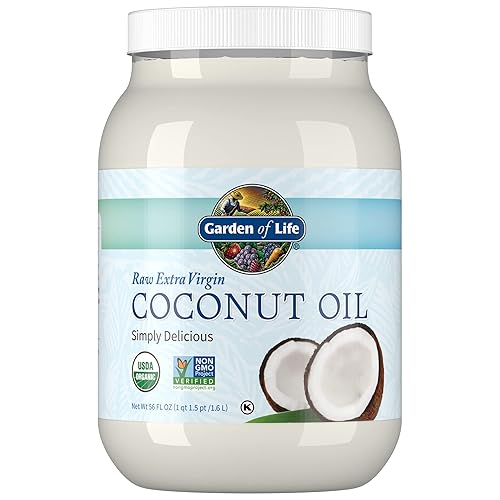
Garden of Life Raw Extra Virgin Organic Coconut Oil
Garden of Life Raw Extra Virgin Organic Coconut Oil
Best for: People who want a pure, versatile coconut oil they can also use for cooking and skin care
- Raw, extra virgin, cold-pressed, unrefined — no processing shortcuts
- USDA organic certified with 57 servings per jar
- Multi-use: oil pulling, cooking, baking, skin care, hair care
- From Garden of Life — a trusted name in organic whole-food supplements
- +Raw, cold-pressed, USDA organic: the highest quality standard for oil pulling coconut oil
- +57 servings per jar makes this the most economical option for regular practice
- +Multi-use for cooking, skin care, and oil pulling: nothing wasted if you stop pulling
- −Solid below 76°F, requires 15-30 seconds of melting in your mouth before swishing
- −No flavoring makes the oily texture unpleasant for many beginners during prolonged swishing
(Affiliate link) · Free shipping on eligible Prime items
Why We Recommend It
Most people who try oil pulling start with coconut oil, and for good reason: coconut oil contains lauric acid, which has antimicrobial properties. A 2016 randomized trial in the Journal of Contemporary Dental Practice divided 60 subjects into three arms — coconut oil pulling, a chlorhexidine rinse, and distilled water — so roughly 20 people swished coconut oil. After two weeks, both the coconut oil arm and the chlorhexidine arm showed a statistically significant drop in salivary Streptococcus mutans, a primary cavity-causing bacterium. A 2015 preliminary report in the Nigerian Medical Journal separately followed 60 adolescents with plaque-induced gingivitis for 30 days and recorded plaque and gingival index scores falling from day 7, but all 60 used coconut oil, so it had no comparison group. Both studies are small, so larger controlled trials are still needed.
Garden of Life’s coconut oil checks every box for oil pulling use: raw (never heated above 115°F), extra virgin, cold-pressed, unrefined, and USDA organic. That “raw” designation is a processing standard rather than a proven oral-health edge: neither trial cited above tested raw coconut oil against a refined one.
The multi-use factor is a genuine advantage. Unlike dedicated oil pulling products, a jar of coconut oil serves triple duty in your kitchen and bathroom. If you decide oil pulling isn’t for you, you haven’t wasted money on a single-purpose product.
Key Features
- Raw extra virgin, cold-pressed, unrefined, USDA organic
- 57-serving jar (1 tablespoon each)
- MCT-rich with naturally occurring lauric acid
- Multi-use for cooking, baking, skin care, hair care, and oil pulling
- Solid at room temperature: melts quickly in your mouth
Who It’s Best For
This is the best option if you want a pure, no-additive coconut oil for traditional oil pulling. It’s also the most economical choice for regular practice: at about $18.99 for a 57-serving jar (about $0.33 per session), the per-use cost is a fraction of dedicated oil pulling products. Good for people who want a multi-use product and don’t mind the 15-30 seconds of melting time before they start swishing.
Potential Downsides
Plain coconut oil has no added flavoring, which means the first few minutes of swishing have a heavy, oily texture that many beginners find unpleasant. Coconut oil is solid below 76°F (24°C), so you’ll need to scoop a tablespoon and let it melt in your mouth before you can start swishing effectively. Some users report that the unflavored experience is what made them quit oil pulling. If taste and convenience are your priorities, a flavored product like GuruNanda CocoMint may be a better starting point. Dispose of used oil in the trash, not the sink: coconut oil solidifies in pipes and can cause clogs.
(Affiliate link) · Free shipping on eligible Prime items
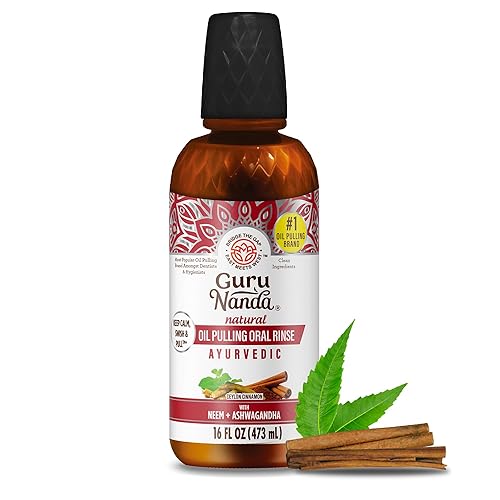
GuruNanda Cinnamon Oil Pulling Mouthwash
GuruNanda Cinnamon Oil Pulling Mouthwash
Best for: People who dislike mint or coconut flavor and want a warming cinnamon option
- Cinnamon flavor with neem and ashwagandha extracts
- 16 oz bottle — twice the size of the CocoMint for better per-ounce value
- 7 essential oils plus vitamins D3, E, and K2
- Alcohol-free, peroxide-free formula
- +Genuinely different warming cinnamon flavor combats the flavor fatigue that makes people quit
- +16 oz bottle is twice the CocoMint size, delivering better per-ounce value
- +Includes neem, an ingredient with a long history in Ayurvedic dental care
- −Cinnamon can cause tingling or burning for people with sensitive oral tissues
- −Polarizing flavor: people tend to love or hate cinnamon in a mouthwash
(Affiliate link) · Free shipping on eligible Prime items
Why We Recommend It
Flavor fatigue is a real reason people stop oil pulling. If you’ve tried mint-flavored products or plain coconut oil and find the taste off-putting after 10-20 minutes of swishing, cinnamon offers a different sensory experience—warm rather than cool, spicy rather than oily. At 4.6 stars across just over 2,000 reviews, the cinnamon formula still rates higher than GuruNanda’s flagship CocoMint.
The formula adds two Ayurvedic ingredients: neem (traditionally used for oral care in India) and ashwagandha (an adaptogen that GuruNanda claims promotes calmness). Whether the ashwagandha does anything meaningful in a mouthwash is debatable, but neem has a long history of use in Ayurvedic dental care, and its inclusion makes this product feel more connected to the traditional practice.
The 16 oz bottle is twice the size of the CocoMint, which significantly improves the per-ounce value. If you’re committed to daily oil pulling and want a flavored product, this is the better long-term buy.
Key Features
- Cinnamon-flavored with neem and ashwagandha extracts
- 16 oz bottle (vs 8 oz for CocoMint) for better per-ounce value
- Coconut oil base with 7 essential oils and vitamins D3, E, K2
- Alcohol-free, peroxide-free
- Stays liquid at room temperature
Who It’s Best For
Choose this if you’ve tried mint oil pulling products and didn’t enjoy the flavor, or if you prefer warm, spicy flavors over cool ones. It’s also a good choice for established oil pullers who want variety: alternating between cinnamon and mint can prevent flavor fatigue over months of daily practice.
Potential Downsides
Cinnamon can cause irritation for people with sensitive oral tissues, and some reviewers report a tingling or burning sensation. The flavor is polarizing: people tend to either love or hate cinnamon mouthwash. At $19.99 for 16 oz, it costs more upfront than the 8 oz CocoMint, though the per-ounce cost is actually lower. Like the CocoMint, this is a heavily marketed product: judge it by the ingredient list and user reviews, not the social media hype.
(Affiliate link) · Free shipping on eligible Prime items
GuruNanda Travel Sachets Coconut Oil Pulling
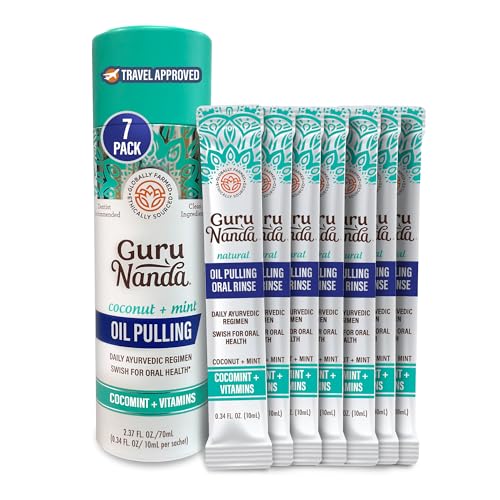
GuruNanda Travel Sachets Coconut Oil Pulling
Best for: First-time oil pullers who want pre-portioned packets to try without committing to a full bottle
- 7 pre-measured sachets — tear and pour, no measuring needed
- Same CocoMint formula as the full-size bottle
- TSA-friendly and mess-free for travel
- Lowest entry price in our lineup at $7.99
- +Lowest commitment price at $7.99, enough for a one-week trial of oil pulling
- +Pre-portioned sachets eliminate the most common beginner mistake of using too much oil
- +TSA-friendly and mess-free for travel
- −Highest per-use cost at about $1.14 per session: not economical for long-term practice
- −Only 7 sachets per box: not designed to sustain a daily routine
(Affiliate link) · Free shipping on eligible Prime items
Why We Recommend It
The biggest obstacle to trying oil pulling is the commitment: buying a full bottle of oil for a practice you might abandon after two tries. GuruNanda’s sachets solve this by offering seven pre-measured doses at $7.99: roughly $1.14 per session. That’s enough to practice daily for a week and decide whether oil pulling works for your routine.
The pre-portioned format also eliminates the most common beginner mistake: using too much oil. Each sachet contains exactly the right amount, which makes the swishing experience more manageable. Several users in dental health communities describe the 10-20 minute time commitment as the practice’s biggest barrier: starting with a measured, flavored product removes one variable from the equation.
At 4.7 stars across 1,559 reviews, the sachets actually score slightly higher than the full-size CocoMint, possibly because the single-use format prevents the quality deterioration that can happen when a bottle is opened repeatedly over weeks.
Key Features
- 7 individual sachets per box
- Same CocoMint formula (coconut oil, peppermint, 7 essential oils, vitamins)
- Pre-measured: no spoon needed, no mess
- TSA-friendly size for travel
- $7.99 per box: lowest commitment price in our lineup
Who It’s Best For
The best entry point for oil pulling beginners. If you’re curious about oil pulling but don’t want to invest $15-23 in a product you might not use again, start here. Also useful for travel: the sachets are compact, mess-free, and TSA-compliant.
Potential Downsides
At $1.14 per session, the per-use cost is high relative to full-size bottles: several times more than using plain coconut oil from a jar. You only get seven sachets, which is enough to try but not to sustain a long-term practice. The small sachet packaging creates more waste than buying a bottle. If you already know you like oil pulling, this format doesn’t make economic sense: buy the full-size CocoMint or Cinnamon bottle instead.
(Affiliate link) · Free shipping on eligible Prime items
Uncle Harry’s Certified Organic Oral Swish
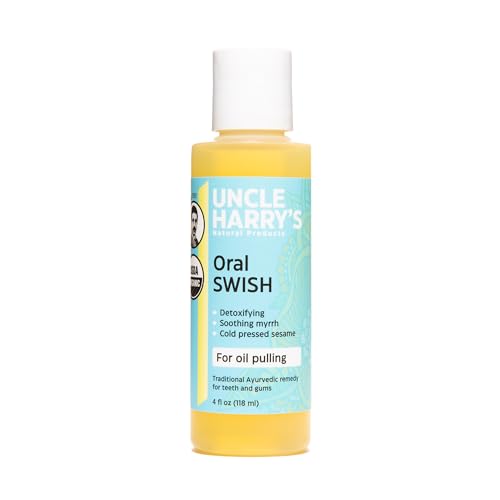
Uncle Harry's Certified Organic Oral Swish
Best for: People who prefer sesame oil in a ready-to-use format with antibacterial herbs
- Sesame oil base with oregano and clove essential oils
- Certified organic — USDA organic seal
- Small-batch production from a Pacific Northwest company
- The only non-GuruNanda dedicated oil pulling product with solid reviews
- +Only non-GuruNanda dedicated oil pulling product with a solid review base
- +Sesame oil base with oregano and clove: a genuinely different approach from coconut-based products
- +USDA organic, small-batch production from an established Pacific Northwest brand
- −Small 4 oz bottle pushes per-ounce cost significantly higher than larger-format products
- −Only 315 reviews: far less user feedback to predict your experience
(Affiliate link) · Free shipping on eligible Prime items
Why We Recommend It
Uncle Harry’s is the sesame-based, certified-organic pick among the non-GuruNanda options; the largest non-GuruNanda review base belongs to Handcraft Blends in our oil pulling mouthwash guide. In a category dominated by one brand, having an alternative matters, especially one that takes a different approach.
Where GuruNanda builds on a coconut oil base with peppermint flavoring, Uncle Harry’s starts with sesame oil (the traditional Ayurvedic choice) and adds oregano and clove essential oils. Both oregano oil and clove oil are traditionally associated with antimicrobial properties, and clove has a long history of use in traditional dental care for its numbing effects.
The company is a small-batch organic producer based in the Pacific Northwest, and the product has a craft, apothecary feel rather than a mass-market one. At 4.5 stars across 315 reviews, the feedback is consistently positive, with users particularly praising the taste and the noticeable difference in gum health.
Key Features
- Sesame oil base (traditional Ayurvedic oil for pulling)
- Oregano and clove essential oils for antimicrobial benefit
- USDA certified organic
- 4 oz bottle: smaller format
- Small-batch production from Uncle Harry’s (Redmond, WA)
Who It’s Best For
Choose this if you prefer sesame oil over coconut but don’t want to practice with plain oil: the oregano and clove add flavor and potential antimicrobial benefit. Also a good option if you want to support a small, independent brand rather than the category’s dominant player.
Potential Downsides
With 317 reviews, this product has a much smaller user base than the other picks in our roundup: less feedback to draw from. The 4 oz bottle is small, which pushes the per-ounce cost significantly higher than larger-format products. Oregano oil has a strong taste that some people find medicinal or unpleasant for a 10-20 minute swish. Availability can be inconsistent: check stock before committing to this as your regular product.
(Affiliate link) · Free shipping on eligible Prime items
Buyer’s Guide: How to Choose the Right Oil for Oil Pulling
What Oil Pulling Actually Does
Oil pulling is thought to work primarily through a mechanical process: swishing oil around your teeth and gums for an extended period may help dislodge bacteria and food particles from areas that brushing misses. Some researchers propose that the oil’s viscosity allows it to reach between teeth and along the gumline, while others attribute the antibacterial effect to specific fatty acids like lauric acid in coconut oil. The exact mechanism is not fully established.
Research supports that this process reduces oral bacteria. The 2022 Healthcare meta-analysis found a statistically significant reduction in salivary bacterial colony counts with oil pulling compared to controls. However, the same analysis found no significant difference in plaque index or gingival index scores: meaning the bacterial reduction hasn’t yet translated into measurable improvements in plaque or gum disease markers in controlled studies.
The mechanism is sometimes described as “pulling” toxins from the body. There is no scientific basis for this claim. Oil pulling is a mechanical cleaning process: a supplement to your oral hygiene routine, not a detoxification practice.
Which Oil to Choose: Coconut vs. Sesame vs. Specialty Products
Coconut oil is the most popular choice in Western practice. It is rich in lauric acid, and swishing with it has measurably lowered salivary counts of Streptococcus mutans, a primary cavity-causing bacterium, in a randomized trial against chlorhexidine and distilled water. It has a mild flavor most people find acceptable. The main drawback: it’s solid below 76°F and takes 15-30 seconds to melt in your mouth.
Sesame oil is the traditional Ayurvedic choice and has been used for oil pulling for centuries. In Ayurvedic practice, it’s specifically favored for gum health concerns. It stays liquid at room temperature, which eliminates the melting step. The flavor is mild and nutty. Clinical studies on oil pulling have used both coconut and sesame oil with comparable results: there’s no strong evidence that one outperforms the other.
Dedicated oil pulling products (like GuruNanda or Uncle Harry’s) are pre-formulated mouthwashes that blend a base oil with essential oils, flavoring, and sometimes vitamins. Their main advantage is convenience and taste—they make a 10-20 minute practice more bearable for people who dislike the texture of plain oil. The trade-off is higher cost per use and additional ingredients that traditionalists may view as unnecessary. GuruNanda dominates this subcategory: they make the most-reviewed oil pulling products on Amazon by a factor of 10x or more. Uncle Harry’s is the main alternative for dedicated oil pulling products.
A note on other oils: Sunflower oil has been studied for oil pulling, but thinly. The 2022 meta-analysis we referenced earlier searched for it and found nothing usable: its nine trials are five sesame-oil studies and four coconut-oil studies, and the authors state outright that no oil pulling literature turned up for sunflower, olive, or corn oil. The closest evidence is a three-person pilot study that measured a transient drop in overall oral microbial burden after swishing standardized sunflower seed oil. So sunflower is a workable fallback if you have coconut or sesame allergies, but you would be choosing it on tolerance rather than on evidence, and it has less consumer product support and fewer dedicated oil pulling products built around it.
How to Oil Pull Correctly
- Measure your oil. Start with 1 tablespoon of oil (or one pre-measured sachet). Beginners may want to start with 1 teaspoon to get accustomed to the sensation.
- Swish gently. Push and pull the oil through your teeth, around your gums, and across all surfaces of your mouth. Do not gargle: swishing only. Keep the oil in the front of your mouth.
- Time it. The traditional recommendation is 15-20 minutes. Research studies have used this duration. If you can only manage 5-10 minutes at first, that’s a reasonable starting point.
- Spit into the trash. Do not spit oil into the sink: coconut oil especially can solidify in pipes and cause clogs. Spit into a trash can or paper towel.
- Rinse and brush. Rinse your mouth with warm water after spitting, then brush your teeth normally.
- Best timing: Most practitioners oil pull first thing in the morning on an empty stomach, before brushing. Some do it in the evening before bed. Choose the time that fits your routine.
What Oil Pulling Does Not Do
Misinformation is common in this category, so the limits deserve the same clarity as the benefits:
- It does not cure or reverse cavities. Once a cavity has formed, no amount of oil pulling will rebuild the lost tooth structure. This is one of the most common misconceptions in online communities: multiple Reddit threads feature people hoping to avoid the dentist by oil pulling. You still need professional dental care.
- It does not replace brushing and flossing. Oil pulling is a supplement, not a substitute. The bacterial reduction shown in studies is promising but not sufficient to replace evidence-based oral hygiene.
- It does not “pull toxins” from your body. This claim has no scientific support. The benefits of oil pulling, where they exist, come from mechanical cleaning and antimicrobial properties of the oil itself.
- It does not whiten teeth dramatically. Some users report modest whitening over weeks of practice, likely from surface stain removal. Do not expect results comparable to peroxide-based whitening products.
Safety Considerations
Aspiration risk. Do not gargle with oil; swish only, keeping the oil in the front of your mouth. Gargling increases the risk of accidentally inhaling oil into the lungs, which in rare cases can cause lipid pneumonia. Start with a small amount (1 teaspoon) if you’re new to the practice, and work up to a full tablespoon once you’re comfortable with the swishing motion.
Essential oil sensitivity. Many dedicated oil pulling products contain concentrated essential oils (tea tree, oregano, clove, cinnamon). These can cause mucosal irritation in some people, especially with the prolonged 10-20 minute contact time. If you notice burning, tingling that doesn’t subside, or sore spots on your gums or cheeks, switch to a plain oil without added essential oils.
Pregnancy and children. There is limited safety data on oil pulling during pregnancy or for young children. If you are pregnant, nursing, or considering oil pulling for a child, consult your dentist or healthcare provider first, particularly with products containing essential oils.
When to See a Dentist Instead
Oil pulling is not appropriate as a primary treatment for any dental condition. See a dentist if you have:
- Active tooth pain or sensitivity that has worsened
- Bleeding gums that persist despite good oral hygiene
- Visible cavities, chips, or cracks in your teeth
- Swelling, pus, or signs of infection in your gums
- Loose teeth or significant gum recession
- Any dental issue that has been ongoing for more than two weeks
Some community members turn to oil pulling because they can’t afford dental care. If cost is a barrier, look into dental schools (which offer reduced-cost care), community health centers, or state Medicaid dental programs before relying on home remedies for active dental problems.
FAQ
Does oil pulling actually work?
There is evidence that oil pulling reduces oral bacteria. A 2022 meta-analysis of nine randomized controlled trials found statistically significant reductions in salivary bacterial counts. However, the same study found no significant improvement in plaque or gingival index scores. The ADA itself does not recommend the practice, and individual clinicians are more divided: some acknowledge the bacterial-count evidence while noting that regular brushing and flossing is more practical and better-studied. Oil pulling may offer modest benefits as a supplement to conventional oral care, but it is not a proven replacement for it.
Is coconut oil or sesame oil better for oil pulling?
Clinical studies have used both oils with comparable results; there is no strong evidence that one is superior. Coconut oil has documented antimicrobial properties due to lauric acid. Sesame oil is the traditional Ayurvedic choice, especially for gum health. The practical differences may matter more: coconut oil is solid at room temperature (needs melting), while sesame oil stays liquid. Choose based on your flavor preference and whether you follow an Ayurvedic practice.
How long do you need to swish?
The standard recommendation is 15-20 minutes, which is the duration used in most clinical studies. This is also the biggest practical barrier: dental professionals note that many patients can’t sustain even 2 minutes of brushing, making 20 minutes of swishing unrealistic for most people. Starting with 5-10 minutes and working up is a reasonable approach, though the evidence base is thinner for shorter durations.
Can oil pulling loosen fillings or dental work?
There is no clinical evidence that oil pulling damages or loosens fillings, crowns, or other dental work. The swishing action is gentle compared to chewing food. However, if you have dental work that is already loose or compromised, any manipulation could be a concern: consult your dentist if you’re unsure.
Will oil pulling clog my drains?
Coconut oil solidifies below 76°F (24°C), and over time it can accumulate in pipes and cause blockages. Always spit used oil into the trash, a disposable cup, or a paper towel: never directly into the sink. Sesame oil and liquid oil pulling products are less likely to cause plumbing issues, but spitting into the trash is still the safest practice for any oil.
Can oil pulling replace mouthwash?
Oil pulling and mouthwash serve overlapping but different purposes. Conventional mouthwashes (especially those with CPC or chlorhexidine) have stronger clinical evidence behind them for reducing plaque and gingivitis. Oil pulling may offer some antibacterial benefit but requires 10-20 minutes compared to 30-60 seconds for mouthwash. If you enjoy oil pulling, it can supplement your routine, but it shouldn’t replace an evidence-based mouthwash if your dentist has recommended one for a specific condition. See our best mouthwash and best alcohol-free mouthwash guides for alternatives.
Is oil pulling safe with dental implants or braces?
There are no documented safety concerns with oil pulling around dental implants, braces, or other orthodontic hardware. The practice involves gentle swishing, not aggressive pressure. However, if you have braces, be aware that oil may be harder to fully rinse out from around brackets and wires: follow up with thorough brushing.