
If you’ve been avoiding mouthwash because it burns, or switching between brands trying to find one that doesn’t dry your mouth out, the problem is almost certainly the alcohol. Alcohol in mouthwash isn’t the active antibacterial ingredient: it’s a carrier and solvent. Alcohol-free formulas rely on their labeled actives instead, without the sting: CPC for plaque and gingivitis, fluoride for cavities, and chlorine dioxide or sodium chlorite for bad breath. When The Healthy asked four dentists to name the best mouthwash, all four said skip the alcohol. We compared the top alcohol-free options to find which ones deliver real results. For targeted needs, see our guides on mouthwash for bad breath, mouthwash for dry mouth, and mouthwash for gingivitis.
How We Evaluated Alcohol-Free Mouthwashes
Active ingredients. Different active ingredients serve different purposes: CPC (cetylpyridinium chloride) and essential oils kill bacteria that cause plaque and gingivitis. Fluoride strengthens enamel and prevents cavities. Chlorine dioxide neutralizes sulfur compounds that cause bad breath. We matched each product to the need its active ingredient best serves.
Clinical evidence. We prioritized formulas whose active ingredients are stated on an FDA DailyMed drug label and have clinical trial data or established efficacy in peer-reviewed research. A 2025 systematic review found CPC and essential oils are clinically comparable for plaque and gingivitis reduction; neither is clearly superior.
Gentleness. Alcohol-free doesn’t automatically mean gentle. Some alcohol-free formulas still sting from menthol, essential oils, or flavor intensity. We weighed real user feedback on comfort: forum comments on burn and gentleness, and Amazon’s review summaries on taste and sting.
Value. Price per ounce varies dramatically across brands, so we compared cost per ounce rather than bottle price. We didn’t assume one standard dose, because the labels differ: Listerine Total Care’s calls for 10 mL twice a day, Parodontax’s for 20 mL twice a day.
In the r/DentalHygiene discussion we read for this guide, a commenter with dental-professional flair laid out a gentleness hierarchy for alcohol-free rinses: CloSYS is mildest ('it tastes pretty much like water'), TheraBreath next ('a milder flavor than most, if you don't like feeling punched in the face by mint'). The clearest user journey in the data started from the other end: 'Listerine burns. Couldn't find a better solution until I used TheraBreath.'
Evidence Receipt
- The ADA’s mouthrinse overview attributes therapeutic effects to active ingredients that target plaque, gingivitis, bad breath, and decay, and notes that an alcohol-free mouthrinse may be the prudent choice for people with dry mouth.
- ADA fluoride guidance states that fluoride mouthrinse promotes remineralization and is retained in plaque and saliva, with over-the-counter sodium fluoride rinses available for daily use by people over 6.
- Active-ingredient claims on this page are checked against FDA DailyMed drug labels: Crest Pro-Health Multi-Protection Clean Mint lists cetylpyridinium chloride 0.07%, antigingivitis/antiplaque, with no fluoride, and ACT Restoring Mint Burst lists sodium fluoride 0.02%, anticavity.
- Memorial Sloan Kettering’s mouth-care guidance tells patients in treatment to use a mouthwash with no alcohol or sugar and to avoid alcohol-containing rinses.
Crest Pro-Health Complete Clean Mouthwash: Editor’s Pick
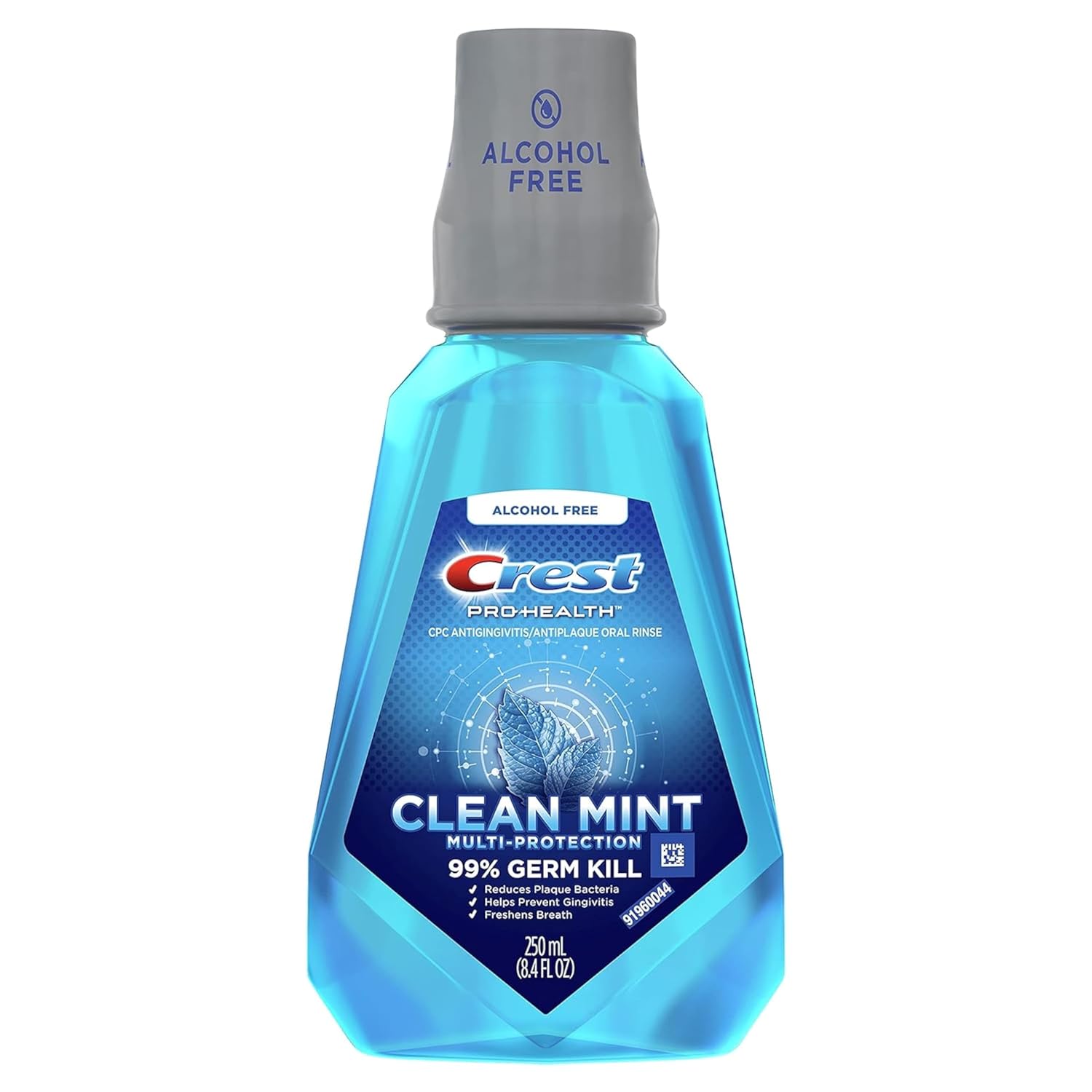
Crest Pro-Health Complete Clean Mouthwash (CPC, Alcohol-Free)
Best for: Most people: everyday plaque and gingivitis protection at the lowest price per liter in the roundup
- CPC (cetylpyridinium chloride) 0.07% antigingivitis and antiplaque active
- Helps prevent and reduce plaque and gingivitis, per Crest's FDA drug label
- Alcohol-free, Clean Mint flavor
- Around $5 for a 1-liter bottle
- +CPC 0.07% antigingivitis and antiplaque active, per the listing's Drug Facts panel and Crest's FDA drug label
- +Alcohol-free, rated 4.7 stars across 13,000+ reviews
- +Around $5 for a 1-liter bottle, the lowest price per liter in this roundup
- −The ADA lists brown staining of teeth, tongue and restorations as a possible CPC side effect
- −No fluoride, so pair it with a fluoride toothpaste if cavity risk is a concern
(Affiliate link) · Free shipping on eligible Prime items
Why We Recommend It
Crest Pro-Health Complete Clean is the everyday antibacterial rinse of this roundup. The active-ingredient panel on the listing we link gives cetylpyridinium chloride (CPC) 0.07%, antigingivitis/antiplaque, and Crest’s FDA DailyMed drug label for its alcohol-free CPC Clean Mint rinse (filed under the Pro-Health Multi-Protection name) lists the same active and purpose: it helps prevent and reduce plaque and gingivitis and controls the plaque bacteria that contribute to bleeding gums. At around $5 for a liter it is the cheapest bottle here, and it carries 4.7 stars across more than 13,000 ratings.
One thing to be clear about, because Crest sells several similarly named rinses: this Clean Mint CPC rinse has no fluoride on its drug label. If cavity prevention is your priority, ACT’s fluoride formula is the better match, and TheraBreath is more effective for chronic bad breath. Where Crest Pro-Health wins is the everyday case: gentle, broad plaque-and-gum protection at a price that makes daily use painless.
Research shows CPC is comparable to essential oils for plaque and gingivitis reduction and produces fewer side effects than prescription chlorhexidine. Its 0.07% strength is the one tested in the six-month trial covered in our antibacterial mouthwash roundup.
Key Features
- CPC 0.07% antibacterial (antigingivitis/antiplaque)
- Helps prevent and reduce plaque and gingivitis
- Alcohol-free
- Clean Mint flavor
- 1-liter bottle
Who It’s Best For
Crest Pro-Health Complete Clean is the right choice for most people looking for a daily alcohol-free mouthwash. If you don’t have a specific clinical need (chronic halitosis, extreme sensitivity, dry mouth, high cavity risk), this covers the plaque-and-gum basics at the best price; pair it with a fluoride toothpaste for cavity protection.
Potential Downsides
CPC can cause brown staining of teeth, tongue and restorations, according to the ADA’s mouthrinse guidance, and in a six-month trial of a 0.07% CPC rinse, staining scores ran slightly higher than with a placebo rinse. It can be alarming if you don’t know to expect it. If you notice staining, stop and switch to a non-CPC option like Listerine Total Care or ACT, and mention it at your next cleaning. For a deeper dive on CPC-based options, see our antibacterial mouthwash roundup.
(Affiliate link) · Free shipping on eligible Prime items
TheraBreath Fresh Breath Mouthwash: Best for Bad Breath
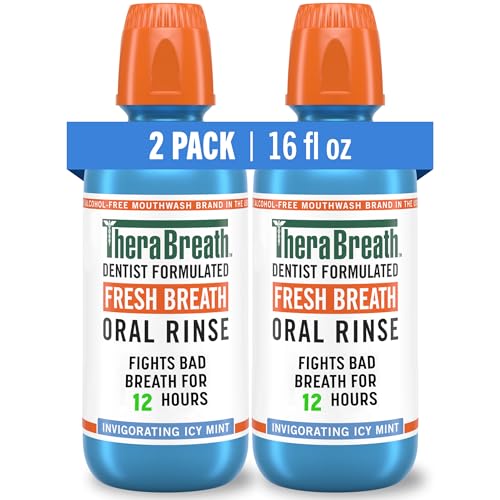
TheraBreath Fresh Breath Mouthwash (Icy Mint, 2-Pack)
Best for: People whose primary concern is halitosis: its OXYD-8 formula, which the brand says is derived from sodium chlorite, targets sulfur compounds rather than masking them
- OXYD-8, a formula the brand says is derived from sodium chlorite, aimed at the volatile sulfur compounds (VSCs) behind bad breath
- Sodium chlorite (OXYD-8) with xylitol, per the listed ingredients
- pH-balanced, alcohol-free, dye-free formula that doesn't dry out the mouth
- 52,000+ reviews at 4.8 stars, the largest review base on this page
- +OXYD-8, the brand's sodium-chlorite-based formula, targets the sulfur compounds behind bad breath rather than masking them
- +Holds the ADA Seal of Acceptance for helping reduce bad breath
- +Largest review base on this page: 52,000+ reviews at 4.8 stars
- −Contains no fluoride, so it's not a substitute for a cavity-prevention rinse
- −Roughly 2-3x the per-ounce price of ACT or Crest Pro-Health
(Affiliate link) · Free shipping on eligible Prime items
Why We Recommend It
TheraBreath approaches bad breath differently from the alcohol and essential-oil rinses in this roundup. Instead of masking odor with strong flavoring or killing bacteria indiscriminately, it uses OXYD-8, which the brand describes as a formula derived from sodium chlorite, aimed at the volatile sulfur compounds (VSCs) that are the actual molecular cause of halitosis. The aim is to neutralize those compounds rather than cover them with flavor.
The formula was developed by Dr. Harold Katz, a bacteriologist who founded the California Breath Clinics. Whether or not you find the origin story compelling, the chemistry has clinical support: a randomized placebo-controlled 7-day trial found that rinsing with a chlorine dioxide mouthwash reduced morning bad breath and lowered concentrations of the three main volatile sulfur compounds (hydrogen sulfide, methyl mercaptan, and dimethyl sulfide) measured by gas chromatography. That trial tested a chlorine dioxide rinse, not TheraBreath’s sodium-chlorite-based formula, so it speaks to the chemistry rather than to this bottle. TheraBreath’s listed ingredients pair sodium chlorite with xylitol, and the rinse holds an ADA Seal for helping reduce bad breath.
With over 52,000 reviews at 4.8 stars, TheraBreath has the largest review base on this page. The pattern in Amazon’s review summary: buyers find it highly effective, with fresh breath lasting for hours and no burning. For a broader look at bad breath solutions beyond mouthwash, see our best mouthwash for bad breath roundup.
Key Features
- OXYD-8 formula (sodium chlorite) with xylitol
- pH-balanced to support a healthy oral environment
- Alcohol-free, dye-free, sulfate-free
- Available in Icy Mint and Mild Mint flavors
- 52,000+ reviews (the largest review base on this page)
Who It’s Best For
TheraBreath is our pick if bad breath is your primary concern. It’s also appropriate for people who want a pH-balanced, alcohol-free rinse. It’s dye-free, and the listing we read carries no staining warning.
Potential Downsides
TheraBreath is noticeably more expensive per ounce than drugstore alternatives: roughly 2-3x the price of ACT or Crest Pro-Health. It’s primarily a breath-focused product, not a cavity-prevention one: it doesn’t contain fluoride, which means it’s not a substitute for a fluoride rinse if you’re cavity-prone. TheraBreath claims 12 hours of bad-breath protection, and Amazon’s review summary says buyers report freshness lasting for hours, but the ADA’s MouthHealthy site calls mouthwash only a temporary solution for bad breath. It’s a management tool, not a permanent fix.
(Affiliate link) · Free shipping on eligible Prime items
ACT Restoring Zero Alcohol Fluoride Mouthwash: Best Budget
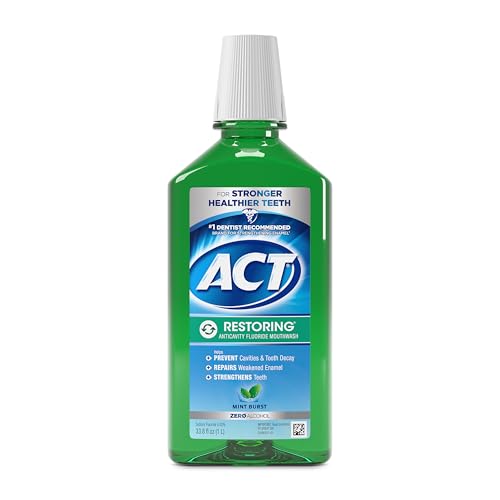
ACT Restoring Zero Alcohol Fluoride Mouthwash (Mint Burst)
Best for: Cavity-prone individuals who want a dedicated fluoride rinse at the lowest price
- Sodium fluoride 0.02% for enamel remineralization and cavity prevention, per its FDA DailyMed drug label
- Fluoride-first formula: strengthens enamel rather than killing bacteria, the complement to your toothpaste if cavities are your main risk
- Alcohol-free formula with mild Mint Burst flavor, no burning or stinging
- Around $6.54 for a 33.8 oz bottle, the lowest-priced bottle in this roundup
- +Sodium fluoride 0.02% anticavity active, verified on its DailyMed drug label
- +ACT says its alcohol-free formulas are designed to have no burning or stinging
- +Lowest-priced bottle in the roundup, under $7
- −Fluoride-only, won't reduce plaque or gingivitis the way CPC or essential-oil formulas do
- −Taste reviews are mixed: Amazon's summary says some buyers find the flavor pleasant and others call it awful
(Affiliate link) · Free shipping on eligible Prime items
Why We Recommend It
ACT’s case rests on two things we can verify: the label and the price. Its DailyMed drug label lists sodium fluoride 0.02% as the anticavity active, in an alcohol-free formula, and at around $6.54 for a full liter it’s the second-cheapest bottle in this roundup, after the Crest rinse: less than half the price of a TheraBreath two-pack and about a quarter of a CloSYS two-pack. ACT’s parent brand markets itself as the “#1 dentist recommended anti-cavity brand” among OTC mouth rinses; that’s the brand’s own marketing claim from its official site, not something we measured, so we weight the label and the price instead.
Fluoride mouth rinse serves a different purpose from antibacterial rinses: instead of killing bacteria, it strengthens enamel and promotes remineralization of early-stage tooth decay. For people who are cavity-prone, have recently had dental work, or whose dentist has flagged enamel erosion, a dedicated fluoride rinse like ACT fits better than an antibacterial one, since fluoride is the ingredient the ADA calls “a proven agent in helping to prevent decay.” Worth being honest about: our forum research turned up no direct community discussion of ACT, so the recommendation here rests on its verified formula and price, not community buzz.
Taste is where reviews split: Amazon’s review summary says some buyers find the Mint Burst flavor pleasant while others describe it as awful. On comfort, the same summary calls it alcohol-free and gentle on the mouth, and at 4.7 stars across 13,200+ reviews, it says customers find it effective. For a more comprehensive look at fluoride options, see our fluoride mouthwash roundup.
Key Features
- 0.02% sodium fluoride (0.009% w/v fluoride ion), the anticavity active on its DailyMed drug label
- Alcohol-free, mild mint flavor
- Enamel strengthening and cavity prevention
- Single-purpose FDA OTC anticavity label: “aids in the prevention of dental cavities”
- 33.8 fl oz (1 liter) per bottle
Who It’s Best For
ACT is the right choice if cavity prevention is your primary goal, or if your dentist has specifically recommended a fluoride rinse. It’s also ideal for budget-conscious buyers: at around $6.54 a bottle, it undercuts the roughly $15 to $26 that TheraBreath and CloSYS two-packs run. Used alongside a fluoride toothpaste, it fits the daily-use case that ADA fluoride guidance describes for OTC sodium fluoride rinses in people with elevated cavity risk.
Potential Downsides
ACT is a fluoride rinse, not an antibacterial one: it won’t reduce plaque or gingivitis the way CPC or essential oil formulas do. If you need both cavity protection and antibacterial action, you’d need to either pair ACT with a separate antibacterial rinse or choose a combined formula like Crest Pro-Health. The taste divides buyers: Amazon’s review summary reports that some find it pleasant and others awful.
(Affiliate link) · Free shipping on eligible Prime items
CloSYS Ultra Sensitive Mouthwash: Best for Sensitivity
CloSYS Ultra Sensitive Mouthwash (Unflavored, 2-Pack)
Best for: People in cancer treatment, people with sore or irritated mouths, or anyone with extreme sensitivity who needs an unflavored rinse with no alcohol or sugar
- pH-balanced, unflavored base formula with optional flavor drops included, so you control the taste intensity
- Stabilized chlorine dioxide, which the listing says eliminates odor-causing bacteria at the source
- No alcohol, sulfates, dyes or triclosan, and gluten-free, per the listing, in a four-ingredient base rinse
- The mildest-tasting rinse in our forum research: a dental professional described it as tasting 'pretty much like water'
- +Unflavored and pH-balanced, a formula the listing calls as gentle as water
- +Unflavored base with optional flavor drops lets you control taste intensity
- +Four-ingredient base rinse with no alcohol, sulfates or dyes, and gluten-free, per the listing
- −Taste reviews split: some buyers say it tastes like nothing, others report an awful aftertaste
- −No fluoride, so pair it with a fluoride toothpaste or rinse for cavity prevention
(Affiliate link) · Free shipping on eligible Prime items
Why We Recommend It
CloSYS Ultra Sensitive is the rinse in this roundup built around gentleness, in a formula its listing calls “as gentle as water.” It uses stabilized chlorine dioxide in a pH-balanced, unflavored formula that produces essentially zero sensation in the mouth: no burn, no tingle, no menthol chill. For people whose mouths are sore from chemotherapy or radiation (Memorial Sloan Kettering lists sores on the lining of the mouth among the signs of mucositis), or who simply have an extremely reactive palate, CloSYS is the one rinse here with an unflavored base: per the listing, water, stabilized chlorine dioxide, trisodium phosphate and citric acid, with the peppermint flavor kept in a separate dropper.
The unflavored approach is CloSYS’s most distinctive feature. The mouthwash comes with optional flavor drops that you can add to taste, or skip entirely. That matters if flavorings are the problem: Fatima Khan, DDS, quoted by The Healthy, says allergic reactions to mouthwash are rare but usually come from “flavoring agents or essential oils within the mouthwash,” and here the peppermint oil sits only in the dropper. Amazon’s review summary adds that customers find it effective for sensitive gums and mouth irritation, noting it soothes soreness.
CloSYS was the mildness benchmark in our forum research: in the r/DentalHygiene discussion we read for this guide, a commenter with dental-professional flair placed it above TheraBreath on gentleness, describing its taste as “pretty much like water,” and a second commenter recommended it outright. For additional options for sensitive mouths, see our mouthwash for sensitive teeth roundup.
Key Features
- Stabilized chlorine dioxide (gentle antibacterial)
- pH-balanced for minimal tissue irritation
- Unflavored base with optional flavor drops included
- No alcohol, no sulfates, no dyes, gluten-free
- 2-pack (2 x 32 oz)
Who It’s Best For
CloSYS is the right choice for anyone who has tried other mouthwashes and found them all too harsh. Its base rinse lists no alcohol and no sugar, the combination Memorial Sloan Kettering asks for during cancer treatment, and the unflavored base has none of the alcohol or strong essential oils that a dentist quoted by The Healthy links to irritation and mouth sores. It also suits anyone avoiding alcohol altogether, and people who simply don’t like the taste of traditional mouthwash.
Potential Downsides
Amazon’s review summary splits on taste: some buyers say it tastes like nothing, others report an awful aftertaste. The absence of sensation (no burn, no tingle, no strong flavor) can make it feel as if nothing is happening; CloSYS holds an ADA Seal for helping reduce bad breath, but if you need the sensory feedback of “freshness” to feel clean, CloSYS may not satisfy that expectation. It’s also more expensive per ounce than mass-market alternatives like ACT or Crest Pro-Health. No fluoride: if cavity prevention is a priority, pair CloSYS with a fluoride toothpaste or a separate fluoride rinse.
(Affiliate link) · Free shipping on eligible Prime items
Listerine Total Care Alcohol-Free Mouthwash: Best All-Around
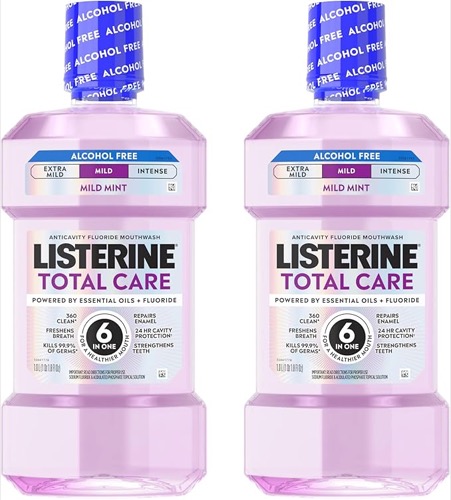
Listerine Total Care Alcohol-Free Mouthwash (Mild Mint, 2-Pack)
Best for: Users who want Listerine's formula, which the brand says kills 99.9% of bad-breath germs, without the alcohol burn
- Sodium fluoride 0.02% is the only active on its FDA drug label, for cavity prevention
- Listerine markets six benefits; the labeled one is cavity prevention, and the four essential oils are listed among the inactive ingredients
- Alcohol-free Mild Mint flavor, without the alcohol burn
- Twin pack (2 x 1L) for extended daily use
- +Sodium fluoride 0.02% anticavity active, per its FDA drug label
- +Six-benefit formula with fluoride for cavity prevention and enamel strengthening
- +No staining warning on its FDA drug label, unlike the ADA's caution for CPC rinses
- −Mixed reports on burn: Amazon's review summary says some buyers praise the lack of burn while others report burning
- −Distinctive flavor that isn't universally liked
(Affiliate link) · Free shipping on eligible Prime items
Why We Recommend It
Listerine Total Care Alcohol-Free is the closest thing to classic Listerine without the burn. It uses the same four essential oils (eucalyptol, menthol, thymol, methyl salicylate) that have been the backbone of Listerine’s antibacterial formula for over a century, but in an alcohol-free carrier. Its FDA drug label lists one active, sodium fluoride 0.02% for cavity prevention, with the oils among the inactive ingredients, and it feels significantly milder than the original.
The practical reason to pick it over the Crest rinse is staining: the ADA lists brown staining as a possible side effect of CPC, and this bottle’s FDA drug label carries no staining warning. Its labeled active is fluoride for cavities, which the Crest rinse doesn’t contain. Don’t buy it expecting the plaque results of the classic alcohol formula: a systematic review of seven head-to-head studies found alcohol-free essential-oil rinses gave somewhat less plaque control than alcohol-containing ones, with no clear difference in gum bleeding or gingivitis (van Swaaij et al., 2024).
At 17,800+ reviews and 4.6 stars, user feedback is generally positive: Amazon’s review summary says buyers find it makes the mouth and teeth feel clean and consider it good value. The twin pack pricing makes the per-ounce cost reasonable, though not as cheap as ACT or Crest Pro-Health.
Key Features
- Essential oils (eucalyptol, menthol, thymol, methyl salicylate), listed as inactive ingredients on its drug label
- Fluoride for cavity prevention and enamel strengthening
- 6-benefit oral care coverage
- Alcohol-free, Mild Mint flavor
- 2-pack (2 x 1L)
Who It’s Best For
Listerine Total Care AF is the right choice if you want a fluoride rinse in the Listerine formula with no staining warning on its label. It’s also a natural pick for longtime Listerine users who want to drop the alcohol without switching brands entirely. The ADA names essential oils among the ingredients shown to help reduce plaque and gingivitis; in this bottle they are listed as inactive ingredients, and the labeled active is the fluoride.
Potential Downsides
Despite being alcohol-free, it doesn’t suit everyone: Amazon’s review summary says some buyers appreciate the pleasant taste and lack of burn, while others find the taste terrible and report burns. Listerine itself describes it as a less intense formula than Total Care Intense, not a flavorless one. The essential oil taste is distinctive and not universally liked: if you’ve never enjoyed Listerine’s flavor profile, the alcohol-free version tastes similar, just milder.
(Affiliate link) · Free shipping on eligible Prime items
Parodontax Active Gum Health Mouthwash: Best for Gum Health
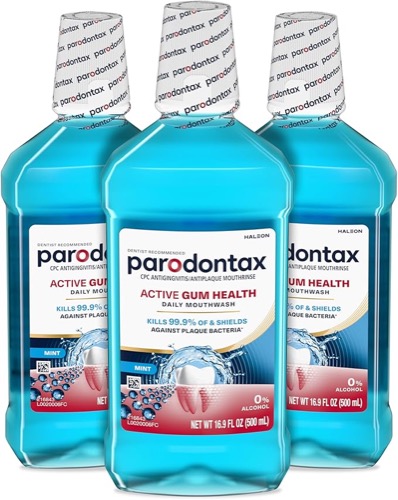
Parodontax Active Gum Health Mouthwash (Mint, 3-Pack)
Best for: People with gingivitis or bleeding gums who want a CPC rinse from the brand behind Parodontax toothpaste
- Antiplaque and antigingivitis formula specifically targeting the bacteria that cause gum inflammation
- Contains cetylpyridinium chloride (CPC) 0.07% w/w as its only active, and no fluoride
- From the makers of Parodontax toothpaste, a brand specifically developed for bleeding gums and periodontal concerns
- Alcohol-free mint formula; 3-pack for extended value
- +CPC 0.07% antigingivitis and antiplaque active, per its drug label
- +Antiplaque, antigingivitis formula that targets the bacteria behind gum inflammation
- +From the Parodontax gum-health brand, pairs with its matching toothpaste
- −Its label says it may cause staining, and the ADA lists brown staining as a possible CPC side effect
- −No fluoride, so pair it with a fluoride toothpaste; better-targeted options exist if your concern is cavities or bad breath
(Affiliate link) · Free shipping on eligible Prime items
Why We Recommend It
Parodontax is a brand built around a single clinical focus: gum health. The US Active Gum Health mouthwash is a CPC rinse: its DailyMed drug label lists cetylpyridinium chloride 0.07% w/w as the active, for antigingivitis and antiplaque, to help prevent and reduce the plaque that leads to gingivitis and bleeding gums. It contains no fluoride.
That makes it a different product from Parodontax toothpaste, whose DailyMed labels list stannous fluoride; the rinse and the paste share a brand and a gum focus, not an active. Its active and strength match the CPC 0.07% on the Crest label cited above, so the choice between them comes down to price, flavor and whether you want to stay within the Parodontax line. If you’re already using Parodontax toothpaste on your dentist’s recommendation for bleeding gums, pairing it with the matching mouthwash keeps a consistent gum-focused routine.
At 4.7 stars across 11,500+ reviews, the feedback is specific: Amazon’s review summary says buyers find it effective for gum health, call the mint flavor mild, and consider the three-pack good value. For a broader look at gum disease products, see our mouthwash for gingivitis roundup.
Key Features
- Cetylpyridinium chloride (CPC) 0.07% w/w, per its drug label; no fluoride
- Antiplaque and antigingivitis formula
- Alcohol-free mint flavor
- From the Parodontax gum health brand
- 3-pack (3 x 16.9 fl oz)
Who It’s Best For
Parodontax Active Gum Health is the right choice if bleeding gums or gingivitis is your primary concern; its label says to stop and see a dentist if gingivitis, bleeding or redness persists for more than 2 weeks, or if you notice signs of periodontitis such as loose teeth or pus at the gum line. It’s also a natural pairing if your dentist has already recommended Parodontax toothpaste.
Potential Downsides
Its label says it may cause staining, and the ADA lists brown staining of teeth, tongue and restorations as a possible CPC side effect; Amazon’s review summary adds that the blue color can leave a light stain on teeth for hours. Some buyers in that summary report it doesn’t sting while others report discomfort, so it’s not as gentle as CloSYS for extremely sensitive mouths. It has no fluoride, and Parodontax is a gum-focused brand, which means it’s somewhat niche: if your gums are healthy and your primary concern is cavities or bad breath, other products in this roundup are better targeted.
(Affiliate link) · Free shipping on eligible Prime items
Buyer’s Guide: Choosing the Right Alcohol-Free Mouthwash
Why Alcohol-Free? The Short Version
Alcohol in mouthwash isn’t the active antibacterial ingredient: it’s a carrier solvent that helps deliver essential oils. Alcohol-free formulas rely on their labeled actives instead: CPC for plaque and gingivitis, fluoride for cavities, and chlorine dioxide or sodium chlorite for bad breath. Meanwhile, alcohol can dry out your mouth. Since saliva is your mouth’s primary natural defense against bacteria and decay, using a product that suppresses it is counterproductive. The ADA’s mouthrinse overview attributes therapeutic effects to active ingredients that target plaque, gingivitis, bad breath, and decay (alcohol is not on that list), and notes that an alcohol-free mouthrinse may be the prudent choice for people with dry mouth.
Some readers have a specific reason to choose alcohol-free. Dry mouth is one: the ADA’s dry mouth overview lists antihistamines, blood pressure medicines and antidepressants among the drugs that can cause it, and lists avoiding irritants such as alcohol-containing mouthrinses among its ways to relieve it. Cancer treatment is another, where Memorial Sloan Kettering tells patients to use a mouthwash with no alcohol or sugar. For children, Tend’s chief dental officer, quoted by NBC Select, says kids should not use mouthwashes with alcohol in case they swallow some. And for tender mouths, a dentist quoted by The Healthy names irritation and mouth sores among mouthwash side effects, “especially with rinses containing alcohol or strong essential oils.” If a canker sore is what sent you looking for a gentler rinse, our guide on how to get rid of a canker sore fast covers care beyond just switching mouthwash.
“But It Doesn’t Burn: Is It Actually Working?”
This is the most common concern people raise when switching to alcohol-free mouthwash, and it’s worth addressing directly. The burning sensation from alcohol-based mouthwash is not a sign that bacteria are being killed—it’s tissue irritation caused by the alcohol. Alcohol isn’t on the ADA’s list of mouthrinse antimicrobials, so the burn is not the active ingredient at work. The active ingredients (CPC, essential oils, fluoride, chlorine dioxide) work chemically whether or not you feel anything. CloSYS Ultra Sensitive is the extreme example: unflavored and without menthol, yet CloSYS holds an ADA Seal for helping reduce bad breath.
Choose by Your Primary Need
The biggest mistake people make with mouthwash is buying a general-purpose product when they have a specific need. Match the active ingredient to your primary concern: if none of these needs is your top priority, our full best mouthwash roundup weighs picks across every use case.
| Primary Need | Best Active Ingredient | Our Pick |
|---|---|---|
| General daily protection | CPC (cetylpyridinium chloride) | Crest Pro-Health Complete Clean |
| Bad breath / halitosis | Sodium chlorite (OXYD-8) | TheraBreath Fresh Breath |
| Cavity prevention | Sodium fluoride (0.02%) | ACT Restoring Zero Alcohol |
| Extreme sensitivity | Chlorine dioxide (pH-balanced) | CloSYS Ultra Sensitive |
| Cavity protection in a Listerine-style rinse | Sodium fluoride (0.02%), with essential oils as inactives | Listerine Total Care AF |
| Bleeding gums / gingivitis | CPC (0.07%) | Parodontax Active Gum Health |
Ingredient Guide: What Each Active Does
CPC (cetylpyridinium chloride): Kills bacteria that cause plaque, gingivitis, and bad breath. Found in Crest Pro-Health and Parodontax Active Gum Health. Named by the ADA alongside essential oils among ingredients shown to help reduce plaque and gingivitis. Side effect to know: the ADA lists brown staining of teeth, tongue and restorations.
Essential oils (eucalyptol, menthol, thymol, methyl salicylate): Kill bacteria through disruption of cell membranes. Found in Listerine products. Named by the ADA among ingredients shown to help reduce plaque and gingivitis. The ADA’s staining caution names CPC and chlorhexidine, not essential oils; they can produce mild tingling even without alcohol.
Sodium fluoride: Strengthens enamel and promotes remineralization of early decay. Found in ACT and Listerine Total Care. Not antibacterial per se, but it is the ingredient the ADA calls “a proven agent in helping to prevent decay.”
Chlorine dioxide (stabilized): Oxidizes sulfur-producing anaerobic bacteria. Found in CloSYS; TheraBreath’s OXYD-8 is a formula the brand says is derived from sodium chlorite. Aimed at the sulfur compounds behind halitosis. Neither the CloSYS nor the TheraBreath listing we read carries a staining warning, and both hold ADA Seals for helping reduce bad breath, not for plaque or gingivitis. Does not provide fluoride.
Stannous fluoride: The fluoride on Parodontax toothpaste labels, but none of the rinses in this roundup use it; the Parodontax mouthwash here is a CPC rinse.
For readers who’d rather skip CPC and essential oils entirely, our oil pulling mouthwash roundup covers ready-to-use rinses built on an oil base instead.
Is Mouthwash Even Necessary?
For people who brush and floss consistently, mouthwash is supplementary rather than essential. The ADA relays a review finding that antimicrobial rinses can benefit people who cannot adequately control plaque and gingivitis through brushing and interdental cleaning alone, while noting that a rinse is not a substitute for brushing and cleaning between teeth. It also calls fluoride a proven agent in helping to prevent decay, and says antimicrobial rinses may help with longer-term control of bad breath. So a rinse earns its place for a specific job: fluoride if your cavity risk is high, an antimicrobial if gingivitis or bad breath is the problem. If your oral health is good and your brushing habits are solid, mouthwash is an optional enhancement, not a requirement.
Frequently Asked Questions
Is alcohol-free mouthwash as effective as regular mouthwash?
It depends on the active. Fluoride rinses carry the same anticavity active with or without alcohol, and the ADA credits CPC and essential oils, not alcohol, with helping reduce plaque and gingivitis. For essential-oil rinses the trade is real but modest: a systematic review of seven head-to-head studies found alcohol-free versions gave somewhat less plaque control, with no clear difference in gum bleeding or gingivitis (van Swaaij et al., 2024). Alcohol serves as a carrier solvent, not as the active antibacterial ingredient; the ADA attributes mouthrinse benefits to actives like fluoride and antimicrobials, not to alcohol content.
Should I wait after brushing before using mouthwash?
Yes, about 30 minutes. In the discussions we read for this guide, a dental professional recommended waiting roughly half an hour between brushing and rinsing so the fluoride from your toothpaste has time to soak in rather than being washed away, and spitting out excess toothpaste without rinsing after brushing for the same reason.
Can alcohol-containing mouthwash cause oral cancer?
The evidence doesn’t show it. The ADA’s mouthrinse page notes that a systematic review and meta-analysis failed to find an association between mouthrinse use and oral cancer, including alcohol-containing mouthrinse. The better reason to choose alcohol-free is comfort: the ADA notes that alcohol can be drying, and suggests an alcohol-free rinse for people managing dry mouth.
Why does Crest Pro-Health stain teeth brown?
The CPC (cetylpyridinium chloride) ingredient in Crest Pro-Health can cause brown staining of teeth, tongue and restorations, per the ADA’s mouthrinse guidance. If you notice staining, stop using it and mention it at your next cleaning. Listerine Total Care AF and ACT use sodium fluoride as their active instead, which the ADA does not flag for this kind of staining.
What mouthwash should I use after tooth extraction?
Follow your surgeon’s instructions first; dry socket happens when the blood clot over the socket is dislodged. Mayo Clinic’s dry socket guidance says to avoid the extraction site for the first 24 hours, then gently rinse with warm salt water several times a day for a week, and it lists antibacterial mouthwashes immediately before and after surgery among the steps your dentist or oral surgeon may recommend to help prevent dry socket. If you add a store-bought rinse once you’re cleared, an alcohol-free one avoids the drying the ADA links to alcohol.
Is mouthwash safe during cancer treatment?
Alcohol-free mouthwash is generally safe and often recommended during chemotherapy and radiation, which can cause oral mucositis (painful inflammation of mouth tissue). Memorial Sloan Kettering specifically recommends a mouthwash with no alcohol or sugar. CloSYS Ultra Sensitive’s base rinse lists no alcohol and no sugar (water, stabilized chlorine dioxide, trisodium phosphate and citric acid), which fits that advice.
Can I use alcohol-free mouthwash if I’m in recovery?
Yes. Alcohol-free rinses leave the ethanol out, so they are the straightforward pick if you are avoiding alcohol. CloSYS, ACT, TheraBreath, and Crest Pro-Health are all completely alcohol-free. Read the inactive ingredients rather than the front label, because that is where alcohol appears on these labels: Listerine Total Care’s Intense Mint bottle lists alcohol (21.6% v/v), while the Mild Mint version in this roundup lists none. If you take disulfiram, its label warns patients to avoid alcohol “in disguised forms,” so ask your prescriber about any alcohol-containing rinse.