
Tonsil stones are the small, pale, foul-smelling lumps that form in the pockets of your tonsils, and the urge when you spot one is to grab whatever’s nearest and dig it out. That instinct is the problem. The tools that actually clear tonsil stones safely are gentler than the metal picks most people reach for, and the single most useful thing this guide can tell you is to flush rather than force. This page compares six removal tools—from a $10 all-in-one kit to a $30 water flosser—but it leads with how to do this without hurting yourself, because that’s where most of the regret comes from. If your goal is fewer stones in the first place, the best mouthwash for tonsil stones covers the rinse side of the routine, which is a different job from removing one that’s already there.
Start here: before you dig anything out
Tonsil stones are usually harmless, and often leave on their own. According to the Cleveland Clinic, tonsil stones are rarely harmful and frequently fall out by themselves; small ones are common findings that are typically managed by waiting them out, with surgery reserved for the rare stone too large to pass on its own. This matters before you buy anything, because it reframes the whole task: you’re clearing a nuisance, not treating an emergency, and that argues for the gentlest method that works rather than the most aggressive.
The mistake nearly everyone makes is scraping with something rigid. A finger, a toothpick, a bobby pin, the tip of a toothbrush, a metal pick—these are what send people to the sub-Reddits with a bleeding tonsil and a stone that’s now wedged deeper than before. It isn’t only online lore: an ear, nose and throat physician at Northwestern Medicine advises against removing tonsil stones at home by scraping with a finger, cotton swab or other tool, because tonsils are delicate and prone to bleeding and infection. Two things follow from that. Rigid objects are the highest-risk approach, and the safe methods are the ones that don’t press hard against tissue.
So flush, don’t force. The methods that carry the least risk are the contact-free ones: a gentle water flush, a warm salt-water gargle, and—for a stone you can clearly see—a soft cotton swab to nudge it loose. The Cleveland Clinic’s own at-home list is exactly that: gargle with warm salt water, cough to dislodge them, use a water pick to flush them out, or gently push a visible one with a cotton swab. Every product below is ranked by how closely it sticks to that principle.
And know when to stop and see someone. Skip the tools and contact a doctor or an ENT if a stone is large, painful, or keeps coming back, if you have bleeding that won’t stop, one-sided swelling or severe pain, or trouble swallowing or breathing. People in tonsil-stone communities repeatedly describe assuming they had a stubborn stone when the real problem was a throat infection—so if something feels worse than a nuisance, it’s worth a professional look rather than another go with a pick.
How We Evaluated
We compared live Amazon listings, ratings and review counts read from the product pages themselves, and each tool’s design against two things: published guidance from medical sources (the Cleveland Clinic, Northwestern Medicine, and the clinical literature) and discussion in the tonsil-stone community, where we reviewed roughly 50 threads. We did not lab-test anything, and community reports are anecdotal—we treat them as signals about what works in practice, not as clinical proof.
We scored each tool across five criteria:
- Gentleness: does the tool flush or suck a stone out, or does it rely on pressing a hard tip against the tonsil? Contact-free beats rigid.
- Reach: can it get at a stone lodged deep in a crypt, which is the problem people most often can’t solve.
- Visibility: tonsil stones are hard to see, and the most common question is simply how to see what you’re doing.
- Gag-friendliness: the gag reflex defeats most manual tools, so shape and control matter.
- Value and honesty of the listing: price per useful tool, and how much the star rating can be trusted in a category full of incentivized reviews.
Which tool for your situation
Tonsil stones aren’t one problem, so the best tool depends on yours:
- You can see the stone. A see-and-flush kit (our Editor’s Pick) or a gentle cotton swab lifts a visible, shallow stone. This is the case most people can handle at home, and doing so is routine, not risky.
- It’s deep and hidden, with no opening you can reach. Don’t dig for it. Loosen it forward first with a warm salt-water gargle, a cough, or a low-pressure water flush, then flush it out. A water flosser has reach a swab doesn’t, but keep it on the lowest setting (see the buyer’s guide). A deep stone that’s stubborn and keeps coming back is a reason to see an ENT, not to force a tool.
- You have a strong gag reflex. A hand-squeezed syringe or a suction tool gives you the most control at the back of your throat.
- You just want one cheap kit. The Editor’s Pick covers seeing, flushing, and gently lifting for about ten dollars.
Underneath all of them is the same rule: flush or gently lift, don’t force.
Airgoesin Upgraded Tonsil Stone Remover — Editor’s Pick
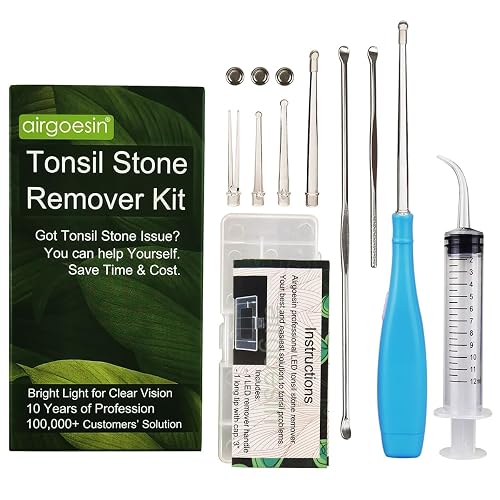
Airgoesin Upgraded Tonsil Stone Remover Tool (LED, 5 Tips)
Best for: Most people — a cheap all-in-one that lets you see, flush, and gently lift a visible stone
- 6.75-inch tool with a built-in LED light
- Five tips plus soft silicone caps
- Includes an irrigation syringe and a stainless pick
- Storage case and spare batteries
- +The most-reviewed dedicated tonsil-stone tool we found, at about ten dollars, and the LED answers the question people ask most: how do you see what you're doing back there
- +Covers the two methods that actually work — a syringe to flush a stone loose and a soft silicone-capped tip to lift a visible one — instead of betting on a single rigid pick
- +One of the few tools here with a specific, campaign-free positive mention in the community we researched, where a user used the light to see and the syringe to flush a stone out
- −The kit also includes a bare metal pick; skip it — scraping is the method that draws blood, and the soft-capped tip does the same job more gently
- −The LED and the syringe are the reason to buy it, not the pick, so treat it as a see-and-flush kit rather than a digging tool
(Affiliate link) · Free shipping on eligible Prime items
Why We Recommend It
The hardest part of removing a tonsil stone isn’t the removing, it’s the seeing—the stones sit in folds at the back of your throat that no bathroom mirror lights properly. This tool leads with an LED for exactly that reason, and it’s the most-reviewed dedicated tonsil-stone product we could find, at around ten dollars.
What earns it the top slot is that it doesn’t stake everything on a rigid pick. It pairs the light with an irrigation syringe, so you can flush a loosened stone out, and a soft silicone cap for the tip, so if you do touch a visible stone you’re pressing something soft rather than metal against the tonsil. That combination—see it, flush it, gently lift it—is what the people who actually clear these stones describe doing, and it’s the combination the guide’s safety section keeps coming back to.
It’s also one of the few products here with a specific, campaign-free positive mention in the community we researched, where one user described using the light to see and the syringe to flush a stone out. That’s one account rather than a consensus, but it lines up with how the tool is built.
Key Features
- A 6.75-inch tool with a built-in LED to light the tonsil area
- Five interchangeable tips plus soft silicone caps to soften the contact point
- An irrigation syringe for flushing and a stainless pick (see the downside)
- A storage case and spare batteries
Who It’s Best For
Anyone starting from scratch who wants one cheap kit that covers the safe methods. It’s especially good if your main obstacle is not being able to see the stone, which is most people’s first problem. Pair it with a warm salt-water gargle before and after, which the medical sources endorse as the gentlest first step.
Potential Downsides
The kit includes a bare metal pick, and we’d leave it in the case—scraping is the single method most associated with bleeding and with pushing a stone deeper, and the soft-capped tip does the gentle version of the same job. Think of this as a see-and-flush kit that happens to include a pick, not a pick that happens to include a light. Its real limit is reach: a syringe and a soft tip work on a stone you can see or bring near the surface, not on one lodged deep out of sight. If your stones are the deep, hidden kind, start with the flush-forward technique and a low-pressure flosser instead.
(Affiliate link) · Free shipping on eligible Prime items
Nuanchu Tonsil Stone Removal Set — Best for Flushing
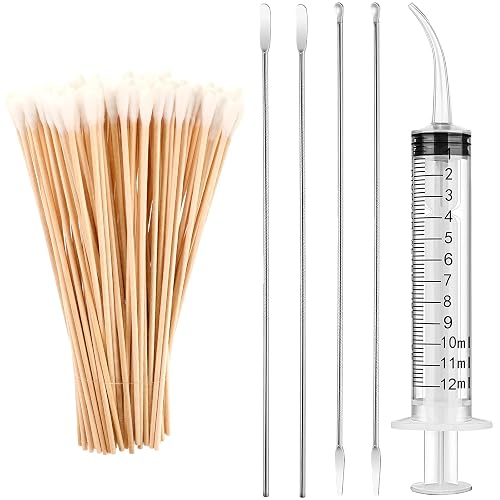
Nuanchu Tonsil Stone Removal Set (Syringe + 100 Swabs + Steel Tools)
Best for: Flushing a stone out rather than digging for it, and anyone with a strong gag reflex
- Curved-tip irrigation syringe (12ml)
- 100 disposable long swabs
- Four stainless steel tools in two styles
- Compact, travel-friendly
- +The curved irrigation syringe is the gentlest of the mechanical methods — you flush a stone out of its crypt rather than forcing anything against the tonsil
- +The 100 disposable swabs cover the gentle cotton-swab method medical sources actually endorse, with a fresh one each time for hygiene
- +The most tools per dollar here, so you can find the approach that suits you without buying several products
- −We found no community track record for the Nuanchu brand specifically in our research, so its case rests on the methods it enables and its components, not on user reports
- −The set also includes rigid stainless picks, which carry the same scraping caveats as any metal tool — the part to use most cautiously, if at all
(Affiliate link) · Free shipping on eligible Prime items
Why We Recommend It
If flushing beats forcing, the humblest tool on this page is arguably the most on-message: a curved-tip syringe. You fill it with warm water or salt water, aim the curved tip at the stone, and flush—no pressing, no scraping, and you control the pressure entirely with your own hand. In the community we researched, the syringe is a recurring favorite precisely because it’s gentler and more controllable than a powered flosser.
This set pairs that syringe with 100 disposable long swabs, which is the cotton-swab method the Cleveland Clinic lists for gently pushing a visible stone, made hygienic by using a fresh one each time. It’s the best value for method coverage here.
We want to be straight about what this pick rests on: we found no mentions of the Nuanchu brand in the tonsil-stone community we researched, so we’re recommending it for the approaches it enables—flushing and gentle swabbing—and its components, not on a user track record we can point to.
Key Features
- A curved-tip irrigation syringe for flushing (roughly 12ml)
- 100 single-use long swabs
- Four stainless steel tools in two styles
- Small enough to keep in a travel bag
Who It’s Best For
People who’d rather flush than dig, and anyone whose gag reflex has defeated every pick they’ve tried—a syringe you control by hand is far easier to modulate than a tool you have to hold steady against the tonsil.
Potential Downsides
The stainless picks in the set carry the same caveats as any rigid metal tool: they’re the part most likely to cause bleeding, so they’re the part to use most cautiously, if at all. And because there’s no community feedback on this specific brand, treat the star rating as a starting point rather than a verdict.
(Affiliate link) · Free shipping on eligible Prime items
ORAVIX Tonsil Stone Vacuum — Best No-Scrape Tool
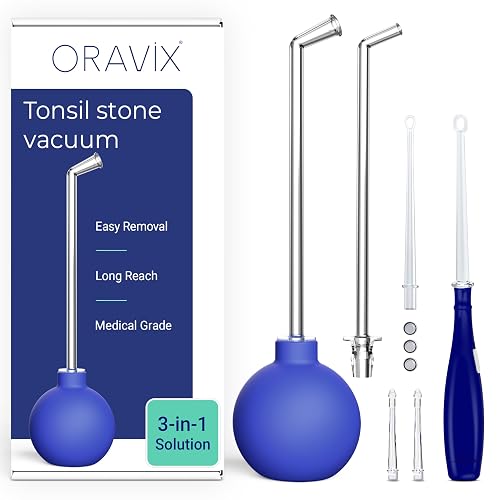
ORAVIX Tonsil Stone Vacuum (Manual Suction, Battery-Free)
Best for: Pulling a loosened stone out by suction instead of scraping, with no electricity or batteries
- Squeeze-bulb suction with a curved tube
- No power source or batteries
- Smooth edges to reduce the gag reflex
- Simple to rinse and sterilize
- +Suction lifts a loosened stone out without a rigid tip pressing into the tonsil, which sidesteps the two things that go wrong most: bleeding and pushing a stone deeper
- +Battery-free and simple, with a curved tube shaped to reduce the gag reflex that defeats most manual tools
- +A deep review base for a niche tool, at under fifteen dollars
- −Cheap tonsil-stone tools attract a lot of incentivized and sponsored reviews, so we weight the star rating here lightly and recommend it on the no-scrape design rather than the review count
- −Suction works best on a stone that's already loose or visible; a deeply lodged one usually needs flushing or gargling first
(Affiliate link) · Free shipping on eligible Prime items
Why We Recommend It
Suction is an underrated middle path between flushing and picking. You squeeze the bulb, place the curved tube near a loosened stone, and release to draw it out—nothing hard presses into the tonsil, which is what avoids the bleeding and the pushed-deeper stone that manual picks cause. It runs on nothing but your hand, and the curved tube is shaped to sit further forward, which helps with the gag reflex.
It’s the only well-reviewed suction tool we could source; the newer electric vacuum devices in this category almost all launched recently and have too few reviews to judge yet. We should be straight that suction isn’t a method the tonsil-stone community actually rallies around—flushing and gargling are what they point to—so this is a design pick, recommended on how gently it works rather than on user reports.
Key Features
- A squeeze-bulb that generates suction by hand, no batteries
- A curved tube to reach the tonsil area with less gagging
- Smooth edges and a shape aimed at first-time users
- Rinses clean and can be sterilized between uses
Who It’s Best For
Anyone who’s uneasy about pressing a tool against their tonsil and wants a no-scrape option, and people who react badly to the gag-inducing straight tools.
Potential Downsides
Two honest cautions. First, this whole category is full of incentivized and sponsored Amazon reviews—we’ve seen brands here openly recruit paid reviewers—so we weight the star rating lightly and recommend this on its no-scrape mechanism rather than its review count. Second, suction shines on a stone that’s already loose or sitting at the surface; a stone wedged deep usually needs a warm gargle or a flush to bring it forward first.
(Affiliate link) · Free shipping on eligible Prime items
COSLUS C20 Cordless Water Flosser — Best Electric Flush
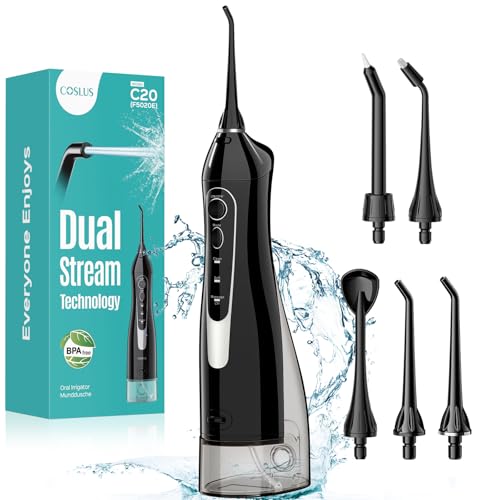
COSLUS C20 Cordless Water Flosser
Best for: People who want an electric water flosser and will keep it on the lowest setting
- Five pressure modes, including a low setting
- 300ml tank
- Cordless and rechargeable, IPX7 waterproof
- Doubles as a normal water flosser for teeth
- +Water flossing is the removal method the community endorses most for flushing deep, hidden stones, and this is a well-reviewed cordless flosser with a genuine low-pressure mode
- +Doubles as an ordinary water flosser for teeth and gums, so it earns its shelf space beyond tonsil stones
- −The community's hard lesson is that full-power dental flossers are too aggressive for tonsils — enough to cause pain, sores, and bleeding even on low, and one user reported this exact model made them bleed
- −Use the lowest of its five settings, aim across the tonsil rather than into the crypt, and stop if it hurts; if even the low setting is too much, a syringe is the gentler flush
(Affiliate link) · Free shipping on eligible Prime items
Why We Recommend It (With a Real Caveat)
A water flosser is the method the tonsil-stone community endorses most for the stones you can’t reach any other way—the deep, hidden ones. The pulsing jet flushes a crypt out from a distance, no contact required, and people who’ve found it work describe it in genuinely enthusiastic terms. The COSLUS C20 is a well-reviewed cordless flosser with three pressure modes, and unlike a single-pressure travel unit it actually has a low setting, which for this job is the setting that matters.
Here’s the caveat, and it’s a serious one. The hardest-won lesson in that same community is that a full-power dental flosser is too aggressive for tonsils. People report pain, sores, and bleeding even on the lowest setting, and one user named this exact model when they described it being too painful and making them bleed. We’re not laundering the category’s general water-flosser enthusiasm onto this specific product; its own named mention in our research was a complaint.
So the honest recommendation is conditional. If you want an electric flosser, use the lowest of its three settings, aim the jet across the tonsil rather than straight into the crypt, keep the sessions short, and stop the moment it hurts. If even the low setting is too much for you—and for some people it is—the hand-controlled syringe above is the gentler way to flush.
Key Features
- Five pressure modes, including a low setting (the one to use here)
- A 300ml tank, larger than most cordless units
- Rechargeable and IPX7 waterproof
- Works as a normal water flosser for teeth and gums
Who It’s Best For
People whose stones sit too deep for a swab or a syringe to reach, who want the flushing power of a water jet—and who will genuinely keep it on the lowest setting. If you already want a water flosser for your teeth, this is a capable one; for tonsil use specifically, it’s power you have to respect. Our portable water flosser roundup covers the general water-flossing use case in more depth.
Potential Downsides
The power that makes it effective is the same power that makes it risky here. Aimed carelessly or run too high, a water flosser can hurt the tonsil, and this one carries a specific bleeding complaint from a tonsil-stone user. It’s the least beginner-friendly tool on the page for that reason, which is why it sits below the gentler flush and suction options rather than at the top.
(Affiliate link) · Free shipping on eligible Prime items
Dr. Frederick’s Original Kit — Most Complete Kit
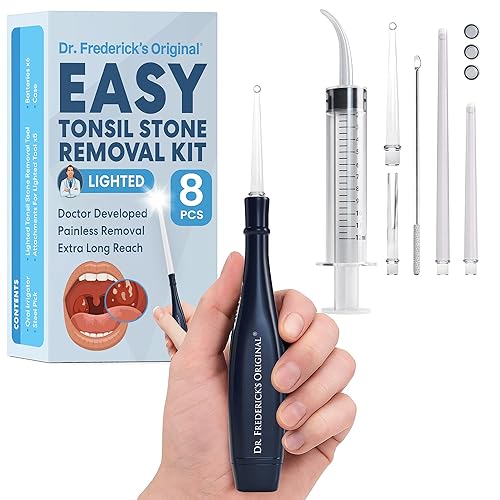
Dr. Frederick's Original Easy Tonsil Stone Remover Kit (8 Pieces)
Best for: Anyone who wants the recognizable all-in-one kit with a lighted tool and an irrigator
- Water irrigator for flushing
- Lighted tonsil-stone tool
- Five silicone-sleeved heads
- Storage case
- +A well-known, recognizable tonsil-stone kit on Amazon, and a genuine all-in-one: it pairs an irrigator for flushing with a lighted tool and soft silicone-sleeved heads for visible stones
- +The silicone sleeves are the right instinct — a softer contact surface than a bare pick — and the case keeps it hygienic between uses
- −We found no discussion of this kit in the tonsil-stone community we researched, so its case rests on its features and Amazon rating rather than user reports we can point to
- −As with any kit, the flushing and soft-tip parts are the safe ones; the rigid attachments carry the usual scraping caveats
(Affiliate link) · Free shipping on eligible Prime items
Why We Recommend It
This is a familiar, recognizable tonsil-stone kit, and it’s a sensible all-in-one. It pairs a water irrigator for flushing with a lighted tool and five heads that wear removable silicone sleeves, so the contact surface is soft rather than bare plastic or metal. That’s the right instinct: it leans toward the gentle, contact-softened end of the manual tools rather than a stiff scoop.
If you want a single tidy box with a case and a bit of everything, this is the recognizable option, and it covers flushing (the irrigator) and lighting (the tool) alongside the soft-tip heads.
We should be clear about the basis for including it: we found no discussion of this specific kit in the tonsil-stone community we researched. Its case here rests on its design and its Amazon rating, not on user reports we can cite.
Key Features
- A water irrigator for the flushing method
- A lighted tool to help you see the stone
- Five heads with removable silicone sleeves for a softer touch
- A storage case for hygiene and travel
Who It’s Best For
Someone who prefers a familiar, self-contained kit over assembling their own approach, and who values the irrigator-plus-light combination in one box.
Potential Downsides
The same rule applies as everywhere on this page: the irrigator and the silicone-sleeved tips are the parts to lean on, and any rigid attachment is the part to treat with care. And because there’s no community feedback on this exact kit, its rating is a starting point rather than a track record.
(Affiliate link) · Free shipping on eligible Prime items
Tonsil Tech Remover — Best Manual Pick
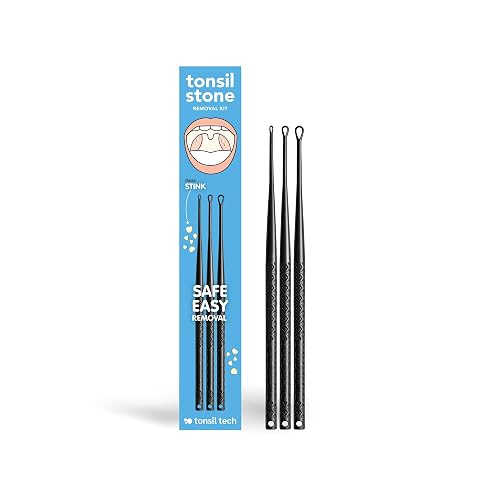
Tonsil Tech Tonsil Stone Remover Tool (Flexible Resin, Made in USA)
Best for: Lifting a clearly visible, shallow stone, if you're going to use a pick at all
- Flexible resin, not rigid metal
- Teardrop tip in three head sizes
- One-piece build with a safety wrist strap
- Made in the USA
- +If you're set on a pick, this is the least-risky design here — flexible resin rather than rigid metal, a rounded teardrop tip, and one-piece construction with a wrist strap so there's nothing to choke on
- +The flexible tip and graded head sizes are aimed squarely at lifting a visible stone without the jab of a stiff metal scoop
- −Picking is the method an ENT specifically advises against, because tonsils are delicate and prone to bleeding and infection, so use it only on a stone you can clearly see
- −No community track record surfaced in our research, and at over twenty dollars it's the priciest manual tool here
(Affiliate link) · Free shipping on eligible Prime items
Why We Recommend It
Some people are going to use a pick no matter what the safety section says, and if that’s you, this is the least-risky pick design in the lineup. It’s flexible resin instead of rigid metal, so it flexes rather than jabs; the tip is a rounded teardrop rather than a sharp scoop; and it’s one continuous piece with a wrist strap, which addresses the genuine worry of a small tool slipping loose at the back of your throat.
Within the category of “tools you press against a visible stone,” those are the right design choices. It’s the honest pick for the person who wants a pick.
As with the other niche brands here, no community track record surfaced in our research, so this is a design-and-spec recommendation.
Key Features
- Flexible resin construction, not rigid metal
- A teardrop tip in three head sizes for shallow and slightly deeper crypts
- One-piece build with a safety wrist strap
- Made in the USA
Who It’s Best For
Someone with a clearly visible, shallow stone who wants to lift it out with a tool and wants the gentlest-designed one available.
Potential Downsides
This is the honest bottom line for every pick, this one included: an ENT specifically advises against removing stones at home by scraping, because tonsils bleed and can become infected. Use it only on a stone you can plainly see, work gently, and never dig for one you can’t reach—that’s exactly how the “made it worse” stories start. At over twenty dollars it’s also the most expensive manual tool here.
(Affiliate link) · Free shipping on eligible Prime items
What the community says vs. what the evidence says
| Common belief (paraphrased) | What the evidence and careful users support |
|---|---|
| “Just dig it out with a pick or a bobby pin.” | The riskiest approach. An ENT at Northwestern Medicine advises against scraping at home because tonsils are delicate and prone to bleeding and infection, and tonsil-stone communities are full of “I made it bleed / pushed it deeper” accounts. Flush or gently swab a visible stone instead. |
| “A Waterpik on low is totally fine for tonsils.” | Not universally. Community members warn that full-power dental flossers are too aggressive even on the lowest setting, reporting pain and bleeding. If you use one, keep it on the lowest setting, aim across the tonsil, and stop if it hurts—or use a hand-controlled syringe. |
| “The LED tool is the magic device.” | The value is the light, not the pick attached to it. Being able to see the stone is most people’s first obstacle; the removal still comes from flushing or a gentle lift, not from the pick. |
| “Salt water is useless, you need a tool.” | Warm salt-water gargling is on the Cleveland Clinic’s own at-home list and is the gentlest first step and the best-supported prevention. It won’t reach a deep lodged stone, but it’s where to start. |
| “A little bleeding is normal, keep going.” | Brief bleeding that stops is one thing; people in these communities pass around a rough rule that if it’s still bleeding an hour later you should see a doctor, which lines up with the general medical advice to get persistent bleeding looked at. Keep going only if it’s stopped. |
| “It’s definitely just a stone.” | Sometimes it isn’t. Users describe assuming they had a stone when they actually had a throat infection or abscess. If there’s one-sided swelling, severe pain, or bleeding that won’t stop, treat it as a reason to see a doctor, not to keep poking. |
Buyer’s Guide: Removing Tonsil Stones Without Making It Worse
The technique that actually works
The method the safe options all share is the same, and it’s worth stating plainly:
- See it first. Use a light (a phone torch or the LED tool) and a mirror. If you can’t see a stone, don’t go fishing for it—that’s how tissue gets torn.
- Loosen it gently. A warm salt-water gargle, a good cough, or a low-pressure flush will bring many stones forward or out on their own.
- Flush or suck, don’t scrape. Aim a syringe or a low water jet across the stone, or use suction. Let water do the work.
- Only lift what you can see. For a clearly visible, surface stone, a soft-capped tip or a moistened cotton swab can nudge it out. Push gently upward, not down and in.
- Stop if it hurts or bleeds. Brief bleeding that stops is common; pain, or bleeding that continues, means stop.
Reaching the ones you can’t see
The most common frustration is a stone you can feel but can’t see or reach—lodged in a deep crypt with no obvious opening. Forcing a tool at it is the wrong move. What tends to help is bringing it forward first: warm salt-water gargling, a low-pressure flush aimed at the general area, and sometimes just time, since stones often work their way out on their own. If a deep stone keeps recurring and nothing shifts it, that’s a reason to see an ENT rather than to escalate the tool.
Using a water flosser without hurting yourself
If you go the water-flosser route, the rules are non-negotiable: lowest setting only, aim the stream across the surface of the tonsil rather than jetting it straight into a crypt, keep bursts short, and stop at the first sign of pain. The power that clears a deep stone is the same power that can hurt the delicate tissue, and “even on the lowest setting it was too rough” is a real refrain among users. Some long-term sufferers get around this with an inherently gentle, low-pressure flosser built for the job—a purpose-made tonsil irrigator with a single soft setting you can’t crank up. Budget versions do exist; they tend to carry mixed ratings (they’re deliberately too weak to satisfy anyone who wanted a powerful general flosser) and the same incentivized-review problem as the rest of the category, so we haven’t singled one out—but that low, unadjustable pressure is the design to look for if you want the gentlest jet. Otherwise a hand-squeezed syringe gives you the same gentle, controllable flush without the risk of turning a dial too far.
How not to gag
The gag reflex ends more removal attempts than anything else. The tricks people rely on: breathe steadily through your nose, bring your tongue forward and down so tools and water stay toward the front of your mouth, work in short attempts rather than one long one, and choose a shape you can control—a hand-held syringe or a curved suction tube is far easier to modulate than a straight rigid pick jammed to the back.
Stopping them coming back
Removal treats today’s stone; prevention is what actually reduces the misery. The Cleveland Clinic points to the basics: brush and floss regularly, clean your tongue, gargle with salt water after eating, stay hydrated, and quit smoking. A tongue scraper and the right mouthwash for bad breath fold into the same routine, since bad breath is the main complaint tonsil stones cause in the first place. Some people also use a well-diluted hydrogen peroxide rinse, but there’s no medical dosing guidance for using it on tonsils and it should never be swallowed—warm salt water is the safer, better-supported default.
When to see a doctor or an ENT
Home tools are for small, reachable, occasional stones. The Cleveland Clinic says to talk to a provider when at-home remedies aren’t working or stones keep coming back—and treat bleeding that won’t stop, one-sided swelling, or trouble swallowing or breathing as reasons to be seen promptly. The clinical literature describes tonsil stones as managed expectantly in most cases, with surgery reserved for the rare stone too large to pass. For chronic sufferers, the normal path is a GP, then an ENT referral, with tonsillectomy as a last resort rather than a first step—not something a $10 tool replaces.
Frequently Asked Questions
How do I remove a tonsil stone I can’t see or reach?
Don’t fish for it blind—that’s the most common way people injure a tonsil. Bring it forward first with a warm salt-water gargle, a firm cough, or a gentle low-pressure flush aimed at the general area. Many stones loosen and come out on their own with that alone. If you genuinely can’t see or reach a stone and it keeps bothering you, that’s a reason to see an ENT rather than to dig deeper with a tool.
Is it safe to use a water flosser on my tonsils?
It can be, on the lowest setting and used carefully, and it’s the method many people find works for deep stones. But it comes with a real warning: full-power dental flossers are strong enough to hurt the delicate tonsil tissue, and users report pain and bleeding even on low settings. If you use one, keep it on the lowest pressure, aim across the tonsil rather than into the crypt, and stop the moment it’s uncomfortable. A hand-squeezed syringe is a gentler way to get the same flushing action.
Will removing a tonsil stone make it bleed?
It can, especially if you scrape or press hard—which is exactly why the gentle, contact-free methods are safer. A little bleeding that stops quickly is common. Bleeding that keeps going is not something to push through: people in tonsil-stone communities use a rough rule that if it’s still bleeding an hour later you should see a doctor, and that matches the general medical advice to get persistent bleeding checked.
How do I stop gagging while I do this?
Breathe steadily through your nose, bring your tongue forward and down so tools and water stay toward the front of your mouth, and work in short attempts rather than one long push. Choosing a tool you can control by hand—a syringe or a curved suction tube—helps far more than trying to steady a rigid pick at the back of your throat.
Why do I keep getting tonsil stones, and how do I stop them?
Some people simply form them more than others, a bit like how some people produce more earwax. You can’t always prevent them, but you can reduce them: the Cleveland Clinic points to brushing and flossing, cleaning your tongue, gargling with salt water, staying hydrated, and not smoking. A consistent oral-hygiene routine that targets the odor-causing bacteria is the realistic lever, not any single tool.
Could this be something other than a tonsil stone?
Sometimes, yes. People in these communities describe assuming they had a stubborn stone when the real problem was a throat infection that needed treatment. If you have severe or one-sided pain, swelling, a fever, difficulty swallowing or breathing, or bleeding that won’t stop, treat it as a reason to get examined rather than to keep working at it with a tool.
Is it bad if I swallow a tonsil stone?
No. As Northwestern Medicine’s ENT puts it, if you happen to swallow one it won’t hurt you—swallowing a dislodged stone is harmless. That’s part of why coughing one loose or flushing it out is a perfectly good outcome, and why you don’t need to catch every stone you remove.
Our Methodology
We research each product category by reading live Amazon listings, reading ratings and review counts directly from the product pages, consulting guidance from medical sources (including the Cleveland Clinic, Northwestern Medicine, and the clinical literature), and reviewing real user discussion—here, roughly 50 threads in the tonsil-stone community. We did not lab-test these tools, and community reports are anecdotal, so we treat them as signals about real-world use rather than as clinical evidence. This is a category with a lot of incentivized and sponsored reviews, so we lean on how a tool is designed and what medical guidance supports, not on star ratings alone. Where affiliate links are included, they’re disclosed clearly and don’t influence which tools we recommend or how we rank them. Nothing here is medical advice; for anything painful, persistent, or worrying, see a dentist or an ENT.
This article was last reviewed in July 2026.