
Traveling with a water flosser used to mean lugging a countertop unit in your checked bag. Today’s portable options are compact enough for a carry-on and powerful enough to do real cleaning work. The challenge is finding one that won’t leak in your luggage, holds enough water for a full session, and actually works, not just one that looks good on paper.
For countertop and home-focused picks, see our full water flosser roundup. If you wear braces or a retainer, our best water flosser for braces guide covers orthodontic-specific needs.
How we researched this guide: We did not test these products hands-on. Our recommendations are based on published clinical evidence, manufacturer specifications, real user feedback from 30 Reddit threads across r/dentistry, r/BuyItForLife, r/braces, r/DentalHygiene, and r/HerOneBag, and verified Amazon review patterns (2,000–53,000 reviews per product). The ADA’s guidance on floss and other interdental cleaners is that cleaning between teeth removes the debris and interproximal plaque a toothbrush can’t reach, and two Waterpik models on this page are covered by Waterpik’s ADA Seal acceptances: the ADA’s acceptance of Waterpik’s cordless water flossers is based on demonstrated efficacy for removing plaque along the gumline and between teeth and helping to prevent or reduce gingivitis. The NHS advises cleaning between your teeth with floss or interdental brushes, noting that removing the plaque that forms along the gum line may also reduce gum disease, tooth decay, and bad breath.
What we prioritized for travel: reservoir size vs. portability (the core trade-off users debate most), leak resistance (a common worry when packing a flosser in luggage), battery type (AA vs. USB, matters more than you’d think internationally), water pressure (Waterpik’s own cordless buying guide puts handheld cordless units at slightly lower overall pressure than countertop models), and whether premium pricing translates to meaningful feature differences.
The most common brand question in the Reddit threads behind this guide was whether budget cordless flossers (COSLUS, Nicwell) hold up against Waterpik. The consensus from experienced users: good enough for daily use, but not as powerful or durable. Nicwell drew no organic Reddit discussion in our research pull, and some of the posts we found about the MySmile LP221 carry affiliate-marketing patterns, so our assessments of those two rest on specs and verified review patterns rather than community testimony. See the gum disease findings in our community consensus research for how flosser pressure figures into periodontal care.
Evidence Receipt
- Waterpik’s cordless water flossers hold a family ADA Seal of Acceptance based on demonstrated efficacy for removing plaque along the gumline and between teeth and helping to prevent or reduce gingivitis (ADA Seal product entry).
- Cleaning between teeth removes the debris and interproximal plaque that toothbrush bristles cannot reach (ADA, floss and other interdental cleaners).
- Advancing gum disease needs professional periodontal treatment, not just a stronger home device (American Academy of Periodontology).
- Handheld cordless flossers use a smaller reservoir and slightly lower overall water pressure than countertop units, and most carry 2 or 3 pressure settings where countertop models carry 3, 6, or 10 (Waterpik, cordless water flosser buying guide; Waterpik, water flosser features).
COSLUS C20 Cordless Water Flosser — Editor’s Pick
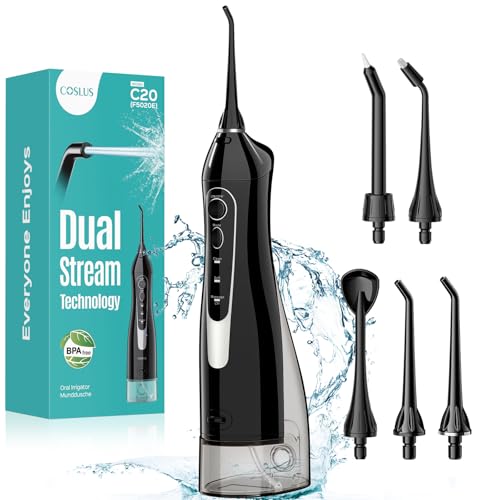
COSLUS C20 Cordless Water Flosser
Best for: Travelers who want the best combination of capacity, value, and a track record of reviews
- 300mL detachable reservoir — enough water for a full session without refilling
- 3 pressure modes (Soft, Massage, Clean) with a rotating nozzle for hard-to-reach areas
- IPX7 waterproof — safe for shower use and easy to rinse clean
- USB charging from any power bank or hotel USB port (cable included, adapter not)
- Five tips in the box: standard jet tips, a periodontal tip and a tongue scraper
- +300mL reservoir completes a full session without refilling
- +IPX7 waterproof with USB charging from any power bank or hotel USB port (cable included, adapter not)
- +3 pressure modes (Soft, Massage, Clean)
- −Durability reviews are mixed: a share of reviewers report the unit stopping within a few months, and 673 of 2,017 battery-life mentions are negative
- −Mid-size bulk: not as pocketable as smallest options
(Affiliate link) · Free shipping on eligible Prime items
The COSLUS C20 is one of the most reviewed cordless water flossers on Amazon for good reason. Its 300mL detachable reservoir gives you enough water for a full flossing session without stopping to refill, and the rotating nozzle reaches awkward angles that standard tips can’t. Three pressure modes (Soft, Massage, Clean) let you start gentle and work up: useful if you’re new to water flossers or have sensitive gums.
For travel specifically, the IPX7 waterproof rating means you can use it in the shower without worry, and USB charging (a cable is included; the wall adapter is not) makes topping up easy from any hotel USB port or power bank. The reservoir detaches cleanly, which reduces (though doesn’t eliminate) leak risk when packed. It’s a mid-size portable: not as pocketable as the smallest options, but meaningfully more capable.
The main complaint in user reviews is durability rather than leaking: a share of reviewers report the unit stopping working within a few months, and 673 of the 2,017 reviews that mention battery life describe it negatively. If you’re relying on this as your only travel flosser, it’s worth keeping the box and receipt until you’ve run it through a few trips.
(Affiliate link) · Free shipping on eligible Prime items
Waterpik Cordless Express Water Flosser WF-02 — Best for International Travel
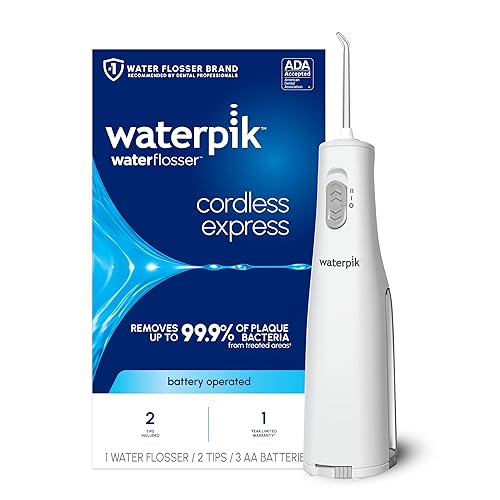
Waterpik Cordless Express Water Flosser WF-02
Best for: Frequent international travelers who need AA battery power anywhere in the world
- Runs on 3 AA batteries: no charging, no voltage adapters, works in any country
- ADA Accepted for safety and effectiveness
- Compact and lightweight (Waterpik lists it at 11.68 oz)
- On/off slider switch with 2 pressure settings; 5 oz removable reservoir
- Includes 2 Classic Jet Tips (JT-450E) and 3 AA batteries
- +AA battery power works anywhere, no chargers or voltage adapters needed
- +ADA Accepted for safety and effectiveness
- +Compact and lightweight (Waterpik lists it at 11.68 oz)
- −Two pressure settings only, so little room to adjust for sensitive gums
- −5 oz reservoir is smaller than the rechargeable picks here
(Affiliate link) · Free shipping on eligible Prime items
The Waterpik Cordless Express is the standout choice for international travel, and the reason is simple: it runs on three AA batteries. You never have to worry about finding the right voltage adapter, hunting for a USB port, or waiting for a charge. If you’re in a country where your charger won’t work or you’re in a rural location without reliable power, the WF-02 just works: pick up AA batteries at any pharmacy or convenience store and you’re flossing.
It carries the ADA Seal of Acceptance, and its pressure sits below a countertop unit’s while still doing the job of disrupting plaque between teeth and along the gumline. The reservoir holds 5 oz of water, which Waterpik rates at up to 30 seconds of flossing time. The controls are as simple as they get: an on/off slider with a low setting and a high setting, and nothing else to configure.
The trade-off is exactly what you’d expect: two pressure steps leave less room to fine-tune for sensitive gums than the COSLUS, Nicwell, or Sonicare picks here, and the reservoir is smaller than the rechargeable competitors. Users in the threads behind this guide worry that cordless pressure will not match a countertop Waterpik, and one returned a cordless Waterpik for exactly that reason; the gap is real. But for what it does (clean teeth reliably anywhere in the world without any tech overhead) it’s hard to beat. If you mostly travel domestically and care more about pressure than battery flexibility, the Cordless Pulse 3100 below may suit you better.
(Affiliate link) · Free shipping on eligible Prime items
Nicwell Cordless Water Flosser — Best Budget
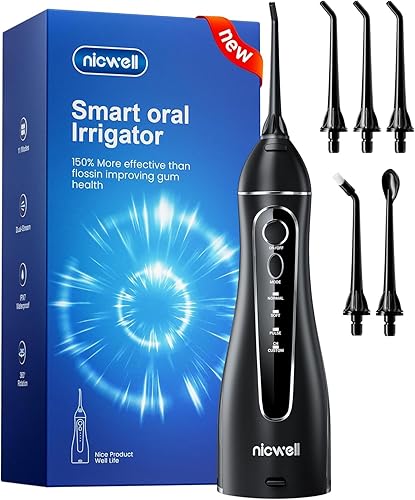
Nicwell Cordless Water Flosser
Best for: Budget-conscious travelers who want 11 pressure settings without a premium price
- 11 pressure settings across 4 cleaning modes (Normal, Soft, Pulse, DIY)
- 200mL reservoir: Nicwell's listing says that's enough water for most users' sessions
- IPX7 waterproof — shower-safe and easy to clean
- USB rechargeable with multiple-day battery life per charge
- Includes 5 jet tips: standard, orthodontic, tongue cleaner, and more
- +11 pressure settings across 4 cleaning modes for granular control
- +At about $30, the lowest price of any pick in this roundup
- +5 jet tips included with an orthodontic option
- −Battery and durability reviews are mixed: 640 of 1,101 battery-life mentions are negative, and several reviewers report the unit no longer holding a charge within months
- −Less brand recognition and clinical validation than Waterpik
(Affiliate link) · Free shipping on eligible Prime items
At around $30, the Nicwell is one of the most feature-rich budget portable water flossers available. Eleven pressure settings give you more granular control than most models at twice the price, and four cleaning modes (normal, soft, pulse, and DIY) let you customize the feel. The 200mL reservoir is smaller than the COSLUS C20’s, though Nicwell’s own listing says it’s enough water for most users’ sessions, and IPX7 waterproofing means you can use it in the shower.
For travelers who want a solid everyday portable without spending much, this is a compelling option. It’s USB rechargeable with a full charge lasting several days of regular use. The five included jet tips (standard, orthodontic, tongue cleaner, and more) add value—you’re not paying extra for accessories you’d need anyway.
The most common complaint in user reviews is battery life: 640 of the 1,101 reviews that mention battery life describe it negatively, and several reviewers report the unit no longer holding a charge within months rather than years. For a travel flosser that mostly sits in your kit between trips, that’s worth weighing against the price, and it’s a good reason to keep the receipt until you’ve tested it through a couple of trips.
(Affiliate link) · Free shipping on eligible Prime items
Philips Sonicare Cordless Power Flosser 3000: Best for Braces and Brackets
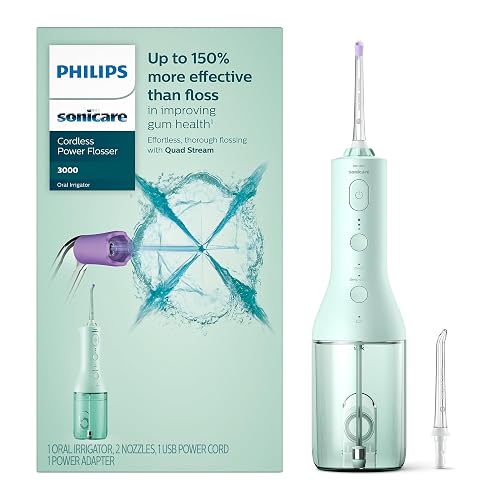
Philips Sonicare Cordless Power Flosser 3000
Best for: Braces and bracket wearers who want a tip shaped to clean around hardware
- X-shaped Quad Stream tip splits the water into four angled jets
- 250ml removable tank: a full 60-second session, or up to 90 seconds in Deep Clean mode
- 2 cleaning modes and 3 pressure settings, with a QuadPacer that pauses every 15 seconds
- Rated at up to 40 days per charge, recharged over a USB-A cable and wall adapter
- IPX7 waterproof; ships with the Quad Stream tip and a Standard tip, both rotating 360°
- +X-shaped tip splits the stream into four angled jets, covering more area per pass than a single nozzle
- +250ml removable tank holds a full 60-second routine, or up to 90 seconds in Deep Clean mode
- +Rated at up to 40 days per charge over standard USB-A, so one charge covers a long trip
- −The most expensive pick in this guide at around $80
- −3 pressure settings is less fine-grained than the budget picks offer
(Affiliate link) · Free shipping on eligible Prime items
Brackets are the reason this slot exists. Philips builds the 3000 around what it calls Quad Stream: an X-shaped tip that splits the water into four angled jets instead of one, so a single pass covers more surface than a nozzle you have to aim by hand. Philips describes the effect for braces and brackets specifically, and tells you to move the tip in small circles rather than thread it around each bracket. That threading step is the part of orthodontic cleaning most people quietly stop doing.
The rest of the specification is built for being away from home. The 250ml tank twists off to fill and holds a full 60-second routine, or up to 90 seconds in Deep Clean mode, where Philips’s Pulse Wave sets a rhythm to move you from tooth to tooth. A QuadPacer briefly pauses the water every 15 seconds to send you to the next quadrant, which is a useful nudge if you tend to rush one side of your mouth. Charging is a plain USB-A cable and wall adapter, and Philips rates a full charge at up to 40 days on a one-minute daily session, so a two-week trip needs no charger in the bag at all.
Two things to weigh. At around $80 this is the most expensive pick here, and three pressure settings give you less fine-grained control than the Nicwell’s eleven, so if dialing in exact intensity is what you care about, the Nicwell above is the one to compare it with. The other is the headline printed on the box: the “150% more effective than floss” headline is Philips’s own comparison against string floss using the Quad Stream nozzle, and its 99%-plaque figure comes from a Philips lab study in pockets up to 6mm, so read both as manufacturer measurements rather than independent results. Its 4,739 ratings at 4.2 stars are a smaller review base than the Waterpik and COSLUS picks carry, though the listing has been live since August 2023 and those reviews belong to this model rather than being pooled from an older one.
(Affiliate link) · Free shipping on eligible Prime items
Waterpik Cordless Pulse 3100 WF-20 — Best Rechargeable
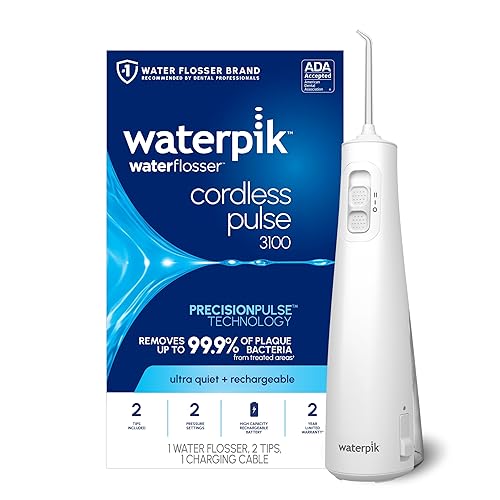
Waterpik Cordless Pulse 3100 WF-20
Best for: Road warriors who want a trusted brand, USB charging, and solid pressure in a compact form
- 2 pressure settings: low and high
- 6 oz removable reservoir, rated at up to 45 seconds of continuous flossing
- USB rechargeable — powers up from any hotel USB port or power bank
- ADA Accepted for safety and effectiveness
- Includes 2 tips (a JT-450E Precision tip and a tongue cleaner); takes Waterpik's cordless tips, not the countertop range
- Amazon Exclusive model — designed for travel use
- +USB rechargeable with multi-day battery life per charge
- +ADA Accepted, with a 6 oz removable reservoir rated at up to 45 seconds of flossing
- +Waterpik tips and after-sale support from an established brand
- −Amazon Exclusive, so it is not available in retail stores
- −Two pressure settings, low and high, against the Nicwell's eleven
(Affiliate link) · Free shipping on eligible Prime items
The Waterpik Cordless Pulse 3100 (WF-20) is Waterpik’s rechargeable travel answer, and the step up from the AA-powered Cordless Express is the battery rather than the controls: both run low and high pressure only, but this one charges over USB instead of eating disposable AAs, and its 6 oz reservoir is rated at up to 45 seconds of continuous flossing against the Express’s 30. The ADA Seal of Acceptance covering Waterpik’s cordless flossers reflects demonstrated efficacy for removing plaque along the gumline and between teeth and helping to prevent or reduce gingivitis. It ships with two flossing tips and charges via standard USB, so any hotel room with a USB port has you covered.
What makes it a strong middle-ground pick is the combination of a trusted brand name and useful features for the price. Waterpik cites more than 80 clinical studies behind its water flosser line, its cordless models hold the ADA Seal, and its replacement tips are easy to find. The battery holds a charge across multiple days of use, which covers most business trips or vacation stays without anxiety about recharging nightly.
Its main limitation is the control range: low and high, against the Nicwell’s eleven steps and the COSLUS C20’s three modes. It’s also Amazon Exclusive, meaning you won’t find it in stores if you need a last-minute purchase before a trip. And at about $35 it sits mid-pack on price in this guide, so what you are paying for is the brand’s after-sale support and the ADA acceptance rather than a spec advantage: the Nicwell offers more pressure steps and a bigger tank for about $5 less. If you also own a countertop Waterpik, don’t assume the tips are interchangeable—cordless models take a different Precision tip than countertop units. See which Waterpik tips fit which flosser before you buy replacements.
(Affiliate link) · Free shipping on eligible Prime items
MySmile LP221 Cordless Water Flosser: Best for Tank Hygiene
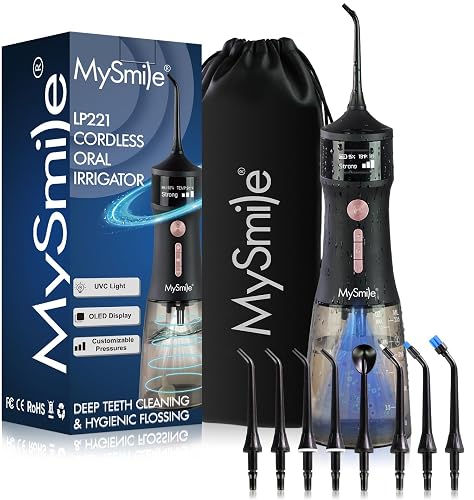
MySmile LP221 Cordless Water Flosser
Best for: Travelers who worry about mold and bacteria building up in a stored flosser
- Built-in UVC light runs a 120-second self-cleaning cycle over the tank and nozzles
- 335ml tank: the largest reservoir in this guide
- 4 modes (Soft, Normal, Strong, Pulse) with 3 pressure steps on everything but Pulse
- OLED screen shows mode, pressure, battery, and water temperature
- 8 jet tips including orthodontic, periodontal, plaque and tongue-cleaner; IPX7 waterproof, travel pouch included
- +Built-in UVC light runs a 120-second self-cleaning cycle over the tank and nozzles
- +335ml tank, the largest reservoir in this guide
- +8 jet tips including orthodontic and periodontal, plus an OLED screen and a travel pouch
- −2,051 ratings is a much smaller review base than the Waterpik and COSLUS picks carry
- −At around $51 it costs more than the budget picks without their track record
(Affiliate link) · Free shipping on eligible Prime items
This page carries a whole section on stopping mold and bacteria growing inside a flosser that lives in a damp toiletry bag, and until now nothing on the list did anything about that in hardware. The LP221 does. A built-in UVC light runs a 120-second self-cleaning cycle over the water tank and nozzles: with the device switched off, you hold the mode button to start it. It does not replace emptying the tank and letting it air-dry, but it is the one pick here that treats tank hygiene as a built-in job rather than a chore you have to remember on the road.
The tank is the other reason it earns a slot. At 335ml it is the largest reservoir in this guide, which matters if you work slowly around braces, implants, or bridges and resent stopping to refill halfway. Four modes cover Soft, Normal, Strong, and Pulse, with three pressure steps on everything except Pulse, and the OLED screen shows the mode and pressure you are on alongside battery level and water temperature, so you are not counting button presses in a hotel bathroom. Eight tips come in the box, including orthodontic, periodontal, plaque, and tongue-cleaner tips, and MySmile rates the battery at up to 40 days on the lowest mode, charged over USB from a laptop, adapter, or power bank.
Two caveats worth being straight about. The listing carries 2,051 ratings at 4.2 stars, a far smaller and younger review base than the COSLUS, Waterpik Cordless Express, and Nicwell listings on this page, each of which carries tens of thousands, so there is less long-run durability evidence behind it. And some of the online discussion we found about this model carries affiliate-marketing patterns, so nothing above rests on user testimony: the case is built on the published specification and the listing’s own review pattern. At around $51 it also costs more than the budget picks without their track record, and if the UVC cycle is not the feature you came for, the COSLUS C20 does the core job for around $33.
(Affiliate link) · Free shipping on eligible Prime items
Buyer’s Guide: How to Choose a Portable Water Flosser for Travel
Reservoir Size vs. Portability: Finding the Right Trade-Off
Portable water flossers exist on a spectrum from ultra-compact (150–250mL reservoirs) to travel-optimized but still substantial (300mL+). The trade-off is real: a 300mL reservoir like the COSLUS C20 lets you complete a full flossing session without stopping, but it adds bulk to your toiletry bag. The Waterpik Cordless Express sits at the other end with a 5 oz tank that Waterpik rates at up to 30 seconds of flossing, so it packs small and asks you to work fast.
For most people with standard dental needs, 250mL is enough for a single session: Philips rates the Sonicare 3000’s 250ml tank at a full 60-second routine, or up to 90 seconds in its slower Deep Clean mode. If you have braces, multiple implants, or use your water flosser aggressively, opt for 300mL or more. The MySmile LP221’s 335mL tank is the largest here, and it is the pick least likely to make you stop and refill during a slow, thorough pass.
AA Batteries vs. Rechargeable: What International Travelers Need to Know
This decision matters more than it might seem. If you travel internationally (especially across multiple countries on a single trip), rechargeable USB models require you to manage charging compatibility. Most modern USB-C chargers work worldwide, but you still need a socket adapter, a USB port in your room, and time to charge.
The Waterpik Cordless Express WF-02 sidesteps all of this by running on AA batteries. Grab batteries at any airport, pharmacy, or convenience store in any country, and you’re done. The pressure is lower and there are only two settings, but nothing else here is this simple to operate. AA-powered models are a practical choice for multi-country trips or remote destinations, where finding compatible chargers can be challenging.
For domestic travel or trips with reliable hotel USB access, rechargeable models are more convenient day-to-day and typically deliver better pressure performance.
Will My Portable Water Flosser Leak in My Luggage?
Leaking in luggage is a common concern with portable water flossers, particularly models where the reservoir cap isn’t fully sealed when packed. Most models on this list are rated IPX7 waterproof (the COSLUS C20, Nicwell, Philips Sonicare 3000, and MySmile LP221 all carry the rating), but IPX7 submersion resistance is different from preventing drips when tipped sideways in a bag.
To minimize leak risk: empty the reservoir completely before packing, store the unit upright if possible, and keep it in a zip-lock bag as a backup. Every pick on this page has a removable tank, so empty and remove it entirely before packing, which eliminates the risk (the Waterpik tanks are also top-rack dishwasher safe). The Sonicare’s tank twists off and has a fill port on the side that Philips tells you to leave open afterwards so the inside can dry, which is a habit worth copying whichever model you pack.
Portable vs. Countertop Pressure: What to Expect
Handheld cordless units run at slightly lower overall water pressure than countertop models, and they give you fewer steps to adjust it. Waterpik’s own buying guide puts most cordless flossers at 2 or 3 pressure settings against 3, 6, or 10 on the countertop line. In practice, the difference is noticeable but not dramatic for users without significant gum disease or deep periodontal pockets. The ADA Seal acceptance covering Waterpik’s cordless water flossers is based on demonstrated efficacy for removing plaque along the gumline and between teeth and helping to prevent or reduce gingivitis, and that acceptance applies to cordless units specifically, not just Waterpik’s countertop line.
If you have periodontal disease or your dentist has recommended aggressive water flossing, the Nicwell’s 11 pressure steps give you the finest control of any pick in this guide, and a countertop unit gives you more headroom at the top end than any cordless model here. For everyone else, a well-designed portable will do the job. See our comparison of water flossers vs. string floss for more on the clinical evidence.
TSA Rules: What You Can (and Can’t) Carry On
A portable water flosser itself is TSA-compliant and can go in carry-on luggage. The relevant question is the water. TSA’s 3-1-1 rule limits liquids in carry-on bags to containers of 3.4 oz (100mL) or less per container, all in a single quart-sized bag. A 300mL water flosser reservoir doesn’t comply if filled; you’d need to pack it dry and fill it at the gate or hotel sink.
You can check a water-filled flosser in your checked luggage with no restrictions. If traveling carry-on only, simply pack it empty and refill wherever you land. Most hotel sinks, airport water fountains, and restaurants provide the potable water you need.
Preventing Mold and Bacteria in Your Water Flosser
Standing water inside a portable flosser is a breeding ground for bacteria and mold: a complaint that came up in user discussions, and the reason some users value a UV-C feature. Travelers who store a damp flosser in a toiletry bag between uses are especially at risk.
To keep your flosser hygienic: empty the reservoir completely after every use and leave the cap open to air-dry. Once a week (or after every trip), run a cycle with a diluted white vinegar or hydrogen peroxide solution to flush the internal tubing. If you notice discoloration or a musty smell, soak removable parts in vinegar for 30 minutes. Removable tanks (every pick on this page has one) are easier to clean and dry than a sealed design, and the Waterpik tanks are also dishwasher safe. The MySmile LP221 goes a step further with a built-in UVC light that runs a 120-second self-cleaning cycle over the tank and nozzles, which is hardware doing a job every other pick here leaves to you.
When a Portable Water Flosser Isn’t Enough
A portable water flosser is a genuine upgrade over skipping interdental cleaning while traveling. But it has limits, and knowing them helps you get the right tool for your situation:
- Tonsil stones. Even a good travel flosser falls short at flushing tonsil crypts; for that, our best tonsil stone removal kit picks are the more purpose-built tool.
- Deep periodontal pockets: If your dentist has noted significant pocket depths, a typical portable flosser’s pressure may not adequately flush debris from those pockets. A countertop model with higher pressure is worth considering. The American Academy of Periodontology recommends professional treatment for advancing gum disease.
- Water flossing alone isn’t flossing. In the Reddit threads behind this guide, the answer from dental professionals is consistently that water flossers complement but do not replace string floss or interdental brushes. Water flossers dislodge loose debris and flush bacteria from between teeth, while string floss and interdental brushes physically clean the contact surfaces. Use both.
- Braces and complex dental work. If you have brackets, bridges, or implants, a standard jet tip may miss critical areas. An orthodontic tip helps, but the most thorough approach is a water flosser plus a threader or orthodontic floss. See our water flosser for braces guide for more.
- Persistent bleeding or gum problems. If your gums bleed regularly during water flossing despite consistent gentle use, that’s a signal to see a dentist, not to increase the pressure. Bleeding gums can indicate gingivitis or periodontal disease that needs professional treatment, not a better gadget.
A flosser also only covers half of a travel oral-care kit; our best travel electric toothbrush picks are sized for the same carry-on constraints on the brushing side.
Frequently Asked Questions
Are portable water flossers as effective as countertop models?
For most people, yes, with consistent daily use. The ADA Seal acceptance for Waterpik’s cordless water flossers covers cordless models specifically, based on demonstrated efficacy for removing plaque along the gumline and between teeth and helping to prevent or reduce gingivitis. The gap between portable and countertop effectiveness is meaningful mainly for people with advanced gum disease who benefit from higher-pressure flushing of deeper periodontal pockets. If you have significant gum issues, ask your dentist whether a countertop model is clinically preferable for your situation.
Can I use a portable water flosser with tap water?
Yes. Standard tap water is fine for water flossing, and plain water is the easiest option when traveling. If you’re in an area where tap water quality is uncertain, use bottled water. Two cautions from Waterpik’s own guidance: mouthwash is allowed at no more than a 1:1 mix with water, followed by a plain-water rinse cycle, and salt water is on the do-not-use list for cordless handheld units because it shortens the product’s life. Other brands publish their own limits, so check the manual before adding anything to the reservoir.
How long does the battery last on a rechargeable portable water flosser?
It varies more than you would expect across this list. COSLUS rates the C20 at up to 30 days and Nicwell rates its flosser at about a month of twice-daily use, though both listings carry mixed battery reviews. Philips rates the Sonicare 3000 at up to 40 days on one charge based on a one-minute daily session, and MySmile makes the same 40-day claim for the LP221 on its lowest mode, so either can cover a long trip without a charger. Battery capacity decreases with age, as with all rechargeable devices, so treat those figures as new-device numbers.
What does IPX7 waterproof mean for a water flosser?
IPX7 means the device can withstand immersion in up to 1 meter of water for 30 minutes without damage. In practical terms, it means you can use it in the shower, rinse it under a running tap without worry, and not be concerned if it gets wet. It doesn’t mean it’s fully sealed against leaking internally when packed: see the leak prevention tips above.
Can I take a water flosser on a plane?
Yes. A water flosser (even cordless/rechargeable) can go in carry-on luggage; it’s not a restricted item. The only consideration is the water: empty the reservoir before going through security to comply with TSA liquid rules, then refill at your destination. Fully loaded with water, you’d need to pack it in checked luggage or drain it before boarding.
Which portable water flosser is best for braces?
The Philips Sonicare Cordless Power Flosser 3000 is our pick for braces travelers. Its X-shaped Quad Stream tip splits the water into four angled jets, and Philips designed it to be moved in small circles around brackets rather than threaded between them. The Nicwell and MySmile LP221 include orthodontic tips in their accessory kits and are strong alternatives at lower prices; the COSLUS C20 is a lower-priced option too, with its own five-tip set (standard jet tips, a periodontal tip, and a tongue scraper). For a dedicated comparison, see our guide to the best water flossers for braces.
Do I still need to string floss if I use a water flosser?
Yes. This is one of the most common questions in dental communities, and the professional answer is consistent: a water flosser is a complement to string floss, not a replacement. Water pressure disrupts loose food debris and flushes bacteria from gum pockets, but it doesn’t mechanically scrape the biofilm that adheres to the contact surfaces between teeth. String floss or interdental brushes handle that. For the best results, use both: floss first, then water floss. See our water flosser vs. floss comparison for the full clinical evidence.
How do I prevent mold in a portable water flosser?
Empty the reservoir completely after every use and leave the cap or lid open so the tank can air-dry. If your flosser has a detachable reservoir, remove it between uses. Once a week, run a cycle with diluted white vinegar or hydrogen peroxide to flush the internal tubing. If you notice discoloration, a musty smell, or visible buildup inside the tank, soak all removable parts in white vinegar for 30 minutes and scrub with a small brush. For travel: always pack the flosser dry, and store it where air can circulate rather than sealed in a plastic bag.