
An electric flosser is a powered handle holding a short span of string floss that vibrates as you work it between your teeth. It is not a water flosser: nothing sprays, there is no reservoir or hose. If you wanted the water kind, our water flosser picks cover that shelf, and plain string floss remains the cheapest option by a wide margin. What these handles are actually for is adherence. Almost nobody we read claims the motor cleans better than floss; what they say, repeatedly, is that they now floss at all. So the buying question is not whether it beats floss. It is whether you will use it, and what keeping it costs.
How We Evaluated
- Powered floss handles only. Everything here holds string floss on a fixed head. Water flossers are a different device class with a different evidence base, and we kept their evidence out of every claim we make about these handles; where we quote the water-flosser literature below, it is labelled as such.
- A review floor of 4.0 stars and 1,000 ratings, read live. Three picks sit under the count floor and are here by an editorial exception: the Slate Origin at 690, the Slate Pro at 365 and the Flaus Extra Strength Woven at 243. Each card says so on itself.
- Review-pool integrity, checked before any star count went on the page. We read the visible review dates on every powered listing against the date Amazon first listed it; on the Reach pack, every visible review was dated 2026. Two failed: the Slate Origin, relisted in March 2026 with older reviews that describe the same battery-powered Slate, and one budget brand named below rather than carded.
- Cost of ownership, not sticker price. Every powered pick is a subscription in disguise. The table prices heads per month using each brand’s own stated replacement cadence, with the arithmetic shown in the buyer’s guide.
- Community accounts traced before they were quoted. Two accounts arguing for Flaus turned out to be the company itself: one posted the Flaus pitch in the first person in a start-up forum in 2020, and one recruited dentist ambassadors from a Flaus address. A third was a single-purpose account attached to a discount code, and a fourth belonged to a competitor. All were excluded, along with four more accounts dropping referral codes.
- What the clinical literature supports, and where it stops. Four trials of a powered floss handle exist, the newest of a 2007 product, and two of the four are quoted below with what they do not show.
Behind the picks: 81 Reddit threads read across 20 communities, six Amazon listings read at the pool level, five of them date-checked against their first-listed date, both brands’ refill and FAQ pages, and the peer-reviewed sources cited throughout.
FLAUS Electric Flosser, Gentle Glide Starter Kit: Editor’s Pick
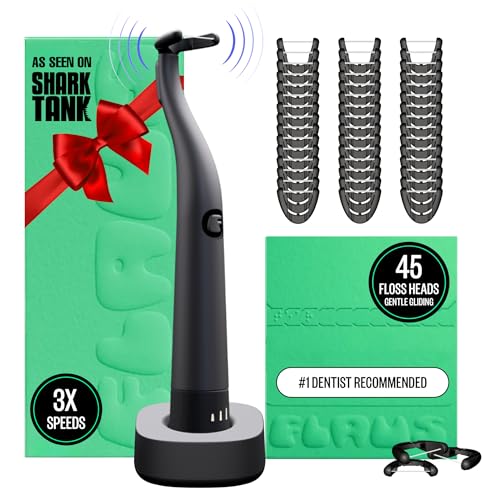
FLAUS Electric Flosser, Gentle Glide Starter Kit (Black)
Best for: People whose whole obstacle to flossing is getting their fingers into their mouth, and who want the largest clean review base among the powered picks
- Three modes, up to 18,000 vibrations a minute per the listing
- The listing describes a USB-C rechargeable handle with about two months per charge
- Starter kit: handle, 45 Gentle Glide heads, charging base, USB-C cable
- Described as waterproof, with no IPX number given
- Heads fit only the handle generation launched in October 2023
- +The largest clean review base among the powered picks at 4.4 stars across 2,003 ratings, a pool shared with this kit's other colour listings
- +The kit ships with 45 heads, a charging base and a USB-C cable, so there is nothing else to buy for about six weeks
- +Flaus states a one-year warranty on the handle on its own website, plus 30 days on head refills
- −Heads are single-use by design, so refills run about $5.00 to $6.33 a month on top of the device
- −Head breakage in tight contacts is the most repeated hardware complaint we read, and four of the six owners who reported it were still using the device
(Affiliate link) · Free shipping on eligible Prime items
Why We Recommend It
This is the pick with the most people behind it of the powered handles and the cleanest numbers: 4.4 stars across 2,003 ratings, a pool shared with this kit’s other colours, every visible review dated after the listing went live. Around $119 buys the handle, 45 heads, a charging base and a cable, and Flaus states a one-year warranty on the handle and 30 days on the heads, on its own website rather than the Amazon listing; Slate states a matching one-year device warranty on its own site too.
What it is good at is narrower than the marketing suggests. One user on r/adhdwomen: “I swear by Flaus. I realized pretty quickly my big issue with flossing was the need to stick my fingers in my mouth. Now it’s just part of my nighttime routine”. A hygienist on r/DentalHygiene who owns this brand named who they hand it to: patients “who just cannot fathom the idea of putting string floss or their fingers in their mouth”, a patient with arthritis, and patients “who only have one functioning arm or hand”. If string floss already works for you, the ADA’s own line is that the tool is not the variable: “it’s generally not what type of floss is used, but how and when it’s used” (ADA).
Potential Downsides
Heads break, and four of the six owners who said so were still using it. “They do break pretty easily though. I love it!” wrote one owner; another found “45 every 90 days means if you break three in a row you’re messing up your supply”, blaming teeth “tight as hell with solid and firm contact between each tooth”. Two owners reported no breakage across months of nightly use, so it is not universal, and the woven-head kit below exists for the people it happens to. The vibration is the part owners are least convinced by: “I’m not really sure if the sonic part is achieving anything more then flossing regularly”, wrote one, “but considering I wasn’t flossing at all and now I’ve been doing it every night it’s certainly achieving more than I was.” One owner also posted that their handle stopped charging at about 45 days and that four warranty emails went unanswered; that thread drew no replies we could recover, so treat it as a single account.
(Affiliate link) · Free shipping on eligible Prime items
Slate Origin 3-in-1 Battery-Powered Electric Flosser: Best Value
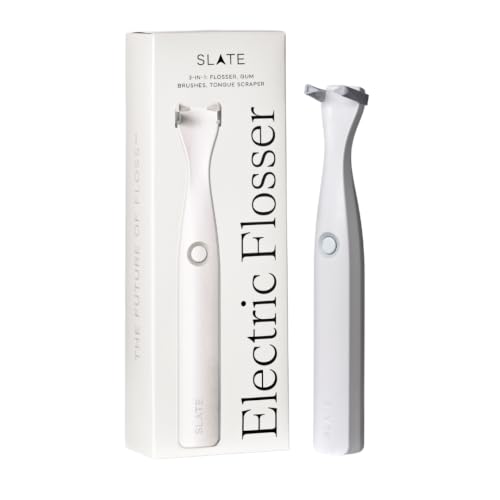
Slate Origin 3-in-1 Battery-Powered Electric Flosser
Best for: Anyone who wants the powered shape at the lowest running cost and does not want another charger on the bathroom shelf
- Runs on one AA battery, included, and is not rechargeable
- Reusable heads the brand says you change about once a week
- Heads are cross-compatible with the Slate Pro and Slate Mini
- Cheapest first-year cost of any powered pick here
- Speed settings and vibration rate are not published on the listing we read
- +Cheapest powered pick here at around $80, and the cheapest first-year cost of any powered pick on this page
- +One AA battery, included, means no charging base and no cable
- +Heads are rinsed and reused rather than binned, and Slate says they also fit the Pro and the Mini
- −690 ratings on a listing Amazon relisted in March 2026, so the count is not a clean single-listing pool; the older reviews we read describe the same battery-powered Slate
- −The listing we read does not publish its speed settings or vibration rate, and no source states what replacement AA batteries cost you over a year
(Affiliate link) · Free shipping on eligible Prime items
Why We Recommend It
The Origin is here on money and simplicity. At around $80 it is roughly $40 under the Flaus kits at purchase, and because Slate’s per-head refill cost is actually higher than Flaus’s, that gap narrows to about $19 after a year of refills rather than closing outright. It is also the only pick with no charger: one AA battery, included, with Slate’s own support confirming in writing that the Origin is not rechargeable and that you unscrew the cap to change it.
The Slate flosser is where the most vivid adherence accounts sit. A user on r/BuyItForLife with a small mouth and crowded teeth: “I’ve flossed every day since I got the Slate (I got the battery one in May or June). I went on a 6 week trip and brought it with me.” Another wrote that they “went from having advanced gum disease to almost perfectly normal gums in 9 months” and named Slate in a follow-up. That is one person’s account of their own mouth, not an outcome to expect; no published trial of this brand exists. Advanced gum disease is treated by a dentist or a periodontist, and a flossing device is maintenance alongside that treatment, never instead of it.
Potential Downsides
The rating needs a caveat we would rather give you than bury. Amazon first listed this page in March 2026, but two of its reviews are dated October 2023 and November 2024. We read those older reviews: they describe AA batteries, weekly reusable heads and the Slate brand, so they are about this product rather than a different one, but 690 is not a clean single-listing count and we will not present it as one.
Two specifications are missing, too. The listing’s feature bullets were collapsed when we read the page, so we cannot tell you how many speed settings the Origin has or how fast it vibrates, and we will not fill that gap from a marketing page. Nobody prices the AA battery either. Then the heads, which is the objection Slate owners actually raise. One wrote: “The replacement heads are more than I’d like to be paying, but they get me to use it more and they’re super effective.” Another listed “Cons: expensive, dependent on Slate replacement heads”.
(Affiliate link) · Free shipping on eligible Prime items
Slate Pro 3-in-1 Rechargeable Electric Flosser: Best Rechargeable Reusable-Head Pick
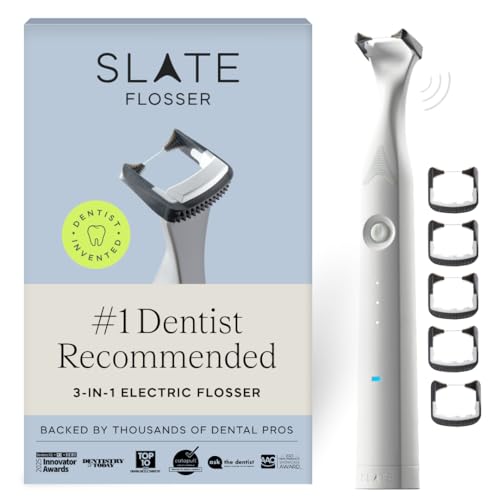
Slate Pro 3-in-1 Rechargeable Electric Flosser
Best for: Readers who want reusable weekly heads but would rather charge a handle than keep AA batteries in a drawer
- Three settings: Gentle, Standard and Deep Clean
- Up to 14,000 vibrations a minute per the listing
- Lithium-ion, USB-C magnetic cable, about three months per charge per the listing
- IPX7 waterproof rating, the only published rating on this page
- Box: five reusable floss heads plus the charging cable
- +The only pick here with a published waterproof rating, IPX7, and a stated three months per charge
- +Ships with five reusable heads, and Slate says those heads fit the Origin and the Mini as well
- +Three settings, Gentle, Standard and Deep Clean, where the Origin has no published setting count
- −365 ratings, under the 1,000 we normally require, so it is here by an editorial exception
- −Most expensive pick on this page at around $130, and its refill heads cost more per month than Flaus's, at about $6.66
(Affiliate link) · Free shipping on eligible Prime items
Why We Recommend It
The Pro is the Origin with a battery you charge instead of replace, plus the specifications the Origin’s listing does not publish: three settings, Gentle, Standard and Deep Clean; up to 14,000 vibrations a minute; lithium-ion with a magnetic USB-C cable and about three months per charge; and IPX7, the only numeric waterproof rating in this lineup, where both Flaus kits are described as waterproof with no number attached. It keeps what makes Slate cheap to run: reusable heads changed about weekly, five in the box, and the listing states they are the same heads the Origin and Mini take.
We have put it below the Origin because the extra $50 buys convenience, not cleaning. Nothing in the literature suggests a higher vibration figure or a mode selector changes an outcome. Buy the Pro if you would rather not think about AA batteries.
Potential Downsides
At 365 ratings it has the second-thinnest review base here, well under the 1,000 we normally require, so it is on this page by an editorial exception; the pool itself is clean, with every visible review postdating the listing.
The warranty question resolves to a wash, not a gap. Both Flaus and Slate state a one-year warranty on the device, each on its own website rather than the Amazon listing; Flaus adds 30 days on the heads, and the only term any Slate listing itself publishes is a 30-day money-back return window. It is also the most expensive thing on this page at around $130, and that only pays back if you genuinely reuse each head for a week.
(Affiliate link) · Free shipping on eligible Prime items
FLAUS Electric Flosser, Extra Strength Woven Starter Kit: Woven Heads for Tight Contacts
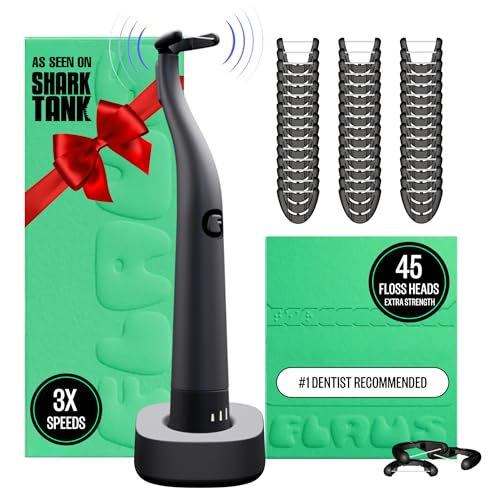
FLAUS Electric Flosser, Extra Strength Woven Starter Kit
Best for: People with tight contacts who have already shredded a floss head and want the sturdier string on the same handle
- Same Flaus handle, charging base and USB-C cable as the Gentle Glide kit
- 45 Extra Strength Woven heads, listed as 250+ microfibers
- The listing claims 200% more strength than the standard head
- Heads fit only the handle generation launched in October 2023
- Same price as the Gentle Glide kit
- +The woven head is the brand's own answer to breakage, listed as 250+ microfibers against the standard head
- +Same handle, charging base and 45-head starter kit as the Gentle Glide pick, at the same price
- +4.3 stars on its own clean review pool, separate from the Gentle Glide listing
- −243 ratings, under our usual 1,000, so it is here by an editorial exception
- −The one user we found who had bought what they called the "heavy duty" heads said they were better than the originals but still broke too quickly for them
(Affiliate link) · Free shipping on eligible Prime items
Why We Recommend It
This is the same handle as the Editor’s Pick at the top of the page, bought for its heads. Head type is chosen at purchase, not afterwards, which is why this is a card rather than a footnote. The handle, charging base, cable, head count and price are identical to the Gentle Glide kit; what changes is the string. Flaus describes the Extra Strength Woven head as 250+ microfibers, and the listing claims 200% more strength than the standard head. That second figure is the brand’s own marketing rather than anything measured independently, so read it as a direction, not a number.
The reason to care is one of the most repeated complaints in this category: six separate owners reported heads breaking, and two of them named tight contacts as the reason. Its review pool is small but its own, 243 ratings on a listing that went live in September 2025 with no reviews predating it. Amazon’s size selector shows Gentle Glide and Extra Strength as options on one page, but they are two separate listings with independent counts, so this 4.3 is not borrowed from the 4.4 above.
Potential Downsides
243 ratings is well under the 1,000 we normally require, and it sits here by an editorial exception rather than on the strength of its numbers. The honest limit on the head comes from the one owner we found who had bought what they called the “heavy duty” heads. They were going “thru heads every other day or so”, and reported them as “definitely better than the original ones but still break too quickly. If they don’t come out with a better head I may go back to string floss.” So the sturdier string is an improvement, on one account, and not a fix.
One listing oddity we will not paper over: the Amazon page’s battery field for this kit reads as an AA battery, while its own feature bullets describe a rechargeable USB-C handle with about two months per charge. Those cannot both be true, and the bullets match the Gentle Glide kit’s hardware.
(Affiliate link) · Free shipping on eligible Prime items
REACH Ultraclean Access Flosser Starter Pack: Try the Shape First (non-powered)
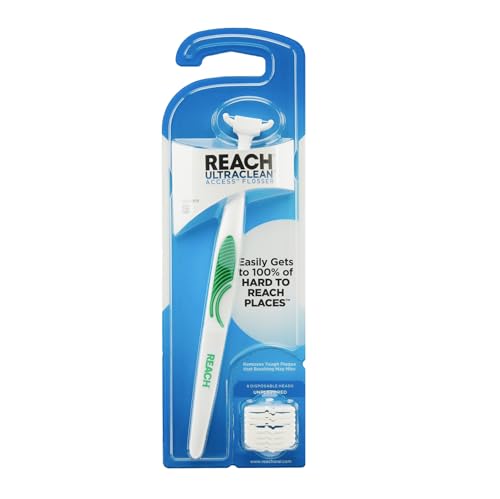
REACH Ultraclean Access Flosser Starter Pack (1 Handle + 8 Heads, Unflavored)
Best for: Anyone who wants to find out whether the long handle is the unlock before paying for a motor and a refill habit
- Long handle with snap-on floss heads, the same shape as the powered picks
- No motor and no vibration
- Starter pack: one handle and eight unflavored heads
- 28-count refill heads sell for around $9
- 4.7 stars across more than 7,500 ratings
- +Around $8 for a handle and eight heads, roughly a tenth to a sixteenth of what the powered picks cost
- +4.7 stars across more than 7,500 ratings, the highest rating and the largest review base on this page
- +A hygienist and one reader's own dentist both point at this exact shape as the thing to try before the motor
- −It does not vibrate, so if the motor is the part you want, this is not it
- −One user who recommends it flags the refill heads as fiddly to snap on, depending on your dexterity limits
(Affiliate link) · Free shipping on eligible Prime items
Why We Recommend It
Everything the powered handles do for the people who love them, they do by holding floss at the end of a stick so your fingers stay out of your mouth. This is a stick that holds floss at the end, for around $8, with the highest rating and the largest review base on this page. It is here because it separates the two things you are buying: the shape, which is cheap, and the motor, which is not.
That recommendation is not ours. A hygienist on r/DentalHygiene, answering a man whose large hands made hand flossing near impossible, wrote: “RDH here. I didn’t know how to properly floss until I went through hygiene school in my thirties. No shame here! I suggest a Listerine brand Reach Flosser. It’s similar to the Flaus but WAAAY cheaper.” A reader on r/sharktank asked their dentist about Flaus; he had not heard of it, and volunteered that he uses the Reach tool himself. A third user found it while shopping for a powered flosser: “It helps me get my back molars and also helped when I had a broken thumb.” The pack is a handle plus eight unflavored snap-on heads, with 28-count refills sold separately for around $9.
Potential Downsides
It does not vibrate. If what you want is the sonic action, or the ritual a charging base on the counter builds for you, this will not deliver it. The fixed-span criticism in the C-shape section applies to this handle too: what the money buys is the shape, not the C. The heads are the other catch: the user who found it while shopping for a powered flosser still flagged that “the refill heads can be a bit finicky to put on”, and whether that matters depends on which dexterity limits you have. If your hands are the reason you are shopping, that is the one place where the powered handles’ quicker head swap is a real advantage.
(Affiliate link) · Free shipping on eligible Prime items
What We Did Not Card
The OILSAO Dual-Line flosser is the cheapest powered handle we found, at around $60, and we left it off for two independent reasons. Its review pool does not hold up: Amazon first listed the page in July 2026, but two of its reviews are dated May and July 2025, so the 234 ratings behind its 4.0 stars were not all earned here. And across three differently-scoped searches we could not find a single independent user account of it: a Reddit search returned nothing, a general web search returned only the brand’s own store and affiliate-linked review videos, and a third index returned only shopping listings. Its listing also contradicts itself on the battery, and the brand’s store copy describes an electric toothbrush and water flosser combination, a different product class.
Voraiya’s flosser carried 21 ratings on a listing that went live in April 2026, and Slate’s Pro-plus-Mini bundle carried 21. Both are far under any floor we would defend.
The Flaus Gentle Glide kit in other colours is the same product on separate listings that share one review pool. The 2,003 ratings and 4.4 stars we quote include reviews that also appear on the white and pink listings; white and pink exist, but they do not carry independent counts of their own.
How the Five Compare
| Pick | Device | Power | Heads | Refill cost per month | Waterproof | Rating |
|---|---|---|---|---|---|---|
| Flaus Gentle Glide | around $119 | USB-C rechargeable, about 2 months per charge per the listing | 45 single-use heads in the kit, one per session | about $5.00 on the brand’s subscription, about $6.33 one-time | Described as waterproof, no IPX number given | 4.4 / 2,003 |
| Slate Origin | around $80 | One AA battery, not rechargeable | Reusable, about one a week | about $6.66 | Not stated on the listing we read | 4.2 / 690 |
| Slate Pro | around $130 | Rechargeable, about 3 months per charge per the listing | 5 reusable heads in the box, about one a week | about $6.66 | IPX7 | 4.1 / 365 |
| Flaus Extra Strength Woven | around $119 | Same handle as the Gentle Glide kit | 45 woven heads in the kit, one per session | about $5.00 to $6.33 | Described as waterproof, no IPX number given | 4.3 / 243 |
| Reach Ultraclean Access | around $8 | None, it does not vibrate | 8 snap-on heads in the pack, refills about $9 for 28 | No stated cadence | Not stated | 4.7 / 7,520 |
What Buyers Report vs What the Evidence Says
| What people report in the threads we read | What the sources support |
|---|---|
| ”I’ve flossed more in the past 3 months than in my entire life.” (r/Productivitycafe) | Adherence is the best-supported thing about this category and still not the same as better gums. The systematic review that owns powered interdental tools reports that in all six of its studies that looked at preference or compliance, the powered device “scored most often clearly better”, then adds that whether this helps long term “has yet to be assessed in properly designed RCT with long‐term follow‐up” (Edlund et al. 2023) |
| “I think electric flossers are crap, personally. None carry the ADA seal, and I see high potential for gingival damage.” (a hygienist on r/DentalHygiene) | The Seal half checks out: when we read the ADA’s Seal list for powered interdental cleaners on 3 September 2026 it held six products, every one a water flosser or oral irrigator. A powered handle is eligible for that category, whose requirements cover “both electrically powered and water pressure powered interdental cleaning” devices and demand a demonstrated gingivitis reduction (ADA Seal requirements). The damage half is thinner: across the whole literature one trial reports soft-tissue trauma, in two participants, from improper use (Hague et al. 2007) |
| “None of my patients do the c-shape properly, and I don’t blame them because it’s hard and tedious.” (a commenter on r/DentalHygiene who says they treat periodontal patients) | The technique the handle is failing to reproduce is the one every authority describes: at the gum line “curve it into a C shape against one tooth”, slide gently, rub up and down, and “never snap the floss into the gums” (MouthHealthy) |
| “The replacement heads are more than I’d like to be paying, but they get me to use it more and they’re super effective.” (r/DoesAnybodyElse) | The running cost is real and priced in the table above. On reuse the ADA is blunt: it “does not recommend using devices to clean between the teeth more than once”, because they may become worn or “deposit bacteria from the previous use back into the mouth” (ADA) |
| “I have a slate and I used it for 3-4 months before my last dentist cleaning. My teeth were so sensitive that she couldn’t complete the cleaning and that’s never happened before.” (r/sharktank) | One account, with a later update from the same person saying it settled after they stopped. No authority links a powered handle to sensitivity. What the authorities warn about is force: “Don’t jam or force the floss into your gums”, and check “you’re not traumatizing your gum tissue and pressing too hard or at the wrong angle” (Cleveland Clinic). And no trial in this literature ran past about a month, so a slow change at the gum line sits outside what any of it could have detected either way |
| ”I was so excited about getting a water pik and thought it would change my life. I used it like twice and I hated it.” (r/adhdwomen) | A common route into this category, and the evidence differs as well as the bathroom. Cochrane’s read on oral irrigators is very low certainty and did not hold past a month: they “may reduce gingivitis measured by GI at one month”, but “not at three or six months” (Cochrane 2019) |
Buyer’s Guide: How to Choose an Electric Flosser
Try the Shape Before the Motor
The cheapest useful thing on this page costs around $8 and does not plug in. Before spending $80 to $130, it is worth knowing which half of the product does the work for you: the long handle that keeps your fingers out of your mouth, or the vibration at the end of it. This is not a contrarian position we invented. A hygienist steered a man with large hands to the Reach flosser as “similar to the Flaus but WAAAY cheaper”, and mentioned the plainer option too: “There’s also just a floss handle, many different brands/shapes, you use your own floss and it’s like a toothbrush handle.” The older literature supports the shape: a 1990 follow-up survey six months after a flossing trial found half the former non-flossers still flossing at least twice a week, and 85% of those using the holder rather than their fingers (Kleber & Putt 1990). Thirty-two people answered it, so read that as a signal rather than a finding. Spend two weeks with the cheap handle. If the shape is your unlock, you have solved the problem for $8; if you skip it anyway, the motor may be what you actually need.
Flaus vs Slate
The two brands make the same shape and disagree about the head, and that disagreement is the whole decision.
Flaus heads are single-use. One head per floss, 45 in the kit, and a 90-head refill at about $15 on subscription or about $19 once. You bin a small piece of plastic every night, and the recycling is a mail-back program rather than kerbside, which one owner called misleading, while allowing they might have misread it: “the heads are only recyclable if you send them back so that was misleading.”
Slate heads are reusable. One head a week, rinsed between uses, with a 12-pack at about $20 lasting about three months, which works out to about $6.66 a month, more than either Flaus option. It wastes far less, though. A buyer asked a version of this about Flaus and got no reply: “It looks like the same piece of floss gets used for each tooth in one round. I read you are supposed to rinse as you go. Isn’t this unhygienic?” Nobody in the corpus asks it of Slate’s weekly cadence, and no clinician answered either way. The nearest authority is the ADA, which “does not recommend using devices to clean between the teeth more than once”, because they may become worn or “deposit bacteria from the previous use back into the mouth” (ADA). That is written about floss products generally rather than about a silicone-ribbed reusable head, but it is the only guidance there is, and it does not favour reuse.
So: Slate costs more per month despite wasting less, and asks you to accept a reuse cadence no independent source endorses. Flaus costs less per month and matches the ADA’s single-use line, but binning a head every night is real waste of its own. Between the two Slates, the Origin is the cheaper, battery-powered one; the Pro is the rechargeable, IPX7, three-setting one for $50 more.
What the Floss Is Made Of
Every powered pick here sells its string on what is not in it. The Flaus Gentle Glide listing says its floss cleans “without PFAS, BPA, or other harmful toxins”; the Extra Strength Woven listing says “without PFAS, PTFE, or other harmful toxins”; Slate’s listing says its heads use woven floss with “no Teflon, PFAS, or PTFE”.
Only one of them names the fibre. Slate’s own FAQ says “Our floss is ultra-high molecular weight polyethylene (UHMWPE) woven floss” and that “None of our floss is coated or waxed”. Flaus’s listing does not say what its string is, in either version.
Two things follow. A reader in a granola-parenting thread got to the first point before we did: they knew Slate’s non-toxic line, “but im pretty sure I read that the floss is made from polyester filaments, aka plastic.” They named the wrong polymer, and the point survives anyway, because polyethylene is a plastic too. Leaving out one family of chemicals is not the same as leaving out plastic, and that is a separate question from the head waste above. The second: PFAS-free is a claim each brand makes on its own page. We read it and quote it as theirs. We did not run a laboratory check on any of these strings, and we found no independent source that has.
The C-Shape Question
Flaus makes that claim on its own listing: its floss is “intentionally designed with slack for the ideal “C” technique to reach under the gum line”. Across 81 threads we found no clinician saying a powered handle achieves the C shape, and one general dentist saying flatly that it does not: “In the same way as plastic flossers can’t wrap around a tooth, this thing has the same issue. Nothing beats manual floss. Unless you have dexterity issues, I wouldn’t recommend this.” A hygienist explained the geometry for floss picks, and it applies to any fixed-span head: teeth are rounded, a straight span goes “in too straight”, and “It’s like trying to clean a ball with a ruler”.
That is real, and it is half the picture. The person shopping for one of these handles is usually not achieving the C shape by hand either, and a commenter on r/DentalHygiene who says they treat periodontal patients said so in the same thread: “None of my patients do the c-shape properly, and I don’t blame them because it’s hard and tedious.” So compare against what you are doing now, not against textbook technique. Either way the technique worth learning is the ADA’s: curve the floss into a C against the tooth, slide it gently under the gum line, rub up and down, and never snap it in (MouthHealthy). One hygienist in these threads sends people with larger hands to a different tool altogether, their recommendation rather than ours: “I LOVE GumChucks and always recommend them for people with larger hands”.
Who These Are Wrong For
Braces, implants, bridges and bonded retainers. The clinical steer in everything we read routes away from a powered floss handle and toward water flossers and interdental brushes. A commenter in r/DentalHygiene listed where water flossing and soft picks belong: “braces, orthodontic appliances like bonded retainers, fixed prosthetics like bridges, limited hand mobility, wide/large embrasure spaces between teeth, etc.” If that is you, start with our water flosser picks for braces or our interdental brush page.
Crowns and veneers: we do not know, and neither does anyone we could find. Someone asked exactly this in a dentistry community, whether a Flaus or Slate is safe with crowns, and the only reply quoted Slate’s own marketing page back at them. No dentist or hygienist answered. Flaus’s own FAQ hedges and tells you to ask your dentist, which is where we leave it.
If your gums are already sensitive or receding, go carefully. Three users and one hygienist raised this. One Slate owner reported teeth so sensitive after three or four months that a cleaning could not be completed, then posted later that it settled after they stopped. A Flaus owner asked whether the space at their gum line was widening and got no professional answer. A hygienist named “high potential for gingival damage” as their concern. That is a caution, not a harm finding: the only trauma in the published literature is two participants in one trial, from improper use (Hague et al. 2007). What both authorities warn against is force. Never snap the floss into the gums (MouthHealthy); “Don’t jam or force the floss into your gums”, and watch that “you’re not traumatizing your gum tissue and pressing too hard or at the wrong angle” (Cleveland Clinic). With a vibrating handle the instinct to push is the wrong one. There is also a limit on what the research could have seen: no trial here ran past about a month, and the systematic review says as much of itself, that its conclusions “are limited to short term (i.e., about 1‐month follow‐up)” (Edlund et al. 2023). A slow change at the gum line is not something these studies were built to catch, in either direction. Bleeding that does not settle within about two weeks, a gum line that looks like it is moving, or sensitivity that stops a cleaning is a dentist question, not a device question.
If string floss already works for you. Six of the nine dental professionals we found discussing powered handles were sceptical. “If you have good technique with normal floss then stick to that, seems gimmickey”, wrote one general dentist. “It’s better than nothing but worse than real good ol’ flossing”, wrote another.
If a brush fits between your teeth. The bluntest verdict in everything we read came from a general dentist on r/askdentists, and it was not about a rival flosser: “All these gimmicky interdental cleaning products still can’t hold a candle to a good old interdental brush that costs £3.50 for a pack of dozen.” Their advice was “Honestly save your money and just use a basic interdental brush (Tepe/Icon/Wisdom etc)”. The uncomfortable part is that nobody has checked whether they are right: the systematic review that owns powered interdental tools, PDICT in its own shorthand, notes that “no studies have compared PDICT with other commonly recommended interdental cleaning devices, such as interdental brushes” (Edlund et al. 2023). If your gaps are wide enough to take a brush, start with our interdental brush picks instead.
What the Evidence Says
Fewer than a third of American adults aged 30 and over floss daily, 31.6% in the CDC’s national survey (Fleming et al. 2018). That is the gap a $119 handle is sold into.
On cleaning, the head-to-heads are flat. The one systematic review dedicated to powered interdental tools pooled four powered-flosser trials, the newest of a 2007 product, and found no significant difference from string floss on interproximal plaque or on bleeding, on evidence it graded low (Edlund et al. 2023). The best-designed single trial, 102 mostly-student participants in 2007, did find the powered device removed more plaque than manual floss at every position in the mouth, with “no significant difference in interdental inflammation between groups” over 30 days (Hague & Carr 2007).
A second trial in that pool names the split plainly. A 70-person, 30-day comparison found “no significant difference between manual flossing and automatic flossing with respect to the MGI and the BI”, the indexes it used for gum inflammation and for bleeding, and reported that the plaque difference that did reach statistical significance “was less than 2%” (Shibly et al. 2001). What did separate the two devices was “a marked preference for the automatic flosser”. The authors then suggest overall gum health “may benefit” from that preference, which is their hypothesis at the end of the paper rather than anything the 30 days measured. The remaining two pooled trials, Anderson 1995 and Cronin 2005, land in the same null place.
On whether preference becomes gum health, the chain breaks where you would least like it. The one four-month randomised trial of a floss holder found the device alone raised self-reported flossing, planning and confidence, while measured gum bleeding improved significantly only when it was paired with reminder texts (Araújo et al. 2020). A better tool moved the behaviour; it took a nudge as well to move the gums.
The adherence case does have support from another angle. A 2025 trial that counted actual usage over 24 weeks found string-floss users managed a mean of 4.96 weeks of regular use against 12.61 weeks for people given an easier interdental tool (Yılmaz et al. 2025). Plaque and bleeding came out similar between groups, so it shows tool choice changing staying power, not the easier tool producing better gums, and the tool was a rubber pick rather than a powered handle. Read together, every adherence study on this page ran on a manual floss holder, a rubber pick, or a mixed group of powered interdental tools; none of them asked whether a powered floss handle specifically makes people floss more.
On flossing at all, the base evidence is softer than the marketing on either side. Cochrane’s 2019 review of 35 trials concluded that adding floss to brushing “may reduce gingivitis or plaque, or both, more than toothbrushing alone”, on evidence graded low to very low certainty, with effect sizes that “may not be clinically important”, and noted that “No trials assessed interproximal caries.” (Cochrane 2019).
On Flaus and Slate specifically, there is nothing peer-reviewed. A PubMed search returns no dental trial of Flaus, and none of the powered-flosser searches we ran surfaced one for Slate, and no powered floss handle carries the ADA Seal. Flaus’s plaque marketing rests on a company-funded study it commissioned and hosts on its own site, reporting 7.74 times more plaque removed than a leading string floss; it has not been through peer review, and we name it so you recognise the number when you meet it in an advertisement. Flaus registered its first trial in August 2026, NCT07779564, enrolling 80 adults for 30 days; it was still recruiting with no results posted when we read the record, and its comparison arm is a manual toothbrush with no flossing at all, so it is not built to answer whether the device beats string floss (ClinicalTrials.gov).
Cost of Ownership
The sticker price is the smaller number. Here is the arithmetic, using each brand’s own stated cadence.
Flaus. One head per floss, so 30 heads a month. A 90-head refill is about $15 on the brand’s subscription, which is $0.167 a head, or about $5.00 a month; at the about $19 one-time price it is $0.211 a head, or about $6.33 a month. About $119 up front and about $5.00 a month after that, call it about $180 a year once you are past the 45 heads in the box, before the $4.99 shipping on repeat subscription orders.
Slate. One head a week, so a 12-pack at about $20 covers about three months by the brand’s own maths, which is about $6.66 a month. On the Origin, about $80 up front and about $6.66 a month after that, call it about $160 a year, the cheapest powered option here; on the Pro, about $130 up front and about $6.66 a month after that, call it about $210 a year. Neither Slate total gives the device credit for included heads, since the Origin’s box contents are not published.
Reach. Around $8 for the handle and eight heads, with 28-count refills at around $9. No brand cadence is published and recent reviewers say a head survives several uses, so we will not invent a monthly figure.
Two costs nobody prices: the Origin’s AA batteries, which no source quantifies, and brand lock-in, since Flaus heads fit only the handle generation launched in October 2023 and Slate’s heads are Slate’s. One owner, writing in May 2025, compared the Flaus subscription against the floss picks they had been using and made it “about 30% more expensive and you have to buy the device”, then kept the device anyway.
Frequently Asked Questions
Are electric flossers a gimmick?
That is the question people keep asking, in one form or another, across five separate threads we read, and the answer depends on the comparison. Against textbook string flossing every night, the powered handle is not an upgrade: the pooled head-to-head trials show no significant difference on plaque or bleeding, on low-quality evidence (Edlund et al. 2023), and six of the nine dental professionals we found said much the same in blunter language. Against not flossing, it is a different question, and that is the comparison most buyers are making. The ADA hands the choice to you rather than ranking tools: “Talk with your dentist and try different options to see which one you like best” (MouthHealthy).
Electric flosser or water flosser: which should I get?
Different devices, separate evidence. A powered floss handle drags string between your teeth; a water flosser sprays. Cochrane’s read on oral irrigators is very low certainty and did not hold past one month, while its read on floss is low certainty and held at one, three and six months (Cochrane 2019). Six people in our research arrived at a powered handle after a water flosser disappointed them, one over mess and counter space, another over the feel of the water. If you have braces, implants or bridges, the steer points at the water flosser: start with our water flosser page or the comparison with string floss.
Flaus vs Slate: which one should I buy?
Two people asked this in identical words on the same day in two different communities, and the r/askdentists version drew no dentist answer at all, only a promo code and removed comments. We could not recover any comments on the other. Ours: it comes down to the heads. Flaus uses a fresh head every night, which matches the ADA’s single-use position and costs about $5 a month. Slate reuses a head for a week, which wastes less but costs more per month, about $6.66, and has no independent guidance behind it. The Origin is also $40 cheaper up front, with the lowest first-year cost of any powered pick here, and runs on an AA battery rather than a charger.
Can I use one if I have crowns, veneers or a bridge?
We cannot tell you, and we would rather say so than guess. Someone asked this exact question in a dentistry community and the only reply quoted a manufacturer’s marketing page; no clinician answered. Flaus’s own FAQ says its device should work with crowns and veneers and then tells you to contact your dentist first, which is the answer we echo. For fixed bridges the clinical steer routes toward water flossers and interdental brushes.
Is it unhygienic to use the same floss head for every tooth in one session?
A Flaus buyer asked a version of this in public, about rinsing between teeth within a single flossing session, and got no reply. Nobody in the corpus asked the same question about Slate’s weekly reuse across days, and no clinician answered either version. The nearest guidance is the ADA’s: it “does not recommend using devices to clean between the teeth more than once”, warning that they may become worn or “deposit bacteria from the previous use back into the mouth” (ADA). That is written about floss products generally rather than about a silicone-ribbed reusable head, and we could not find any authority addressing either practice specifically. Flaus’s daily-disposal design sits on the right side of the ADA’s single-use line; Slate’s weekly reuse has no independent endorsement either way.
Will an electric flosser last, and is there anything good under $150?
Everything on this page is under $150, which answers the second half. On durability the picture is thin. Both Flaus and Slate state a one-year warranty on the device, each on its own website rather than the Amazon listing; Flaus adds 30 days on the heads. Owner reports run both ways: one Flaus user has had theirs for two or three years, another had a handle stop charging at about 45 days and reported no reply to four warranty emails.