
If your jaw aches in the morning, your temples throb, or your jaw clicks and catches, a night guard bought for teeth grinding may not be the right tool, and the threads we read are full of people whose guard is the reason the jaw hurts. This page is sorted by guard type rather than by star rating, because for clenching and TMJ pain the type is what matters: the muscle-activity studies favour hard and hybrid splints, the soft boil-and-bite guards that dominate Amazon can increase clenching in some wearers, and the front-teeth-only splints that people credit with relief are also the design with repeated reports of a changed bite. If your problem is worn or chipped enamel rather than jaw pain, our mouth guards for grinding page is the better start.
How We Evaluated
Five checks, shaped by what goes wrong when people with jaw pain buy a grinding guard:
- Guard type first. We sorted every candidate into hard or hybrid custom, soft moldable, and front-teeth-only splint, because a 1987 recording study found a hard splint reduced night-time jaw-muscle activity in eight of ten people while a soft one increased it in five of the ten (hard vs soft splints).
- A review floor of 4.0 stars and 1,000 ratings, read live on Amazon US. Night guards rate lower than almost any other category we cover: the big drugstore boil-and-bite names sit between 3.4 and 3.9 stars. Every pick here clears the floor, and the products that did not are named in the buyer’s guide rather than quietly dropped.
- What the listing actually says. Guard type, whether you take your own impression, turnaround time, sizes and what is in the box come from the Amazon listing read on 2026-09-06, not from the brand’s marketing.
- The community record, author-checked. Thirty-seven Reddit threads from r/TMJ, r/bruxism, r/askdentists, r/Dentistry and r/DentalHygiene, plus the r/Frugal thread that holds the only CustMbite owner report, read in full, with the account history pulled on the brand-praise comments we quote for enCore and CustMbite and on four accounts praising a brand that is not on this page. That brand failed the check; the quoted accounts passed.
- What the evidence allows us to say. The National Institute of Dental and Craniofacial Research’s position is that splints are reversible and may help with habit reversal, but that there is not a lot of evidence on whether they improve TMD pain (NIDCR on TMD). No card on this page claims a cure.
Behind the picks: the 2020 systematic review of 37 splint trials, the 2017 meta-analysis of stabilization splints, two muscle-activity studies comparing splint designs, and the NIDCR treatment guidance.
enCore Custom Mouth Guard: Editor’s Pick for Clenching
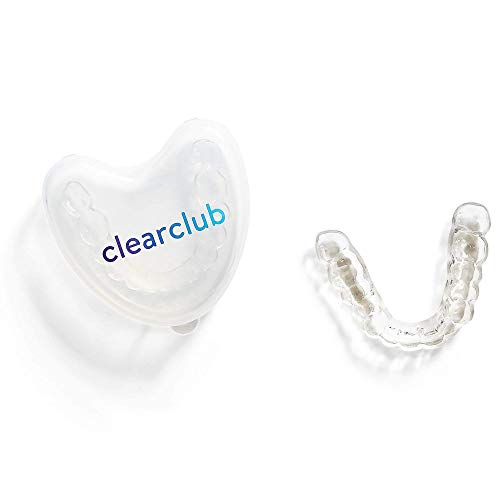
enCore Custom Mouth Guard (Hard, Hybrid or Daytime Hard, lab-made from your impression)
Best for: Clenchers who want the closest at-home match to the hard or hybrid splints the TMD trials used, knowing no lab can do the dentist's adjustment
- Four guard types from one impression: Hard, Soft, Hybrid or Daytime Hard, per the listing
- Made by a dental lab from your own at-home impression, upper or lower
- Materials sourced in the US and Germany; BPA and latex free per the listing
- Single guard with impression kit, about $149
- The listing describes a lab with more than 20 years making dental appliances
- +Highest rating on this page, 4.5 stars across about 5,900 ratings
- +The only pick here that lets you order a hard or daytime-hard splint, the designs the muscle-activity studies favour for clenching
- +Lab-fabricated from your own impression, so the fit does not depend on a boil-and-bite session
- −About $149 for a single guard, and the impression kit adds a wait of days to weeks
- −Choosing Hard, Soft, Hybrid or Daytime Hard is on you; the listing does not diagnose, and a badly taken impression means a re-do
- −No chairside adjustment after it arrives, which is why one mail-in lab founder says not to buy online for TMJ specifically
(Affiliate link) · Free shipping on eligible Prime items
Why We Recommend It
enCore is the pick because it is the only product on this page where you can order the design the evidence points to. The 2017 meta-analysis of 33 randomized trials found a stabilization splint had a positive short-term effect on pain, with the effect confirmed in the subgroup whose TMD was muscular in origin (stabilization splint meta-analysis). The same review found no difference between the stabilization splint and other oral appliances, rated the evidence low quality, and found the long-term results equalised with other treatments, so this is a short-term edge, not a cure. A stabilization splint is a full-coverage hard appliance, and the listing’s Hard and Daytime Hard options are the closest an at-home kit gets to one. The Hybrid, hard outside and soft inside, is the version the community likes wearing: one r/bruxism owner of three enCore guards wrote, “Ive owned three of them now, I like the hybrid model the best of all the nightguards I’ve tried. No slipping around my mouth at night and I’ve never ground through them.” Another bought it for jaw symptoms specifically: “I got an Encore guard for around 150, and it seems to be helping my tmj symptoms so far after about 3 weeks. I bought it on Amazon.”
The review base is the other argument. At 4.5 stars across about 5,900 ratings, it is the best-rated guard we found that clears our review floor, in a category where the household names sit under four stars, and the long-term enCore owner whose two-year update we checked has a hundred-comment history across unrelated subreddits, which is the check a competing lab founder says the category needs.
Potential Downsides
The impression is yours to take. One long-term owner describes sending photos of the mould by email for the lab to confirm before it makes anything, and having a spare tray to retry with, but the same owner warns against stocking up: “I wouldn’t recommend ordering more than one at a time - if you need a new filling or have a change in three shape of your teeth, your nightguard won’t fit anymore.” Staining is the recurring complaint from long-term owners, one of whom replaces the guard yearly rather than stretching to two. And the choice of type is on you: if you are not sure whether you clench or grind, read the buyer’s guide’s first section before you pick Hard over Hybrid. What no mail-in lab can give you is the chairside adjustment after the guard arrives, which is the step the clinicians we read say matters most for a painful jaw.
(Affiliate link) · Free shipping on eligible Prime items
Remi Custom Night Guard: Best Value Custom
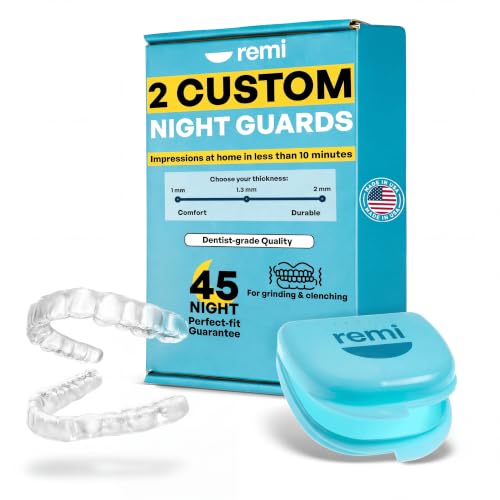
Remi Custom Night Guard Impression Kit (two lab-made guards)
Best for: Anyone who wants two custom guards, a top and a bottom or a spare, for less than most single dentist-made splints
- One impression kit returns two custom guards, a top and bottom or two of either, per the listing
- Stated turnaround of less than 14 days per the listing
- Three thickness options, 1, 1.3 or 2 mm per the listing images
- Made in the USA from vinyl polysiloxane impressions; BPA free per the listing
- Two guards plus case for about $129
- +Two custom guards for about $129, so a spare or a top-and-bottom pair costs less than one enCore
- +Three thickness options (1, 1.3 or 2 mm per the listing images), so a clencher can choose a firmer 2 mm guard
- +Made in the USA from your own vinyl polysiloxane impression, with a stated turnaround under 14 days
- −No hard-only or daytime option; if your dentist has said 'hard acrylic', enCore is the closer match
- −You take your own impressions, and the top Amazon review describes needing a second kit before the lab could make guards that fit
(Affiliate link) · Free shipping on eligible Prime items
Why We Recommend It
Two guards for the price of a single one is the whole case, and it matters more for jaw pain than it sounds. People in the threads we read had already paid $650 to $1,000 for a dentist-made guard, cracked it, and could not fund another; a spare is what lets you keep wearing one while a replacement is made. Remi’s top-rated Amazon reviewer, who had used a $900 dentist guard, wrote that the Remi pair “feel every bit as good as the $900 custom guard I received from my dentist,” and that when the first impressions were poor the company sent a second kit at no cost. An r/bruxism buyer reported the same service when the lab spotted a bad lower impression: “when they got the molds they told me the lowers wouldn’t feel right and asked me if I wanted to do it all over or just take two uppers.”
The listing sells it as “protection from a hard mouth guard & comfort of a soft mouthguard” and offers three thicknesses; the dental lab technician quoted below reads the same product as a set of retainers in different thicknesses. Either way, for a clencher the 2 mm option is the firmer choice, and it is thinner than the hard acrylic a dentist would make.
Potential Downsides
This is the most argued-over product on the page, and you should read the argument before you buy. A dental lab technician answering an r/askdentists question about Remi wrote: “Having looked at the website, those are just retainers in various thicknesses. Not a ‘nightguard’ like we would sell.” A separate commenter in the same thread describes a subscription that was hard to cancel; the Amazon listing is a one-time kit, but check what you are agreeing to if you reorder through the brand. A hygienist looking it up during an appointment “seemed apprehensive towards them, but told me to try them for a week or so to see how they feel.” And the hybrid’s soft layer is the wear point across every lab that makes one, so expect a shorter life than a hard guard.
(Affiliate link) · Free shipping on eligible Prime items
CustMbite Rest in Peace Night Guard: Best for Tonight
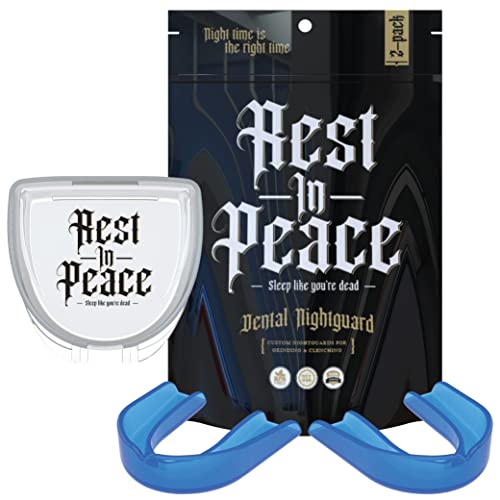
CustMbite Rest in Peace Night Guard (2-Pack)
Best for: A tonight fix from a dentist-founded brand while you decide whether to go custom
- Fitted in the microwave in about two minutes, per the listing; no boiling water
- Trimmable after fitting for a closer edge
- What the brand calls its patented Vistamaxx fitting material, rather than plain EVA
- Free of BPA, phthalates and parabens per the listing; made in the USA
- Two guards with a ventilated case, about $25
- +Fits in the microwave in about two minutes, no boiling water and no impression kit
- +Two guards for about $25 from a brand co-founded by a dentist, with a ventilated case
- +Free of BPA, phthalates and parabens per the listing, and made in the USA
- −A soft moldable guard: the only design class the muscle-activity studies found can raise clenching in some wearers
- −Exactly at the 4.0-star floor across about 1,200 ratings, the smallest review base on this page
(Affiliate link) · Free shipping on eligible Prime items
Why We Recommend It
Most people arriving at this page need something tonight, and this is the moldable guard we can put a card on. CustMbite was co-founded in 2004 by Dr. Monroe Elkin, a pharmacist who retrained as a dentist and practised for three decades according to the company’s own account, and the product is built around what the brand calls its patented Vistamaxx material rather than the EVA foam in the four-packs. The fitting is a two-minute microwave job, which the community rates as a real advantage over boil-and-bite: one r/TMJ commenter’s objection to the standard method was “not a fan of having to bite into the mold while it is hot, I feel like this can damage you teeth.” It can be trimmed after fitting, which is how people in the thinner-is-better threads get a crowded tongue some room.
It has a thin but organic community record: the one owner we found, in an r/Frugal thread about grinding guards, wrote “I use “Rest In Peace.” They’re decently priced, come in a 2 pack, and they’re re-moldable.” That account has a long history across unrelated subreddits and no other brand mentions, which is the check we run before quoting any guard brand from Reddit. It also clears a floor that the famous names do not. DenTek Comfort-Fit (3.9 stars), The Doctor’s NightGuard (3.7), SleepRight Select-Comfort (3.7) and the Oral-B guard (3.4) all sat under four stars when we read them, so at 4.0 stars it is tied with TheSleepGuard for the best-rated moldable we found, and it is the one with a dentist behind the material.
Potential Downsides
It is a soft over-the-counter guard, and the caution the r/TMJ threads attach to that class applies to the Rest in Peace by name. In the 1987 recording study the soft splint increased night-time muscle activity in half the participants, and the community says the same thing in plainer words: “the softer ones promote clenching imo.” Use it as a bridge, not a treatment, and if your jaw feels worse after a week of wearing it, stop. The 4.0-star rating is exactly at our floor, not above it, and reviewers describe it as thicker than a lab-made guard. One more caveat on the brand rather than the guard: in an r/snoring thread about CustMbite’s separate anti-snore mouthpiece, one buyer reported four unanswered refund emails, so read the returns terms before you rely on the guarantee.
(Affiliate link) · Free shipping on eligible Prime items
TheSleepGuard Clench No More: Cheapest Trial
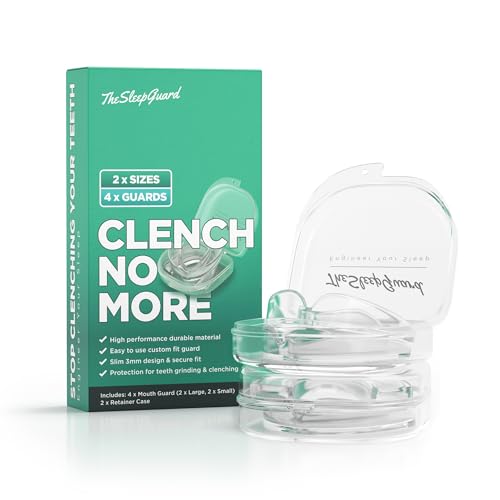
TheSleepGuard Clench No More Mouth Guard (4-Pack, Small and Large)
Best for: Trying a boil-and-bite guard for under $20 before committing to anything custom
- Four boil-and-bite guards in small and large sizes, per the listing
- Two storage cases in the pack
- EVA material per the listing
- About $17 for the four-pack
- +Under $20 for four guards in two sizes, the cheapest way on this page to find out whether you tolerate a guard at all
- +Largest review base among the moldable picks, about 4,600 ratings at 4.0 stars
- +Small size is a real option for smaller mouths, which one-size boil-and-bite guards do not offer
- −Soft EVA boil-and-bite, so the same caveat as every soft guard: it protects teeth, it does not reliably reduce clenching
- −Bulk of the reviews are about grinding protection, not jaw pain relief
(Affiliate link) · Free shipping on eligible Prime items
Why We Recommend It
The four-pack answers the question the community asks most often, “Has anyone had success with an over the counter dental guard?”, with the cheapest possible experiment. A dental hygienist on r/DentalHygiene who recommends them to patients put the case for trying one before spending hundreds: “Better than what? Better than what you can get from your dentist? Probably not. Better than grinding your teeth into a fine powder? Almost definitely.” A hygienist in another thread admitted to the same thing: “I’m a hygienist and used a OTC one for a while when I was waiting on my lab to send my new one.”
What sets this pack apart from the one-size drugstore guards is sizing: the pack comes in small and large per the listing, and four guards means you can refit one that came out wrong without buying again. Both quotes above are about over-the-counter guards in general, not this product; TheSleepGuard itself has no community record, and everything on this card comes from the listing and its Amazon reviews.
Potential Downsides
It is the softest guard on the page and the least TMJ-specific: the listing’s own “recommended use” line says enamel protection, and the reviews are about grinding. The product does not come up in any of the threads we read, and a second search on the brand name found nothing, so there is no reader with jaw pain vouching for it here. The corpus’s caution about over-the-counter guards for TMJ applies to this pack by name: nothing about EVA foam addresses clenching, and one long-term soft-guard user’s warning about the class applies here in full: “You need a hard guard, 2-3 mm. I spent 6 years in soft guards from online shops, they worked fine…but did not protect my teeth. At all.” Treat it as the two-week test described in the buyer’s guide, not as the destination.
(Affiliate link) · Free shipping on eligible Prime items
What Clenchers Report vs What the Evidence Says
| What people report in the communities we researched | What the sources support |
|---|---|
| The guard made the clenching worse (“Night guard makes me clench more haha”, 10 upvotes in r/TMJ) | Plausible for soft guards: the 1987 recording study found a soft splint significantly increased night-time muscle activity in five of ten participants while a hard splint reduced it in eight (hard vs soft splints) |
| A partial-coverage drugstore guard changed my bite over two years and my jaw started locking | The NIDCR’s advice on any appliance is to make sure it is not designed to change your bite and to stop using it and consult your dentist if it causes pain (NIDCR) |
| A front-teeth-only splint was the only guard that let me wake up with a relaxed jaw | Consistent with a pilot study in which the front-teeth NTI-tss device reduced night-time jaw-muscle activity where a full-coverage Michigan splint did not (NTI-tss vs Michigan splint) |
| A front-teeth splint opened my bite and I needed braces to fix it | The same pilot study’s authors warn that in long-term use patients should be informed of the possible risk of irreversible occlusal changes, and the 2008 systematic review of the NTI-tss device says it should be chosen only if the patient will be compliant with follow-up appointments (NTI-tss review) |
| Custom is better than over-the-counter for TMJ | Partly. The 2017 meta-analysis found a stabilization splint had a positive short-term effect on pain, clearest in muscle-origin TMD (meta-analysis); what the trials studied was a dentist-made and adjusted splint, and the clinicians in our threads say the adjustment, not the plastic, is what a mail-in kit cannot supply |
| A night guard will cure TMJ | No. The 2020 systematic review of 37 trials found very low-certainty evidence that did not demonstrate splints reduced pain in TMD as a group of conditions (2020 systematic review), and the NIDCR notes that symptoms go away without treatment for many people |
Buyer’s Guide: Choosing a Mouth Guard for TMJ
Is Your Problem Clenching, Grinding, or the Joint?
The threads we read split into three groups, and the right answer is different for each. Grinders wear enamel and chip teeth; a guard is a barrier, and almost any guard does that job. Clenchers wake with sore jaw muscles, temple headaches and a tight face; for them the guard has to change what the muscles do, which is why type matters and why a barrier alone can make things worse. The third group has a joint problem, clicking that catches, a jaw that locks, or pain in front of the ear, and for them the NIDCR’s guidance is the starting point: sounds without pain are normal and need no treatment, many cases resolve on their own, and experts recommend conservative, reversible care first (NIDCR on TMD). One r/bruxism commenter’s story is the whole triage in two sentences: “I had a hard clear plastic mouth guard from the dentist that initially helped, but ended up doing me more harm than good because I’m a clencher, not a grinder.”
Why the Guard You Already Own May Be Making It Worse
Four causes recur, and three of them are visible if you look. Thickness crowds the tongue and stops the lips closing; the fix that worked for one r/TMJ poster was a dentist taking “some plastic off the inside sides of mine and my tongue wasn’t so crowded and it was a lot more comfortable and much better.” Soft material gives the jaw something to chew: the recording study above is the evidence, and the community’s version is “the softer ones promote clenching imo.” Partial coverage lets the back teeth meet before the front ones, and one r/TMJ user traced two years of worsening pain and locking to exactly that: “I noticed my guard didn’t cover all my teeth and when I’d slowly bite down my back molars would touch before other teeth. That’s when I realized the OTC guard changed my bite.” Two years later the bite had not returned to normal. The fourth cause is no adjustment: a dentist checks how the new guard meets the opposing teeth and grinds it in, and no kit can do that. On the thickness point, the thin moldable the community praises most consistently is the SOVA, a 2 mm remoldable guard named by five separate r/bruxism accounts with no complaint recorded, including a self-described clencher who had been harmed by a hard dentist guard; the SOVA 3D listing sat at 4.0 stars but only about 350 ratings when we read it, under our review floor, so it has no card here, and the SOVA Aero is reviewed on our grinding guards page.
The Four Appliance Types, Plainly
| Type | What it is | What the evidence says | Where it is on this page |
|---|---|---|---|
| Soft boil-and-bite or moldable | EVA or similar foam you soften and bite into | Protects enamel; raised muscle activity in half of one study’s participants | CustMbite, TheSleepGuard |
| Front-teeth-only splint | A small hard pad over the upper front teeth so the molars never meet | Reduced muscle activity in a pilot study; repeated bite-change reports; needs follow-up | Discussed below, no card |
| Mail-in custom, hard or hybrid | A lab makes a full-coverage guard from your own impression | Closest at-home match to the stabilization splints in the trials; no chairside adjustment | enCore, Remi |
| Dentist-made and adjusted splint | Impression, lab, then an adjustment appointment | The appliance the trials actually tested; $650 to $1,000 in the US threads we read | Not a product; see below |
The Front-Teeth Splint Trade-Off, Stated Honestly
The over-the-counter version of this design is the SmartGuard Elite, a moldable pad that sits on the upper front teeth so the back teeth cannot touch; its designer, Dr. David Spainhower, is a dentist, and the two-guard pack costs about $23. We read it carefully and did not give it a card, and the reason is worth your time. In its favour: the evidence for front-teeth-only devices reducing clenching is real, with the NTI-tss pilot study finding muscle activity fell only while the front-teeth device was worn, in ten otherwise healthy sleep bruxers using devices a dentist made individually for them, and most of them still preferred the full-coverage splint for comfort (NTI-tss vs Michigan splint), and one r/bruxism user who had failed two dentist-made guards wrote that “This is the only one that both protected my teeth and let me wake up with a somewhat relaxed jaw.” Against it: SmartGuard Elite sat at 3.8 stars across about 2,800 ratings when we read it, below our floor, with thickness and a bite that felt strained the next morning as the recurring complaints. More importantly, four separate r/bruxism and r/askdentists users describe front-teeth splints opening their bite. One wrote: “I used an NTI 20 years ago. It helped relieve bruxism and spared my molars, but all that impact on the front teeth worsened my open bite. Ultimately I needed braces to correct my bite. I do not recommend the NTI splint.” The 2008 systematic review reached the same place from the trial evidence: the device may be used successfully for bruxism and TMD, but only if the patient will be compliant with follow-up appointments, because of possible side effects including bite changes (NTI-tss review). One r/TMJ user who did well with an anterior splint wore it for a month under weekly checks and then switched to a stabilization splint “as prolonged use of ARS can cause change in bite.” If you try one, that is the model: short-term, and check your bite after weeks, not years. The same 2008 review lists aspiration and ingestion among the concerns for a small front-teeth device, which answers the “will I choke on it” question people ask in r/TMJ: a front-teeth pad is the one design where that worry has a basis, and a full-coverage guard is the safer shape if it is yours.
Mail-In Custom Labs: What You Are Buying and What You Are Not
You are buying the plastic, made to your teeth. You are not buying the two things a dentist adds: an impression taken by someone who does it daily, and the adjustment after the guard arrives. The Pro Teeth Guard founder puts the first at “over 80% of people get it right,” which also means roughly one in five does not; one enCore owner describes a spare tray in the kit to retry with, and Remi sent one buyer a second kit at no cost. The adjustment is the bigger gap, and an r/DentalHygiene commenter explained why it hits TMJ buyers hardest: with mail-in guards “there is no adjustment” and “with no adjustment sometimes you end up with more pain from the way your teeth put force on each other.” The founder of Pro Teeth Guard, a competing mail-in lab, said the same thing about his own product in a disclosed r/bruxism comment: “If you’re looking for a night guard specifically to treat TMJ, we actually DON’T recommend buying online (and say so on our website).” On price, the US threads quote $650 to $1,000 for a dentist-made guard against $100 to $170 online, and it is worth asking your dental plan what it covers before assuming full price: the one CustMbite owner we quote bought his guard because his insurer required one before approving a crown, then denied the claim anyway. Otherwise, and on lifespan owners report anywhere from six months to two years, and on a hybrid the soft layer wears first. A hard guard tolerates most clenching; a hybrid is easier to keep in.
When a Guard Is the Wrong Tool
Locking, a jaw that will not open fully, pain in or in front of the ear, or ringing in the ears are joint signs, not muscle signs, and the community’s own success stories with those symptoms involve a specialist, not a purchase. Two hidden drivers come up in thread after thread: medication, with SSRIs and stimulants named as the reason a guard “isn’t working,” and sleep-disordered breathing, where a reply in the biggest r/askdentists thread we read was to “talk with an airway minded ENT to see if sleep disordered breathing is why you grind your teeth.” A night guard does not treat sleep apnea, and if snoring or gasping is part of your picture the sleep test comes before any guard: as one r/TMJ commenter asked another, “Have you had a sleep test? Clenching can be from oxygen drops at night.” The NIDCR’s first-line list is soft foods, heat or cold with gentle stretching, over-the-counter anti-inflammatories, and reducing clenching, gum chewing and nail biting, with a warning against any treatment that permanently changes the teeth, bite or joint (NIDCR on TMD). If a guard hurts, the same page says to stop and consult your dentist. Our guide to getting a dental second opinion covers what to ask when the first answer is a $900 splint.
Who Should Not Mold a Guard at Home
The box question people ask in r/TMJ, “it says on it don’t use if you have…”, has a real answer: over-the-counter guard packaging carries its own exclusions, and the ones we saw on listings while sourcing this page were age limits and a maximum daily wear time. Beyond the box, three situations turn a moldable guard into a dentist question rather than an Amazon purchase: braces or a retainer, because a guard molded over moving teeth is molded to the wrong position; crowns, implants or a partial denture, because the enCore owner’s warning about a new filling changing the fit applies in reverse, the guard puts force on the work; and any locking, limited opening or ear pain, which is the joint group from the triage above. None of the four picks here is designed to change your bite, and the NIDCR’s rule for any appliance is to stop and consult your dentist if it causes pain.
Daytime Clenching
The night guard is the wrong answer to daytime clenching, and the threads are blunt about it: “I clench when I’m stressed. I’m stressed all of the time. Are you?” What people actually do is notice the clench, drop the jaw, and use heat and massage; the two threads that describe a real solution involve a thin daytime appliance made by a specialist alongside a thicker night one. enCore’s Daytime Hard option is the only listing on this page that offers a daytime-specific guard, and it is a full-coverage hard design, not the thin front-teeth pad the specialists fitted.
Keeping It Clean
Every guard on this page needs the same care as a retainer: rinse after wear, brush without toothpaste, dry fully, and store in the ventilated case. The enCore owners’ staining complaint is the normal life of any guard, and the tablets and ultrasonic options in our retainer cleaner picks work on night guards too.
Frequently Asked Questions
Has anyone had success with an over-the-counter guard for TMJ?
Yes, and the failures are just as common. The people who report relief either moved to a thinner or harder guard or to a front-teeth-only design; the people who got worse were mostly wearing thick or soft guards, or one that did not cover all their teeth. A treating clinician’s framing was the fairest we read: better than a dentist’s guard, probably not; better than nothing, almost definitely.
Can a night guard change my bite?
It can. One r/TMJ user traced two years of worsening pain and locking to a partial-coverage drugstore guard, and four others describe front-teeth-only splints opening their bite, one to the point of needing braces. The tell is your back teeth meeting before your front teeth when you bite down slowly without the guard. The NIDCR’s rule is to make sure an appliance is not designed to change your bite and to stop if it causes pain.
Hard, soft or hybrid for clenching?
Hard, with hybrid as the comfort compromise. The 1987 recording study found a hard splint reduced night-time muscle activity in eight of ten people while a soft one increased it in five; hybrids are hard outside and soft inside, and the enCore owners who chose one say it stays in better than the fully hard guards they tried. The soft moldables on this page are for tonight, not for the long term.
Are the mail-in custom guards safe?
Neither listing names its polymer, so we cannot vouch for the material beyond the BPA-free line both carry. enCore’s owner reports are consistently positive on fit and durability; Remi’s are mixed, as above. What both lack is the adjustment step, which is why the Pro Teeth Guard founder says not to buy online for TMJ specifically. If the guard arrives and your teeth do not meet evenly on it, do not push through: one enCore buyer was told by the company’s chat support to re-soften the guard in hot water and bite it in again, and reports that made the fit worse, and a Remi buyer was told a further impression kit costs about $20 once the free retry is used up. A badly fitting guard is a conversation with the lab, not something to wear through.
Should I wear it on my upper or lower teeth?
Both enCore and Remi let you choose, and CustMbite’s listing says its guard protects both upper and lower teeth. The clinical replies we read favour a single arch, upper by default, and are pointed about not stacking two: “Too thick. Keep it simple with one arch guard.”
I take my night guard out in my sleep. What does that mean?
Usually that it is too thick or too soft for you, or that it does not fit closely enough to stay put. The thin-versus-thick threads are where people solved this: a guard trimmed or thinned so the lips close and the tongue has room stays in, and a custom guard made from an impression stays in more reliably than a boil-and-bite. If a well-fitting guard still comes out night after night, tell your dentist; it is a fit problem to solve, not a habit to push through.
How long before a guard helps jaw pain?
The trial evidence is short-term: the 2017 meta-analysis found the pain effect of a stabilization splint in the short term, with no advantage over other treatments at long-term follow-up. Owners describe the first few nights as the hardest, and the enCore buyer quoted above reported his jaw symptoms easing at about three weeks. If you are worse after a week, or your bite feels different, stop and see a dentist rather than waiting it out.