
A chewie is a small soft cylinder you bite along your arch to press a clear aligner fully onto your teeth. It exists because trays can sit with a visible air gap between plastic and tooth, and that gap is the thing most people are trying to close when they go looking for one. This guide compares six options—from fifty-cent generics to Align Technology’s own seaters—but it starts somewhere most pages don’t, because the honest answer to “do I need these?” is less settled than the category’s marketing suggests. If you’re still costing out treatment, our Invisalign cost guide covers the bigger picture, and keeping trays clean is a separate job from seating them.
Start here: three things before you buy anything
A visible gap over one tooth is the normal reason people end up on this page. Aligners are meant to sit flush against every tooth, and a gap—often over a lateral incisor or a canine—is the complaint that sends most people looking for a chewie in the first place. Trying one is reasonable. What a chewie will not do is rescue a tooth that genuinely isn’t tracking: if the gap is still there after several days on the same tray, that’s a conversation with your provider rather than a shopping problem. Attachments change how this looks too—trays sit differently around them, and a tray that looks slightly proud near an attachment isn’t necessarily unseated.
Ask your orthodontist before you spend anything. Practices often hand chewies out free, and how freely varies enormously from office to office. More importantly, your provider knows two things this page cannot: whether you have jaw-joint problems or an open bite, which are the specific reasons some orthodontists advise against chewies altogether, and how long you in particular should be using one. Their instruction beats anything you read online, this page included.
Then technique, then product. The loudest complaint in the aligner communities we researched isn’t that chewies don’t work—it’s that nobody explained how to use one. Technique matters more than brand, and it’s covered in the buyer’s guide below. If you’re already past all three of these, the lineup starts further down.
How We Evaluated Aligner Chewies
We compared live Amazon listings, ratings and review counts read from the product pages themselves, manufacturer design documentation, FDA device-listing records, and the published clinical literature, against discussion in aligner communities—76 Reddit threads, 44 of them read as full comment trees, spanning 2017 to 2026. We did not lab-test anything, and nobody can meaningfully bench-test a silicone cylinder at home.
We scored each product across five criteria:
- Seating function: whether the shape does anything a plain cylinder doesn’t, and whether the manufacturer states a reason.
- Firmness and durability: how long it survives, which is the axis buyers care about most and the one we could find no published number for.
- Format: handle or no handle, size, and whether it’s easy to hold in position on a back tooth.
- Hygiene and replacement: how the product expects to be replaced, since these degrade.
- Value per piece: the honest measure in a category where price spans more than twenty-fold for the same stated job.
Do chewies actually do anything? Start here
Two things are true at once, and most pages on this topic only tell you the first.
The mechanism is straightforward and uncontroversial. Aligners work by fitting closely around the teeth and applying gentle pressure to reposition them, so a tray sitting away from a tooth is not delivering the force it was shaped to deliver. Closing that gap is a real objective, and biting on something compressible is a reasonable way to do it. Orthodontists commonly hand these out, though how freely varies a lot by practice.
What doesn’t exist is evidence that using one changes your outcome. As of this writing we could find no published trial testing whether chewies improve aligner seating, tracking, or treatment time. The nearest relevant work is a 2026 systematic review in PLoS One covering physical adjunctive interventions in clear aligner treatment—and chewies were not among the interventions studied at all. It examined vibration devices and low-level laser therapy, and concluded that current randomised evidence does not demonstrate a consistent benefit for the adjuncts it did cover. That is a statement about vibration and lasers, not about chewies. It is worth knowing mainly because it shows what this field looks like when someone does run the trials.
The aligner communities we researched split accordingly, and not in the direction you’d expect. In the most on-point recent thread, the highest-voted comment was from someone who never uses chewies and simply presses trays into place by hand. Alongside that sit users—concentrated among people in refinement stages, or with one stubborn tooth—who describe losing tracking without them and regaining it with them. A third group reports their orthodontist actively advising against them, on the grounds that patients overuse them. Even the research that does measure chewie use finds it neglected: in a 2026 study of compliance among children and adolescents in clear aligner treatment, chewie usage scored lowest of the eight compliance behaviours measured.
So: a chewie is a few dollars, the mechanism is sound, and the downside of using one sensibly is small. Buy one if your trays show gaps. Just don’t buy the idea that it’s the difference between a good result and a bad one, and don’t let anyone sell you a premium one on a speed claim.
Chewies, Munchies, Movemints and seaters: four different things
These four words get used interchangeably, including by orthodontic offices, and the confusion is the single most common defect in existing coverage. They are not synonyms.
- Chewies are the generic soft silicone cylinders, typically a little over an inch long. Commodity product, usually $6 to $30 for a dozen or more. Third-party sellers describe theirs as being for Invisalign rather than as Invisalign-brand chewies, because Invisalign is Align Technology’s trademark.
- Aligner Seaters is Align Technology’s name for its own version, sold as a soft blue and a medium orange piece. Align describes the shape as a patent-pending quatrefoil and the material as medical-grade silicone.
- Munchies are a distinct ridged, three-armed silicone seater, sold to consumers as Invisalign Munchies EPS. Here EPS stands for Enhanced Posterior Seating — the manufacturer expands it that way on its own product page. It describes the shape’s purpose, not the material: the same page states the material twice as medical-grade silicone, not expanded polystyrene foam. A page that calls them foam has misread the acronym.
- Movemints are edible xylitol mints with contoured grooves. Not a chewie at all: you consume them.
The practical consequence is that community opinion on Munchies and Movemints runs in opposite directions—the ridged silicone seater is well-regarded on function and criticised on price, while the mints attract the sharpest value criticism in the category. Treating them as one product, as some coverage does, averages away both findings.
One practical note on material: every seater here, Invisalign’s own included, is silicone rather than foam or rubber. So within the seaters, firmness rather than material is the variable that does the work.
PISSION 12-Pack Silicone Aligner Tray Seaters — Editor’s Pick

PISSION 12-Pack Medical Grade Silicone Aligner Tray Seaters
Best for: The default 12-pack for people who'd rather replace a chewie than nurse one
- Twelve mint-scented silicone cylinders
- 1.375 inches per the listing
- Storage case and extension stick included
- +The deepest review base of any plain silicone chewie we sourced — 1,191 ratings at 4.4 stars
- +Twelve pieces at about fifty cents each, which is the replacement cadence this product actually needs
- +The only Amazon generic in this lineup with a specific, traceable mention in the aligner communities we researched — described there as firmer than a dentist-supplied white chewie
- −Firmness is described on the listing only as marketing prose — none of the products we sourced publishes a durometer figure
- −The listing's top-billed dentist-endorsement line is unsubstantiated seller copy, and we give it no weight
(Affiliate link) · Free shipping on eligible Prime items
Why We Recommend It
For most people the right chewie is a plain silicone cylinder bought in enough quantity that replacing a degraded one costs nothing worth thinking about. This is that product, with the deepest review base of anything in its class: 4.4 stars across 1,191 ratings, twelve pieces for around $6.
It is also the only Amazon generic in this lineup with a traceable footprint in the aligner communities we researched, where one user compared the green PISSION pieces against the white ones their dentist had supplied and found them somewhat firmer. That is one person’s comparison rather than a consensus, but firmness is exactly the axis buyers report struggling to choose on, and it is more than the other generics we sourced offer.
The pack includes a case and an extension stick. Neither is a reason to buy, but both are the kind of thing you appreciate three months in.
Key Features
- Twelve silicone cylinders, mint-scented, listed at 1.375 by 0.4375 inches
- Storage case and extension stick included
- Listed as BPA-free medical-grade silicone
- Around $6 for the pack, roughly fifty cents a piece
Who It’s Best For
Anyone who wants chewies and doesn’t want to think about it further. Buy this, replace them freely, and spend your attention on the technique section below, which matters more than the brand.
Potential Downsides
The listing leads with a dentist-endorsement claim that has nothing behind it, which we mention because you’ll read it. Firmness is stated as marketing prose rather than a specification—true of every product in this category, since no manufacturer publishes a durometer figure, but worth knowing when a listing implies precision it doesn’t have.
(Affiliate link) · Free shipping on eligible Prime items
HEMILAB 12 Pcs Silicone Aligner Seaters — Best Rated
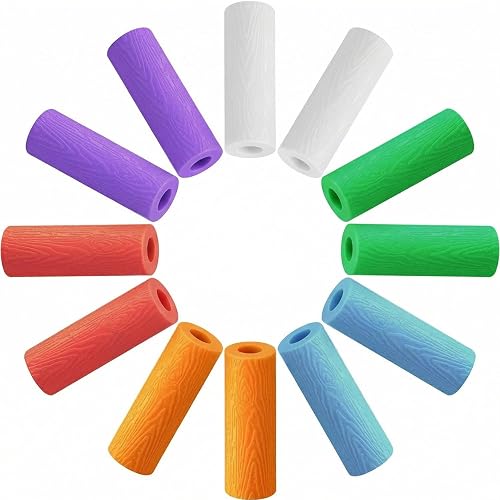
HEMILAB 12 Pcs Silicone Aligner Seaters, Multicolor
Best for: Replacing a chewie often enough to keep it hygienic
- Twelve multicolour silicone seaters
- Textured non-slip surface
- Highest rating in this lineup at 4.6 stars
- +The highest Amazon rating in this lineup at 4.6 stars
- +Textured surface addresses the slipperiness that makes a smooth cylinder hard to hold onto
- +Same fifty-cents-a-piece economics as the Editor's Pick, framed around frequent replacement
- −390 ratings is a modest base next to the four-figure review counts elsewhere in this lineup
- −No community track record we could locate, so its case rests on the listing and its rating rather than user reports
(Affiliate link) · Free shipping on eligible Prime items
Why We Recommend It
Being straight about this one: it is the same product class as the Editor’s Pick at the same price. It earns its slot on a single verifiable fact — 4.6 stars is the highest rating in this lineup — and not on anything the listing claims about itself. The listing’s own pitch is that chewies collect residue and should be swapped rather than nursed, which happens to match the most consistent complaint about the category, but that is a seller’s argument and we weight it accordingly.
The textured surface is the other differentiator. A wet smooth cylinder is genuinely hard to keep hold of, and texture is a sensible answer to that.
We want to be precise about the basis for this pick: we found no discussion of this brand in the aligner communities we researched. Its case rests on its rating, its price, and the format—not on user reports we can point to.
Key Features
- Twelve silicone seaters in assorted colours
- Textured, non-slip surface
- Stated as compatible with Invisalign, ClearCorrect, Byte and other aligner brands
- Around $6 for the pack
Who It’s Best For
People who would rather bin a chewie weekly than clean one, and anyone who finds a smooth cylinder slips out of position mid-bite.
Potential Downsides
390 ratings is respectable but thin beside the four-figure counts on the Editor’s Pick and the IXO set, so its 4.6-star average rests on less data than that number alone implies. As above, we have no community reports on this brand either way.
(Affiliate link) · Free shipping on eligible Prime items
IXO Aligner Chewies with Seater Handles — Best for Back Teeth
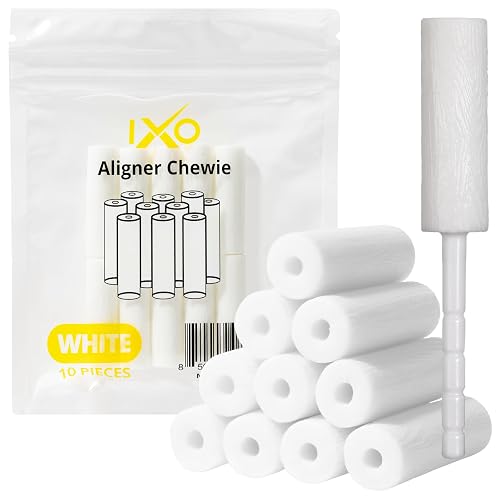
IXO Aligner Chewies 10-Pack with 5 Aligner Seater Handles
Best for: Reaching back molars without putting fingers in your mouth
- Ten unscented chewies
- Five reusable seater handles
- Resealable storage packaging
- +The handle directly addresses two recurring problems: reaching the back teeth, and a slippery cylinder that's awkward to hold in position
- +1,126 ratings at 4.4 stars, the second-deepest review base among the plain-chewie sets here
- +Unscented, which suits anyone who finds the flavoured generics distracting
- −Around ninety-three cents a piece before counting the handles, so nearly double the plain multipacks
- −No community track record we could locate for this brand specifically; the handle format is what earns its slot, not user reports
(Affiliate link) · Free shipping on eligible Prime items
Why We Recommend It
Two problems come up repeatedly with plain cylinders. Back teeth are awkward to reach without putting your fingers in your mouth, and a wet chewie is slippery enough that people end up gumming the whole thing like candy, which doesn’t seat anything reliably.
A handle answers both. You hold the handle, position the chewie precisely, and bite—without your fingers going in after it. This set pairs ten unscented chewies with five reusable handles at around $9.
As with the HEMILAB set, we should be clear about what this recommendation rests on: we found no discussion of the IXO brand specifically in our community research. What we did find, repeatedly, is that handled and stick-mounted formats are the answer aligner users reach for when reach or choking is the problem. The format earns this slot; the brand is simply the best-reviewed example of it we could source.
Key Features
- Ten chewies plus five reusable aligner-seater handles
- Unscented (a mint-scented option exists on the same listing)
- Resealable packaging
- Around $9.25, roughly ninety-three cents per chewie before counting the handles
Who It’s Best For
Anyone whose problem tooth is a back molar, anyone with a strong gag reflex, and anyone who has worried about swallowing one. Also the sensible pick if flavoured silicone puts you off.
Potential Downsides
It costs close to double the plain multipacks per piece, and the handles are the reason—if reach and grip aren’t your problem, you’re paying for a fix you don’t need. The unscented listing is the one we sourced; confirm the variant before ordering if scent matters to you either way.
(Affiliate link) · Free shipping on eligible Prime items
Invisalign Aligner Seaters, Blue and Orange — Best Firmness Sampler
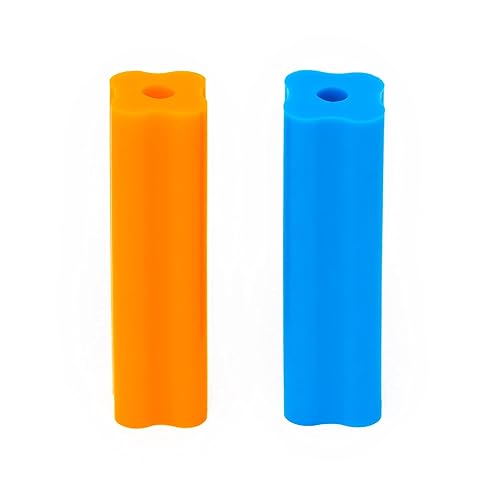
Invisalign Aligner Seaters, Blue and Orange (2 pack)
Best for: Finding out which firmness suits you before buying in bulk
- Align Technology's own seater
- One soft blue and one medium orange
- Shape Align calls a patent-pending quatrefoil
- +The only pack here that pairs two firmness grades in a single purchase — the selection question nothing else in this lineup answers
- +Made by the company that makes the aligners, in a shape it calls a patent-pending quatrefoil rather than a plain cylinder
- −Five dollars per chewie against fifty cents for the generics — ten times the price for two pieces
- −The lowest rating in this lineup at 4.2 stars, and the official product carries no evidence advantage over a generic
(Affiliate link) · Free shipping on eligible Prime items
Why We Recommend It
This is here for one specific reason, and it isn’t brand loyalty. Firmness is the axis that determines whether a chewie works for you—too soft and it collapses without seating anything, too firm and it’s uncomfortable and can be chewed through anyway—and almost nothing on Amazon sells you a way to compare. This pack does: one soft blue piece and one medium orange piece, for about $10.
Use it as a diagnostic. Find out which end of the range suits your bite, then buy a dozen generics in roughly that firmness and stop thinking about it. That’s a better use of $10 than committing to twelve of the wrong thing.
Align calls the shape a patent-pending quatrefoil rather than a plain cylinder, and states the material as medical-grade silicone. Worth noting the Amazon listing itself says neither — both come from Align’s own store. We’ve found no comparative testing showing the shape seats better than a cylinder, so treat it as a design rationale rather than a demonstrated advantage.
Key Features
- Two seaters per pack: soft blue and medium orange
- Shape described by Align as a patent-pending quatrefoil; material stated as medical-grade silicone
- Made by Align Technology, which manufactures Invisalign aligners
- Around $10 per pack, roughly $5 per piece
Who It’s Best For
Anyone who has chewed through cheap chewies quickly, or found them too soft to do anything, and wants to identify the firmness that suits them before buying in quantity.
Potential Downsides
The price is the problem: about ten times the per-piece cost of the generics, for a product with the lowest star rating in this lineup—and that 4.2-star average rests on just 216 ratings, a shallow base beside the four-figure counts on the generic packs, so read it as a weak signal rather than a settled verdict. Being the official product confers no evidence advantage here—there is no published trial behind any chewie, Align’s included. Buy it to calibrate, not to stock up.
(Affiliate link) · Free shipping on eligible Prime items
Invisalign Munchies EPS — Best for Stubborn Back Teeth
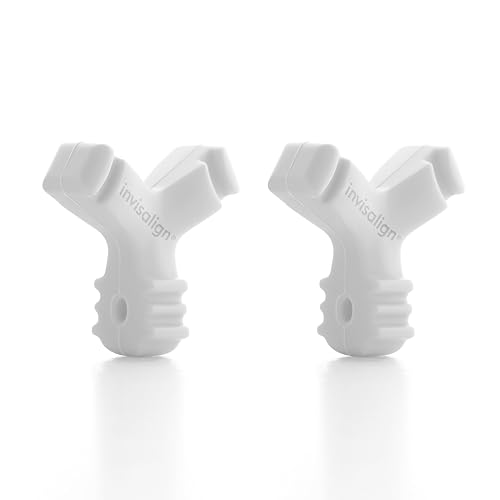
Invisalign Munchies EPS Aligner and Retainer Seater, White (2 pack)
Best for: Seating molars that lift, if the design is worth the price to you
- Three-armed ridged design
- A designated groove per mouth position
- Enhanced Posterior Seating shape, medical-grade silicone
- +The only product here whose shape is designed specifically for posterior seating
- +Aligner communities repeatedly praise this design's durability against ordinary chewies, though not unanimously, and at least one user described it as easier on the jaw
- +Ridged multi-surface shape gives a defined bite position instead of a smooth surface that slides
- −Eleven dollars per piece — about twenty-two times the cheapest chewies here, and price is the single loudest complaint about it in aligner communities
- −Durability is not unanimous: some users report chewing through them within a day, including the larger version
(Affiliate link) · Free shipping on eligible Prime items
Why We Recommend It
This is the one higher-priced product in the category with a real argument behind it. The design is three ridged arms with a designated groove for different parts of the mouth, shaped for seating back teeth rather than presenting a uniform surface—and among the people we researched who had used both, the comparison against ordinary chewies runs favourably on durability, though not unanimously. At least one described it as kinder to the jaw than a plain cylinder, which is worth noting given the overuse concerns further down this page.
The name causes confusion worth clearing up: EPS means Enhanced Posterior Seating. It is not expanded polystyrene. These are medical-grade silicone, as Align states on its product page.
Key Features
- Two seaters per pack, three-armed ridged design
- A designated groove per mouth position, shaped for posterior seating
- Medical-grade silicone, biocompatible per the manufacturer
- Around $22 per pack, roughly $11 per piece
Who It’s Best For
People with a specific back-tooth seating problem, heavy chewers who destroy ordinary chewies quickly, and anyone who has found plain cylinders uncomfortable to bite.
Potential Downsides
The price is genuinely hard to defend on the numbers: about $11 a piece against fifty cents, for a product with no published evidence behind it any more than the generics have. Its 4.5-star average also rests on only 183 ratings—a thin base, so weight it lightly. Price is the loudest and most repeated complaint about this product among the users we researched, and some report chewing through them within a day, including the larger version. There is also a marketing claim circulating—that this design halves treatment time—which we address directly below. It does not hold up.
(Affiliate link) · Free shipping on eligible Prime items
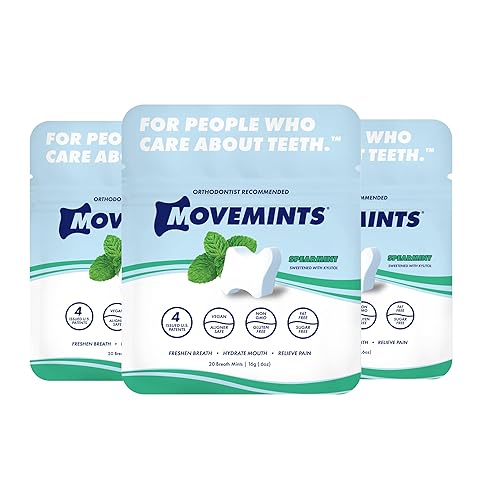
Movemints Clear Aligner Mints — Best Chewie-Free Alternative
Movemints Clear Aligner Mints, Spearmint (3 pack)
Best for: Seating trays without carrying a silicone cylinder around
- Edible xylitol mint with contoured grooves
- Dissolves rather than being reused
- Largest review base in this lineup
- +By far the largest review base in this lineup at 3,652 ratings
- +Nothing to rinse, store, or lose, and it addresses aligner dry mouth at the same time
- +Discreet in a way a silicone cylinder is not, which matters if you reseat trays at work
- −Value is the dominant criticism in aligner communities by a wide margin — the recurring point is that an ordinary sugar-free mint does the same job for a fraction of the cost
- −It is consumed rather than reused, so unlike every other product here the cost never stops; users also report fragments lodging under the aligner
- −Contains xylitol, which is toxic to dogs — keep them where a pet cannot reach
(Affiliate link) · Free shipping on eligible Prime items
Why We Recommend It
We’re including this as the honest alternative for a specific person: someone who won’t realistically carry a silicone cylinder around, rinse it, and keep track of it. A mint solves the logistics problem completely, and users report it helping with the dry mouth they get while wearing aligners. It also has the largest review base on this page by a wide margin.
But we’d be misrepresenting our research if we presented this as a straightforward recommendation. Among the aligner users we studied, this is the most negatively received product in the category on value, and the criticism is consistent rather than scattered: the recurring argument is that an ordinary sugar-free mint accomplishes the same thing for a fraction of the price. That view was the top-voted response on the main discussion we found, well clear of any defence of the product. A counter-current does exist—some users liked them a great deal, particularly for the breath and dry-mouth benefit—but it is the minority position.
Two practical faults also came up: the mints can crumble mid-use, leaving fragments under the aligner, and biting hard on one can scratch a tray.
Key Features
- Edible xylitol mints with patented contoured grooves, spearmint
- Three packs per order
- Sugar-free per the listing
- Around $17 per order
Who It’s Best For
People who reseat trays in public and want something discreet, people who suffer from aligner dry mouth, and anyone who has already lost or abandoned several chewies.
Potential Downsides
The value criticism is the main one and it’s well-founded—a plain xylitol mint is much cheaper and geometry is the only difference. Because it’s consumed, the cost recurs forever, where a $6 pack of chewies covers months. And a genuine household hazard: xylitol is toxic to dogs, so these need storing where a pet cannot reach them.
(Affiliate link) · Free shipping on eligible Prime items
What the community says vs. what the evidence says
| Common community belief (paraphrased) | What the evidence supports |
|---|---|
| “Chewies are essential — you’ll lose tracking without them” | Unproven either way. No published trial tests chewies for seating, tracking or treatment time; the closest relevant work, a 2026 PLoS One systematic review of physical adjuncts, studied vibration and laser devices and did not include chewies. Plenty of users report tracking fine without them, and others report the opposite. Treat it as a cheap, low-risk aid with a sound mechanism, not a proven one. |
| “Munchies cut treatment time in half” | This is a marketing claim and the aligner community disputes it directly. The sharpest rebuttal is arithmetical: the “without Munchies” comparison assumed two weeks per tray while “with Munchies” assumed seven days, and plenty of people already run seven-day trays without them. No published evidence supports a treatment-time effect for any chewie. |
| “Chewing more is better” | Reported provider guidance varies widely, but the instruction that recurs most is short seating bursts of a few seconds per tooth, with several orthodontists reported as warning against extended use. The “about an hour a day” figure that circulates is a diminishing-returns ceiling users described, not a prescription any provider issued in the discussions we read. |
| “The official Invisalign-branded ones must be better” (a reasonable buyer assumption rather than something the communities actually claim) | Nothing supports it. Align’s own products carry no clinical evidence advantage, the retail Aligner Seaters pack on Amazon has the lowest star rating in this lineup, and the per-piece price runs ten to twenty-two times the generics. What the official products genuinely offer is a firmness pair to sample and, in the Munchies, a posterior-specific shape. |
| “Chewies are a regulated medical product, so quality is assured” | Only loosely. Aligner seaters appear in the NLM’s FDA device registry under product code ECS, classified as an “orthodontic aligner/retainer seater, single-use” and exempt from premarket submission. The record we found is a dental-distribution brand, GC Orthodontics America — not one of the Amazon sellers most buyers actually reach. |
Buyer’s Guide: Choosing and Using a Chewie
How to actually use one
The most common mistake in our research was putting the whole chewie in the mouth and chewing it like gum. That gags people, drives the fear of swallowing one, and doesn’t seat anything reliably.
The technique users and providers describe instead:
- Seat the tray by hand first, pressing it onto the teeth with your fingers.
- Hold one end of the chewie between finger and thumb; only the other end goes between your teeth.
- Bite and hold on one spot—a few seconds is the figure that recurs—then move along the arch, working front to back.
- Go back to the problem area. If one tooth shows a gap, that’s where the attention goes, not the whole mouth equally.
- Rinse it and let it air dry afterwards, and don’t store it damp in a closed case.
Users ask a lot about the tray popping loose on the opposite side while they bite, and the answers vary; steady pressure on one area rather than a hard bite is one suggestion, and it’s worth raising with your provider.
How long and how often — and why every answer differs
There is no consistent instruction in this category, and it’s worth knowing that before you go looking for one. Across the discussions we researched, patients reported provider instructions ranging from five seconds per tooth to twenty minutes a day, along with a distinct group told not to use them at all. That range isn’t confusion on the patients’ part; the guidance genuinely differs by practice.
Two things are worth extracting from it. The short-burst-for-seating instruction is the one that recurs most in what patients report being told. And the “about an hour a day” figure that circulates online was described as a point of diminishing returns, not a target—we found no provider prescribing it. Your orthodontist’s number beats anything on the internet, including this page.
Firmness, shape and size — the selection framework nobody publishes
This is the axis that actually determines whether a chewie suits you, and we could find no durometer figure published for any product here, so you’re choosing on description alone.
- If you chew through them quickly, you want firmer. Users report colour sometimes tracking firmness within a brand, but it isn’t standardised across brands, so it’s trial and error. The Invisalign soft-and-medium pack is the cheapest structured way we found to sample.
- If biting is uncomfortable or your jaw gets sore, go softer, and cut the duration before you cut the firmness.
- If your problem is a back molar, shape and reach matter more than firmness—a handled format or the ridged posterior design are the two answers.
- If you have a strong gag reflex or worry about swallowing one, choose a handled format or a larger piece. Small smooth cylinders are the ones people report losing control of.
When not to chew
This is the section most competing pages omit, and it’s the one with the clearest signal in our research.
Patients repeatedly reported being told to stop or avoid chewies for specific reasons: existing TMJ or TMD problems, an open bite, and concern about extended chewing warping trays or moving teeth in unintended ways. Jaw inflammation after an aggressive per-tooth routine came up across independent threads; in one first-hand account it resolved once the user cut back to brief seating only.
These are patient accounts of provider advice rather than published clinical guidance, and we present them as that. But the direction is consistent enough to act on: if you have jaw joint problems, ask before you start, and if chewing makes your jaw ache, that is a reason to do less of it rather than push through. A chewie is meant to seat a tray, which takes seconds—not to be a jaw workout.
Chewies also don’t rescue a tooth that genuinely isn’t tracking. Several users described diligent use and still needing refinements. If a tooth isn’t moving, that’s an appointment, not a product.
If a chewie irritates your mouth
Everything in this lineup is silicone, but reactions do get reported. One aligner user in our research described a rash they attributed to the chewie their practice supplied and suspected latex; if your mouth reacts to an office-supplied one, switching to a different product is a cheap test before assuming aligners are the cause. Two milder complaints also recur and are worth knowing so they don’t surprise you: chapped or dry lips from working a chewie for long stretches, and squeaking—some chewies audibly squeak against the trays, which one user reported their family finding unbearable. None of these is dangerous. They are the kind of thing that quietly makes people stop using a product they paid for.
Retainers count too
Most of this applies after treatment ends. The higher-priced product in this lineup is named for aligners and retainers, and a retainer that isn’t fully seated has the same problem an aligner does. If you’ve finished active treatment and your retainer feels like it sits proud after a night off, the same seating technique applies—and the same caution about not chewing for extended periods.
Branded vs generic: the twenty-two-fold question
Per piece, this category spans from about fifty cents to about eleven dollars for products that claim the same job:
| Product | Pack | Approx. per piece |
|---|---|---|
| PISSION / HEMILAB 12-packs | 12 | ~$0.50 |
| IXO with handles | 10 (+5 handles) | ~$0.93 |
| Invisalign Aligner Seaters | 2 | ~$5.00 |
| Invisalign Munchies EPS | 2 | ~$11.00 |
Nothing in the published evidence justifies that spread, because there is no published evidence on any of them. What the premium products actually sell is design—a firmness pair you can sample, or a posterior-specific shape—and whether that’s worth ten to twenty-two times the price depends entirely on whether you have the problem it addresses. If you don’t, the generics are the rational buy, and that’s most people.
Free alternatives people actually use
Worth saying plainly: the first thing to try is asking your orthodontist for more. Supply varies enormously between practices—some hand out packs freely, and some charge—but it costs nothing to ask.
Beyond that, aligner users improvise widely, and the substitutes that came up most were rolled or folded fabric such as a facecloth, cotton rolls of the kind used chairside, and—the most argued-for option—a baby teether, on the reasoning that teethers are engineered not to break down. We’re reporting these because you’ll encounter them, not endorsing them; none is made for this, and a dozen purpose-made chewies cost about six dollars. The one class we would actively avoid is anything with a wire or rigid core.
Care, storage and replacement
Chewies degrade—splitting, flattening and losing the springiness that makes them work—and reusing a shredded one is both less effective and unpleasant. Rinse after use, let it air dry rather than sealing it damp into a case, and replace it once it’s visibly deformed. The device registry classifies this class as single-use, which is stricter than how anyone actually uses them — but it is a good reason to keep a chewie to yourself and to bin one rather than nurse it.
Buying a twelve-pack rather than a two-pack is the practical answer to all of this: at fifty cents a piece, replacing one is a non-decision.
Frequently Asked Questions
Do I actually need chewies?
Not necessarily, and that’s a more honest answer than most pages give. The mechanism is sound—aligners work by fitting closely and applying gentle pressure, so a tray that isn’t seated isn’t delivering it—but no published trial has tested whether chewies improve seating, tracking or treatment time. Plenty of aligner users report tracking perfectly without ever using one, while others, particularly at the refinement stage or with one stubborn tooth, describe them making a clear difference. Given they cost a few dollars and carry little downside used sensibly, trying one is reasonable. Believing your result depends on it is not.
What’s the difference between chewies and Munchies?
Chewies are the generic soft silicone cylinders, around $6 for a dozen. Munchies are a specific ridged, three-armed seater with a groove for different mouth positions, sold to consumers as Invisalign Munchies EPS at around $22 for two. The “EPS” stands for Enhanced Posterior Seating and describes the shape, not the material—both are silicone. Movemints, a third product often lumped in with these, are neither: they’re edible xylitol mints you consume rather than reuse.
How long should I chew for?
Short bursts to seat the tray is the instruction that recurs most in what patients report being told—a few seconds per area, working along the arch, rather than extended sessions. Practices vary widely, and some orthodontists advise against chewies entirely, so your own provider’s instruction should override anything you read. The “about an hour a day” figure circulating online was described as a point beyond which users saw no further benefit, not as a recommendation.
Do chewies speed up treatment?
There’s no published evidence that they do, and the specific claim that a premium seater halves treatment time doesn’t survive scrutiny—the comparison it rests on assumes two weeks per tray without and one week with, when plenty of people already run one-week trays regardless. The nearest published work on speeding up aligner treatment, a 2026 systematic review, examined vibration and laser devices rather than chewies and found no consistent benefit for those. Seating a tray properly is a reasonable goal on its own; treat speed claims as marketing.
Can you use a chewie too much?
Yes, and this is the caution most worth taking seriously. Aligner users reported being advised against extended chewing for reasons including existing TMJ or TMD problems, open bites, and concern about warping trays. Jaw inflammation after an aggressive per-tooth routine came up across independent threads, and in one first-hand account it resolved on cutting back to brief seating. If you have jaw joint problems, ask your orthodontist before starting; if chewing makes your jaw ache, do less rather than pushing through.
Which firmness should I choose?
We could find no hardness figure published for any of these, so this is trial and error—but the direction is simple. Chewing through them fast means you want firmer; a sore jaw or an uncomfortable bite means softer, and shorter. Colour sometimes tracks firmness within one brand but isn’t standardised across brands, so it’s not a reliable guide. The soft-and-medium Invisalign pack is the cheapest structured way we found to work out which end suits you before committing to a dozen.
Is it dangerous if I swallow one?
Swallowing a chewie is a common enough worry that it shapes what people buy. These are silicone rather than anything toxic, but a small smooth object is a genuine choking consideration, particularly for younger patients—which is why handled formats and larger pieces exist and why holding one end rather than putting the whole thing in your mouth is the recommended technique. If you’re worried about it, buy a handled set. Swallowing one whole is the more common version of this scare, and aligner users do report it happening: if it’s gone down and you’re breathing and speaking normally, the usual advice is to keep an eye on things and call your dentist or doctor for reassurance rather than to panic. If you ever actually choke or have trouble breathing, that’s emergency care, not a dental question.