
A travel toothbrush has to solve three problems a home brush never meets: charging away from your own bathroom, packing into a bag that is already full, and staying clean while it lives in that bag between hotels. We compared six options across those three problems plus cleaning performance. Four are electric brushes, one is a folding manual for people who leave the electric brush at home, and one is the clip-on cover that answers the question we saw asked most often in dental forums: how do you keep a wet brush clean in a wash bag? For home use, see our guides on electric toothbrushes for sensitive teeth and budget electric toothbrushes; for a full-size brush at home, the electric toothbrush guide covers the Oral-B and Sonicare picks across every price tier, and the portable water flosser roundup covers the flossing half of a travel kit.
How We Evaluated Travel Toothbrushes
Cleaning performance. A travel toothbrush that doesn’t clean well defeats the purpose. We evaluated brush head motion type (sonic vibration vs. oscillation-rotation), strokes per minute where specified, and ADA acceptance as an independent marker of efficacy. For the manual pick we looked for soft bristles, which the ADA’s toothbrush guidance recommends to limit gum abrasion, plus a compact head for packing.
Portability and size. We looked at handle length and diameter, whether a travel case is included, and whether the case adds significant bulk. The best travel toothbrushes travel with their case, not just their handle; a folding manual carries its case in its handle.
Charging method. This is the most practically important factor for travelers. USB charging is preferred; it works with adapters you already carry and doesn’t require a proprietary dock. Battery-operated models (AAA) are a separate, legitimate category for travelers who can’t guarantee charging access, and a manual brush sidesteps the question entirely.
Battery life. Longer is better, but most rechargeable options deliver at least 2–4 weeks per charge: sufficient for most trips. We highlighted the outlier (Oclean’s 150-day runtime) separately as it solves a different problem.
Hygiene in the bag. The forum question we saw most often was not about brushing at all: it was whether a wet toothbrush sealed in a case grows something. The ADA’s toothbrush-care guidance says it can, so we weighed how each pick dries and added a cover that protects the bristles without sealing the whole brush.
TSA compliance. All electric toothbrushes are permitted in carry-on bags by the TSA. Models with lithium-ion batteries (the majority of rechargeable options) should be carried in your carry-on rather than checked luggage, which is the TSA’s standing guidance for devices containing lithium batteries.
Travel-toothbrush discussion in the ~1,486 Reddit threads we read across 80 topics splits into two questions, and neither is which electric brush to buy. Gram-counting one-bag packers list a folding manual brush as the default, the most-upvoted packing thread we read carries a compact travel electric in a case instead, and a separate set of threads in the dentist and hygienist subreddits asks whether a cover or case is bad for a wet brush. The lineup serves all three: four electric brushes, one folding manual, and one clip-on cover.
Evidence Receipt
- Powered toothbrushes remove more plaque and reduce gingivitis more than manual brushing, per the Cochrane review of powered versus manual toothbrushing: an 11% plaque reduction at one to three months (21% beyond three months) and a 6% gingivitis reduction at one to three months (11% beyond). Oscillating-rotating designs are the most-studied type in that evidence base. The ADA’s toothbrush guidance states the other half plainly: either manual or powered toothbrushes can be used effectively.
- The ADA’s toothbrush-care guidance says to store a brush upright and let it air-dry, that storing a moist toothbrush in a closed container promotes microbial growth more than leaving it in the open air, that brushes should be replaced every three to four months, and that soft bristles are recommended to limit gum abrasion. The same page notes there is no evidence the bacteria a brush harbors cause adverse health effects, and that data on toothbrush sanitizing is thin.
- The Oral-B iO Series appears on the ADA Seal of Acceptance roster as a product line, which covers the iO Series 3 on this page.
- Electric toothbrushes are permitted in carry-on bags, per the TSA’s electronic toothbrush entry; lithium-battery models belong in the cabin, not checked luggage.
Bitvae Travel Electric Toothbrush: Editor’s Pick
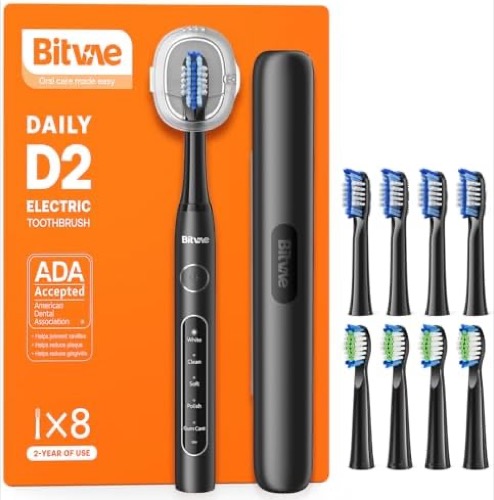
Bitvae Travel Electric Toothbrush (Shadow Black)
Best for: Travelers who want the whole kit in one box: handle, case, spare heads, and a battery that outlasts most trips
- Slim handle with a holder that doubles as a cover, sold as a complete kit for around $25
- 60-day battery life with 5 cleaning modes: White, Clean, Soft, Polish, and Gum Care
- Includes 8 brush heads, enough replacements to last about two years
- +Complete travel kit for around $25: handle, a holder that doubles as a cover, and a full set of spare heads
- +60-day battery life with five cleaning modes: White, Clean, Soft, Polish, and Gum Care
- +Includes 8 brush heads, about two years of replacements at the standard 3-month cadence
- −Sonic output is lower than full-size home brushes; the cleaning-power difference is perceptible for users of high-power models like the Oral-B iO or Sonicare DiamondClean
- −The listing calls the brush ADA-accepted, but the brand is not on the ADA Seal roster at our August 2026 read, so we do not repeat that claim
(Affiliate link) · Free shipping on eligible Prime items
The Bitvae bundles the most spare heads of any brush in this roundup: no other electric brush here ships five modes and roughly two years of brush heads for around $25, and the holder in the box doubles as a cover for the head. The 60-day battery is long enough that most travelers won’t think about charging it between trips. The kit includes 8 brush heads, which at the standard 3-month replacement cadence covers about two years of replacements, a meaningful cost-saving over the life of the brush.
The five cleaning modes give the Bitvae more flexibility than most travel toothbrushes. The listing names them as White, Clean, Soft, Polish and Gum Care; the soft mode is the one to reach for on long flights or in dry climates, and gum care is a gentler setting per the listing. With over 13,000 ratings and a 4.4-star average, the review base is large.
Potential downside: The Bitvae’s sonic output is lower than full-size home brushes: it’s a travel-optimized compromise. For users accustomed to high-power home brushes like the Oral-B iO or Philips Sonicare DiamondClean, the cleaning power difference will be perceptible. For the traveler who primarily uses it on trips rather than as their daily brush, this trade-off is entirely reasonable. We found no owner reports of the Bitvae brush in our research, so its case rests on the listing’s record of over 13,000 ratings and on the general Cochrane finding for powered brushes, not on community testimony. Its listing describes the brush as ADA-accepted, but the brand does not appear on the ADA Seal roster at our August 2026 read, so we do not repeat that claim.
Oclean Electric Toothbrush (150-Day Battery): Best Battery Life
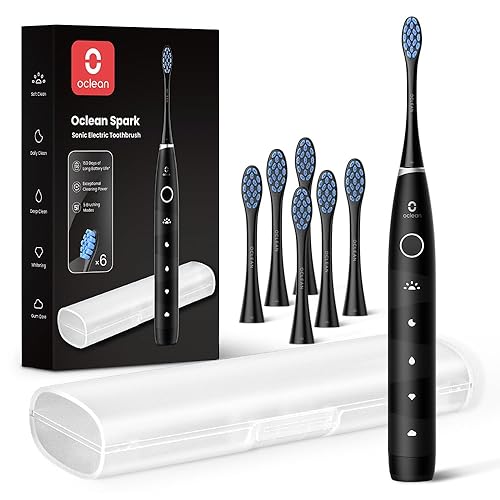
Oclean Electric Toothbrush (150-Day Battery, USB)
Best for: Long-haul travelers, backpackers, or anyone who charges devices infrequently and wants the longest possible runtime
- Up to 150 days per charge, per the listing: charge it once and forget it for months
- USB charging over a standard cable, no proprietary charger to pack
- Includes 6 brush heads and a travel case; 5 cleaning modes including sensitive and whitening
- +Up to 150 days per charge, per the listing, the longest runtime in this roundup by a wide margin
- +Charges over a USB cable rather than a proprietary dock, so a cable you already carry works
- +Includes 6 brush heads and a travel case, with five cleaning modes
- −The thinnest review base on this page at about 1,300 ratings, and the one question asked about the brand in our research, longevity against Philips, went unanswered
(Affiliate link) · Free shipping on eligible Prime items
The Oclean’s claimed 150-day battery life is a different category of runtime from the 30-day norm. A traveler who charges it fully before a long trip and uses it twice daily should not need to charge again for months. For backpackers, extended travel, or anyone who finds battery management a persistent nuisance, this removes the problem entirely, and at around $40 it sits in the middle of this page on price.
The practical advantages compound beyond the obvious. Because it charges over a USB cable rather than a proprietary dock, charging it once you eventually need to is simple. The one first-hand Oclean travel report in our research is about a different Oclean model (an older blue USB-C handle), so it is category evidence rather than a review of this listing, but it says what the spec sheet says: “This has eliminated the need for a whole charger for the toothbrush” and “for the 4 weeks I’ve been out haven’t charged it once”. The one open question about the brand in those threads is longevity against Philips, asked once in a dentist subreddit and never answered, which is one reason the review record here (about 1,300 ratings) matters more than usual. The included 6 brush heads provide long-term coverage comparable to the Bitvae kit. Cleaning performance is solid for a compact brush, with five modes that cover most use cases.
Potential downside: Replacement heads for this handle are an online purchase rather than a pharmacy pick-up, so carry a spare from the six in the box on any long trip. The listing read 4.4 stars over 1,278 ratings at our September 2026 US check.
Oral-B iO Series 3 Limited Deep Clean: Best Premium
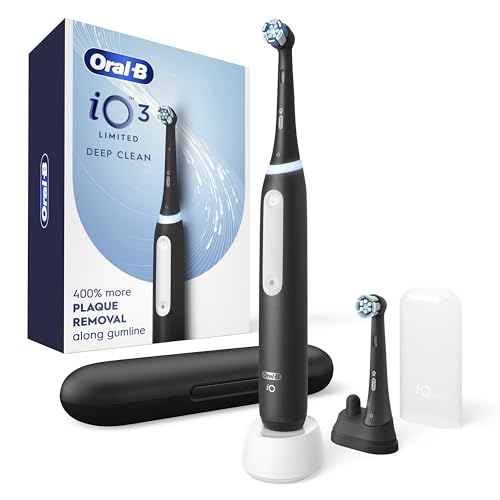
Oral-B iO Series 3 Limited Deep Clean Electric Toothbrush
Best for: Travelers who use an Oral-B iO at home and want the same iO magnetic drive on the road, with a case and spare head in the box
- Oral-B iO magnetic drive oscillates and rotates at the same time, the brush type with the deepest plaque-removal evidence base
- Visual pressure sensor signals too hard, too soft and just right, protecting gums from over-brushing
- 3 cleaning modes, two brush heads, and a travel case in the box
- +iO magnetic drive oscillates and rotates, the brush type with the deepest evidence base for plaque removal, and the iO Series is on the ADA Seal roster
- +Visual pressure sensor signals too hard, too soft and just right, protecting gums from over-brushing
- +Ships with two heads and a travel case, and uses the same heads as Oral-B iO home models
- −Uses a proprietary charging dock rather than USB, another item and cord to pack
- −At around $110 it is the priciest option in this roundup by a wide margin
(Affiliate link) · Free shipping on eligible Prime items
The Oral-B iO Series 3 is the only powered brush in this roundup that uses oscillation-rotation (the others use sonic vibration). Oral-B’s iO magnetic drive moves the brush head in a circular, oscillating motion; Cochrane’s review of powered brushing notes oscillating-rotating designs are the most-studied type and found powered brushes superior to manual ones. For existing Oral-B iO users, the iO3 delivers familiar performance in a travel-viable setup: same brush heads, same cleaning feel, lower price than the flagship, and the Limited Deep Clean edition ships with a travel case and a second head in the box. The iO Series also appears on the ADA Seal roster as a product line.
It is the drive type one hygienist singled out in our research, second-hand: one poster reported that their hygienist “likes a brush that rotates and pulsates”. The visual pressure sensor is the iO feature most worth traveling with. It removes the guesswork: it signals when you press too hard, too softly, or just right. The ADA recommends soft bristles and gentle pressure to reduce the risk of gum injury, and the sensor is a reliable cue for people who are naturally heavy-handed, particularly useful in the morning-rush context of airport or hotel brushing.
Potential downside: The iO Series 3 uses Oral-B’s proprietary charging dock, not USB. The dock is not large, but it is another item to pack and another cord to track, and charging is the sharpest Oral-B complaint in our research: one one-bag packer left the brand because an older Oral-B “had to be charged up every week and it took 22 hours to fully charge it” (an older model, not the iO3, whose charge time we did not read). At around $110 it’s also the priciest option in this roundup by a wide margin: it’s the right choice for Oral-B loyalists, not for travelers choosing a travel brush from scratch. The Limited Deep Clean edition is the iO3 listing in stock at our September 2026 read, and its listing states compatibility with Oral-B iO replacement heads.
Philips One by Sonicare Battery Toothbrush: Best Battery-Powered
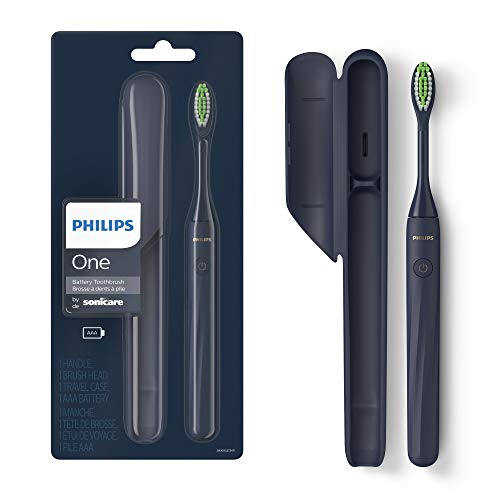
Philips One by Sonicare Battery Toothbrush (Midnight Blue)
Best for: Travelers who want the compact electric the travel community names most, on a single AAA battery with no charger to pack
- Micro-vibration handle on one AAA battery, with a listed battery life of about three months
- 2-minute timer with 30-second pacing, per the listing
- Slim Sonicare handle sold with one brush head, a travel case and one AAA battery; replacement heads come from Philips
- +The compact electric named in the most-upvoted packing thread in our research (862 upvotes), from a brand dental professionals already know
- +Runs on a single AAA battery with a listed three-month battery life, so there is no charger, dock or adapter to pack
- +2-minute timer with 30-second pacing, and replacement heads sold by Philips
- −Micro-vibration rather than full Sonicare power: one owner in our research says the travel version does not clean the way the rechargeable Sonicare line does
- −At around $30 it costs more than the Bitvae, and this listing ships one brush head
(Affiliate link) · Free shipping on eligible Prime items
The Philips One is the compact electric the travel community actually names. The single most-upvoted packing thread in our research, an 862-upvote “no compromise” toiletries kit, carries one in a case, and when a reader asked “What is that tiny electric toothbrush?? I hate using a basic one but figured that’s all there is for travel size”, the poster answered “it’s the philips one by sonicare :) there’s a battery version and another version that’s rechargeable with a usb cable”, and a second reader replied “we have the same toothbrush!” It also answers a hesitation a flaired dental hygienist raised in another thread about a direct-to-consumer brand: this one is a Philips product, so the brand needs no introduction at a dental office.
The design is the AAA version of Sonicare’s entry handle: micro-vibrations rather than the full sonic motor, a 2-minute timer with 30-second pacing, and a listed battery life of about three months on one AAA cell, so there is nothing to charge and no adapter to pack. At around $30 with a 4.4-star average over more than 5,000 ratings, it is the compact electric here with both a known brand and a large review base. The rechargeable version of the same handle read as unavailable in every colour at our September 2026 check, so this card links the battery version.
Potential downside: It is a micro-vibration brush, and owners say so. The most-upvoted Philips One comment in our wider electric-toothbrush research puts it plainly: “the “Philips One” travel version does NOT work just as well, it’s a different system. any basic version will do the same job though”. Treat it as a manual brush with a timer and a buzz, not a substitute for the iO3 or a full Sonicare, and note that this listing ships one brush head, with a travel case and one AAA battery in the box.
GUM Folding Travel Toothbrush: Best Folding Manual
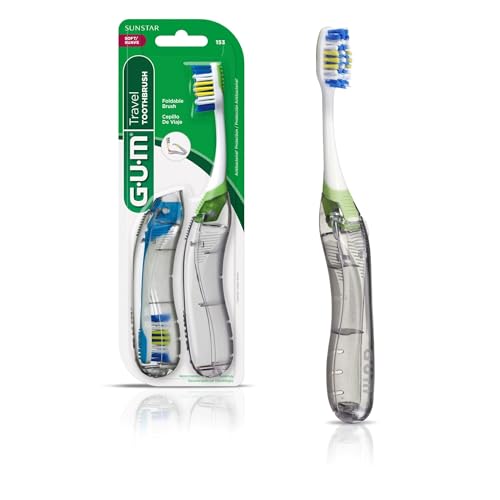
GUM Folding Travel Toothbrush, Soft (2 Count)
Best for: One-bag packers and anyone who leaves the electric brush at home: a soft manual that folds into its own handle
- Tri-fold handle closes over the bristles, so the brush is its own case
- Soft bristles and a compact head, with a built-in tongue cleaner on the back of the head
- Two per pack for around $12, sold under GUM's Sunstar label
- +Folds so the bristles sit inside the handle, so it needs no separate case and stays clean in a pocket or wash bag
- +Soft bristles, the type the ADA recommends to limit gum abrasion, with a compact head and a built-in tongue cleaner
- +The brush named most often in the one-bag kit lists we read, with one of the largest review bases on this page at over 18,000 ratings
- −A manual brush gives up the plaque and gingivitis edge that powered brushes show in the Cochrane evidence; one traveler in our research blamed three months on a soft manual for new gum disease
- −One one-bag packer found folding brushes noticeably less comfortable to use than a full-size handle
(Affiliate link) · Free shipping on eligible Prime items
The GUM folding brush is the one product in this roundup that the travel community named before we did. In the one-bag packing threads we read it appears unprompted in kit lists that argue over every gram: item five of a 159-upvote two-week kit is “Gum folding toothbrush”, a 50-upvote one-week kit lists “1 x Gum Travel Toothbrush”, and a reply in that thread reads, in full, “Here’s mine. Hail the Gum folding toothbrush!” Across three threads it drew six mentions from at least four different accounts and not one complaint about the brush itself. That is the strongest organic signal for any product on this page, and it is why a manual brush earns a card on a page that started life as an electric roundup.
The design is the point. The handle folds in three so the bristles end up inside it, which means the brush carries its own cover and never sits loose in a wash bag. GUM’s listing describes soft bristles, a compact head, and a tongue cleaner on the back of the head; soft bristles are what the ADA’s toothbrush guidance recommends, because they limit abrasion to the gums. At around $12 for two, it carries a 4.7-star average over more than 18,000 ratings, one of the largest review bases on this page.
Potential downside: It is a manual brush, and the Cochrane review of powered versus manual brushing found powered brushes remove more plaque and reduce gingivitis more. For a week away that difference is small; for someone who brushes with an iO or Sonicare at home and travels most of the month, one of the electric picks above is the better long-term choice. Two travelers in the same thread make the case against it in their own words. One found “the 2 piece/folding find to be way less comfortable to use personally, and the size trade off not worth it vs just having a full size toothbrush in my travel dopp kit”. Another went further: “I used a soft bristle brush for 3 months of travel and when I got back and visited the dentist I found out I had minor gum disease. I instantly moved back to my motorised oral b for the duration of my travel”. One account is not a study, but it matches the direction of the Cochrane evidence, so treat the folding manual as a short-trip tool.
Steripod Clip-On Toothbrush Protector: Best Cover
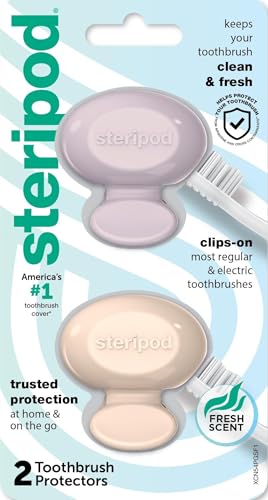
Steripod Clip-On Toothbrush Protector (2 Count)
Best for: Anyone whose brush lives in a wash bag between hotels: a clip-on cover that fits manual and electric heads alike
- Clips over the brush head of most manual and electric toothbrushes, per the listing
- Carries a thymol scent, an ingredient found in many mouthwashes, which the maker says keeps the cover smelling fresh for up to three months
- Two per pack for around $6; the maker suggests replacing every three months
- +The listing says it fits over the head of most manual and electric toothbrushes; we did not confirm fit on each brush here
- +Covers the head rather than sealing the whole brush; the maker's product page says the cap allows airflow, a claim we did not test, so dry the brush first
- +The largest review base of any product on this page at over 23,000 ratings, and the cover one dental-hygiene-subreddit poster packs as their own baseline
- −The maker suggests replacing it every three months, an ongoing cost of a few dollars a quarter
- −It protects the head only: a wet brush still needs to air-dry before it goes in the bag
(Affiliate link) · Free shipping on eligible Prime items
Nobody in our research reviews a toothbrush cover; what they do, in six separate threads in the dentist and hygienist subreddits, is worry about one. A brother’s cover “seems to be a bit brown (I think it’s some sort of microbe growth) and even if we try dry it it gets cloudy from the evaporation”. A dorm resident who cannot leave a brush out writes: “I find myself just throwing my toothbrush in the bag which doesn’t seem hygienic at all… Don’t want the humidity to stay in the case though, so, if there were holes that’d be ideal. Looked up cases on Amazon but they only have cases without any holes and that are too small to contain an electric toothbrush.” The Steripod is on this page because it is the answer to that post, and because one poster in the dental-hygiene subreddit, who says they don’t typically recommend battery-powered brushes, packs “a manual Colgate floss tip toothbrush with a steripod cover” as their own baseline.
The Steripod answers the recurring question directly. It clips over the head rather than sealing the whole brush in a tube, and the listing says it fits most manual and electric toothbrushes; we did not confirm the fit on each brush above. The ADA’s toothbrush-care guidance is that a moist brush in a closed container grows more microbes than one left in the open air, and that air-drying upright is the goal; a head cover is the compromise for a brush that has to go in a bag, and Steripod’s own product page says the cap “allows for proper airflow”, a claim we did not test. It keeps the bristles off the bag’s contents and the hostel sink; it is not a drying aid. The thymol scent is a freshness feature, not a sanitizer: the ADA’s same page notes that data on toothbrush sanitizing is thin and that the bacteria a brush carries have not been shown to cause harm.
Potential downside: Steripod suggests replacing the cover every three months, so a two-pack covers half a year and the cost recurs. It also protects only the head. If you clip it onto a brush that is still wet and drop it in a sealed wash bag, you have recreated the closed-container problem one layer down; let the brush dry first. We found no complaint about the Steripod in our research, but we found no praise either: every mention was a packing-list line, a poster’s own kit, or a brand name in an unanswered question, so its case rests on the drying mechanism above and its review record, not on testimonials.
Buyer’s Guide: Choosing a Travel Toothbrush
Folding Manual vs. Bringing Your Electric
Start with the question one frequent flyer asked after buying a brush for its half-size case: “that seems pretty unnecessary to have a travel-specific toothbrush.” The travel community’s own answer is split, and the split is useful. In the gram-counting one-bag threads the default is a folding manual: the GUM brush shows up in kit after kit, and one reply to the one dedicated travel-brush question in our research was “If you require a specialized toothbrush, use what you use at home and add a cover.” But the single most-upvoted packing thread we read, at 862 upvotes, carries an electric brush in a case rather than a folding manual: a compact Philips One by Sonicare, which the poster describes as coming in “a battery version and another version that’s rechargeable with a usb cable”, and the reply “we have the same toothbrush!” drew 16 upvotes of its own. That is the compact-electric route the Bitvae and the Philips One sit in, and the Philips One is the brush in that thread. Both routes are legitimate; the difference is how much you travel and how much cleaning power you are willing to give up. The community’s dentists disagree too: one self-described clinician in an ultralight-hiking thread (no subreddit flair) argues that cheap vibrating travel brushes clean no better than a manual one (the comment scored 61), while two other hikers report their own dentists disagreeing with each other on whether electric beats manual at all: “my dentist says electric toothbrushes aren’t much beneficial compared to the traditional brushes”, and, in reply, “Mine says the opposite”. None of that is a study, so we source the cleaning question to Cochrane below.
The evidence gives a clear answer for daily life and a softer one for a trip. Powered brushes remove more plaque and reduce gingivitis more than manual ones in the Cochrane review, so the electric brush is the right home tool. For a week or two away, a soft folding manual used for a full two minutes gives up little, and it removes every charging and packing problem on this page at once. The honest split: if you travel most of the month, or you are managing gum disease, bring a compact electric (the Bitvae and the Philips One are both slim handles that add almost no bulk); if you travel occasionally and pack light, the GUM folding brush is what the gram-counting one-bag threads carry. The ADA’s own line on the underlying question is calm: “Either manual or powered toothbrushes can be used effectively.” Its guidance adds that people with braces or other appliances may find a powered brush easier to use, which is the case for bringing the electric on an orthodontic trip. And if your gums bleed or ache after a long trip, that is a dentist visit, not a brush swap.
Rechargeable vs. Battery-Powered
The majority of travel electric toothbrushes use USB or proprietary charging. These are generally the right choice for travelers who stay in hotels or Airbnbs, have a standard toiletry kit, and can reliably charge their phone at night: your toothbrush charges in the same window.
Battery-powered (AAA) options solve a different problem: power access is unavailable or inconvenient. Camping, backpacking, extreme multi-country trips, and situations where outlet adapters are already maxed out are real use cases where the Philips One’s AAA design is preferable to a slightly more powerful rechargeable option.
USB vs. Proprietary Charger
If you’re choosing a rechargeable travel toothbrush, prioritize one that charges over a USB cable (like the Oclean or the Bitvae) rather than a proprietary dock. Proprietary charging docks (like the Oral-B iO Series 3’s dock) add another cable to track and a dock that takes up counter space. USB-based charging works with adapters already in your bag.
Covers, Cases, and What Happens to a Wet Brush
This is the question that came up most often in our research, six times across the dentist and hygienist subreddits, and it was never answered by a verified professional. The best answer in those threads came from another user: “Air drying is best. I use caps when I’m traveling but otherwise leave it in the holder or standing on the charger if it’s an electric brush.” A one-bag packer solves the same problem with “a super light zip perforated bag. It lets those items dry and not let bacteria grow as easily”. The recurring shopping complaint is that cases on Amazon “only have cases without any holes and that are too small to contain an electric toothbrush”, so ventilation, not just fit, is the buying criterion.
The ADA’s toothbrush-care guidance settles the mechanism: store the brush upright and let it air-dry, because a moist toothbrush in a closed container promotes microbial growth more than one left in the open air. The same page adds two calming facts. First, while toothbrushes do harbor bacteria, there is no evidence those bacteria cause adverse health effects. Second, data on toothbrush sanitizing is thin, so a UV case is a convenience purchase, not a proven hygiene step. The practical routine for travel: rinse the brush, shake it out, let it air-dry as long as the morning allows, then clip a head cover like the Steripod on before it goes in the bag. A cover that has gone brown or cloudy, as one poster described, is a cover to wash and then replace; the ADA’s guidance covers rinsing the brush after each use and says nothing about covers, and Steripod itself suggests a new one every three months. A sealed hard case is fine for protecting an electric handle in your bag; it is the wrong place for a wet head. Replace any brush or head every three to four months, or sooner once the bristles fray.
Ready-Made Kits vs. Building Your Own
The “travel oral care kit” bundles on Amazon (a brush, a mini paste, floss picks, sometimes a scraper, in a zip pouch) look convenient, and we read the listings. We did not card any of them. At our September 2026 read the 7-in-1-style kits were unbranded listings with fewer than 100 ratings each (87, 47, 43 and 7), below the review floor this site applies to every recommendation. The one branded pack that cleared the floor, Reach’s three-pack of a capped manual brush with sample-size Crest and Scope (4.7 stars, about 3,600 ratings), is a brush with samples rather than a kit with floss, and the GUM above covers the brush half better. Building your own kit costs about the same and lets you pick the parts: a folding manual or compact electric from this page, a travel-size tube of the paste you already use (the 159-upvote two-week kit in our research lists a “15mL travel toothpaste (lasts me 14 days)”), a card of floss picks or a portable water flosser, and a head cover. Every liquid or paste must be 3.4 oz (100 ml) or under per container to clear a carry-on checkpoint, per the TSA liquids rule.
What the ADA Seal Actually Means
The ADA Seal of Acceptance on a toothbrush means the product has met standards for safety and efficacy that the manufacturer submitted voluntarily for independent review. It is not a certification that every brush without it fails: it’s a meaningful signal of independent verification. One option in this roundup carries the seal: the Oral-B iO Series 3, which the roster lists under the Oral-B iO Series. The Bitvae listing describes that brush as ADA-accepted, but the brand did not appear on the roster at our August 2026 read, so we do not count it here.
Do Travel Electric Toothbrushes Have to Be Checked?
No. Electric toothbrushes are permitted in both carry-on and checked baggage per TSA rules. However, if your toothbrush uses a lithium-ion or lithium-metal rechargeable battery (which most USB-charging models do), best practice (and some airline guidelines) is to pack it in your carry-on rather than checked luggage. Battery-operated models using standard alkaline AAA batteries can go in either bag without restriction.
Frequently Asked Questions
Can I bring an electric toothbrush on a plane? Yes. The TSA explicitly permits electric toothbrushes in both carry-on and checked bags. Models with rechargeable lithium-ion batteries are best carried in your carry-on (standard practice for lithium battery devices), while AAA battery-powered models have no restrictions.
Is it bad to put a wet toothbrush in a closed case? It is the one thing the ADA’s toothbrush-care guidance specifically warns against: a moist brush in a closed container promotes microbial growth more than a brush left to air-dry in the open. Let the brush dry as long as you can, then use a cover that protects the head without sealing the whole brush, like the Steripod. The same guidance notes the bacteria on a brush have not been shown to cause harm, so this is about keeping the brush pleasant, not about a health emergency.
Do UV toothbrush sanitizing cases actually do anything? The ADA’s toothbrush page says there is little data in the literature on toothbrush sanitizing. One in-vitro study it cites found soaking a brush in 3 percent hydrogen peroxide or a mouthwash cut bacterial load substantially, but that is a lab result, not a health outcome. Treat a UV case as a convenience, not a requirement; air-drying is the step that matters.
Is a folding travel toothbrush as good as a regular one? A folding manual with soft bristles and a compact head does the same job as a standard manual brush; the hinge is a packing feature, not a cleaning compromise. What it gives up is the powered-brush advantage: the Cochrane review found electric brushes remove more plaque and reduce gingivitis more than manual ones. For a short trip that gap is small; for months of travel a compact electric is the better tool.
What should be in a travel oral care kit? A brush (folding manual or compact electric), a travel-size tube of your usual paste at 3.4 oz (100 ml) or under for carry-on per the TSA liquids rule, floss picks or a portable water flosser, and a ventilated head cover. The 7-in-1-style pre-packed kits on Amazon were unbranded listings with under 100 ratings at our read, and the one branded pack that passed is a brush with sample-size paste and rinse, so we recommend assembling your own from products with a real review record.
Do I need a travel-specific toothbrush at all? Often not. One reply to the one dedicated travel-brush question in our research was “If you require a specialized toothbrush, use what you use at home and add a cover”, and the most-upvoted packing thread we read carries a compact Philips One travel brush in a case, not a folding manual. A travel brush earns its place when your home brush’s dock is the problem, when you are away for weeks at a time, or when you pack to a gram.
Can I just cut down a normal toothbrush or use a kid’s brush? Yes, and one-bag packers do: “you can cut part of the handle off your normal toothbrush to make it lighter and smaller, backpacker style”, and another uses kids’ brushes because “they tend to be small and soft”. A folding brush like the GUM does the same job without the hacksaw and keeps the bristles covered.
Does my electric toothbrush charger work abroad, or do I need a converter? Two different problems get conflated here. Voltage: some rechargeable toothbrush chargers are dual-voltage and some are not; the range is printed on the charger’s label, so check it before assuming. For the one proprietary dock on this page, the iO3, the listing does not state the charger’s input voltage, so read the label on the dock. Plug shape: dual-voltage does not fit the socket for you; you’ll still need a physical plug adapter for the destination country. Battery-powered models like the Philips One and the folding manual sidestep the question entirely.
How long should a travel toothbrush battery last? For most trips, the two to four weeks per charge that most rechargeable travel brushes deliver is more than adequate. If you travel frequently without reliable charging access, look for 60 days (Bitvae) or the Oclean’s listed 150-day runtime. The Philips One runs on a AAA battery, so runtime is a battery swap rather than a charge; its listing puts one battery at about three months.
Is a travel electric toothbrush as effective as a full-size one? No trial we found compares travel-size brushes with full-size ones. Several travel models run at lower power to stretch battery life, and the Bitvae and Philips One cards say so. The Oral-B iO Series 3 is a full-size home handle, so nothing is given up there.
Do I need a travel case for my electric toothbrush? A case does two jobs: it protects the head from whatever else is in your bag and protects the handle from knocks. The Bitvae, Oclean, iO3 Deep Clean and Philips One all list a case or cover in the box. If yours didn’t come with one, or you want the head covered without sealing the whole brush, the Steripod clip-on above fits most manual and electric heads; and whatever you use, let the brush dry before it goes in.
What’s the difference between sonic and oscillating-rotation electric toothbrushes? Sonic and micro-vibration brushes (Bitvae, Oclean and Philips One) vibrate the bristles at high speed in a sweeping motion. Oscillating-rotation brushes (Oral-B iO) rotate and oscillate in a circular motion. Both are significantly more effective than manual brushing, per the Cochrane review of powered versus manual brushing. Oscillating-rotating designs are the most-studied type in the Cochrane evidence base. The better toothbrush is the one you’ll use consistently.