
Whitening pens won’t replace strips or professional treatments for heavy discoloration; but for on-the-go touch-ups, post-coffee stain removal, and maintaining results you’ve already achieved, they’re hard to beat. Most work by applying a thin layer of hydrogen peroxide or carbamide peroxide gel directly onto tooth surfaces: no trays, no strips, no mess, and small enough to carry in a bag or pocket for spot-treating between full whitening sessions. We compared six pens on ingredient concentration, application precision, sensitivity risk, and treatment count to find the best options across different needs and budgets. For a complete whitening routine instead of spot-touch-ups, see our guide to the best at-home teeth whitening kits; for daily maintenance, our best whitening toothpaste guide.
How We Evaluated Teeth Whitening Pens
Active ingredient and concentration. The two main whitening agents are hydrogen peroxide (HP) and carbamide peroxide (CP). CP releases about a third of its content as HP, per the ADA, and a review the ADA cites found tray gels of the two caused about equal sensitivity and gum irritation. Only one pen here, AuraGlow at 9% HP, states its strength on its Amazon listing. Higher concentrations aren’t always better for daily use: the ADA notes sensitivity can be more common at higher concentrations.
Application precision and dry time. A precision brush tip that allows targeted, tooth-by-tooth coverage matters. Gel that dries before you close your mouth is a practical advantage: especially for the overnight format. We looked at how easy each pen is to apply without getting gel on gums.
Sensitivity design. We evaluated whether each formula includes desensitizing agents (potassium nitrate, hydroxyapatite, or fluoride), and whether a peroxide-free option exists for users who cannot tolerate bleaching agents.
Treatment count and cost per application. A $20 pen with 40 treatments works out to $0.50 per use; a $3 pen with 20 treatments is $0.15. We calculated cost-per-application across the lineup so you can compare value accurately.
Brand credibility and clinical backing. We looked for peer-reviewed research, ADA-referenced formulations, dentist involvement in development, and established market presence. That matters here because pen listings leave gaps: only AuraGlow states its peroxide strength, so for the other pens a maker’s published directions and, where it gives one, its full ingredient list are what we could actually check.
Colgate Optic White Overnight Teeth Whitening Pen — Editor’s Pick
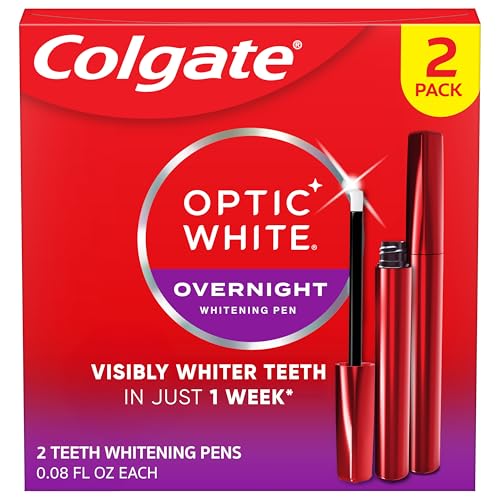
Colgate Optic White Overnight Teeth Whitening Pen
Best for: Most people who want an overnight, no-mess whitening routine from a trusted brand
- Hydrogen peroxide formula designed for overnight wear: apply before bed, brush it off in the morning
- Enamel-safe, vegan, gluten-free formula designed for no tooth sensitivity, per Colgate
- Colgate says it removes 15 years of stains in 1 week when used as directed
- +Backed by Colgate, with a 60,000-plus rating history
- +Overnight formula removes the waiting period: apply before bed with no open-mouth wait, then brush it off when you wake up
- +Colgate calls it enamel safe and vegan, and says it is designed for no tooth sensitivity
- −One small 0.08 oz pen, and the listing gives no treatment count to work out a cost per use
- −Amazon's review summary is mixed on whitening: some buyers report good results, others say it doesn't work at all
(Affiliate link) · Free shipping on eligible Prime items
The Colgate Optic White Overnight Pen is the most straightforward recommendation here. It comes from Colgate, uses hydrogen peroxide as its active ingredient, and sidesteps the open-mouth wait most of the other pens here ask for by designing the formula for overnight wear. You apply it before bed, go to sleep, and let the gel work during the hours you’re least likely to eat or drink. No open-mouthed waiting, no watching the clock.
Colgate claims it can remove 15 years of stains in one week when used as directed. That’s marketing language, and the listing points to the packaging for the conditions rather than naming a study. Stain type matters: the ADA notes that some stains from inside the tooth, such as tetracycline staining, can take three to four months of nightly treatment, on average. Colgate calls the formula enamel safe, vegan and gluten-free, and says it is designed for no tooth sensitivity.
Potential downside: This listing is a single 0.08 oz pen, and Colgate’s listing does not say how many nights it lasts, so its cost per treatment is harder to compare than the pens below that state a count. The 3.8-star average also reflects a genuine split: Amazon’s review summary says some buyers report good whitening while others say it doesn’t work at all, and that the gel can harden on the brush.
AuraGlow Teeth Whitening Pen — Best HP Formula
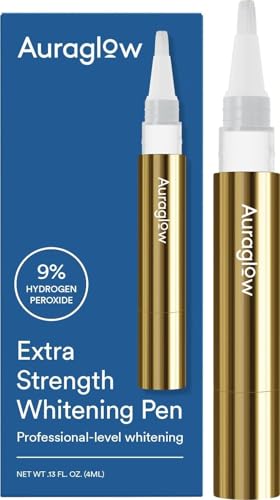
AuraGlow Teeth Whitening Pen
Best for: People who want a high-concentration hydrogen peroxide pen with a simple 1-minute daily routine
- 9% hydrogen peroxide, the only stated strength among these six pens
- 40+ whitening treatments per 4mL pen: dissolves on contact, no rinsing required
- Made in the USA; AuraGlow says it is clinically proven to whiten up to 10 shades in 7 days
- +9% hydrogen peroxide, the only stated strength among these six pens, which AuraGlow says acts faster than carbamide peroxide
- +Gel dissolves on contact, no rinsing required, and roughly $0.50 per application
- +Made in the USA and marketed as a no-sensitivity formula
- −Plan it as a course: AuraGlow counts its 40 treatments at one a day and makes its shade claim for seven days
- −The ADA lists temporary tooth sensitivity and gum inflammation as whitening's most common side effects
(Affiliate link) · Free shipping on eligible Prime items
AuraGlow positions itself as the professional-strength option among standalone pens, and it is the only pen here whose Amazon listing states a strength: 9% hydrogen peroxide. AuraGlow says hydrogen peroxide releases its whitening power immediately on contact and so works faster than carbamide peroxide. Each 4mL pen contains 40+ treatments, which works out to roughly $0.50 per application at about $20.
The application process is simple: twist the pen, paint gel onto each tooth, keep your smile relaxed for 60 seconds. The gel dissolves on its own: no rinsing required. AuraGlow is made in the USA and marketed as a no-sensitivity formula, which speaks to the main anxiety people have when trying a higher-concentration product for the first time. Of all the pens we evaluated, this is the one we’d reach for if speed of results is the priority.
Potential downside: Treat it as a course rather than a forever habit: AuraGlow counts its 40 treatments at one a day and makes its shade claim for seven days. The ADA lists temporary tooth sensitivity and gum inflammation as the most common side effects of whitening, and notes sensitivity can be more common at higher concentrations.
Lumineux 2-in-1 Whitening Pen — Best Peroxide-Free
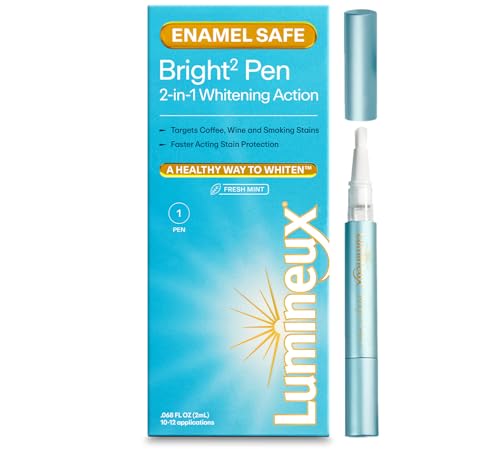
Lumineux 2-in-1 Whitening Pen
Best for: People with sensitivity who want whitening without hydrogen peroxide bleaching
- Peroxide-free formula; Lumineux calls it clinically proven and cites over 70 peer-reviewed studies
- 2-in-1 design lifts existing stains and helps prevent new ones from coffee and wine
- Precision brush tip for targeted on-the-go application, no trays or strips required
- +Peroxide-free formula; Lumineux cites over 70 peer-reviewed studies behind its approach
- +2-in-1 design lifts existing stains and helps prevent new ones from coffee and wine
- +Precision brush tip for targeted application without trays or strips
- −It works on surface stains; the ADA says changing a tooth's own color takes a peroxide bleaching reaction
- −Not suited for rapid whitening in 7 to 14 days; best for maintenance and prevention
(Affiliate link) · Free shipping on eligible Prime items
Lumineux takes a different approach than every other pen on this list: no hydrogen peroxide, no carbamide peroxide. Instead, it uses a blend of coconut oil, Dead Sea salt, sage oil and lemon peel oil that Lumineux calls dentist-formulated and backs with a count of over 70 peer-reviewed studies (its listing does not name them); the brand says it lifts stains without bleaching. The “2-in-1” design lifts existing stains while helping block new ones: useful if coffee or tea is a daily habit and you want both removal and prevention.
For users who’ve experienced painful tooth sensitivity from peroxide-based whitening products, this is the pen on this page that removes peroxide entirely, and Amazon’s review summary says buyers find it doesn’t cause sensitivity. The same summary is mixed on how much it whitens, and without peroxide it works on surface stains rather than the tooth’s own color; for maintenance and mild daily stain prevention, it fills a different role. The precision brush tip allows targeted application without trays or strips.
Potential downside: If you want to change the tooth’s own shade, this is not the tool. Lumineux is best suited for maintenance and prevention rather than intensive stain correction. The American Dental Association says reducing stains inside the tooth takes a chemical bleaching reaction, most commonly with carbamide or hydrogen peroxide, and that products working mainly on surface stains won’t have a significant impact on the tooth’s intrinsic color.
Venus Visage Teeth Whitening Pen (2-Pack) — Best 2-Pack
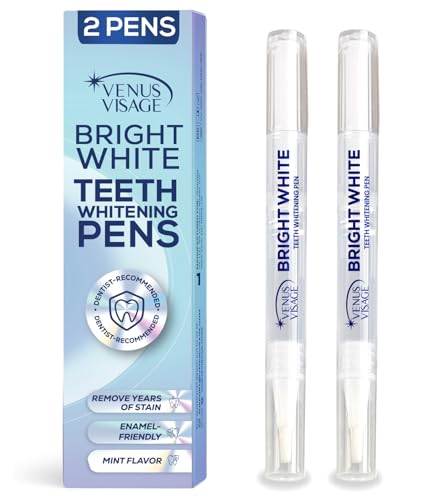
Venus Visage Teeth Whitening Pen (2-Pack)
Best for: People who want two pens for the price of one and a formula Venus Visage markets as low-sensitivity
- Two carbamide peroxide pens with 20+ uses each: 40+ total treatments for $19.95
- Marketed as low-sensitivity and safe to apply on veneers and crowns (won't whiten them), per Venus Visage
- Quick-drying, precision brush tip: no drips, mess-free application at home or on the go
- +Two carbamide peroxide pens at $19.95, 40-plus total treatments for the price
- +Carbamide peroxide formula Venus Visage markets as low-sensitivity and safe to apply on veneers and crowns (it only whitens natural teeth)
- +Quick-drying precision tip reduces dripping and mess
- −Its directions call for a 20 to 30 minute wait and a rinse, against AuraGlow's 60 seconds with no rinse
- −Two pens mean tracking two expiration dates
(Affiliate link) · Free shipping on eligible Prime items
The Venus Visage 2-pack at $19.95 meaningfully lowers the per-pen cost compared to single-pen options at similar price points. You get two carbamide peroxide pens with 20+ uses each (40+ total treatments), which stretches the value considerably. Carbamide peroxide releases about a third of its content as hydrogen peroxide, per the ADA, and it is the agent the ADA says dentist-supplied home tray systems typically use, at 10% to 38%. Venus Visage markets the formula as low-sensitivity, though a review the ADA cites found carbamide and hydrogen peroxide tray gels caused about equal sensitivity.
Venus Visage says regular application can whiten teeth by 4 to 8 shades; that is the maker’s figure, not a tested one. The formula is described as safe for veneers and crowns, though it’s worth noting: whitening agents can only change the shade of natural tooth enamel. They won’t bleach porcelain, composite, or ceramic restorations: those will stay their original shade while your natural teeth whiten around them. The precision tip allows targeted coverage, and the quick-drying formula reduces dripping.
Potential downside: Its directions call for applying the gel, waiting 20 to 30 minutes and rinsing, against AuraGlow’s 60 seconds with no rinse, and AuraGlow claims its hydrogen peroxide acts faster than carbamide peroxide. Two pens also means tracking two expiration dates.
SNOW Extra Strength Teeth Whitening Pen (2-Pack): Dual-Peroxide Formula
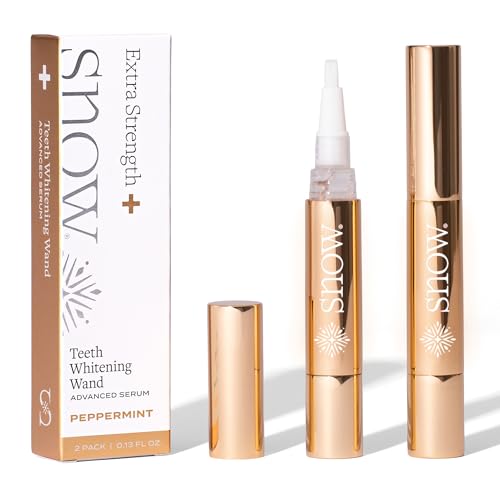
SNOW Extra Strength Teeth Whitening Pen (2-Pack)
Best for: People who want an extra-strength dual-peroxide gel whose ingredient list also names potassium nitrate
- Hydrogen and carbamide peroxide gel; its ingredient list includes potassium nitrate
- Hydroxyapatite, hyaluronic acid and red algae, which Snow says support enamel and hydrate gums
- Leave on 9 to 30 minutes a day with Snow's LED mouthpiece, or brush on for touch-ups, per Snow
- +Its ingredient list includes potassium nitrate, the antihypersensitivity active in sensitivity toothpastes such as Sensodyne
- +Snow adds hydroxyapatite, hyaluronic acid and red algae, which it says support enamel and hydrate gums
- +Works independently of Snow's LED accelerator device
- −The priciest purchase here, at $41.70 for a 2-pack (about $20.85 a pen)
- −Its listing says to patch test first and to stop if sensitivity occurs
(Affiliate link) · Free shipping on eligible Prime items
Snow is the premium option here, and the $41.70 price for a 2-pack reflects a different formulation. The gel pairs hydrogen peroxide with carbamide peroxide, and its ingredient list includes potassium nitrate, the same active that Sensodyne’s drug-facts label lists for building protection against painful sensitivity. Snow also adds hydroxyapatite, hyaluronic acid and red algae, which it says support enamel and hydrate gums. It is the only pen on this page whose Amazon ingredient list names potassium nitrate.
Snow says it has sold over 5 million units, and it sells this as an extra-strength formula, so the sensitivity ingredients sit alongside a strong dose rather than replacing it. Snow’s directions are to brush it on and leave it 9 to 30 minutes a day with its LED mouthpiece for maximum results in as little as 14 days, or to use the pen on its own for on-the-go touch-ups. Note that this is the pen on its own, not the full Snow LED kit: it works without the light device.
Potential downside: At $41.70 for a 2-pack (about $20.85 a pen), it is the priciest purchase here, though per pen it is close to the single Colgate pen. It is also sold as the strong option, not the gentle one: the listing’s first bullet sells it on maximum strength whitening, and it says to do a patch test before use and to discontinue use if sensitivity occurs. If you don’t need the extra strength, the single Colgate or AuraGlow pen costs less per purchase. Snow makes most sense for users who want a strong dual-peroxide gel and like that it also carries potassium nitrate.
GuruNanda Teeth Whitening Pen — Best Value
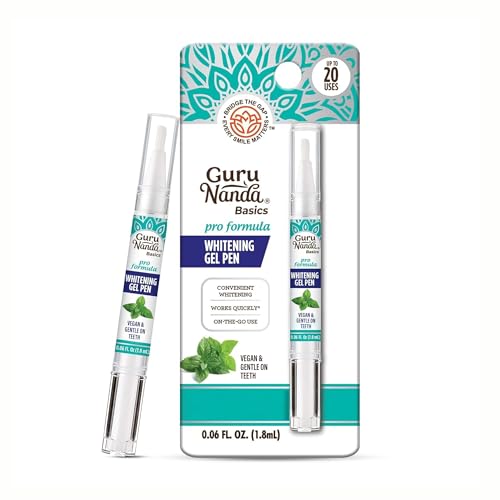
GuruNanda Teeth Whitening Pen
Best for: First-time whitening pen users and budget-conscious shoppers testing the format
- Under $3 per pen with hydrogen peroxide + menthol formula: about $0.12 per application
- Vegan, cruelty-free, gluten-free; up to 20 uses per pen
- Compact and travel-friendly, for touch-ups on the go
- +Under $3 per pen, about $0.12 per application, the lowest-cost option on the list
- +Vegan, cruelty-free, gluten-free hydrogen peroxide plus menthol formula
- +Compact and travel-friendly for touch-ups on the go
- −GuruNanda does not state its peroxide strength, so you cannot compare it with AuraGlow's stated 9%
- −A 15-minute wait and a rinse, against AuraGlow's 60 seconds with no rinse
(Affiliate link) · Free shipping on eligible Prime items
At $2.50, GuruNanda’s whitening pen is the lowest-cost option on this list by a wide margin, and the low price does not come with a vague label: its listing names every ingredient (glycerin, propanediol, water, hydrogen peroxide, carbomer, menthol and sodium hydroxide) and gives clear directions. Each pen delivers up to 20 uses, working out to about $0.12 per application.
This is the ideal starting point if you’ve never tried a whitening pen before and want to find out whether the format suits your routine before investing more. The vegan, cruelty-free, gluten-free formulation will matter to some users. The application instructions call for 15 minutes of contact time before rinsing (AuraGlow asks for 60 seconds and no rinse), with a 30-minute window before eating or drinking afterward, and GuruNanda directs twice-daily use for two weeks. That’s a more involved routine than, say, the Colgate overnight approach: worth factoring in before committing.
Potential downside: GuruNanda does not state its peroxide strength, so you cannot weigh it against AuraGlow’s stated 9%. Treat it as an introductory option. If you want a known strength, AuraGlow is the one pen here that states it.
Buyer’s Guide: What to Know Before Buying a Whitening Pen
Do Teeth Whitening Pens Actually Work?
The answer: yes, but with meaningful limitations. Cleveland Clinic says it’s not unusual to see teeth lighten a few shades with regular use of at-home whitening products, that whitening strips and gels typically lighten teeth within two weeks, and that bleaching works best on teeth yellowed with age or stained by food and drink.
Some discoloration is slow going or out of reach: the ADA notes tetracycline stains can take three to four months of nightly treatment, on average, and Cleveland Clinic says brown or gray discoloration could signal problems a bleaching kit won’t fix. For that level of whitening, professional treatments or dentist-supervised at-home kits with higher concentrations are more appropriate. If you’re unsure what type of staining you have, a dentist can tell you in one appointment whether OTC whitening is likely to help.
Hydrogen Peroxide vs. Carbamide Peroxide: What’s the Difference?
Hydrogen peroxide (HP) is the active whitening agent in both cases. In carbamide peroxide (CP) products, the HP is bound to urea, and the ADA says CP releases about a third of its content as HP. The practical difference:
- HP pens (AuraGlow, Colgate, GuruNanda): the gel is the active agent itself. AuraGlow claims HP acts faster than CP; wear times still vary, from AuraGlow’s 60 seconds to Colgate’s overnight.
- CP pens (Venus Visage): CP is the agent the ADA says dentist-supplied home tray systems typically use. Venus Visage’s directions call for 20 to 30 minutes before rinsing.
By the ADA’s one-third figure, a 35% CP formula carries roughly as much HP as a 12% HP formula. Neither is inherently “better” for sensitive teeth: a review the ADA cites found tray gels of the two caused about equal sensitivity and gum irritation, and the ADA notes sensitivity can be more common at higher concentrations.
How to Use a Whitening Pen Correctly
Start with clean, dry teeth: GuruNanda’s directions say to brush and wipe your teeth dry, and Colgate’s say to apply to clean, dry teeth. A few seconds with a tissue works. Then:
- Twist or click the pen to dispense a small amount of gel onto the brush tip
- Apply in a thin, even layer across the front surface of each tooth
- Keep your mouth slightly open for 30–60 seconds while the gel sets (unless using an overnight formula)
- Follow the pen’s own wait and rinse instructions: GuruNanda rinses after 15 minutes and then asks for 30 minutes without food or drink, while AuraGlow needs no rinse
Some pens (like Colgate Overnight) are designed to stay on through sleep: these don’t require keeping your mouth open. Follow the specific instructions for whichever product you choose.
Whitening Pens vs. Strips vs. Kits
Pens are best for: travel, targeted touch-ups, maintenance after professional whitening, and users who find strips awkward or messy.
Whitening strips cover a whole arch in one go. In a 2020 review cited in the ADA’s whitening overview, paint-on gels whitened about as well as whitening toothpaste, which in turn fell short of strips. See our best teeth whitening kit guide for options that include strips and trays.
Whitening kits (with LED lights, trays, or both) are more involved and cost more. Cleveland Clinic says gel-filled trays work fastest, with results sometimes seen in as little as a few days, which makes them the stronger route for significant stain correction.
Frequently Asked Questions
How long does it take to see results from a whitening pen?
The makers’ own claims run from one week to two: Colgate says 15 years of stains in one week when used as directed, AuraGlow says up to 10 shades in seven days, GuruNanda directs twice-daily use for two weeks, and Snow says maximum results in as little as 14 days with its LED mouthpiece. Cleveland Clinic says strips and gels typically lighten teeth within two weeks, and the ADA notes that the type of stain can change how many treatments you need.
Can I use a whitening pen every day?
Follow the pen’s own schedule: GuruNanda directs twice a day for two weeks, AuraGlow counts its 40 treatments at one a day, and Colgate calls its pen enamel safe for daily use. Cleveland Clinic’s advice is to read and follow the instructions because “you don’t want to overdo it,” and a Mayo Clinic dentist notes that every bleaching option can make teeth more sensitive.
Will a whitening pen work on crowns, veneers, or dental bonding?
No, whitening agents only affect natural tooth enamel. They won’t change the shade of porcelain, ceramic, or composite restorations. If you have visible restorations on your front teeth, whitening your natural teeth may create a color mismatch. Consult your dentist before starting any whitening regimen if you have crowns or veneers.
Are whitening pens safe for sensitive teeth?
It depends on the formulation. Amazon’s review summary for Lumineux, the peroxide-free option here, says buyers find it doesn’t cause sensitivity. Among peroxide-based pens, Snow is the one whose ingredient list includes potassium nitrate, a desensitizing active, but it is sold as an extra-strength formula and its listing says to discontinue use if sensitivity occurs; the ADA notes sensitivity can be more common at higher peroxide concentrations. If you have significant sensitivity, consult a dentist before use: sensitivity can indicate enamel erosion or exposed dentin that whitening products may aggravate. For more on managing sensitivity, see our best toothpaste for sensitive teeth guide.
Do I need to rinse after using a whitening pen?
It depends on the product. AuraGlow is designed to be left on with no rinsing required, and the Colgate overnight pen stays on while you sleep and comes off when you brush in the morning. GuruNanda’s instructions call for rinsing after 15 minutes. Always follow the product-specific instructions; leaving a rinseable formula on overnight can cause gum irritation.
Can I use a whitening pen before or after brushing?
Use it after brushing. GuruNanda’s directions say to brush and dry your teeth before applying the gel, and Colgate’s say to apply it to clean, dry teeth; Philips gives the same brush-first step for its take-home trays, telling users to brush well to remove plaque before the gel goes on. Don’t brush immediately after applying the pen: wait until the recommended contact time has passed and you’ve rinsed (if applicable).