
Denture care goes well beyond rinsing: regular cleaning with an appropriate cleanser removes plaque, kills bacteria, prevents staining, and controls odor in ways that brushing alone cannot. The American Dental Association recommends soaking dentures daily in a denture cleanser to remove biofilm and debris. The challenge is that the category has dozens of products with meaningful differences in formulation, soak time, and whitening capability. We compared six of the best options (tablets and liquids, quick-clean and overnight formats) to find the right cleaner for every routine. For retainer cleaning, see our best retainer cleaner guide, which covers similar products optimized for Invisalign trays.
How We Evaluated Denture Cleaners
Antibacterial effectiveness. The primary job of a denture cleanser is to kill the bacteria and fungi that accumulate on denture surfaces. We looked for formulas with documented efficacy against common oral pathogens and for clear maker guidance on which appliances each one is made for; Polident and Efferdent both list partial dentures.
Soak time. Ranges from 3 minutes (quick clean) to overnight (8+ hours). Soak time affects convenience and cleaning depth: overnight soaks allow extended antibacterial contact, while quick-clean formulas prioritize morning routine efficiency.
Stain and odor removal. We evaluated which formulas are designed to address visible yellowing or staining over time, versus those focused on antibacterial action and odor control only.
Compatibility with denture materials. Not all cleaners are safe for all denture types. We noted which appliances each maker names, such as full and partial dentures, retainers, and aligners.
Cost per use. With daily use, price per tablet matters. We calculated cost-per-day across all five options so you can compare running costs accurately.
Efferdent Denture Cleaner Tablets (Minty Fresh, 126 ct) — Editor’s Pick
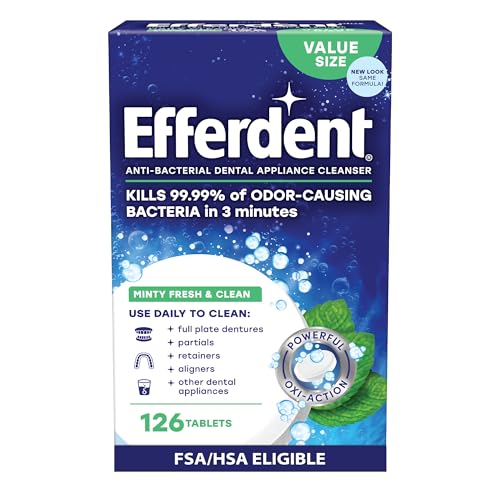
Efferdent Denture Cleaner Tablets (Minty Fresh, 126 ct)
Best for: Most denture wearers who want a reliable, widely available daily cleaning tablet with a fresh-breath finish
- Kills 99.99% of odor-causing bacteria in 3 minutes, per the listing, so no overnight soak is needed
- Minty fresh formula leaves dentures smelling clean and reduces denture-related bad breath
- Safe for full dentures, partials, retainers, and orthodontic appliances including aligners
- +The listing says it kills 99.99% of odor-causing bacteria in 3 minutes, fast enough for a morning routine without overnight soaking
- +Minty formula targets the denture odor that rinsing alone leaves behind
- +Safe for full dentures, partials, retainers, and aligners, so one product covers every appliance
- −Sold as an everyday antibacterial cleaner rather than a whitening formula; Polident Overnight Whitening is the pick if whitening is the priority
(Affiliate link) · Free shipping on eligible Prime items
Efferdent is one of the two dominant brands in the denture cleaner category, and the Minty Fresh 126-count is its best all-around tablet. Efferdent’s listing says the formula kills 99.99% of odor-causing bacteria in three minutes, quick enough to use as part of a normal morning routine without leaving your dentures soaking for hours. The minty formulation addresses one of the most common denture complaints: odor buildup that regular rinsing doesn’t eliminate. At roughly $6 for 126 tablets, cost per use is under $0.05, making it one of the most affordable daily cleaners available.
One underappreciated advantage of Efferdent: it’s explicitly safe for retainers, aligners, partial dentures, and other dental appliances, not just full dentures. If you use multiple types of appliances, one product covers everything. The effervescent action (the fizzing) is functional, not cosmetic: it creates oxygen that disrupts the biofilm layer where bacteria live, reaching the crevices that brushing misses. For the vast majority of denture wearers, this is the right daily cleaning tablet.
Potential downside: Minty Fresh is sold as an everyday antibacterial cleaner rather than a whitening formula, though the listing says it dissolves tough stains. Polident’s Overnight Whitening tablets (below) are the better choice if whitening is a priority.
Polident 3 Minute Antibacterial Cleanser Tablets (60 ct) — Quick Clean
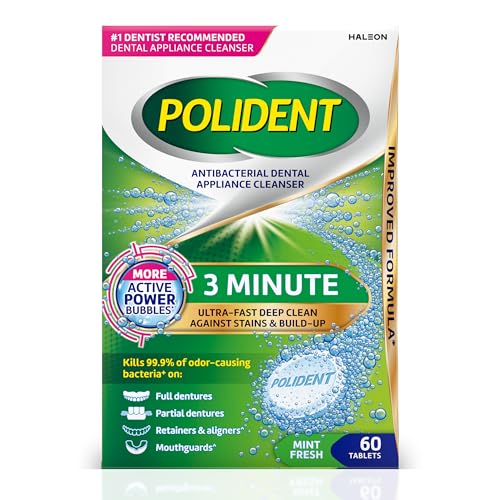
Polident 3 Minute Antibacterial Cleanser Tablets (60 ct)
Best for: People with busy morning routines who need a full clean in under 5 minutes
- Polident says it kills 99.9% of odor-causing bacteria in just 3 minutes
- Oxygen-action formula removes food deposits, plaque, and stains on full and partial dentures
- Made for full dentures, partial dentures, retainers, aligners, and mouthguards, per Polident
- +A 3-minute soak per Polident, short enough for a morning routine
- +Oxygen-action formula removes food deposits, plaque, and stains on full and partial dentures
- +Polident names full dentures, partial dentures, retainers, aligners, and mouthguards among the appliances it is made for
- −60-count packs run out quickly for daily users — the 2-pack is more economical at scale
(Affiliate link) · Free shipping on eligible Prime items
The Polident 3 Minute is built for a quick clean. Polident says the formula kills 99.9% of odor-causing bacteria in three minutes, a short routine for people who put their dentures back in quickly in the morning. That three-minute window is Polident’s own claim, carried in the product’s name, so follow the packet timing rather than cutting it shorter. One small clinical study (Brazilian Dental Journal, 2013) had 25 partial-denture wearers soak in Polident 3 Minute for three minutes a day for 15 days and found lower total microorganism and streptococci counts on the denture, though no change in Candida (yeast) counts.
Polident and Efferdent occupy similar market positions, and both sell a 3-minute tablet: Efferdent’s listing says its Minty Fresh tablets kill 99.99% of odor-causing bacteria in 3 minutes, and Polident says its formula kills 99.9% in the same time. Where Polident stands out for partial wearers is its dedicated partials hub, and its product page names partial dentures among the appliances the tablet is made for. Neither maker page we read says anything specific about metal clasps or frameworks, so if your partial has metal parts, check the packet or ask your dentist. At roughly $6 for 60 tablets, cost per day is about $0.10, comparable to Efferdent.
Potential downside: 60-count packages sell out faster for daily users. The 90-count 2-pack option (below) brings the per-tablet cost down if you’re committed to this formula.
Polident Overnight Whitening Cleanser Tablets (120 ct) — Best Overnight
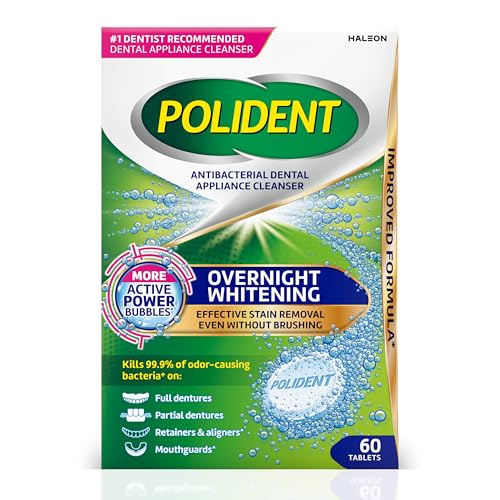
Polident Overnight Whitening Cleanser Tablets (120 ct)
Best for: People who prefer to soak dentures overnight and want a trusted antibacterial formula from a leading brand
- Overnight antibacterial soak kills 99.99% of bacteria with extended contact — maximum protection
- Whitening action brightens dentures during sleep — no additional products or steps required
- MicroClean formula reaches into microscopic scratches where bacteria hide in denture material
- +Extended overnight soak kills 99.99% of bacteria for maximum antibacterial contact
- +Whitening action brightens dentures during sleep with no extra products or steps
- +Polident lists partial dentures among the appliances it is made for, which matters for partial denture wearers
- −Overnight soaking isn't appropriate for every denture type — immediate-wear or flexible dentures may have material restrictions
(Affiliate link) · Free shipping on eligible Prime items
Polident’s Overnight Whitening is the companion to their 3-Minute tablet for people who prefer a full overnight soak. Where the 3-Minute formula is engineered for speed, the Overnight version is designed for maximum antibacterial contact time: the extended soak allows Polident’s oxygen-action formula to work through all surface areas of the denture, including the microscopic pits and scratches that accumulate in acrylic material over time. Polident calls this MicroClean technology, and while it’s marketing language, the underlying principle (longer contact = more thorough bacteria removal) is sound.
The whitening component is meaningful for regular overnight users: consistent soaking prevents staining from building up in the first place, rather than trying to reverse established discoloration. For denture wearers who already take their dentures out each night, adding an overnight soak to the routine requires no extra steps: just drop the tablet in the soaking container with water before bed. We chose it as the overnight pick partly because Polident’s own product page names partial dentures among the appliances it is made for, alongside full dentures, retainers, aligners, and mouthguards, which matters for partial denture wearers.
Potential downside: Overnight soaking is not appropriate for every denture type. Immediate-wear or flexible dentures may have material restrictions: check with your dentist or the denture manufacturer if unsure.
Dr. B Dental Solutions Liquid Crystal Soak Cleanser (12 oz) — Best Liquid Soak
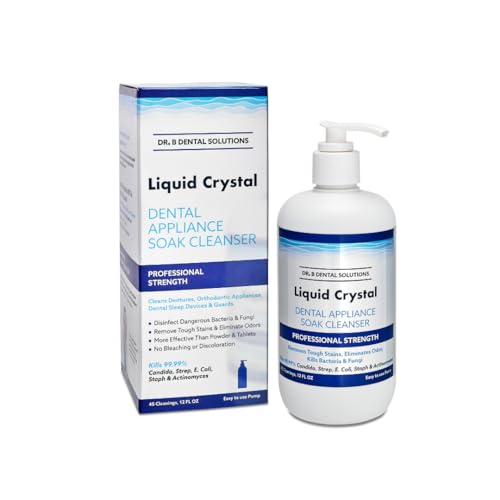
Dr. B Dental Solutions Liquid Crystal Soak Cleanser (12 oz)
Best for: People who want a deep-cleaning liquid formula for dentures, aligners, retainers, or night guards
- Liquid crystal formula penetrates biofilm in crevices that tablet fizzing may not fully reach
- Removes stains, odors, and bacteria across all dental appliances — dentures, night guards, aligners
- Concentrated 12 oz bottle provides months of daily use — no bleach, alcohol, or chlorine in the formula
- +Liquid penetrates biofilm in crevices that tablet fizzing may not fully reach
- +Works across every dental appliance — dentures, aligners, retainers, night guards, and sleep apnea devices
- +Concentrated 12 oz bottle lasts months of daily use
- −Requires measuring and mixing each use — less convenient than drop-in tablets
- −Higher upfront cost than entry-level tablet options
(Affiliate link) · Free shipping on eligible Prime items
Tablet cleaners work by dissolving in water to create an effervescent cleaning solution. Dr. B’s Liquid Crystal takes a different approach: it’s a pre-dissolved crystal solution that you add to water to create a more concentrated, consistent soak. The advantage is that liquid penetration into the fine scratches and crevices of denture material can be more thorough than the fizzing action of tablets, which creates cleaning turbulence but may not uniformly reach every surface.
Dr. B’s formula is one of the few denture cleaners explicitly designed to work across every type of dental appliance: full and partial dentures, clear aligners, retainers, night guards, and sleep apnea devices. If you have multiple appliances to clean simultaneously, one product handles everything. At $27.95 for 12 oz, the upfront cost is higher than tablets, but given the concentration and daily use volume, the cost per use is comparable to premium tablet options over time. Best for users who’ve found tablets insufficient for stubborn staining or who want a product that handles multiple appliance types.
Potential downside: Liquid cleaners require measuring and mixing each use, which some people find less convenient than drop-in tablets. The higher upfront cost may be a barrier compared to entry-level tablet options.
Polident 3 Minute Antibacterial Cleanser Tablets (90 ct, 2-Pack) — Best Bulk Value
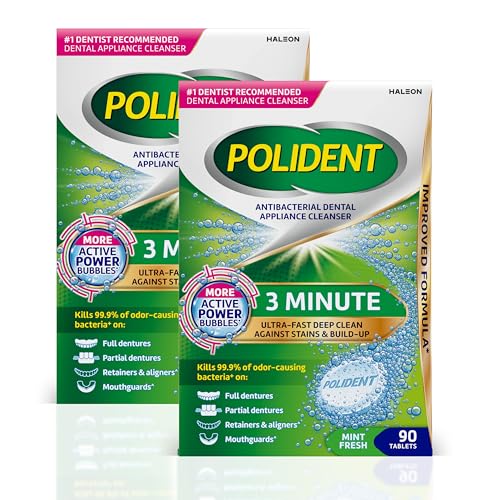
Polident 3 Minute Antibacterial Cleanser Tablets (90 ct, 2-Pack)
Best for: Regular denture wearers who want to buy in bulk and reduce the cost of daily cleaning
- Two 90-count packs of the 3-minute formula — 180 tablets total, covering 6 months of daily cleaning
- Same 3-minute antibacterial formula as the 60-count single pack, at a lower per-tablet price
- Reduces reorder frequency; practical for households with multiple denture wearers
- +180 tablets total, roughly a six-month supply for a single denture wearer
- +About $0.06 per tablet, the lowest per-tablet price in the Polident lineup, with the same 3-minute clean
- +Bulk supply reduces the chance of running out and skipping cleaning days
- −Worth testing the 60-count single pack first if you're switching from a different brand
(Affiliate link) · Free shipping on eligible Prime items
If you’ve settled on Polident 3-Minute as your daily cleanser, the 2-pack 90-count is the most cost-effective way to buy it. At roughly $11 for 180 tablets, cost per tablet drops to about $0.06—comparable to Efferdent on a per-use basis, with the same 3-minute soak time Efferdent’s listing gives. For single denture wearers, 180 tablets is approximately a six-month supply; for households where two people use denture cleaners, it’s a three-month supply.
Bulk buying also reduces the chance of running out and skipping cleaning days, which matters more than it might seem: daily cleaning is what prevents the biofilm and staining from building up in the first place. The product is identical to the 60-count single pack in formulation; you’re simply buying in volume. Order if you already know Polident 3-Minute works for you and want to optimize the ongoing cost.
Potential downside: None specific to this format: just don’t buy in bulk with any cleanser you haven’t already tested. Try the 60-count single pack first if you’re switching from a different brand.
Buyer’s Guide: Choosing the Right Denture Cleaner
Tablets vs. Liquid Soaks
Tablets are the most common format: convenient, shelf-stable, easy to use (drop in water, soak). The effervescent action creates oxygenated cleaning turbulence. Most people do well with tablets for daily cleaning.
Liquid soaks (like Dr. B’s) offer more uniform surface contact and are useful for multi-appliance households. They require slightly more handling but may be preferable for stubborn staining or for people who find tablets insufficient.
Quick-Clean vs. Overnight Soaking
Quick-clean (3–5 minutes): practical for morning routines, provides antibacterial protection and odor control. Best for consistent daily use.
Overnight soaking (6–8 hours): maximum antibacterial contact time, better for gradual whitening, preferred by people who remove dentures nightly. Not appropriate for some immediate-wear or flexible denture types—verify with your dentist.
Whitening Considerations
Denture cleaners with whitening action work on the acrylic components of dentures by removing surface staining. They do not whiten porcelain denture teeth, and they cannot reverse deep discoloration built up over many years. Regular use of an overnight whitening cleaner from the beginning prevents staining from accumulating.
If you have significant discoloration, a professional denture cleaning from your dentist or prosthodontist (ultrasonic cleaning) may be more effective than any home cleanser.
What Not to Use
Go easy with regular toothpaste. The ADA lists toothpaste or mild soap with a soft-bristle brush as an alternative to a commercial cleanser, but its consumer site MouthHealthy tells wearers to brush with a soft brush and a non-abrasive cleanser so the dentures don’t get scratched. Avoid bleach (damages metal components and darkens acrylic over time) and very hot water (can warp thermoplastic components). The ADA’s denture page says placing dentures in water or a denture cleanser solution when they are not being worn helps them keep their shape, and that soaking in cleaning solution can help reduce the bacterial load. And if what you find during a soak is a hairline crack rather than stubborn stain, that’s a job for a denture repair kit, not a stronger cleanser.
FAQ
Can I use denture cleaner tablets for my retainer or Invisalign? Yes: Efferdent and Polident both explicitly list retainers and aligners as compatible appliances. Use the same soak method: dissolve one tablet in a full glass of water, soak for the recommended time, then rinse thoroughly before reinserting. Never use hot water, which can distort thermoplastic retainers.
How often should I clean my dentures? The ADA recommends daily cleaning. Most people clean in the morning (after removing dentures overnight) or at night before the overnight soak. Daily cleaning with a tablet or liquid cleanser, combined with light brushing of denture surfaces with a soft denture brush, is the daily routine the ADA’s denture page recommends.
Do denture cleaners kill the bacteria that cause gum disease? Denture cleaners target bacteria that colonize denture surfaces. They’re not substitutes for cleaning the gum tissue and oral mucosa under the dentures, which should be cleaned daily with a soft toothbrush. Maintaining clean oral tissues under dentures is important for reducing inflammation and infection risk.
My dentures still smell even after cleaning. What’s wrong? Persistent odor usually indicates biofilm buildup in the micro-scratches of the denture material, which standard cleaning may not fully reach. Try switching to an overnight whitening formula for 2–4 weeks of extended soaking, or consider a liquid crystal soak. An at-home ultrasonic cleaner adds a mechanical step a soak can’t: cavitation shakes debris out of those micro-scratches, and it pairs with a tablet rather than replacing one—our best ultrasonic cleaner roundup compares six models, with each one’s stated tank capacity and what that means for a full denture. If odor still persists after that, a professional ultrasonic cleaning by a dentist or dental lab is the next step.
Are generic denture cleaner tablets as effective as Efferdent or Polident? Generic tablets using the same effervescent chemistry (persulfate-based) can be effective. However, both Efferdent and Polident publish compatibility guidance for different denture types, including partials, and both brand-name tablets have been tested by name in published lab and clinical studies, which generic tablets usually have not. For a product you use daily on a dental appliance, the brand reliability and compatibility information is worth the modest price premium.