
Dental care starts earlier than most parents realize. The American Academy of Pediatric Dentistry’s best-practice policy on perinatal and infant oral health care emphasizes establishing a dental home early and beginning oral hygiene and preventive care in infancy. Cleveland Clinic makes the same case in plainer terms: building oral care habits “as soon as that first tooth sprouts can help keep your kid cavity-free” and set the stage for a lifelong healthy smile. We evaluated six toothbrushes for infants and toddlers on bristle softness, head size, handle ergonomics, and how well they actually help parents get into a consistent routine with young children. For older kids, see our best kids’ toothbrush and best kids’ electric toothbrush guides.
How We Evaluated Toddler Toothbrushes
Bristle softness and head size. Infant gum tissue and newly erupted teeth are delicate. We required extra-soft bristles and small brush heads, in line with Cleveland Clinic’s advice to use “a small, soft toothbrush” once the first tooth comes in.
Handle design for parents. The ADA says caregivers should brush an infant’s teeth and keep assisting or supervising until the child can spit out excess toothpaste. We evaluated handle grip, length, and maneuverability from the parent’s perspective—particularly one-handed control while managing an uncooperative toddler.
Engagement for toddlers. A toddler who doesn’t want to brush is a real problem. We considered whether character designs, bright colors, or gentle vibrations meaningfully increase compliance, and which features actually matter vs. which are novelty.
BPA-free materials. All brushes evaluated are BPA-free. For toddlers who chew on toothbrush handles, we noted any additional safety considerations.
Replacement frequency and cost. The ADA recommends replacing toothbrushes every 3–4 months or sooner if bristles fray. Multi-pack value matters for a product replaced this frequently.
Dr. Brown’s Infant-to-Toddler Toothbrush Set (4-Pack, Ages 0–3) — Editor’s Pick
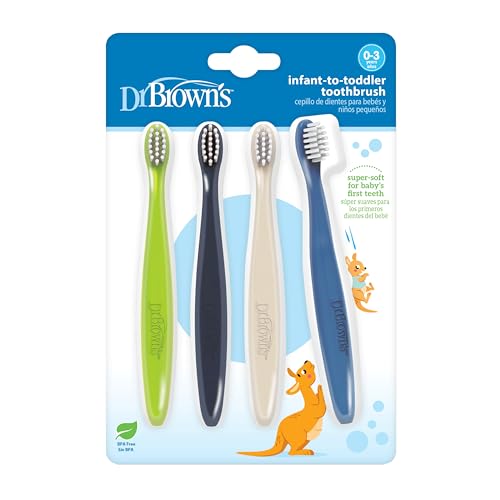
Dr. Brown's Infant-to-Toddler Toothbrush Set (4-Pack, Ages 0–3)
Best for: Parents who want a gentle, BPA-free 4-pack for ages 0 to 3 at the lowest per-brush price here
- Super-soft bristles that the listing says gently clean baby's first teeth and gums
- Training brush sized for small mouths and little fingers, ages 0 to 3
- Soft comfort-grip handle; each brush lies flat so bristles avoid surfaces
- +Super-soft bristles on a training brush sized for small mouths, per the listing
- +Soft comfort-grip handle, and each brush lies flat so the bristles stay off the counter
- +Four brushes for about $1.25 each, enough for a year of quarterly replacements
- −Plain colours (green, dark blue, ecru and blue) with no character to win over a reluctant toddler
(Affiliate link) · Free shipping on eligible Prime items
This Dr. Brown’s 4-pack is the most practical starting point on this page: the lowest cost per brush of the six picks. The listing describes super-soft bristles on a training brush “sized just right for small mouths and little fingers,” for ages 0 to 3, and the set is BPA-free. At $4.99 for four brushes, you’re paying about $1.25 per brush: enough for a full year of recommended quarterly replacements in one purchase.
What makes this the Editor’s Pick is the combination of the physical design the ADA asks for (a child-sized brush with soft bristles and a small head) with the practical 4-pack format. Each brush is designed to lie flat when put down, so the bristles don’t touch the counter, a small thing that matters when you’re brushing a resistant two-year-old’s teeth. Start with this and progress to character brushes or electric options once your toddler is more accustomed to the routine.
Potential downside: The brushes come in plain colours (green, dark blue, ecru and blue, per the listing) with no character on them: if your toddler needs more visual engagement to cooperate with brushing, the character brushes below may work better.
Oral-B Baby Manual Toothbrush, Pooh Characters (3-Pack, Ages 0–3) — Best for Character Appeal
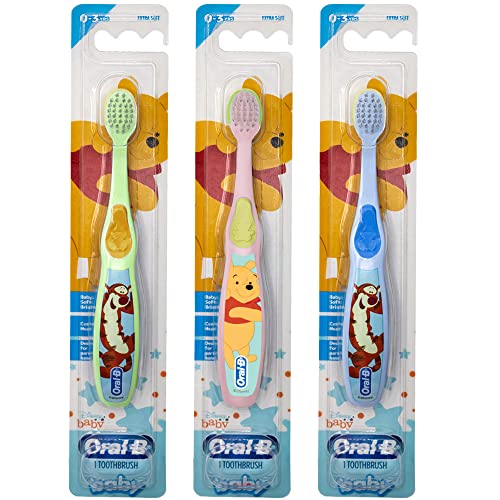
Oral-B Baby Manual Toothbrush, Pooh Characters (3-Pack, Ages 0–3)
Best for: Parents whose toddlers respond better to brushing when the brush features a familiar character
- Disney Baby Pooh characters on the handle, which may help a toddler who responds to familiar graphics
- Oral-B's extra-soft bristles follow the ADA's soft-bristle guidance for young children
- 3-pack provides multiple backups; characters may vary across the pack
- +Disney Baby Pooh characters (characters vary) for toddlers who respond to familiar graphics
- +Extra-soft bristles, in line with the ADA's soft-bristle guidance for young children
- +3-pack gives backups for about nine months at quarterly replacement
- −Higher per-brush cost than Dr. Brown's 4-pack for children who cooperate without character engagement
(Affiliate link) · Free shipping on eligible Prime items
If your toddler pushes back at brushing time, a character brush is one simple thing to try: Wirecutter’s kids’ toothbrush guide says cartoon and character designs “may help motivate young brushers.” Oral-B’s baby line puts Disney’s Pooh characters on the handle, with baby-soft bristles and a cushioned head the listing says is designed to help protect tender gums. Oral-B calls its baby brushes “the number 1 dentist recommended toothbrush for kids”, which is the maker’s own claim.
The practical case for character brushes is straightforward: a toddler who cooperates with brushing has their teeth cleaned; one who refuses doesn’t. If your child shows resistance with plain brushes, switching to a character they recognize is a legitimate compliance strategy, not just a marketing gimmick. The 3-pack provides enough brushes for about nine months at recommended quarterly replacement, and “characters may vary” means you might get some variety across the pack.
Potential downside: At $8.00 for three vs. $4.99 for four with Dr. Brown’s, the per-brush cost is higher (about $2.67 per brush vs. about $1.25). If your child brushes cooperatively without character engagement, the Dr. Brown’s set is the better value.
Papablic Toddler Sonic Electric Toothbrush (Ages 1–3) — Best Electric
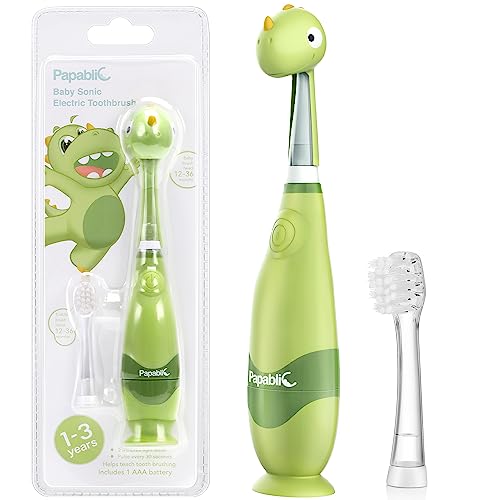
Papablic Toddler Sonic Electric Toothbrush (Ages 1–3)
Best for: Parents ready to introduce a vibrating electric toothbrush to a toddler who tolerates the sensation
- 18,000 sonic vibrations per minute, per the listing
- 2-minute smart timer with 30-second pulse reminders to move to the next quadrant
- Dinosaur head cover, a built-in LED light and 2 replacement brush heads
- +18,000 sonic vibrations per minute, which the listing calls delicate, sized for ages 1 to 3
- +Built-in 2-minute LED timer with 30-second pulses helps establish proper brushing duration
- +Sold for ages 1 to 3, with 2 replacement brush heads and batteries included
- −Not every toddler tolerates the vibration; some find it distressing
(Affiliate link) · Free shipping on eligible Prime items
Electric toothbrushes are not necessary for toddlers, but some children take to them more readily than manual brushes, particularly toddlers who are fascinated by vibrating and buzzing objects. The Papablic is sold for ages 1–3, with what its listing calls 18,000 “delicate” sonic vibrations per minute and a size meant for toddler mouths. The built-in 2-minute timer, with pulses every 30 seconds, is a bonus that helps establish the right brushing duration habit from the beginning.
For parents who want to introduce an electric brush early, the Papablic is the only electric pick on this page, and the only one sold specifically for ages 1 to 3. The linked version has a dinosaur head cover, a built-in LED light that the listing says helps parents see inside the mouth, and a suction-cup base. At $15.99, it costs more than manual options but comes with two replacement heads and targets a very specific use case.
Potential downside: Not every toddler will tolerate the vibration: some find it distressing. If your child hasn’t shown tolerance for vibrating toys or sensations, start with a manual brush and try an electric later. The ADA says both manual and powered toothbrushes are effective at removing plaque, so technique matters more than brush type.
Colgate My First Baby & Toddler Toothbrush (6-Count, Ages 0–2) — Best Multi-Pack
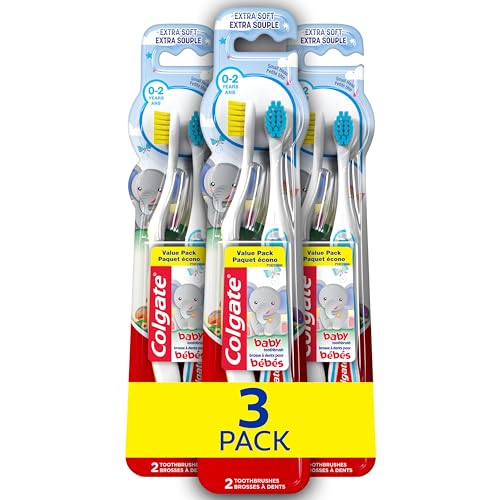
Colgate My First Baby & Toddler Toothbrush (6-Count, Ages 0–2)
Best for: Parents who want the most brushes in one box, for multiple homes or caregivers
- Six extra-soft brushes for approximately 18 months of quarterly replacements in one purchase
- Non-slip handle that the listing says fits a parent's hand and, when ready, the child's
- Extra-soft bristles and a small head, labelled for ages 0 to 2
- +Six extra-soft brushes cover about 18 months of quarterly replacements in one purchase
- +Non-slip handle the listing says fits a parent's hand and, later, the child's
- +About $1.95 a brush, the most brushes of any pack on this page
- −0-2 age label is more conservative than other brands' 0-3 designation
(Affiliate link) · Free shipping on eligible Prime items
Colgate My First is the volume play in the toddler brush category. Six brushes at $11.67 works out to about $1.95 per brush, more per brush than the Dr. Brown’s 4-pack, but enough for 18 months of quarterly replacements without reordering. The listing describes extra-soft bristles, a small head “for child’s little mouth” and a non-slip handle, the same basic design as the Dr. Brown’s and Oral-B options.
What it offers over the Dr. Brown’s 4-pack is the six-brush count: if you have multiple caregivers (home, daycare, grandparents), the volume means you can keep brushes at several locations.
Potential downside: Ages 0–2 on the label is more conservative than some other brands’ 0–3 designation, so an older toddler may outgrow it sooner. It also costs more per brush than the Dr. Brown’s 4-pack.
Dr. Brown’s Training Toothbrush Set with Fluoride-Free Toothpaste (Ages 0–3) — Best Starter Set
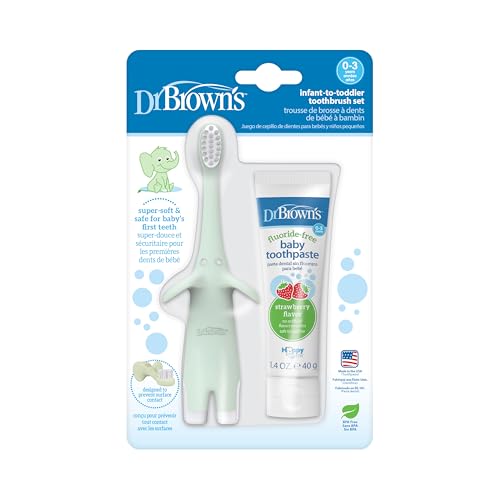
Dr. Brown's Training Toothbrush Set with Fluoride-Free Toothpaste (Ages 0–3)
Best for: Parents starting from scratch who want a matched toothbrush and fluoride-free training toothpaste in one purchase
- Bundled with strawberry-flavored fluoride-free baby toothpaste (1.4 oz tube)
- Mint elephant design toothbrush with super-soft bristles, for ages 0 to 3
- The listing says the toothpaste is safe to swallow
- +Bundled fluoride-free training toothpaste removes the guesswork for a first brushing routine
- +Elephant-design brush with super-soft bristles, for ages 0 to 3
- +The listing says the paste is safe to swallow
- −Training toothpaste is transitional and provides no cavity protection on its own
(Affiliate link) · Free shipping on eligible Prime items
If you’re establishing a first brushing routine from scratch (new parent, new baby teeth) the Dr. Brown’s Training Set removes the question of “which toothpaste do I use?” The included strawberry-flavored toothpaste is fluoride-free, and the listing says it is safe to swallow. The ADA recommends fluoride toothpaste starting from when the first tooth appears, but for parents who are concerned about fluoride swallowing in very young or resistant toddlers, a training paste removes that anxiety and still establishes the brushing habit.
Note that the ADA’s guidance is a rice-grain-sized smear of fluoride toothpaste from the first tooth, so plan to move to it soon: fluoride protection matters for primary teeth. But for the initial weeks of getting a toddler accustomed to brushing, the training paste is a practical bridge. The elephant ears let the brush sit down without the bristles touching the counter, per the listing, and the design is playful without a licensed character.
Potential downside: Training toothpaste is a transitional product, not a long-term solution. Plan to transition to a fluoride toothpaste as soon as your toddler can understand to spit. See our best toddler toothpaste guide for what to use next.
Oral-B Baby Toothbrush, Disney Pooh (Single, Ages 0–3) — Best Budget
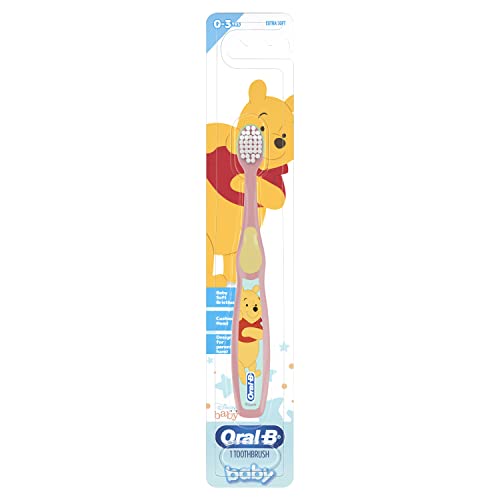
Oral-B Baby Toothbrush, Disney Pooh (Single, Ages 0–3)
Best for: Parents who want a reliable single-brush starting point before committing to a multi-pack
- Single baby-soft Oral-B brush, the lowest-friction way to start a brushing routine
- Disney Pooh character design, as on the 3-pack
- Under $5: no commitment required before you know what works for your toddler
- +Lowest-risk entry point to test tolerance before committing to a multi-pack
- +Same Disney Pooh design and soft bristles as the 3-pack, sold individually
- +Under $5, no commitment required before knowing what works for your toddler
- −Higher per-brush cost than any multi-pack option
(Affiliate link) · Free shipping on eligible Prime items
Before buying a 4- or 6-pack of any toothbrush, it’s reasonable to test a single brush first, particularly with toddlers, where preferences and tolerances can be hard to predict. The single Oral-B Pooh brush is the lowest-risk entry point: one brush with a Disney Pooh design, for ages 0 to 3, under $5. If it works, buy the 3-pack to save on replacements. If it doesn’t, you haven’t committed to multiple brushes your child won’t use.
This is also a useful recommendation for grandparents or occasional caregivers who need a toddler brush on hand but don’t need a full multi-pack. Both listings describe baby-soft bristles, a cushioned head and a non-slip handle for ages 0 to 3, so the difference is the count.
Potential downside: The single-unit cost is higher per brush than any of the multi-pack options. If you already know you’ll want multiple brushes, skip this and go straight to the 3-pack.
Buyer’s Guide: Toddler Toothbrushes and Early Dental Care
When to Start Brushing
The ADA says it and the AAPD agree that brushing should begin as soon as the first tooth erupts, which may be as early as 6 months of age, because erupted primary teeth are at risk of tooth decay. It recommends brushing an infant’s teeth twice a day with a child-sized toothbrush that has soft bristles and a small head.
Manual vs. Electric for Toddlers
Both work. The ADA says both manual and powered toothbrushes are effective at removing plaque, so technique and consistency matter more than the brush type. Electric brushes offer a built-in timer advantage and can be more engaging for some toddlers. If your child cooperates with manual brushing, there’s no clinical reason to switch to electric. If they resist manual brushing and you want a different approach, the Papablic sonic is worth trying.
How Much Toothpaste, and Which Kind?
The ADA recommends:
- Under 3 years: A smear of fluoride toothpaste, no more than the size of a grain of rice
- Ages 3–6: A pea-sized amount of fluoride toothpaste
Use fluoride toothpaste as soon as the first tooth appears. The ADA keeps the amounts small because fluorosis “may occur when excess levels of fluoride are ingested during tooth development”. If your toddler swallows everything and you’re concerned, keep to the rice-grain smear rather than switching to fluoride-free, which provides no cavity protection.
How to Brush a Resistant Toddler’s Teeth
NHS guidance offers two starting points: “Use a mirror to help your child see exactly where the brush is cleaning their teeth,” and “Make tooth brushing as fun as possible by using an egg timer to time it for about 2 minutes.” Other things parents try: let the toddler hold a brush while you use another, use a character brush they choose themselves, name teeth as you brush them, and brush at the same times each day so it becomes routine. If resistance is severe and persistent, raise it with your child’s dentist.
If you are here because someone suggested a U-shaped or mouthpiece brush for a toddler who bites the brush, our AutoBrush guide covers what the research and other parents say. The short version: the smallest size is sold for ages 3 to 5, and it works as a supplement, not a replacement.
FAQ
How often should I replace my toddler’s toothbrush? Every three to four months, per the ADA, or sooner if the bristles are visibly matted or frayed. Toddlers often chew on brushes, which accelerates bristle wear. Check the brush regularly; frayed bristles are less effective and can irritate gums.
Should I use a finger brush or a handle toothbrush? Finger brushes (silicone finger covers with soft nubs) can be useful for very young infants with first erupting teeth. Once teeth are coming in, the ADA’s guidance is a child-sized toothbrush with soft bristles and a head small enough to reach all tooth surfaces, which is what the manual brushes on this page are.
Do toddlers need to brush twice a day? Yes, the same twice-daily recommendation that applies to adults applies to toddlers from the first tooth. NHS guidance on children’s teeth puts one of the two brushes last thing at night before bed.
My toddler won’t spit the toothpaste out. Is that okay? The rice-grain smear is the ADA’s amount for under 3s, kept small because the ADA links fluorosis to swallowing excess fluoride while teeth develop; the ADA also says children should be taught to spit the excess out. You can work on spitting as a skill (“spit like a snake” is a useful cue), but don’t withhold toothpaste or switch to fluoride-free out of spitting concerns alone.